
Building Muscle in Bull Terriers: Beyond the Exercise Chart
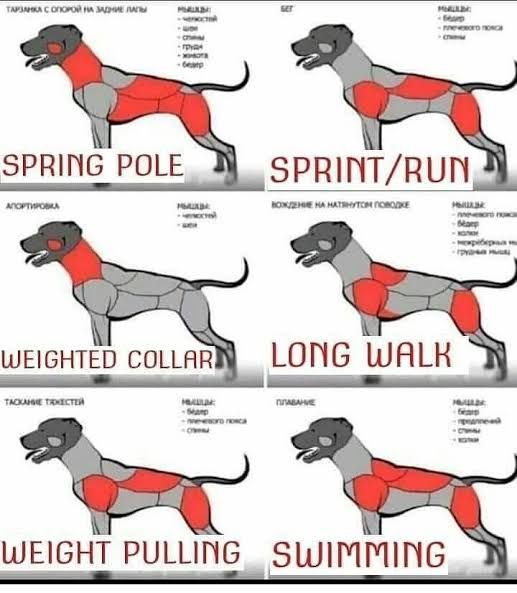
If you’ve been around the Bull Terrier or working dog community online, chances are you’ve seen this picture. We certainly have. Over the years, it’s been circulated countless times — we’ve been tagged in it, sent it directly, and asked for our opinion more times than we can count.
The picture is not ours (and we don’t know who the original creator is), but we can say this: it does a good job at showing which muscles take the most work during popular dog exercises like spring pole, sprinting, or swimming. Of course, no muscle ever works in complete isolation — the dog’s body is a unit. Every movement engages a chain of muscles working together. But the chart highlights the prime movers, and in that sense, it’s accurate.

Still, the picture is only part of the story. If you really want to develop your Bull Terrier’s physique and performance safely, there are two more things you need to consider: progression and the mind–handler bond. That’s where the real transformation happens.
What the Chart Gets Right: Exercise and Muscle Focus
Spring Pole
Engages the neck, jaw, shoulders, and chest as the dog hangs, pulls, and shakes. It builds grip and upper-body strength, but should always be done under supervision and with time limits to avoid overexertion.
Sprint/Run
Primarily works the hindquarters, hamstrings, and core. Sprinting develops explosive power and endurance. It’s one of the most natural ways for dogs to build muscle, but should be balanced with recovery to protect joints.
Weighted Collar
Adds resistance to everyday movement, stressing the neck and shoulders. While it does strengthen those areas, it must be used carefully. Short sessions and very light resistance are enough — overuse can cause harm.
Long Walk
Seems simple, but steady walking conditions the whole body, especially the legs, shoulders, and back, while supporting heart health. Long walks also provide one of the most valuable things: bonding time between you and your dog.
Weight Pulling
Develops tremendous strength in the hind legs, glutes, chest, and shoulders. It’s a true power exercise — but it requires structured training, gradual load increase, and careful attention to form. Done correctly, it’s one of the best all-around strength builders.
Swimming
A low-impact, full-body workout that targets the shoulders, back, core, and hind legs. Because it reduces stress on joints, swimming is excellent for conditioning, recovery, and summer training when it’s too hot for running.
The chart highlights these areas well. But without a plan, it’s like looking at a gym poster without knowing how to train.
The Missing Piece: Progression and Bond
Muscles don’t grow just because you do an exercise — they grow with structured progression. Dogs, like humans, need gradual increases in difficulty: longer sprints, slightly more resistance, or more repetitions. Jumping straight to heavy weight pulling or long spring pole sessions risks injury instead of progress.
The other missing piece is the mind and bond. Muscle without discipline is chaos. Your Bull Terrier’s physical training only becomes meaningful when it’s paired with mental focus, obedience, and the connection they share with you. This is where our training framework — Bond → Engagement → Drive → Focus (BEDF) — comes into play. Without that bond, the dog may build muscle, but it won’t build trust or work ethic.
Putting It All Together
So, what does a balanced approach look like? Here’s a simple example:
Day 1: Sprint work (short bursts, build explosive drive) + obedience session
Day 2: Long walk (endurance and bonding)
Day 3: Spring pole (short, controlled play) + place/recall training
Day 4: Rest / light swimming (active recovery)
Day 5: Weight pulling or resistance work (start light, progress slowly)
Day 6: Long walk or hike + engagement games
Day 7: Rest
This is only a guideline — the exact routine should be tailored to each dog’s age, health, and personality.
Final Thoughts
The picture everyone shares is a good reference. It shows the main muscles worked during different exercises, and in that sense, it’s accurate. But remember: the body works as a unit, no muscle functions alone, and building a strong Bull Terrier is not just about muscle — it’s about balance, progression, recovery, and above all, the bond between you and your dog.
That’s the missing piece that no chart can show.
If you’d like to dive deeper into the bond, engagement, and training side of things, our Bull Terrier guides go far beyond exercise charts — they show you how to build the complete partnership with your dog.


Leave a Reply