
Bull Terrier Crate Training, Sleep & Arousal Control
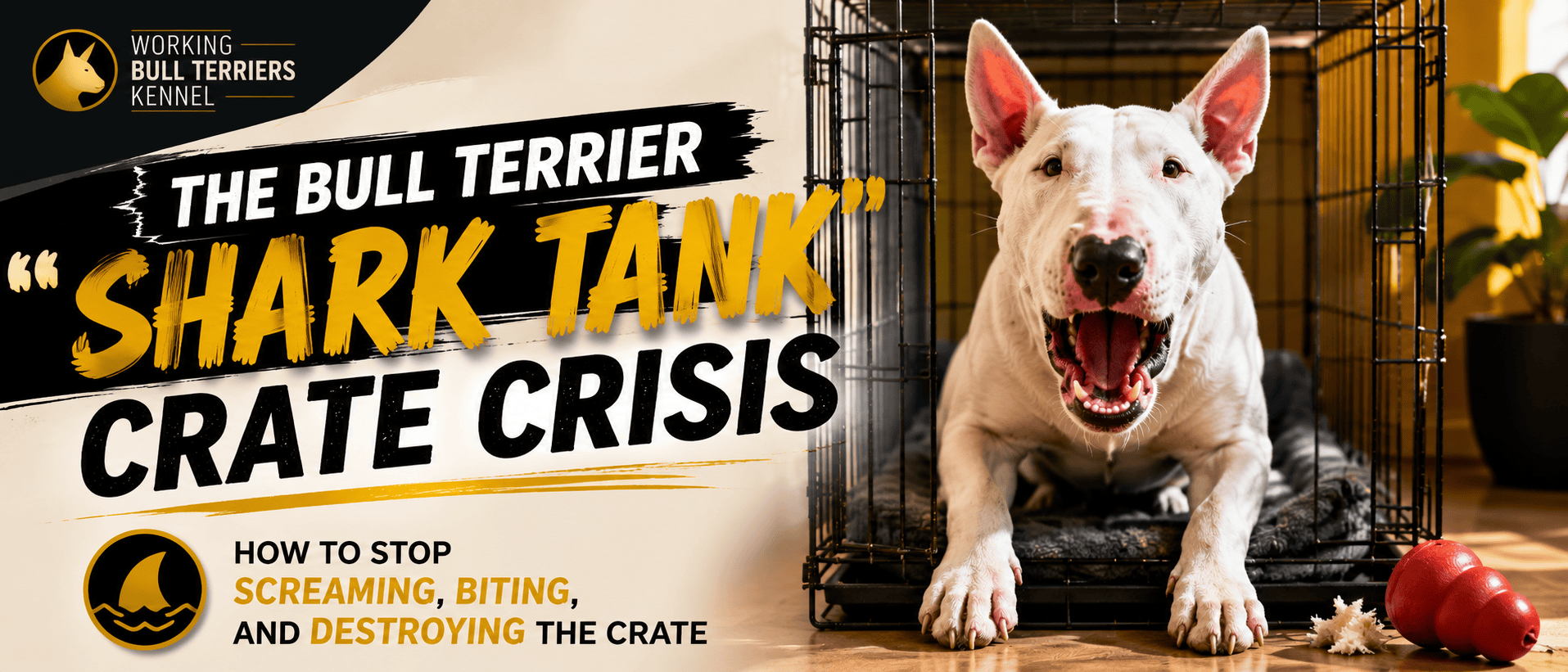
The Bull Terrier “Shark Tank” Crate Crisis: How to Stop Screaming, Biting, and Destroying the Crate
What to Do When a Young Bull Terrier Turns Crate Time Into a Full Meltdown
A Bull Terrier crate crisis is usually not solved by force or by giving up completely. First check safety. Then rebuild the crate as a safe rest routine with tiny layers, meals, chews, calm door openings, pre-crate decompression, short successful sessions, legal chewing, and practice while you are home. Do not release peak screaming if the dog is safe and only protesting, but do not ignore real panic, self-injury, or dangerous crate destruction.
Safety first: If your Bull Terrier bends bars, breaks teeth, cuts gums or paws, escapes dangerously, soils from panic, drools heavily, or injures itself, stop treating this as a simple obedience issue and get professional support.
A young Bull Terrier in a crate can sound like a trapped wild animal.
Screaming. Barking. Chewing the bars. Throwing the body into the sides. Digging at the floor. Biting bedding. Flipping bowls. Trying to force the door open. Foaming with frustration. Looking like the crate has become a shark tank.
For many owners, this is one of the most stressful parts of raising a Bull Terrier.
They were told crate training would help the puppy settle. Instead, the puppy explodes. The house becomes chaos. The owner feels guilty, angry, embarrassed, and exhausted. Neighbours complain. The puppy becomes more frantic. The crate becomes a battlefield.
The first thing to understand is this:
A Bull Terrier destroying the crate is not always “separation anxiety.” It is not always “dominance.” It is not always “being bad.” It is often a mix of frustration, poor crate conditioning, too much energy, too much pressure, lack of sleep, lack of impulse control, and a dog who has not yet learned how to come down.
The crate is not the problem by itself.
The problem is what the dog believes the crate means.
The Crate Should Not Feel Like a Trap
A crate can be one of the best tools in a Bull Terrier home.
It can help with sleep, safety, toilet training, travel, recovery after surgery, visitor management, decompression, and preventing destructive behaviour when the owner cannot supervise.
But a crate only works properly when the dog has been taught that the crate is safe.
If the dog experiences the crate as sudden isolation, loss of control, punishment, or emotional abandonment, it may fight it hard.
Bull Terriers are not soft little ornaments. Many young Bull Terriers are powerful, frustrated, loud, physical, and persistent. If they decide the crate is the enemy, they may attack it with everything they have.
So the goal is not simply to force the dog into the crate.
The goal is to change the dog’s emotional relationship with the crate.
A good crate should mean:
Rest. Safety. Chewing. Sleep. Calm. Routine. Predictability.
Not:
Panic. Punishment. Isolation. Frustration. Loss of freedom. Owner disappears.
First: Check Safety
Before training, check the crate setup.
A Bull Terrier who bites bars, bends wire, scrapes paws, or throws its body around can injure itself.
Look for:
- broken crate wires;
- sharp edges;
- loose latches;
- gaps where teeth or paws can get stuck;
- collars or tags that can catch;
- bedding the dog destroys and swallows;
- water bowls that spill or become hazards;
- crates too small for comfort;
- crates too flimsy for the dog’s strength;
- overheating;
- poor ventilation;
- crate placement in a chaotic area.
Never leave a collar on a dog inside the crate if there is any risk of it catching.
If the dog is injuring itself, breaking teeth, bending bars, bleeding, panicking severely, or escaping dangerously, treat it seriously. This is no longer just an annoying training problem. You may need a safer confinement setup, professional support, and veterinary or behaviour guidance.
Safety comes before pride.
Why Young Bull Terriers Fight the Crate
Young Bull Terriers often struggle with crates for several reasons.
They want access to the owner. They want action. They hate missing out. They are overtired but cannot settle. They are frustrated by barriers. They have been released when they scream. They were crated too long too soon. They only go in the crate when fun ends. They have no proper pre-crate routine. They have too much energy in the body. They have too much arousal in the brain. They have not learned that calm behaviour opens the door.
A Bull Terrier puppy may be physically tired but mentally unable to switch off. This is where many owners misunderstand the breed.
The puppy is not always screaming because it needs more freedom.
Sometimes it is screaming because it has no off switch yet.
And the off switch must be trained.
Do Not Use the Crate Only When Life Gets Bad
If the puppy only goes into the crate when the owner leaves, gets angry, ends play, or removes freedom, the crate becomes bad news.
The dog learns:
“Crate means I lose everything.”
That is a terrible association.
Use the crate during normal, calm life.
Feed meals in the crate. Toss treats into the crate. Let the puppy find chews there. Leave the door open sometimes. Reward the puppy for going in voluntarily. Use the crate while you are still home. Use it for short rests, not only long absences.
The crate should not appear only when the owner is desperate.
It should be part of the daily rhythm.

A young Bull Terrier usually fights the crate harder when sleep, chewing, toilet timing, arousal, and daily structure are already wrong. The Puppy Training Guide gives owners the early foundation behind crate routines, sleep, bite prevention, calm resets, and household structure.
Build the Crate in Tiny Layers
Many crate problems happen because owners skip steps.
They put the puppy inside, close the door, walk away, and expect acceptance.
Some puppies handle that.
Many Bull Terriers do not.
Build the skill in layers:
First, reward the puppy for looking at the crate.
Then for stepping toward it.
Then for putting the head inside.
Then for stepping fully inside.
Then for eating inside with the door open.
Then for staying inside for one second.
Then for two seconds.
Then for five.
Then close the door briefly and open it before the puppy panics.
Then increase duration slowly.
Then step away.
Then return.
Then move out of sight briefly.
This may feel slow, but it is much faster than creating a crate war and spending months repairing it.
The puppy should learn:
“I can be in here and nothing bad happens.”
Do Not Release the Puppy During Peak Screaming
This is difficult but important.
If the puppy screams, bites the bars, and throws a full tantrum, and the door opens during the peak of that explosion, the puppy may learn:
Explosion opens the crate.
Bull Terriers are excellent at remembering what works.
This does not mean you should ignore panic forever. It means timing matters.
If possible, wait for even a tiny pause. A breath. A half-second of quiet. A moment when the puppy stops biting the bars. Then open calmly.
The lesson should be:
Calm opens the door. Screaming does not open the door.
But there is a difference between frustration noise and genuine panic.
A puppy protesting for a moment is not the same as a puppy injuring itself or spiralling into extreme distress.
Use judgment.
Do not reward tantrums, but do not leave a dog to harm itself.
Teach Calm Door Opening
Many dogs explode because the door opening itself becomes exciting.
The puppy learns:
Door opens = launch.
So the dog screams, paws, bites, and throws itself forward because it wants the door to open faster.
Teach the opposite.
Approach the crate calmly.
If the puppy screams or throws itself at the door, pause.
When the puppy settles even slightly, continue.
Touch the latch.
If the puppy explodes, pause again.
Open the door a little.
If the puppy pushes, close it gently.
Open again when calm.
Release with a cue.
This teaches impulse control.
The crate door is not a starting gun.
The dog comes out when calm.
Use a Pre-Crate Routine
Do not take a wild puppy in peak excitement and suddenly lock it in a crate.
That is asking for a meltdown.
Before crate time, use a predictable routine:
Toilet break. Short calm sniffing. Water if needed. A few easy obedience reps. Food scatter. Chew prepared. Lights calmer. Voice lower. Into crate.
The routine tells the puppy what is coming and helps the nervous system shift down.
For many Bull Terriers, the transition matters as much as the crate.
You cannot go from full chaos to full confinement and expect peace.
Bring the dog down first.
The Crate Is for Rest, Not Emotional Explosion
If your puppy goes into the crate already at level 10, the crate will become the place where level 10 happens.
Instead, crate before the puppy is completely wild.
Many owners wait too long.
They let the puppy bite, run, scream, chase feet, hump toys, grab clothes, and spin around until everyone is exhausted. Then they crate the puppy.
By then, the puppy is overloaded.
Use the crate earlier, when the puppy is tired but not frantic.
A young Bull Terrier may need help settling before it loses control.
The crate works best as a rest routine, not as a punishment after chaos.
Overtired Puppies Often Fight Sleep
A young Bull Terrier who needs sleep may not look sleepy.
It may look possessed.
Biting. Jumping. Barking. Grabbing. Zooming. Refusing to listen. Attacking the crate.
This is why owners often make the wrong choice. They think the puppy needs more exercise, more play, more freedom, more stimulation.
Sometimes the puppy needs a nap.
But if the puppy has never learned to sleep in the crate, it will fight the very thing it needs.
That is why crate training and sleep training belong together.
A better-rested puppy usually bites less, screams less, destroys less, and learns faster.
Rest is not the opposite of training.
Rest is part of training.
Give the Mouth a Legal Job
A young Bull Terrier in a crate with no legal outlet may chew the bars, bedding, tray, or crate corners.
Give the mouth something appropriate.
Use safe chews, food-stuffed toys, frozen lick items, or crate-only chew options.
The best crate chew should be:
safe for the dog’s age and chewing style; interesting enough to hold attention; not easily swallowed; not something that causes guarding or frantic excitement; and used under supervision until you know the dog handles it safely.
Do not fill the crate with bedding and toys the puppy destroys and eats.
A Bull Terrier who swallows bedding, plastic, fabric, or toy pieces can create a medical emergency.
Choose carefully.
Location Matters
Some puppies panic because the crate is too isolated.
Others cannot settle because the crate is in the busiest part of the house.
Find the balance.
For a young puppy, starting near the family may help. The dog can hear normal life and feel less abandoned. Later, you can gradually increase independence.
For a dog who gets overstimulated by movement, a quieter area may be better.
Some dogs settle with a crate cover. Others panic if covered. Some need partial cover. Some need more airflow and visibility.
Watch the dog.
The right crate location is the one where the dog can actually learn to relax.
Do Not Turn the Crate Into Solitary Confinement
Crate time must match the dog’s age, training level, bladder capacity, exercise, and emotional tolerance.
A young puppy cannot be expected to stay crated for long periods without preparation. A high-arousal adolescent Bull Terrier cannot be locked away for hours without enough physical and mental outlet and then be blamed for exploding.
The crate is a tool, not a substitute for a complete day.
The dog still needs:
movement; toilet breaks; training; sniffing; play; social time; chewing; sleep; and calm human interaction.
A crate cannot fix a life with no structure.
It supports structure.
Frustration Screaming vs Panic Screaming
There is a difference between protest and panic.
Frustration may look like barking, complaining, pawing, or demanding release.
Panic may look like frantic escape attempts, self-injury, heavy drooling, uncontrolled trembling, destructive attempts focused on escape, loss of bladder or bowel control, or inability to recover.
A frustrated puppy needs training, timing, and consistency.
A panicking puppy needs a slower plan and possibly professional support.
Do not treat true panic like simple stubbornness.
But do not treat every complaint like trauma either.
Bull Terriers can be very dramatic when they want something.
Your job is to read the difference.
Stop Practicing Long Crate Battles
If every crate session becomes a 45-minute screaming war, you are not training calm.
You are training battle.
Shorten the session.
Make it easier.
Use food.
Use the crate while you are nearby.
Open before panic.
Build many small successful repetitions.
Then gradually increase difficulty.
A puppy who succeeds ten times for thirty seconds is learning more than a puppy who fails once for thirty minutes.
Success teaches faster than endurance contests.
Practice Crate Time When You Are Home
If crate time only happens when you leave, the crate predicts abandonment.
Practice while you are home.
Put the puppy in with a chew while you sit nearby.
Then while you move around the room.
Then while you leave the room briefly.
Then while you return.
Then while you cook, work, clean, or relax.
The puppy learns:
“My owner can exist while I am in the crate. The crate does not always mean being left behind.”
This reduces the emotional charge.
Use a Pen if the Crate Is Too Much
Some young Bull Terriers do better starting with an exercise pen or gated area before moving to a crate.
A pen gives more space and can reduce barrier frustration.
You can place the crate inside the pen with the door open, allowing the dog to choose the crate as a resting area. Over time, the crate becomes less threatening.
This is not failure.
It is smart training.
The goal is not to win a crate argument.
The goal is to build calm confinement skills.
For some dogs, the pen is the bridge.
Do Not Use the Crate as Punishment
If the puppy bites, you scream, grab it, shove it into the crate, and slam the door, the crate becomes punishment.
Then the owner later wonders why the dog hates the crate.
A reset is different from punishment.
A reset is calm, predictable, and unemotional.
The puppy is guided to the crate or pen, given something appropriate, and allowed to come down.
The owner does not rage.
The owner does not use the crate as revenge.
The crate should say:
“Rest now.”
Not:
“You are in trouble.”

Crate problems are often part of a bigger training picture: impulse control, place, calm release, barrier frustration, door manners, food scatter, legal chewing, and the ability to settle while life happens. The Training Guide supports the structure behind those skills.
Teach “Crate” as a Cue
The dog should learn to enter the crate voluntarily on cue.
Use a word such as:
“Crate.” “Bed.” “House.” “Inside.”
Toss food in. Let the dog go in. Reward. Release.
Repeat until the dog happily enters.
Then add duration.
Then add door closure.
Then add distance.
A Bull Terrier who chooses to enter the crate is in a very different emotional state from a dog dragged and forced inside.
Voluntary entry is powerful.
Watch for Barrier Frustration
Some Bull Terriers are not afraid of the crate. They are angry at the barrier.
They can see you. They want you. They want the toy. They want the other dog. They want the visitor. They want out.
So they scream and bite the crate because the barrier blocks access.
For these dogs, you must teach calm around barriers in general.
Practice behind baby gates.
Reward calm when separated by a door.
Use place while people move around.
Teach the dog that seeing something does not mean getting it.
The crate is only one version of a bigger lesson:
You can want something and still remain calm.
When Another Dog Makes It Worse
Some puppies explode in the crate when another dog is loose.
They see the other dog moving, playing, eating, getting attention, or going outside, and they lose control.
Do not set the crated puppy up to watch everything it cannot access.
Separate routines.
Block visual access if needed.
Give crate chews when the other dog is calm.
Do not let other dogs tease, sniff, stare at, or bother the crated puppy.
A crate should be a safe rest area, not a place where the puppy watches life happen without it.
Night-Time Crate Screaming
Night crate issues are common.
For young puppies, make sure the basics are handled:
toilet, comfort, safe temperature, appropriate crate size, enough daytime rest, and not too much late-night excitement.
At night, the crate may initially need to be near you. Then you can gradually move it farther away as the puppy gains confidence.
Do not turn bedtime into a two-hour negotiation.
Use a calm routine. Keep lights low. Keep your voice boring. Toilet if genuinely needed. Back to crate.
If every cry leads to play, cuddles, food, and excitement, the puppy will learn that night screaming works.
If genuine distress is present, slow down the training and build confidence during the day too.
Night problems are often daytime training problems showing up in the dark.
When Crate Destruction Is Dangerous
Some crate destruction is annoying.
Some is dangerous.
Get help if your dog:
- bends crate bars;
- breaks teeth;
- cuts gums or paws;
- escapes repeatedly;
- panics immediately when confined;
- drools heavily;
- cannot recover after release;
- screams for long periods without improvement;
- injures itself;
- soils from panic;
- destroys bedding and swallows it;
- has severe separation anxiety signs.
In these cases, do not just buy a stronger crate and continue the same plan.
A stronger crate may contain the body, but it does not fix the panic or frustration underneath.
You may need a different setup, a slower plan, professional behaviour help, and veterinary support.
Containment must be safe and humane.
A Simple Rebuild Plan
If your Bull Terrier already hates the crate, rebuild from the beginning.
For a few days, feed near the crate.
Then feed at the crate door.
Then feed inside with the door open.
Then use short chew sessions inside.
Then close the door for one second.
Then open before screaming.
Then build to five seconds.
Then ten.
Then thirty.
Then one minute.
Then step away.
Then return.
Then leave the room briefly.
Progress only when the dog is calm at the current level.
If the dog melts down, you moved too fast.
Go back.
This is not weakness.
This is training.
What Not to Do
Do not shove the puppy into the crate in anger.
Do not use the crate only when you leave.
Do not release during peak screaming if the dog is safe and only protesting.
Do not ignore severe panic or self-injury.
Do not leave collars or tags on inside the crate.
Do not provide bedding the dog eats.
Do not crate a young dog too long.
Do not expect the crate to fix poor routine, lack of sleep, or lack of exercise by itself.
Do not turn crate training into a battle of wills.
Do not give up after one bad session and let the dog learn that destruction ends the crate forever.
Calm consistency wins.
Drama loses.
The WBT View: The Crate Is Not the Enemy — Poor Crate Training Is
A crate can protect a young Bull Terrier from destroying the house, swallowing dangerous objects, rehearsing chaos, harassing other animals, or staying awake until it becomes a biting machine.
But the crate must be taught.
A Bull Terrier is not born understanding confinement.
The owner must build that understanding.
The right crate routine gives the dog rest, boundaries, and emotional control.
The wrong crate routine creates screaming, panic, frustration, and war.
This breed needs structure, but structure must be intelligent.
Not harsh.
Not sloppy.
Not emotional.
Intelligent.
Final Thought
A young Bull Terrier screaming and destroying the crate can make an owner feel defeated.
But the solution is rarely to simply “let them scream forever” or to abandon the crate completely.
The solution is to rebuild the meaning of the crate.
Make it safe. Make it predictable. Make it rewarding. Use tiny steps. Reward calm. Teach door manners. Give legal chewing. Avoid peak-arousal crate battles. Do not release the explosion. Do not ignore real panic. Use a pen if needed. Build the off switch.
A Bull Terrier who learns to rest in a crate is not a broken dog.
It is a dog with a valuable life skill.
Because freedom without an off switch becomes chaos.
And a powerful young Bull Terrier who can settle safely is not losing its fire.
It is learning how to control it.
Frequently Asked Questions About Bull Terrier Crate Crises
Crate screaming can come from frustration, poor crate conditioning, overtiredness, barrier frustration, separation distress, too much arousal, or a puppy who has not learned how to settle yet.
Do not release peak screaming if the dog is safe and only protesting, but do not ignore severe panic, self-injury, dangerous escape attempts, or extreme distress. Timing and safety both matter.
Start with meals and rewards near the crate, then inside with the door open, then short door closures, then tiny durations, then distance and out-of-sight practice. Progress only when the dog is calm at the current level.
For some young Bull Terriers, yes. A pen can reduce barrier frustration and act as a bridge toward crate comfort, especially if the crate itself has become emotionally charged.
It is dangerous if the dog bends bars, breaks teeth, cuts itself, swallows bedding, escapes repeatedly, soils from panic, drools heavily, or cannot recover. In these cases, seek professional support.