
Working Bull Terriers Kennel
The Bull Terrier breed dictionary for real life with the breed.
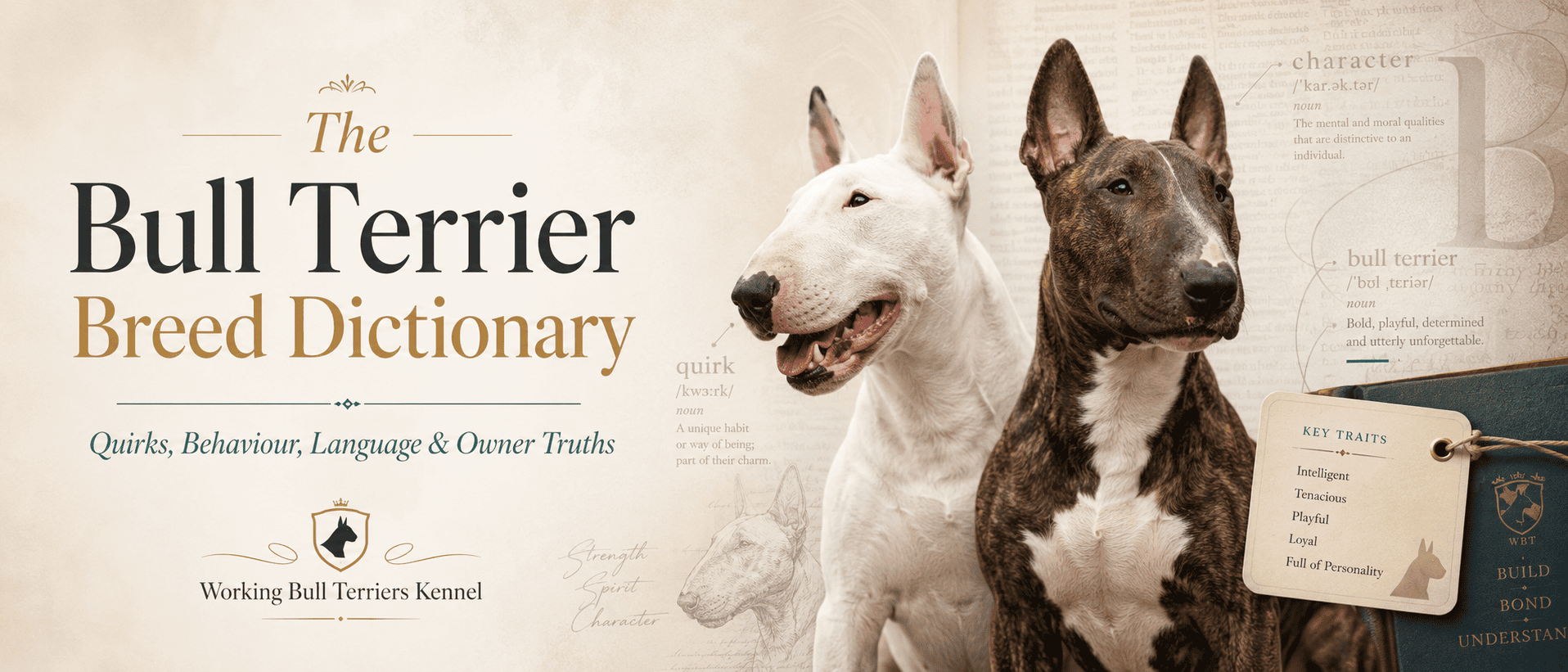
This Bull Terrier breed dictionary is not a normal dog glossary. It is the WBT language map for the words, quirks, owner phrases, funny habits, training meanings and behaviour patterns that appear when you live with Bull Terriers long enough to stop calling everything “random”.
Some breeds need a manual. Bull Terriers need a dictionary.
Because Bull Terrier people know the truth: the stare has meaning, the hucklebuck has timing, the scream has drama, the shutdown has a reason, the zoomies have a trigger, and the “I heard you but I disagree” face is practically a language of its own.
This is the dictionary for the breed that can be funny, emotional, brilliant, stubborn, intense, loyal, ridiculous and deeply serious — sometimes in the same five minutes.
Browse the language
Use the A-Z index to jump through Bull Terrier quirks, owner words and training concepts.
Read the pattern
Each term explains what owners see, what it may mean and why context matters.
Choose the route
Some entries are funny. Some point toward articles, books, training or deeper WBT support.
The WBT Dictionary System
This page explains meaning, not just words.
A normal glossary gives definitions. This Bull Terrier breed dictionary gives translation. It looks at the behaviour, the owner language, the emotional state behind it and the training meaning when the pattern matters.
That is why every important entry includes a WBT Translation: a short practical reading of what may be happening beneath the surface.
And because Bull Terriers are never only serious, selected entries now include In Bull Terrier Language — a small Bully Wisdom voice line that says what every owner was already thinking.
Bully Wisdom gives voice to the experience. WBT gives structure to the meaning.

Strength. Spirit. Character. This is the language behind the breed — not random behaviour, but patterns, pressure, comedy, recovery and meaning.
Category labels
How to read each entry
Use the labels as a quick map. They tell the reader whether the term is funny, normal, training-related or something that deserves closer attention.
Simple rule: enjoy the funny parts, but read the pattern when the behaviour repeats.
How to use this dictionary
Read the term, recognise the pattern, then choose the right route.
Each entry in this Bull Terrier breed dictionary is written for owners, not for textbook readers. Some terms are funny. Some are emotional. Some are training-related. Some are warning signs that the dog may need better structure, clearer handling, or a more complete behaviour plan.
Normal & funny
Breed charm, humour, expression, clown behaviour and harmless Bull Terrier theatre.
Training meaning
Patterns that tell you something about arousal, clarity, pressure, impulse control or recovery.
Needs attention
Repeated patterns that are becoming difficult, unsafe, obsessive, reactive or stressful for the owner.
This dictionary is educational. It does not diagnose a dog from one word. It helps you recognise what may be happening so you can choose a better next step.
A-Z quick navigation
Explore the Bull Terrier breed dictionary.
Jump to a letter group, browse a specific term, or scroll through the whole page and enjoy the madness in order.

Main dictionary
Bull Terrier breed dictionary A-Z
This is the living WBT dictionary of Bull Terrier quirks, behaviour language and owner truths. The entries below are not random jokes or clinical labels. They are practical translations of real life with the breed.
Arousal, bully logic and clown mode
Arousal
Plain meaning: The internal engine level of the dog. Arousal is not automatically bad; it is the amount of energy, excitement, frustration, anticipation or pressure moving through the Bull Terrier.
What owners see: Faster movement, less thinking, grabbing, jumping, barking, spinning, pulling, ignoring known cues or reacting harder than the situation seems to deserve.
Route: Use this term when a dog “knows it at home” but loses clarity around guests, dogs, movement, noise or excitement.
Barrier Frustration
Plain meaning: Frustration that builds when the Bull Terrier can see, hear or smell something but cannot reach it.
What owners see: Fence fighting, window barking, lead explosions, car reactivity, crate protest or intense pulling toward dogs, people, animals or movement.
Route: If it repeats often, treat it as a training pattern, not as a one-off noisy moment.
Body-Slam Greeting
Plain meaning: The classic Bull Terrier belief that affection should arrive with full physical commitment.
What owners see: A happy dog launching hips, shoulders or the whole body into a person as if love is a contact sport.
Route: Teach four feet on the ground, place, calm greetings and permission-based contact.
Bull Terrier Stare
Plain meaning: The famous intense look that can mean focus, curiosity, expectation, stubborn negotiation, emotional connection or fixation depending on the context.
What owners see: The dog stands still, looks directly, studies the situation and seems to be reading the room like a strange little philosopher with muscles.
Route: Related reading: Why Bull Terriers Stare.
Bully Run
Plain meaning: The explosive, curved and slightly ridiculous Bull Terrier running style that appears when the body gets ahead of the plan.
What owners see: Tucked body, sudden acceleration, wild corners, sideways movement and the face of a dog who has chosen speed over dignity.
Route: Do not remove the joy. Make the space safer and teach recovery after the burst.
Clown Mode
Plain meaning: The Bull Terrier state where the dog becomes a performer, comedian, chaos artist and emotional manipulator at the same time.
What owners see: Funny faces, silly movement, rolling, stealing objects, exaggerated gestures, teasing the owner and acting shocked when rules still exist.
Route: Celebrate the personality, but do not let the joke become the rule of the house.
Dictionary Note: Not every Bull Terrier quirk is a problem. Some are personality. Some are communication. Some are early signs that the dog is moving from charm into a pattern. The job of this page is to help owners recognise the difference.
Drama, pressure and the hucklebuck
Dramatic Sigh
Plain meaning: The sound of a Bull Terrier publicly announcing disappointment with the service, the schedule or the human management.
What owners see: Heavy breathing, collapsing onto the floor, side-eye, and the emotional weight of a dog who has suffered greatly because dinner was three minutes late.
Route: Bully Wisdom material, unless the physical context changes.
Environmental Pressure
Plain meaning: The amount of pressure created by the environment: noise, movement, dogs, people, traffic, lights, smells, surfaces or confined space.
What owners see: A Bull Terrier who works beautifully at home but loses clarity outside, near guests, near dogs or in busy places.
Route: Work at a level where the dog can still think. Then build difficulty gradually.
Egghead Logic
Plain meaning: The special Bull Terrier reasoning system where the dog’s decision makes perfect sense to the dog and absolutely no sense to the human.
What owners see: Choosing the worst sleeping position, refusing the obvious route, sitting on the impossible object or solving a problem by creating a larger one.
Route: This is identity material, but it can become a boundary issue if the dog always wins by being weird.
Fixation
Plain meaning: The dog locks mentally onto a target, object, movement, sound or idea and struggles to disengage.
What owners see: Hard staring, frozen posture, stalking movement, refusing food, ignoring the handler, trembling, whining, lunging or escalating when blocked.
Route: Work below threshold, teach disengagement and stop rehearsing the lock-on pattern.
Frustration Biting
Plain meaning: Biting or grabbing that appears when the dog is blocked, overwhelmed, overexcited or unable to get what it wants.
What owners see: Grabbing sleeves, biting the lead, jumping into the handler, redirecting at the owner, or escalating during play, walks or restraint.
Route: If it is escalating, the owner needs a proper plan rather than random internet corrections.
Guest Chaos
Plain meaning: The Bull Terrier pattern where visitors entering the home create a full emotional event.
What owners see: Jumping, barking, grabbing, body slamming, pacing, climbing on guests, refusing to settle or becoming too intense to manage.
Route: Place command, lead control, staged greetings and recovery work matter more than hoping the dog will calm down by itself.
Hucklebuck
Plain meaning: The explosive Bull Terrier burst of spinning, bouncing, running, twisting and emotional electricity.
What owners see: Sudden zooming, mad circles, low body movement, fast turns, furniture danger and a dog who looks possessed by happiness.
Route: Funny is fine. No recovery means the owner should look at arousal, rest, outlets and structure.
WBT Reading Rule: Watch the recovery. The first behaviour matters, but what happens after it often tells you more. Can the Bull Terrier return to the owner, breathe, listen and settle, or does the pattern keep pulling the dog forward?

Independent thinking, lock-on and the famous disagreement
“I Heard You, But I Disagree”
Plain meaning: The Bull Terrier expression that says the command was received, processed, evaluated and respectfully rejected.
What owners see: A pause, a stare, a slow blink, a head turn, or the dog performing a completely different behaviour with confidence.
Route: Sometimes comedy. Sometimes a training gap. Sometimes a dog who has learned negotiation works.
Impulse Control
Plain meaning: The dog’s ability to pause, think and choose instead of exploding toward the first feeling.
What owners see: Waiting at doors, holding position, releasing toys calmly, greeting with manners or disengaging before the body takes over.
Route: Doors, food, toys, guests, walks and play all become training opportunities.
Independent Thinking
Plain meaning: The Bull Terrier tendency to participate in training as a thinking partner, not as a robot.
What owners see: Testing options, offering alternatives, negotiating, inventing shortcuts or deciding that the human plan could be improved.
Route: The art is to keep the dog’s personality while building reliability.
Kangaroo Bounce
Plain meaning: The vertical Bull Terrier bounce that appears when excitement moves upward instead of forward.
What owners see: Springy front feet, repeated hopping, popping up near the owner’s face or bouncing in place before the brain loads.
Route: Cute does not always stay cute when the dog becomes stronger.
Lap-Dog Delusion
Plain meaning: The Bull Terrier belief that size, weight, elbows and personal space are human problems, not dog problems.
What owners see: Climbing into laps, sitting on chests, leaning on faces or folding a muscular body into impossible positions on top of a person.
Route: A place command can protect affection from becoming constant physical control.
Lock-On
Plain meaning: The early stage where the dog begins to narrow attention onto one thing before full fixation appears.
What owners see: Head stillness, forward ears, slower blinking, closed mouth, body leaning forward or ignoring easy cues that usually work.
Route: Learn to interrupt early, reward disengagement and create distance before the dog crosses threshold.
Mouthy excitement, obsession loops and overarousal
Mouthy Excitement
Plain meaning: Using the mouth when excitement rises, even when the dog is not trying to harm anyone.
What owners see: Grabbing hands, sleeves, lead, toys, cushions or whatever is available when the dog becomes too high.
Route: Do not wait until it becomes painful or frightening before adding structure.
Obsession Loop
Plain meaning: A repeated cycle where the dog returns again and again to the same target, behaviour, object or idea.
What owners see: Checking the same place, staring at the same reflection, returning to the same object, demanding the same activity or being unable to move on mentally.
Route: Reduce rehearsal, change the environment and teach replacement patterns that actually help the dog settle.
Overarousal
Plain meaning: A state where the dog is too high to think clearly, even if the dog is not trying to be difficult.
What owners see: Lunging, jumping, grabbing, barking, spinning, ignoring known cues, crashing into things or escalating quickly.
Route: Build recovery, rest, structure, impulse control and realistic training setups.
Ownership of Space
Plain meaning: The Bull Terrier assumption that the sofa, bed, doorway, hallway, blanket and human lap are naturally under Bully management.
What owners see: Blocking paths, leaning into everyone, taking the best spot and looking personally betrayed when asked to move.
Route: Access is not removed forever. It becomes earned, clear and calm.
Piglet screams, place command and recovery
Piglet Scream
Plain meaning: The dramatic Bull Terrier vocal performance that sounds much larger than the situation deserves.
What owners see: Squealing, screaming, complaining or making noises that convince neighbours something historical has happened.
Route: Know your dog’s normal sounds so you can recognise when a sound is not normal.
Place Command
Plain meaning: A structured station where the dog learns to remain, settle, observe and recover without controlling the room.
What owners see: Bed, platform, mat or place board used during guests, meals, cleaning, training breaks or daily regulation work.
Route: Related route: WBT online training can help owners build this correctly in difficult cases.
Predatory-Style Chasing
Plain meaning: Chasing that is not just play, but has the intensity of eye, stalk, rush, grab or pursuit.
What owners see: Hard focus on cats, small dogs, wildlife, bikes, running children, shadows or fast movement.
Route: Manage safety first, then work on control, outlets, threshold and disengagement.
Recovery
Plain meaning: How quickly the Bull Terrier can return to a thinking, calmer state after excitement, stress, frustration or a trigger.
What owners see: The dog notices something, reacts or becomes interested, then can breathe, disengage, respond and settle again.
Route: When judging progress, do not only ask “did he react?” Ask “how quickly did he come back?”
Reactivity
Plain meaning: Big reactions to triggers such as dogs, people, vehicles, noises, animals or movement.
What owners see: Barking, lunging, screaming, pulling, spinning, freezing, redirecting or becoming unreachable near triggers.
Route: Related route: customized online training for serious cases.
Regulation
Plain meaning: The dog’s ability to manage emotional and physical energy without constantly tipping into chaos.
What owners see: Better settling, less grabbing, clearer listening, easier walks, improved guest manners and fewer wild swings between excitement and frustration.
Route: This is one of the biggest differences between random activity and real training.
Training Note: The same word can have different meanings depending on intensity, context and recovery. A playful chase is not the same as predatory-style chasing. A funny stare is not the same as fixation. A noisy complaint is not the same as distress.
Selective hearing, shutdown and trancing
Selective Hearing
Plain meaning: The famous Bull Terrier condition where the dog hears a biscuit packet from another room but cannot hear “come” from two metres away.
What owners see: Sudden deafness, slow response, turning away, sniffing with false urgency or pretending the human has become background noise.
Route: Recall must be built, protected and paid well. It should not be poisoned by constant low-value use.
Shadow Chasing
Plain meaning: Repetitive chasing or fixation on shadows, lights or reflections.
What owners see: Staring at floors or walls, pouncing, scanning, spinning or becoming unable to relax near light movement.
Route: Reduce rehearsal, change the environment and build calm alternatives. Do not tease the dog with lights or reflections.
Shutdown
Plain meaning: The dog stops offering normal behaviour because pressure, confusion, stress or conflict has become too much.
What owners see: Freezing, refusing to move, avoiding eye contact, slow responses, lying down, sniffing excessively or appearing “stubborn” under pressure.
Route: This term matters because many sensitive or confused Bull Terriers are labelled stubborn when they are actually stuck.
Side-Eye
Plain meaning: The silent Bull Terrier commentary delivered without moving the head.
What owners see: Eyes slide sideways, body remains still, judgement becomes visible and the owner suddenly understands they are being reviewed.
Route: Context decides whether this is comedy, discomfort or conflict.
Threshold
Plain meaning: The line between a dog who can still think and a dog who is now reacting, fixating or losing clarity.
What owners see: At a good distance, the dog notices and responds. Too close, the dog locks on, explodes, shuts down or ignores the handler.
Route: Train where the dog can still win. Then make the world harder slowly.
Trancing
Plain meaning: The slow-motion Bull Terrier walk under hanging fabric, plants, curtains or anything that lightly touches the back.
What owners see: The dog moves extremely slowly, almost hypnotised, often under bushes, tablecloths, curtains or laundry.
Route: This is one of the classic terms that belongs in any real Bull Terrier breed dictionary.
Velcro bullies, wall sitting and zoomies
Understanding Before Intervention
Plain meaning: The WBT principle that behaviour should be read before it is corrected, managed or trained.
What owners see: Asking what the dog is feeling, rehearsing, avoiding, seeking or struggling with before deciding what to do next.
Route: Read first. Then intervene with purpose.
Velcro Bully
Plain meaning: The Bull Terrier who believes being near the owner is good, being on the owner is better, and being inside the owner’s personal space is ideal.
What owners see: Following room to room, leaning, climbing, touching, sleeping against people and monitoring all human movement.
Route: Love the closeness, but teach the dog how to be calm without constant contact.
Wall Sitting
Plain meaning: The mysterious Bull Terrier choice to sit against walls, furniture or humans as if the body needs architectural support.
What owners see: Sitting upright, leaning strangely, backing into things or choosing the most awkward position available.
Route: Classic identity term. Not every strange posture is training-related.
Workable Energy
Plain meaning: The energy level where the Bull Terrier is awake, motivated and interested, but still able to think.
What owners see: Bright eyes, engagement, movement, reward interest, response to cues and a body that can still come back to the handler.
Route: This is the sweet spot for training powerful, expressive Bull Terriers.
Zero Regret Face
Plain meaning: The expression worn by a Bull Terrier after making a questionable decision with full confidence.
What owners see: Torn toy, stolen item, rearranged sofa, muddy paws, proud posture and no visible connection between action and consequence.
Route: A perfect Bully Wisdom term and a small reminder that prevention beats cleaning up chaos.
Zoomies
Plain meaning: A burst of fast, playful movement that releases energy or excitement.
What owners see: Sudden running, spinning, sliding, wild turns and the owner calculating furniture damage in real time.
Route: Let the dog be joyful, but give joy a safe container.
When the word becomes a pattern
Funny once can become difficult when it repeats, escalates or controls the household.
The point of the Bull Terrier breed dictionary is not to remove the breed’s personality. The point is to understand it. A Bull Terrier should not lose its fire, humour, courage or expression. But owners also need to know when “that’s just how the breed is” has become an excuse for a pattern that needs help.
If the same behaviour keeps returning, gets stronger, creates stress, causes conflict, affects safety or makes the owner feel lost, it is no longer only a funny breed word. It is a training route.
WBT route: If your Bull Terrier is showing reactivity, frustration biting, fixation, obsession loops, guest chaos, shutdown or serious overarousal, the next step is not more random advice. The next step is a clear plan based on the dog in front of you.
Continue learning
Use this Bull Terrier dictionary as a starting point, not the finish line.
Some words in this dictionary are funny owner language. Others are doorways into deeper training, behaviour and breed understanding. These routes help you keep learning inside the WBT ecosystem.
Living dictionary
This page will keep growing with the breed.
The Bull Terrier breed dictionary is designed as a living WBT hub. New terms can be added over time, and the most important entries can later become full guides, articles, tools or Bully Wisdom designs.
Future article candidates
Bull Terrier hucklebuck, trancing, overarousal, shutdown, fixation, guest chaos, selective hearing, place command, recovery and obsession loops.
Future Bully Wisdom routes
Side-eye, zero regret face, lap-dog delusion, dramatic sigh, clown mode, egghead logic and “I heard you, but I disagree.”
FAQ
Bull Terrier breed dictionary questions
What is a Bull Terrier breed dictionary?
A Bull Terrier breed dictionary is a guide to the words, quirks, behaviour patterns and owner language that appear in real life with the breed. This WBT version explains both the funny meanings and the training meanings behind common Bull Terrier behaviour.
Are Bull Terrier quirks normal?
Many Bull Terrier quirks are normal and part of the breed’s charm. The important question is whether the behaviour is harmless, manageable and recoverable, or whether it is becoming intense, obsessive, unsafe or stressful.
What is a Bull Terrier hucklebuck?
A hucklebuck is the famous Bull Terrier burst of wild movement, spinning, running and joyful chaos. It can be normal fun, but owners should still watch whether the dog can calm down afterwards.
Why does my Bull Terrier ignore commands?
A Bull Terrier may ignore commands because of overarousal, environmental pressure, weak reinforcement history, confusion, fixation, poor timing or too much freedom before the behaviour is reliable. It is not always because the dog does not understand.
When is a funny Bull Terrier behaviour a training problem?
It becomes a training problem when it repeats, escalates, causes stress, affects safety, prevents recovery or starts controlling the household. Funny behaviour can still need structure if it becomes too intense.
Can this Bull Terrier dictionary replace training?
No. This Bull Terrier dictionary helps owners recognise patterns and understand language. A dog with serious reactivity, biting, fixation, anxiety, obsession loops or household conflict needs a proper plan based on that individual dog.