
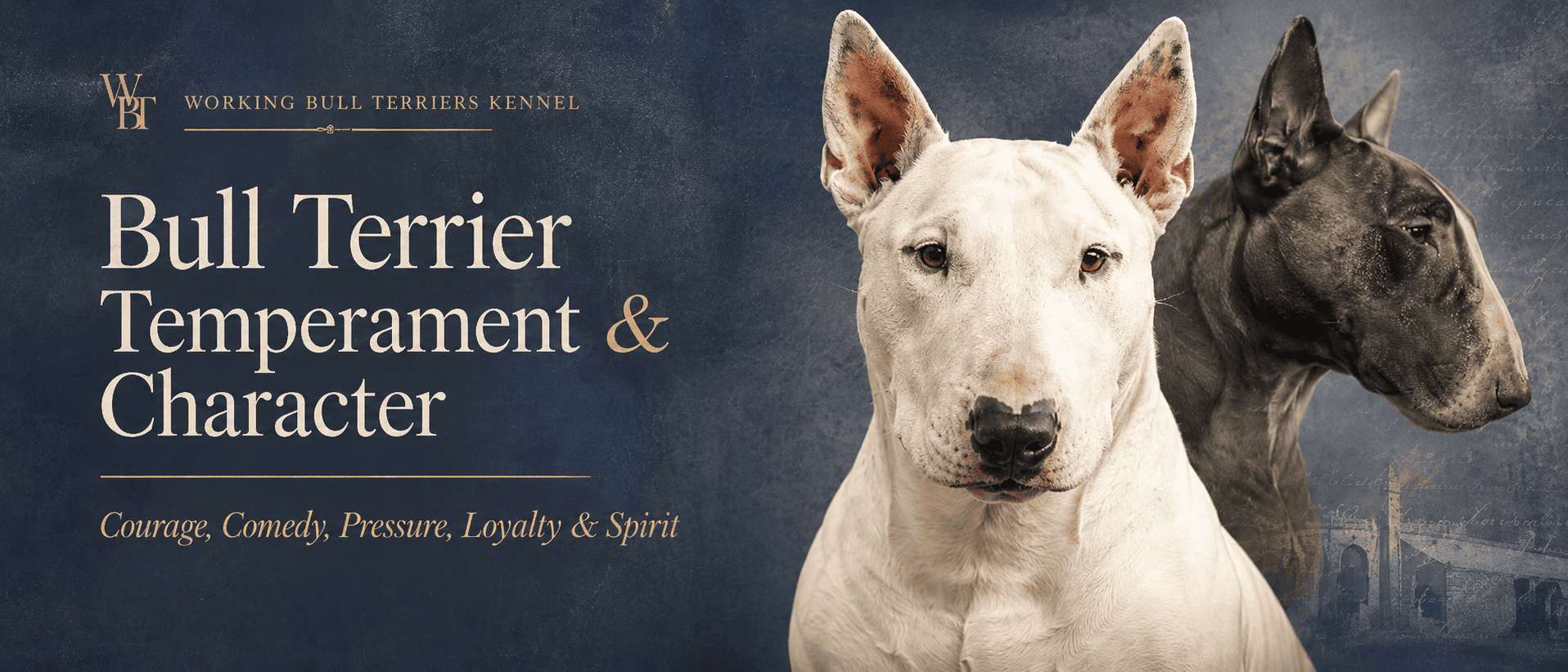
Working Bull Terriers Kennel
Bull Terrier temperament is not simple. That is exactly why people misunderstand the breed.
Bull Terrier temperament is often described with a few easy words: playful, stubborn, loyal, funny. All of those can be true. But they are not enough.
The Bull Terrier is a breed of character — physical, emotional, intelligent, intense, affectionate, independent, comic, loyal, demanding, and unforgettable. When that character is understood, it can be beautiful. When it is misunderstood, it can feel overwhelming.
You do not own a Bull Terrier temperament. You live with a personality.
Funny, not simple
The comedy is real, but it often sits on top of arousal, pressure, confidence and emotional expression.
Loving, not soft
Many Bull Terriers are deeply attached to their people, but that attachment still needs boundaries and direction.
Stubborn, not stupid
A Bull Terrier may ignore, negotiate or test, but that does not mean the dog cannot think. Often, the dog is thinking very hard.
How to read this page
Understand the breed first. Then the behaviour makes more sense.
This page is built for real owners, future owners and serious breed people. You can read it fully, or use the quick route below.
The central WBT idea
The Bull Terrier is not a normal companion dog.
A normal companion dog may be happy with affection, basic rules and a simple routine. A Bull Terrier often asks for more: more clarity, more engagement, more boundaries, more humour, more patience, and more ability from the owner to read what is happening underneath the behaviour.
This does not make the breed bad. It makes the breed serious.
The goal is not to remove the Bull Terrier from the dog. The goal is to give that character direction.
In plain English
If you only see “stubborn,” you miss the dog.
Many owners describe Bull Terriers as stubborn because that is what they see from the outside. But the inside picture may be more complex: arousal, motivation, confusion, pressure, excitement, frustration, boredom, independence, or a dog who has learned that negotiation works.
WBT reading: Bull Terrier temperament needs to be read, not labelled. Once you read it better, you guide it better.

The five temperament pillars
Courage. Comedy. Pressure. Loyalty. Spirit.
Every Bull Terrier is an individual, but these five pillars help explain why the breed feels so different from generic companion dogs.
Courage
Not aggression. Not fake toughness. Real nerve, confidence, presence and willingness to engage with life.
Comedy
The clown is real. Bull Terriers can be ridiculous, expressive, dramatic and impossible not to laugh at.
Pressure
They can push physically, emotionally and socially when they want something or when arousal rises.
Loyalty
Deep attachment, strong people-orientation and emotional closeness are part of the breed’s power.
Spirit
The fire inside the breed: drive, will, determination, playfulness, intensity and character.
Simple takeaway: the Bull Terrier is not one thing. The magic and the challenge come from the combination.
The bright side and the challenge
The same temperament traits can become beautiful or difficult depending on guidance.
This is why honest breed education matters. The Bull Terrier’s strongest qualities are often the same qualities that become hard to live with when the dog has no structure.
✅ The brilliant side
- Affectionate and people-oriented.
- Funny, expressive and full of personality.
- Playful, athletic and physically confident.
- Deeply loyal and emotionally present.
- Intelligent, observant and quick to learn patterns.
- Entertaining, bold and unforgettable.
⚠️ The challenging side
- Can become stubborn, pushy or demanding.
- Can rise into overarousal quickly.
- Can become mouthy when excitement climbs.
- Can obsess, fixate or rehearse patterns.
- Can struggle with recovery when too high.
- Can control the household if boundaries are weak.
In the right environment, Bull Terrier character is magic. Without guidance, magic can become mayhem.
The problem is usually not that the dog has character. The problem is that the character has no direction, no boundaries, no recovery, or no clear outlet.
Misunderstood, not malicious
Many Bull Terriers are labelled badly before they are understood properly.
Owners often call the dog dominant, crazy, aggressive, impossible, disobedient or deliberately difficult. Sometimes the behaviour is serious and needs action. But the label alone rarely helps.
Behind the behaviour, there may be overarousal, unclear rules, no recovery, too much freedom, frustration, weak boundaries, under-stimulation, stress, health discomfort, or a dog who has never been taught how to settle.
WBT reality: character is not the enemy. Lack of guidance is.
What owners often miss
A Bull Terrier can be funny and still need structure.
A dog can be wagging and over threshold. A dog can be playful and rehearsing pressure. A dog can be affectionate and controlling space. A dog can be “just excited” and still unsafe with its mouth, body or intensity.
Do not remove the humour. Read what is underneath it.

What Bull Terrier temperament needs from the owner
A Bull Terrier does not need a perfect owner. It needs a present, fair, consistent and educated one.
This breed does not do well with extremes. Harshness can damage trust. Permissiveness can create chaos. Constant negotiation can teach the dog that every boundary is optional.
The owner’s job is not to dominate the Bull Terrier. The job is to provide leadership that makes sense to the dog.
Temperament by life stage
Bull Terrier temperament changes shape as the dog grows.
The character is there from the beginning, but it does not look the same in a puppy, adolescent, adult or senior dog.
Curiosity, teeth and chaos
Early boundaries matter. Puppy charm should not become puppy law. This stage builds the foundation for bite inhibition, routine, handling and calm.
Pressure and testing
This is often where owners feel the breed most strongly. Arousal, independence, pushing, selective hearing and intensity may rise fast.
Clearer character
With good guidance, the adult Bull Terrier can become more stable, more readable and more reliable. Without guidance, rehearsed patterns become stronger.
Deeper bond, same soul
Many seniors soften, but the personality remains. The comedy, opinions, loyalty and emotional presence are still there.
Owner note: the adolescent stage is not the time to “wait and see.” It is the time to build structure before habits become identity.
When temperament becomes a behaviour problem
Normal breed character becomes a problem when it repeats, escalates or controls the home.
Not every intense Bull Terrier behaviour is a disaster. But some patterns should not be ignored. A funny habit becomes more serious when the dog cannot come down, cannot hear the owner, repeats the behaviour daily, or forces the whole household to adapt around it.
The earlier you read the pattern, the easier it is to guide the dog.
WBT reality check
Good Bull Terrier ownership is not about being perfect. It is about being clear.
You need affection, but not weakness. Rules, but not cruelty. Humour, but not permissiveness. Training, but not robotic obedience. Structure, but not a life without joy.
A Bull Terrier is not a breed to micromanage into silence. It is a breed to understand, guide and live with honestly.
They do not need a perfect owner. They need a fair, present, consistent, educated and stable leader.
Continue learning
Use this Bull Terrier temperament page as a bridge into the full WBT ecosystem.
If this page helped you understand the breed more clearly, continue through the connected WBT routes below.
Bull Terrier temperament FAQ
Common questions about Bull Terrier temperament and character.
What is Bull Terrier temperament really like?
Bull Terrier temperament is usually affectionate, playful, loyal, physical, expressive and full of character. It can also be intense, stubborn, demanding, pushy or easily overaroused when the dog lacks structure and recovery.
Are Bull Terriers stubborn?
Yes, many Bull Terriers can be stubborn, but stubborn does not mean stupid. Often the dog is independent, highly motivated by the environment, emotionally charged, or has learned that negotiation works.
Are Bull Terriers good family dogs?
Bull Terriers can be deeply loving family dogs in the right home, but they are not automatic easy pets. They need structure, boundaries, training, supervision, outlets and owners who understand the breed’s physical and emotional intensity.
Why is my Bull Terrier so intense?
The breed often carries strong physical confidence, emotional force, play drive, people-orientation and determination. Intensity becomes easier to live with when the dog has clear rules, meaningful outlets and recovery work.
Can Bull Terrier temperament become a behaviour problem?
Yes. Normal temperament can become a problem when behaviour repeats, escalates, becomes unsafe, controls the household, or the dog cannot recover. This is when owners should look at structure, arousal, boundaries, routine and training direction.
What kind of owner does a Bull Terrier need?
A Bull Terrier needs a fair, calm, consistent, educated and present owner. Not harsh. Not permissive. The best owner understands humour and affection, but also provides structure, leadership and clear boundaries.
Understand the temperament. Respect the character. Guide the spirit.
The Bull Terrier is not simply funny, stubborn, loving or difficult. It is a breed of character — and character becomes easier to live with when it is understood properly.
Working Bull Terriers Kennel
Strength. Spirit. Character.