
Bull Terrier Attachment, Independence & Separation Anxiety
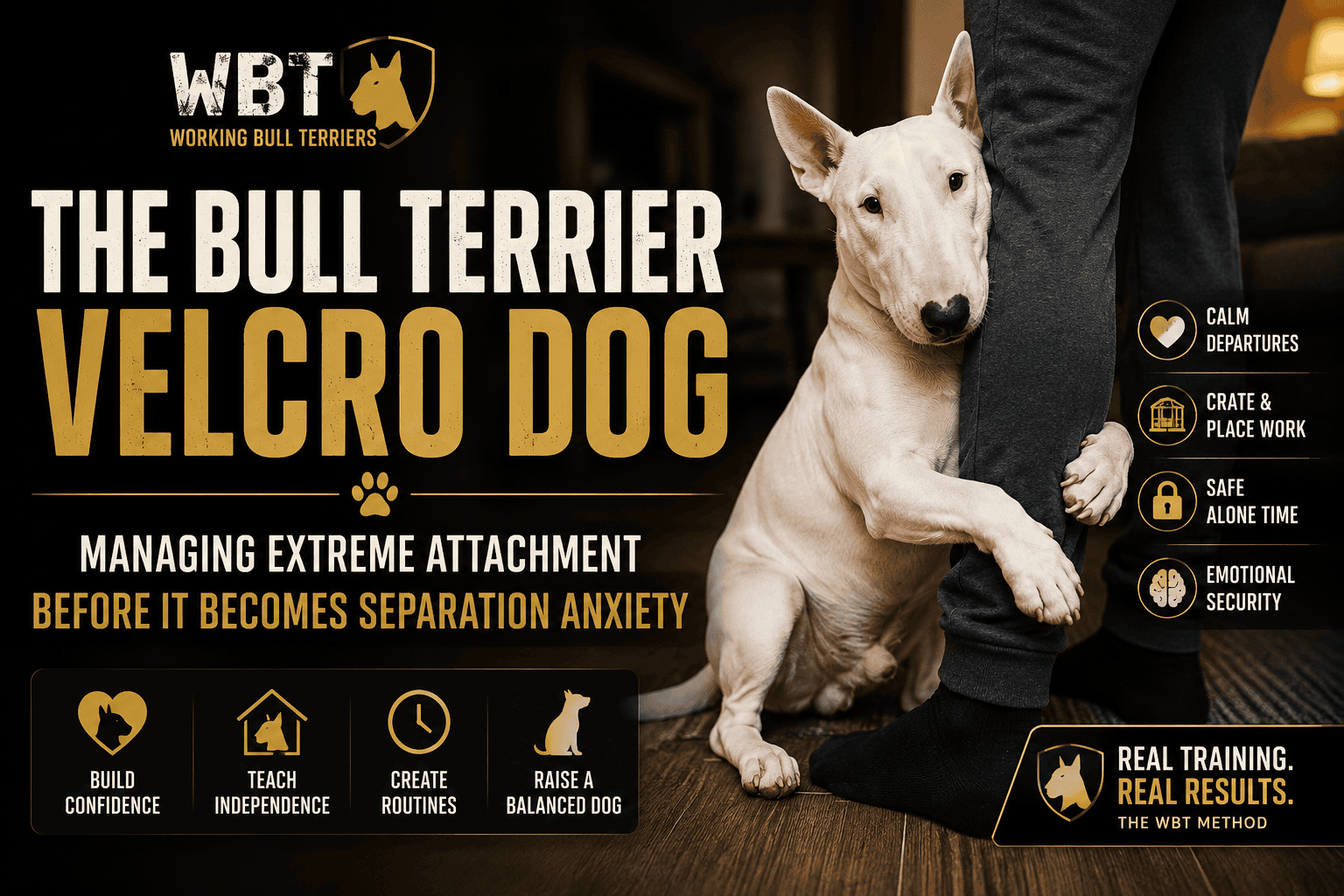
The Bull Terrier Velcro Dog: Managing Extreme Attachment Before It Becomes Separation Anxiety
How to Love a Highly Emotional Bull Terrier Without Creating a Dog Who Cannot Cope Alone
A Velcro Bull Terrier is not automatically a problem. The problem begins when closeness becomes distress and the dog cannot settle, eat, rest, or cope when the owner moves away. Build tiny separations, calm place routines, an independence zone, boring departures, out-of-sight practice, chewing and sniffing support, and get help early if the dog panics, destroys, injures itself, or cannot tolerate even seconds alone.
Important: Severe separation anxiety is not spite or disobedience. If your Bull Terrier injures itself, destroys exits, screams continuously, drools heavily, soils only when alone, or cannot tolerate seconds of separation, involve a veterinarian or qualified behaviour professional.
Bull Terriers can attach deeply.
Sometimes beautifully.
Sometimes intensely.
Sometimes too much.
A Bull Terrier may follow you from room to room, stare at you constantly, sleep pressed against you, panic when a door closes, cry when you leave, sit outside the bathroom, push into your body, demand touch, and act as if your absence is a personal emergency.
Owners often call this “love.”
And sometimes it is love.
But when attachment becomes distress, the bond can turn into a problem.
A Bull Terrier who cannot rest unless the owner is present is not just affectionate. A dog who panics when left alone is not simply loyal. A dog who screams, destroys, salivates, injures itself, or loses control when separated is not being dramatic.
That dog is struggling.
The goal is not to make the Bull Terrier cold or independent.
The goal is to teach the dog emotional security.
A healthy Bull Terrier should love its owner deeply — but still be able to breathe when the owner leaves the room.
Bull Terriers Are Emotional Dogs
Bull Terriers are not casual companions.
They are intense, physical, sensitive, funny, stubborn, and deeply connected to their people. Many Bull Terriers do not simply live beside the owner. They live through the owner.
They watch routines. They study moods. They follow movement. They react to exits. They notice shoes, keys, bags, jackets, and tiny changes in the house. They can become emotionally glued to one person.
This emotional intensity is part of the breed’s charm.
But without structure, it can become dependence.
A Velcro Bull Terrier may begin as a sweet shadow and slowly become a dog who cannot regulate alone.
That is where owners must be careful.
Love should create safety.
It should not create panic.
Attachment Is Normal. Panic Is Not.
There is nothing wrong with a Bull Terrier wanting to be near you.
A bonded dog may follow you, rest near you, check in often, and prefer your company. That is normal.
The problem begins when separation creates distress.
Possible warning signs include:
- crying when you leave the room;
- scratching at doors;
- pacing when you prepare to leave;
- refusing food when alone;
- drooling during absence;
- destructive behaviour near exits;
- trying to escape crates, rooms, or gates;
- barking or howling when left;
- trembling before departure;
- following the owner obsessively;
- inability to settle unless touching the owner;
- panic when the owner is out of sight;
- overexcited greetings that look frantic rather than happy;
- self-injury during confinement or separation.
A little protest is not the same as severe separation anxiety.
But small signs can grow if the owner responds in ways that increase dependence.
The Mistake: Making the Dog’s Anxiety the Centre of the House
Many owners accidentally build the problem.
The puppy cries, so the owner rushes back immediately.
The dog paws, so the owner gives touch every time.
The dog follows, so the owner allows access everywhere.
The dog panics at a closed door, so doors are never closed.
The dog screams in the crate, so the crate disappears.
The dog becomes frantic when the owner leaves, so the owner makes long emotional goodbyes.
The owner thinks they are comforting the dog.
But the dog may be learning:
I cannot cope unless my human returns immediately. My panic controls the environment. Alone time is dangerous. Separation is a big emotional event.
This does not mean you ignore real distress.
It means you must not let distress write the whole training plan.
A Bull Terrier needs comfort, yes.
But it also needs skill.
Being alone is a skill.
Do Not Confuse Closeness With Security
A dog lying on your chest all day may look secure.
But true security is not measured by how close the dog stays when you are available.
True security is measured by how well the dog copes when you are not available.
A secure Bull Terrier can enjoy closeness and also rest alone.
An insecure Bull Terrier may demand closeness because it cannot regulate without it.
That difference matters.
If the dog only sleeps when touching you, only eats when you are nearby, only settles when you sit still, and becomes anxious whenever you move, then the dog is not just affectionate.
The dog is dependent.
The aim is not less love.
The aim is more confidence.
Start With Tiny Separations
You do not fix a Velcro Bull Terrier by suddenly leaving it alone for hours.
That usually makes the problem worse.
You start with tiny separations the dog can handle.
Stand up and sit down. Step behind a baby gate and return. Close a door for one second and reopen it. Walk to another room and come back before the dog panics. Touch your keys without leaving. Put on your shoes and stay home. Open the front door, close it, and continue normal life.
The point is to teach the dog:
Owner movement does not always mean disaster. Doors closing do not always mean abandonment. Departure signals are not emergencies.
Small repetitions build emotional tolerance.
Do not start at the level where the dog already fails.
Start below panic.
Do Not Make Departures Emotional
Humans love dramatic goodbyes.
Dogs with separation issues do not need them.
If every departure includes hugging, apologizing, nervous energy, repeated reassurance, and emotional tension, the dog learns that leaving is a major event.
Keep departures calm and boring.
No long speech. No guilt performance. No anxious face. No repeated “I’ll be back, don’t worry.” No last-minute emotional explosion.
Prepare the dog calmly. Give the routine. Leave quietly.
Return calmly too.
Overexcited greetings can also feed the emotional rollercoaster. That does not mean you ignore your dog cruelly. It means you wait for a little calm before the big affection.
The message should be:
Leaving is normal. Returning is normal. Nothing dramatic happened.

A Velcro Bull Terrier does not need less love. It needs clearer daily structure: place work, crate or pen routines, calm exits, reset areas, confidence-building, and predictable rules.
Build a Safe Independence Zone
Every Bull Terrier should have a place where it can settle without being attached to the owner’s body.
This may be:
- a crate;
- an exercise pen;
- a quiet room;
- a gated area;
- a place bed;
- a raised platform;
- a chew station.
This area must not only appear when you leave.
If the dog only goes there when separation happens, it may become a warning sign.
Use the independence zone during normal life.
You cook, dog rests on place.
You work, dog chews in the pen.
You watch television, dog relaxes on its own bed.
You move around the house, dog practices staying settled.
This teaches the dog that being near you and being on top of you are not the same thing.
The dog can be safe without constant contact.
Teach Place as Emotional Structure
The place command is not just obedience.
For a Velcro Bull Terrier, it is emotional structure.
Place teaches:
“You do not need to follow every movement.” “You can relax while life happens.” “You have a job that is calm.” “You are safe even when the owner is not touching you.”
Start easy.
Reward the dog for going to place. Then for staying. Then for relaxing. Then for remaining there while you take one step away. Then two steps. Then across the room. Then briefly out of sight.
Do not rush.
The dog should learn calm success, not failure.
A good place routine can change the whole house.
Reward Calm Independence
Many owners reward clinginess without realizing it.
The dog pushes into them, they pet.
The dog paws, they pet.
The dog whines, they talk.
The dog blocks the path, they respond.
The dog follows everywhere, they constantly engage.
Meanwhile, calm independent behaviour gets ignored.
Flip that pattern.
When your Bull Terrier chooses to lie on its own bed, reward calmly.
When the dog relaxes without touching you, praise softly.
When the dog stays calm while you move, reward.
When the dog watches you leave the room and does not panic, reward.
Do not only give attention to the loudest behaviour.
Pay the behaviour you want to grow.
Use Chewing and Sniffing to Support Calm
A Bull Terrier who struggles with separation often needs help entering a calmer state.
Chewing and sniffing can help.
Use:
- food-stuffed toys;
- safe chews;
- scatter feeding;
- lick mats;
- rolled towels with food;
- sniffing games;
- calm search games.
These should not be frantic excitement games. They should help the dog slow down.
Give them in the independence zone while you are still home at first.
The dog should learn:
This space predicts good things, not abandonment.
Later, these calming activities can support short absences.
Practice “Out of Sight” Before “Out of House”
Many owners jump too quickly.
The dog cannot handle the owner going to the bathroom alone, but the owner expects the dog to handle a two-hour absence.
That is too big a jump.
First, teach out-of-sight tolerance inside the house.
Step behind a door for one second. Return.
Then three seconds.
Then five.
Then ten.
Then walk to another room.
Then close a door briefly.
Then return calmly.
Only when the dog can handle small indoor separations should you build longer departures.
Separation training is built in layers.
Skip the layers, and the dog falls through.
Watch the Departure Triggers
Dogs with attachment anxiety often respond before you leave.
They notice:
- shoes;
- keys;
- bags;
- jacket;
- phone;
- routine changes;
- shower before work;
- closing windows;
- feeding time changes;
- lights being turned off;
- the owner’s tension.
These become predictors.
The dog begins panicking before the actual separation.
To weaken this, practice false departures.
Pick up keys and sit down.
Put on shoes and make coffee.
Grab your bag and go nowhere.
Open the door, close it, and stay inside.
Walk outside for two seconds and return.
The goal is to make departure signals boring again.
Do this calmly and often, without turning it into a big training performance.
Do Not Let the Dog Rehearse Panic Daily
If the dog is already panicking every time you leave, repeating long absences may keep the problem alive.
Training works best when the dog practices success, not panic.
This may mean temporarily using help:
- another family member;
- a trusted sitter;
- day care if appropriate;
- adjusted routines;
- shorter absences;
- leaving the dog after exercise and decompression;
- building alone time gradually.
This is not always easy in real life, but the principle matters.
Every panic session teaches the nervous system that being alone is terrifying.
Every calm session teaches the opposite.
The more calm repetitions you build, the better the chance of improvement.
Crate Training: Helpful or Harmful?
Crates can be excellent for some Bull Terriers and terrible for others if introduced badly.
A crate should be a calm bedroom, not a prison.
If the dog has been properly conditioned to the crate, it may feel safe there. If the dog has only been locked in during panic, the crate may increase distress.
Good crate training starts with:
open-door exploration, feeding inside, short calm sessions, chews, rest, no drama, and gradual door closure.
Bad crate training looks like:
forcing the dog inside, leaving immediately, ignoring full panic, using the crate only when angry, or expecting the crate to solve anxiety by itself.
A crate is a tool.
It is not a magic box.
If a dog injures itself trying to escape, bends bars, breaks teeth, or panics severely, seek professional help. Safety comes first.
Exercise Helps, But It Is Not the Whole Answer
A tired Bull Terrier may rest better.
But exhaustion alone does not cure separation anxiety.
Some owners try to run the dog into the ground before leaving. Sometimes this helps a little. Sometimes it creates an overtired, overstimulated dog who still panics.
The better plan is:
physical outlet, mental outlet, decompression, calm routine, then separation practice.
Do not finish with wild excitement and then disappear.
Bring the dog down first.
A good pre-departure routine might be:
walk, sniffing, toilet, water, calm place, chew, quiet departure.
The dog should not be at peak arousal when you leave.

The Velcro behaviour can look sweet, funny, demanding, dramatic, or deeply emotional. The Quirks guide helps owners understand breed-specific patterns before they become serious.
Avoid Constant Entertainment
Some owners think a Velcro dog needs constant stimulation.
More toys. More games. More talking. More touching. More attention. More activity.
But a dog who is constantly entertained by the owner never learns to simply exist.
Bull Terriers need outlets, but they also need boredom tolerance.
The dog should be able to lie down while nothing interesting happens.
That skill is built gradually.
Start with short calm periods. Reward quiet. Use place. Use chew routines. Let the dog learn that not every moment requires interaction.
A dog who cannot handle boredom often cannot handle separation.
One-Person Attachment
Some Bull Terriers bond too heavily to one person.
They ignore other family members, panic when the favourite person leaves, and only settle when that person is present.
To reduce this, other household members should become part of the dog’s care and routine.
They can feed, walk, train, play, give chews, practice place, and handle calm routines.
The goal is not to weaken the primary bond.
The goal is to widen the dog’s safety network.
A dog who depends on only one person is more vulnerable to anxiety.
A dog who feels safe with several trusted people has more emotional flexibility.
Do Not Punish Panic
Separation anxiety is not spite.
A dog who destroys the door, chews the frame, barks, or soils during absence is not “getting revenge.”
The dog is distressed.
Punishing the dog after you return does not help. The dog will not connect the punishment in the way humans imagine. It may only become more anxious about your return.
Do not scold the dog for panic behaviour after the fact.
Instead, change the plan:
shorter absences, better conditioning, safer setup, more gradual training, veterinary or professional support if needed.
Punishment does not teach a panicking dog how to feel safe alone.
When It Is More Than Training
Some dogs have severe separation anxiety.
These dogs may need help beyond standard owner training.
Speak with a veterinarian or qualified behaviour professional if your Bull Terrier:
- screams or howls continuously;
- destroys doors, walls, crates, or windows;
- injures itself trying to escape;
- drools heavily during absence;
- refuses all food when alone;
- panics before you leave;
- cannot tolerate even seconds of separation;
- soils only when left alone;
- has sudden adult-onset anxiety;
- shows extreme distress despite gradual training.
In severe cases, veterinary behaviour support and medication may be appropriate as part of a full plan.
Medication is not a failure.
For some dogs, it lowers panic enough for learning to happen.
But medication without training is incomplete.
Training without recognizing severe panic can also be unfair.
A Simple Daily Independence Plan
For a Velcro Bull Terrier, build small independence moments every day.
Morning: short place session while you move around.
Midday: chew in pen while you are still home.
Afternoon: brief door-closing practice.
Evening: calm bed time away from your body.
Randomly: pick up keys, put them down, no departure.
Several times daily: reward the dog for resting independently.
Keep it boring. Keep it calm. Keep it consistent.
You are not trying to reject the dog.
You are teaching the dog that it can be okay without constant contact.
What Not to Do
Do not suddenly leave the dog for long periods if it already panics.
Do not punish destruction after returning.
Do not make emotional departures.
Do not allow constant body contact all day and then expect independence at night.
Do not only use the crate when leaving.
Do not reward every demand for attention.
Do not let the dog rehearse panic daily.
Do not assume love and anxiety are the same thing.
Do not wait until the dog is destroying the house before building alone-time skills.
The earlier you build independence, the easier the problem is to prevent.
The WBT View: A Strong Bond Should Make the Dog Safer, Not More Fragile
Bull Terriers bond hard.
That is one of the reasons we love them.
But a bond should not become a trap.
A healthy bond gives the dog confidence. It does not make the dog collapse when the owner steps away.
The best Bull Terrier relationship is not built on constant access. It is built on trust, structure, clarity, and emotional safety.
The dog should know:
“My owner comes back.” “I can rest here.” “I do not need to panic.” “Doors closing are normal.” “Being alone for short periods is safe.” “My place is safe.” “My crate or pen is safe.” “I can love my person and still cope.”
That is real security.
Final Thought
The Velcro Bull Terrier is easy to love.
The following, the staring, the body contact, the devotion — it can feel beautiful. And it is beautiful, when the dog is emotionally healthy.
But when closeness turns into panic, the owner has a responsibility to help.
Do not shame the dog for needing you.
Do not drown the dog in constant reassurance either.
Teach independence gently.
Build tiny separations. Reward calm distance. Use place. Create a safe zone. Make departures boring. Practice out-of-sight moments. Stop rewarding every anxious demand. Get help early if the panic is severe.
A Bull Terrier should be allowed to love deeply.
But it should also be taught how to stand emotionally on its own four feet.
Because the strongest bond is not the one where the dog cannot live without you for one minute.
The strongest bond is the one where the dog trusts you enough to relax when you are gone — because it knows you always come back.
Frequently Asked Questions About Velcro Bull Terriers
No. A Velcro Bull Terrier may simply be very attached. Separation anxiety begins when separation creates real distress such as panic, destruction, drooling, howling, escape attempts, or inability to settle alone.
Start with tiny separations below panic level: stepping behind a gate, closing a door for one second, moving around while the dog stays on place, or practicing false departure cues such as keys and shoes.
Get help if your dog injures itself, destroys doors or crates, howls continuously, drools heavily, refuses all food alone, soils only when left, or cannot tolerate even seconds of separation.