

Working Bull Terriers Kennel
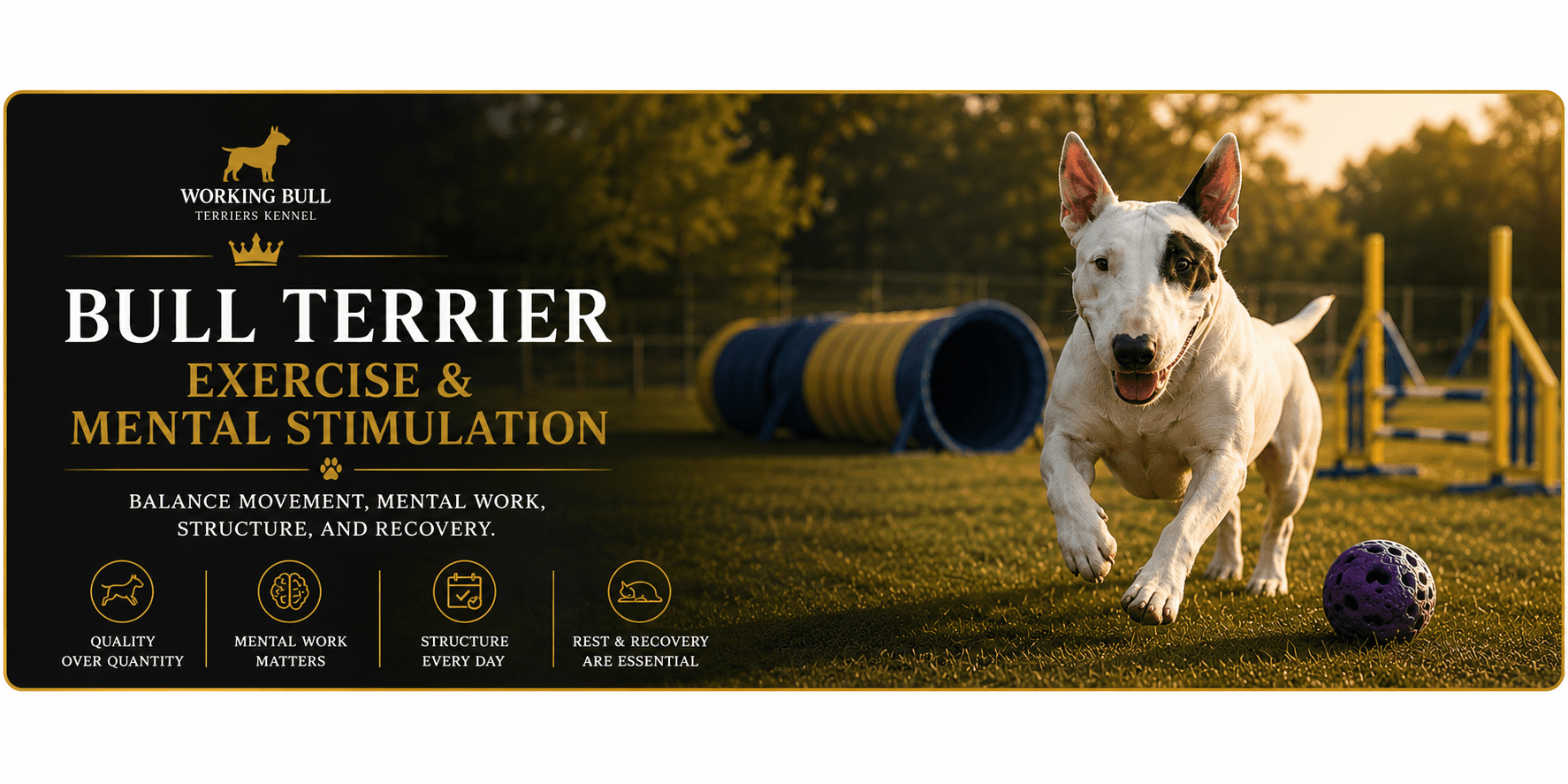
A balanced Bull Terrier needs more than a longer walk.
Healthy movement, meaningful mental work, structure and recovery must support one another. More activity is not automatically better if the dog becomes fitter, more aroused and less able to settle.
This hub helps owners choose the right type of exercise, enrichment and recovery for the dog in front of them—not chase exhaustion as the only goal.
Start with the individual dog
Age, health, body condition, weather, arousal and experience all change what appropriate activity looks like.
Use purposeful physical work
Walking, controlled play and conditioning should support health without creating unnecessary overload.
Add meaningful mental work
Training, problem-solving and engagement should make the dog think—not demand constant entertainment.
Teach the nervous system to come down
A complete routine includes sleep, quiet transitions and the ability to settle after activity.
Quick Answer
How much exercise and mental stimulation does a Bull Terrier need?
There is no single distance or number of minutes that suits every Bull Terrier. The right amount depends on age, health, temperature, body condition, temperament and how the dog responds after activity.
The goal is quality and balance: appropriate physical exercise, mental work, training, rest and recovery—not exhausting the dog until it can no longer move.
What Success Looks Like
Activity should improve the rest of the day.
The dog returns home able to drink, decompress and settle.
Movement supports focus rather than creating harder pulling and scanning.
Mental work leaves the dog satisfied rather than demanding endless stimulation.
The routine can be repeated consistently without pain, exhaustion or escalating arousal.
Read the Dog After Activity
The response after exercise tells you whether the balance is working.
Do not judge the routine only by distance, speed or how tired the dog looks in the moment. Watch what happens during recovery.
Healthy satisfaction
The dog can drink, rest, engage calmly and return to normal behaviour without a long emotional crash.
Under-stimulated
The dog remains available for constructive work and appears to need clearer outlets rather than random freedom.
Over-aroused
Activity is followed by frantic movement, biting, fixation, harder pulling, barking or an inability to settle.
Physically overloaded
Stiffness, limping, reluctance, excessive panting or unusual fatigue requires rest and possibly veterinary review.
Exercise & Mental Stimulation Library
Choose the area that needs work instead of adding more of everything.
These are real published WBT articles, grouped by purpose so owners can move directly to the most relevant guidance.

Physical Exercise
Walking, play, conditioning and age-appropriate movement
Start here when you need to judge duration, physical outlet, puppy exercise or productive ways to use the body.

Mental Work & Engagement
Use the brain without creating constant entertainment
Start here when the dog needs more productive thinking, motivation, focus and owner-led interaction.
Recovery & Regulation
Tired is not the same as calm.
A Bull Terrier can run, train or play hard and still return home more emotionally charged than before. Exercise may expose a regulation problem rather than solve it.
Recovery means the dog can transition from activity into drinking, resting, sleeping and normal household behaviour without remaining trapped in a high-arousal state.
Build the Downshift
Recovery should be planned—not left to chance.
- Finish intense activity before control and coordination disappear.
- Use a calm transition rather than moving directly into chaotic household freedom.
- Provide water, cooling and an appropriate quiet resting place.
- Avoid stacking several high-arousal activities without recovery between them.
- Track whether the dog settles faster across several weeks.
Interactive WBT Tools
Turn general advice into a routine that fits your dog.
Use these free tools to make the page practical rather than relying on guesses or copying another dog’s schedule.
Exercise Planner
Build an age-aware exercise outline around the dog’s routine, activity and current needs.
Use the Exercise Planner →Enrichment & Toy Finder
Match enrichment ideas and toy types to the Bull Terrier’s play style and needs.
Find Enrichment Ideas →Daily Routine Builder
Balance movement, training, feeding, quiet periods and rest across the full day.
Build a Daily Routine →Growth & Body Condition Tracker
Track weight and condition when exercise, growth or physical development is part of the concern.
Open the Growth Tracker →Puppy Exercise
Protect development while building good habits.
Bull Terrier puppies need movement, play, exploration and training, but they also need sleep, recovery and protection from excessive repetitive impact.
The correct puppy routine develops coordination, owner engagement and calmness without treating the puppy like a smaller adult athlete.
Health and Safety
Exercise advice must change when the body changes.
Reduce activity and seek veterinary guidance when a Bull Terrier shows pain, limping, collapse, unusual weakness, breathing difficulty, heat distress, sudden reluctance to move or a major change in recovery.
Puppies, seniors, overweight dogs and dogs with orthopedic, cardiac or respiratory concerns need individualized limits. Hot weather also changes what is safe, even when the dog still wants to continue.
Choose the Correct Supporting Route
Energy problems may belong to a different part of the system.
Use the route that matches what is actually breaking down: physical outlet, engagement, arousal, routine or a larger behaviour pattern.
Focus & Engagement
Use this when walks and activity are dominated by pulling, scanning, fixation or weak owner connection.
Open Focus & Engagement →Behaviour Problems Hub
Use this when excitement, roughness, reactivity or household chaos continues despite substantial activity.
Open Behaviour Problems →The WBT Method
See how exercise and mental work fit into management, structure, engagement and responsible freedom.
Explore The WBT Method →Complete Training Guide
Continue through the wider WBT education library for training and behaviour.
Open the Complete Guide →AI Behaviour Diagnostic
Use this when the dog’s activity, arousal and behaviour form a layered individual case.
Start the AI Diagnostic →Training Reviews
See how WBT clients have used structured plans with real Bull Terrier cases.
Read Training Reviews →When a Generic Routine Is Not Enough
Some dogs need a personalized balance plan.
Customized support becomes more appropriate when exercise repeatedly increases arousal, the dog cannot settle, several behaviour problems overlap or health and household limits make generic schedules unrealistic.
WBT online training uses the dog’s videos, daily routine, environment, rewards and recovery pattern to build a plan the household can actually apply.
Personal Help May Fit When
More activity keeps making the day harder.
- The dog becomes more frantic after walks or play.
- Pulling and fixation dominate outdoor activity.
- The household cannot create a workable daily rhythm.
- The dog remains restless despite substantial exercise.
- The owner needs weekly adjustment rather than another generic schedule.
General Health Reference
General exercise guidance is useful—but the individual dog still decides the limit.
Owners can also read the AKC guide on how much exercise dogs need. WBT adds Bull Terrier-specific attention to arousal, engagement, recovery, age and real household behaviour.
Balance Before Exhaustion
The best routine improves movement, thinking and recovery together.
Choose activity that suits the individual dog, use mental work with purpose, watch the response after exercise and build calm transitions into the routine from the beginning.
Need a practical starting point?
Build a personalized activity outline with the free WBT tool.
Use the Exercise Planner →Need better mental outlets?
Match enrichment and toys to the dog rather than buying at random.
Use the Enrichment Finder →Still struggling with the full pattern?
Use the Behaviour Problems Hub or see how personalized online training works.
How Online Training Works →