
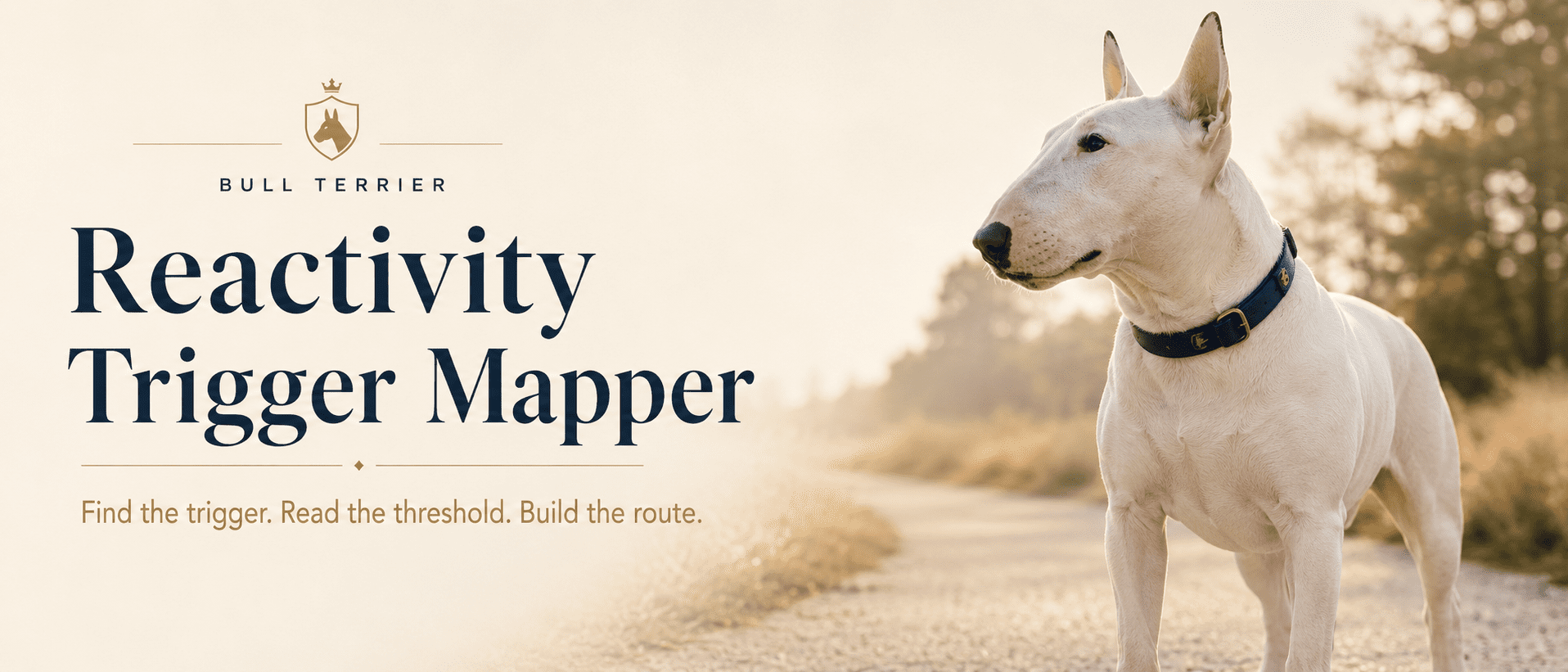
Bull Terrier Reactivity Trigger Mapper
Bull Terrier Reactivity Trigger Mapper
A WBT tool for owners who need to find the trigger, read the threshold, and choose the right route.
The Bull Terrier Reactivity Trigger Mapper helps owners understand what sets the dog off, how close the trigger needs to be, what the environment adds to the problem, and whether the pattern looks more like distance trouble, leash frustration, barrier reactivity, home triggers, or a higher-risk support case.
The goal of the Bull Terrier Reactivity Trigger Mapper is not to guess whether the dog is “bad.” The goal is to map triggers, distance, pressure, recovery, handler influence, and food response so the next step becomes much clearer.
Quick Answer
How do I know what triggers my Bull Terrier’s reactivity?
You find the trigger by looking at exactly what appears before the reaction, how close it is, whether the dog is on lead or behind a barrier, whether food still matters, how long recovery takes, and whether the dog reacts more from fear, frustration, excitement, or pressure.
The Bull Terrier Reactivity Trigger Mapper helps owners organize that information so they can stop saying “everything is a trigger” and start seeing the actual behaviour picture.
Find the trigger. Read the threshold. Build the route.
A calm alert dog can already be showing the start of a trigger pattern. The body, the eyes, the distance, the environment, and the handler all matter.
The WBT goal: understand what the dog noticed, how quickly tension rises, and which route makes the most sense next.

Before You Use The Tool
The map is not the same as the full plan.
The Bull Terrier Reactivity Trigger Mapper is designed to help owners organize the reactivity pattern before they jump into random advice. It does not replace a full training plan. It helps you decide what the route should probably be.
If the dog is exploding at close distance, redirecting, making the owner feel unsafe, or getting worse quickly, that is not the time to keep experimenting. That is the time to protect safety, reduce rehearsal, and consider stronger support.
Interactive WBT Tool
Use the Bull Terrier Reactivity Trigger Mapper
The Bull Terrier Reactivity Trigger Mapper checks the main trigger, the environment, threshold distance, lead pressure, barrier effect, food response, recovery time, and seriousness level so the result can route owners toward the correct WBT next step.
Important note.
This is an educational mapping tool. It does not diagnose fear, aggression, or medical problems. If the behaviour feels unsafe, use prevention, distance, and professional guidance.
1. Dog and trigger basics
Start by identifying the dog’s age and the clearest trigger type.
2. Environment and threshold
This is where the map becomes useful: where does the trigger appear, and how close before the dog reacts?
3. Workability and recovery
This tells us whether the dog is still reachable or already too loaded.
4. Pressure and seriousness
These answers help the Bull Terrier Reactivity Trigger Mapper decide whether the case needs a deeper support route.
WBT Reactivity Routes
The Bull Terrier Reactivity Trigger Mapper separates the pattern before it suggests the route.
The Bull Terrier Reactivity Trigger Mapper does not throw every reactive dog into the same plan. It first looks at triggers, threshold distance, environment, lead pressure, barriers, recovery, and seriousness.
Distance & Threshold Route
For dogs that mainly need safer distance, better threshold reading, and more honest setup.
Leash Frustration Route
For dogs that react harder on lead when they cannot move or access the trigger.
Environmental Trigger Route
For dogs reacting to cars, movement, sound, or general outside picture.
Guest / Home Trigger Route
For home, window, gate, guest, or household territory patterns.
Barrier Reactivity Route
For fences, gates, windows, and frustration amplified by separation.
High Arousal / Frustration Route
For dogs that lose food, lose thinking, and stay loaded too long.
Quick Diagnostic Route
For mixed or unclear cases that need the full WBT picture mapped.
Safety / Online Training Route
For unsafe, escalating, redirecting, or overwhelming reactivity cases.
WBT Philosophy
“Reactive to everything” is often just unorganized observation.
The Bull Terrier Reactivity Trigger Mapper teaches owners to look at the real picture. What is the trigger? How far away? What changes on lead? What changes behind a barrier? Can the dog still think? How long does recovery take? Those answers build a much better starting point than labels alone.
FAQ
Bull Terrier Reactivity Trigger Mapper FAQ
Why is my Bull Terrier reactive only at certain distances?
Distance often acts like a pressure dial. At one distance the dog can still think, take food, and recover. At another distance the dog crosses threshold and loses workability.
Why is the reaction worse on lead?
Lead tension can add frustration, remove movement choice, increase handler emotion, and make the dog feel more trapped or more driven toward the trigger.
What if the dog reacts more behind fences or windows?
That often points toward barrier frustration or territorial rehearsal. The dog keeps seeing the trigger but cannot resolve the tension, so the reaction gets repeated and strengthened.
Why does food stop working around triggers?
When food disappears, the dog may already be too loaded. That is useful information, not failure. It means threshold, setup, and recovery need attention.
When should I seek more direct support?
If the reactions are intense, escalating, redirecting, unsafe, or making normal life very difficult, use the Quick Diagnostic and consider online training support.
Working Bull Terriers Kennel
Map the trigger first. Training becomes clearer after that.
The Bull Terrier Reactivity Trigger Mapper helps owners stop guessing, organize the reactivity pattern, and choose the right WBT route before the problem gets heavier.
Unique mindset. Unmatched loyalty. Not just a breed, a lifestyle.