
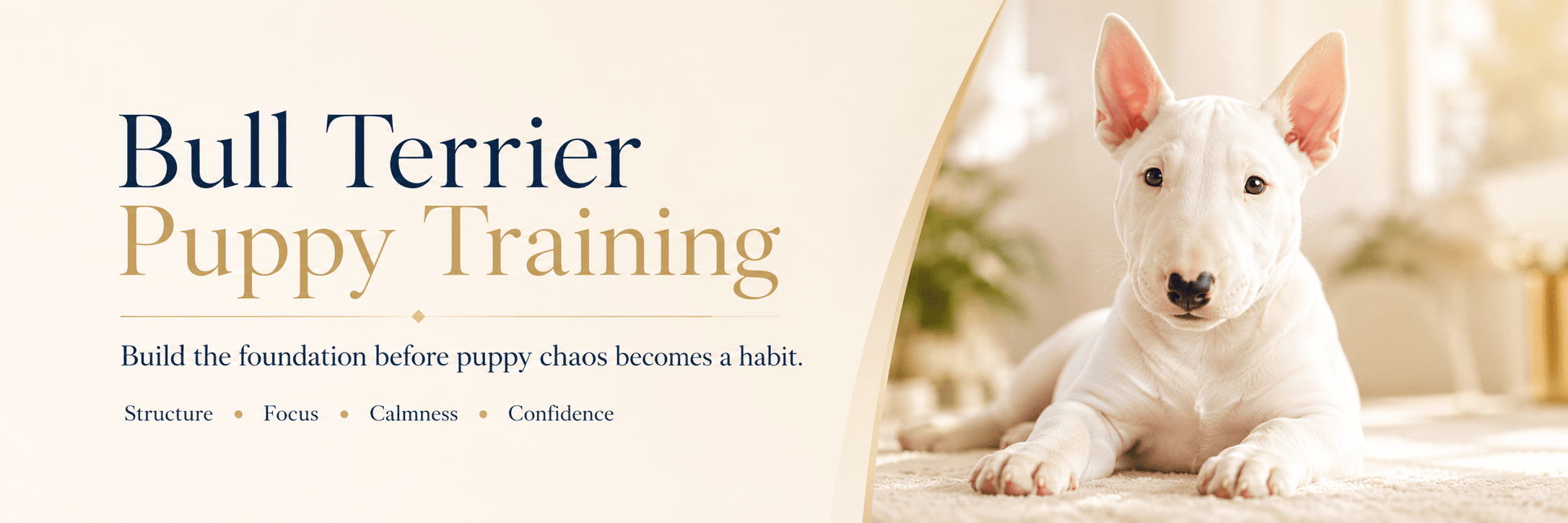

Bull Terrier Puppy Training
Build the puppy before you spend years correcting the adult dog.
The first goal is not perfect obedience. It is a puppy that can sleep, recover, follow the owner, accept guidance, learn bite control and handle freedom without turning the household into permanent chaos.
This hub gives new Bull Terrier owners a clear order: routine first, biting management, engagement, careful exposure, appropriate exercise and freedom that grows with reliability.
Quick Answer
What matters most in Bull Terrier puppy training?
Bull Terrier puppy training should begin on the first day at home, but it should not begin with heavy pressure or long obedience sessions.
The foundation is daily rhythm: sleep, toilet timing, crate comfort, handling, biting management, short engagement, safe exploration and simple boundaries. These skills teach the puppy how to live before the owner asks for more difficult behaviour.
When the foundation is weak, owners often mistake overtiredness, overarousal and too much freedom for stubbornness.
The Puppy Development Path
Build in the correct order.
Each stage supports the next. Do not rush toward freedom or difficult commands while sleep, biting and owner connection are still unstable.
Settle the nervous system.
Build sleep, crate comfort, toilet rhythm and calm transitions before expecting concentration.
Manage biting and physical chaos.
Prevent overtired explosions, control rehearsal and teach better ways to interact.
Build owner value.
Use short sessions, clear rewards and voluntary engagement before the outside world becomes more valuable.
Expose without overwhelming.
Introduce people, surfaces, sounds and environments at a level the puppy can process.
Increase freedom through reliability.
Give the puppy more access as settling, recall, engagement and household behaviour improve.

A tired puppy is not always a well-exercised puppy.
Many of the worst biting, zooming and refusal periods appear when the puppy has been awake too long, has moved through too many stimulating situations or has no predictable way to come down.
Sleep, toilet rhythm, chewing outlets, crate comfort and calm transitions are active parts of training. They make the puppy more capable of learning everything else.

Do not wait until the puppy is overloaded to start guiding the mouth.
Biting is normal puppy behaviour, but constant rehearsal, overtiredness, chaotic play and unclear interaction rules can turn normal mouthiness into an exhausting household pattern.
The answer is not simply to shout, hold the mouth or keep redirecting forever. Owners need to recognize the stage before escalation and manage rest, freedom, access, play and attention.

Make the owner relevant before demanding obedience around distractions.
A puppy that voluntarily follows, checks in and enjoys working with the owner has a much stronger base for recall, leash work and later impulse control.
Socialization should also protect confidence. The goal is not to force the puppy to greet everything; it is to help the puppy notice, process and recover without being flooded.

Exercise should support development—not create a fitter, more frantic puppy.
Young Bull Terriers need movement, play, exploration and confidence-building. They do not need endless repetitive exercise, intense impact or a routine built around exhaustion.
Watch what happens after activity. A suitable routine helps the puppy drink, recover and settle rather than escalating into biting, zooming and household chaos.
Free Bull Terrier Puppy Checklist
Give the first weeks a clearer structure.
The checklist helps new owners think beyond commands and organize the foundations that shape daily puppy life.
- Routine, sleep and toilet rhythm
- Biting management and controlled freedom
- Focus, handling and crate comfort
- Exercise, recovery and calm transitions
Puppy Starter Checklist
Send the free checklist to your email.
Use it as a practical reference while your puppy settles into the household.
After subscribing, check your email to confirm and receive the checklist.
Ordered Puppy Reading Path
Read in the order that puppy life normally develops.
This sequence keeps owners from jumping directly to advanced behaviour advice before the daily foundation is in place.
The First 90 Days With a Bull Terrier Puppy
The overall foundation for the first stage at home.
Bull Terrier Puppy Biting
Understand normal mouthiness, overload and better management.
Why Puppies Need Structure Early
Use boundaries and routine before freedom becomes chaos.
Build a Calm Puppy Routine
Organize sleep, feeding, toilet breaks, play and training.
Socialization Without Overwhelming
Build confidence without forcing greetings or flooding the puppy.
How Much Exercise Does a Puppy Need?
Balance movement, development, arousal and recovery.
Teach a Bull Terrier Puppy to Settle
Build the transition from activity into calm household behaviour.
Crate and Place Training
Create safe rest, management and predictable quiet periods.
Start Focus Training
Build voluntary owner engagement before difficult distractions.
Common Puppy Owner Mistakes
Recognize the patterns that make normal puppy life harder.
Puppy Tools
Use a tool when you need to build the day—not read another long article.
These resources turn general puppy guidance into a more practical routine.
Puppy Routine Builder
Organize sleep, toilet breaks, feeding, training, play and calm periods.
Build the Routine →Growth & Body Condition Tracker
Track weight alongside ribs, waist, tuck, appetite, energy and development.
Track Growth →Exercise Planner
Create an age-aware activity outline while protecting recovery and development.
Plan Exercise →Books & Training Guides
Move into structured self-study when you want the puppy system in greater depth.
View Puppy Guides →When General Advice Is Not Enough
Some puppy cases need an individual plan early.
Personal guidance becomes more useful when biting is intense or unsafe, the puppy cannot settle despite a structured routine, fear or reactivity is developing, several problems overlap or the household cannot find a workable daily rhythm.
Early support is not about labelling a young puppy as difficult. It is about changing the pattern before months of repetition make it stronger.
Behaviour Map
Use this when you are unsure whether the puppy behaviour is normal, escalating or part of a larger pattern.
How Online Training Works
See how WBT reviews the puppy, routine, environment and videos to build a personal plan.
Puppy Training FAQ
The questions new Bull Terrier owners ask first.
When should Bull Terrier puppy training start?
Training starts on the first day at home through routine, toilet rhythm, crate comfort, handling, short engagement and simple household boundaries. Early training should be clear and consistent without becoming heavy.
How do I stop Bull Terrier puppy biting?
Begin by managing tiredness, excitement, freedom, play and rehearsal. Redirect before the puppy is fully overloaded, provide appropriate chewing outlets and use rest when the behaviour is part of an overtired escalation.
Why is my Bull Terrier puppy suddenly wild in the evening?
Evening chaos is often connected to accumulated stimulation, insufficient sleep, excessive freedom or several exciting activities stacked together. The solution usually begins earlier in the day, not only when the explosion starts.
How much exercise does a Bull Terrier puppy need?
The amount depends on age, health, development, temperature and the puppy’s response after activity. Movement and exploration are important, but endless exercise can increase arousal and does not replace sleep or training.
What is the best first training goal?
The first goal is a puppy that can rest, recover, follow the owner, accept handling, learn bite control and understand the daily rhythm. Reliable commands become easier on top of that foundation.
Working Bull Terriers Kennel
Start with structure. Protect the character. Build the dog in front of you.
Puppyhood is not about removing the Bull Terrier personality. It is about giving that personality a stable foundation before strength, confidence and independence increase.