
Bull Terrier History • Origin • Purpose
Bull Terrier History, Origin & Purpose
The real story behind one of the most recognizable, misunderstood, humorous, intense, affectionate, and unique breeds in the dog world.
To understand the modern Bull Terrier properly, we have to look beyond the famous head and the clown reputation. We have to understand where the breed came from, what shaped it, and why that history still matters for training, behaviour, ownership, breeding, and preservation.

Why history matters
The Bull Terrier did not begin as a joke.
The Bull Terrier is often described as the clown of the dog world. Anyone who has lived with one understands why. They are funny, theatrical, dramatic, stubborn, emotional, and capable of turning an ordinary room into a stage without trying.
But that is only one layer of the breed.
Behind the modern clown reputation is a deeper story: old Britain, working and sporting dogs, human selection, courage, controversy, refinement, fashion, health, preservation, and survival. The Bull Terrier’s past is not always comfortable, and it should not be romanticized blindly. But it should be understood.
The temperament, body, determination, physical courage, emotional intensity, and unique way the breed connects with people all make more sense when we understand the origin behind the modern dog.
Before the modern Bull Terrier
The world before the Bull Terrier.
Before the Bull Terrier became the dog we know today, there were older dogs known broadly as bull-and-terrier types. These were not one fixed breed in the modern sense. They were working and sporting crosses, usually developed from bulldog-type dogs and terrier-type dogs.
The bulldog side brought strength, grip, physical toughness, and determination. The terrier side brought speed, agility, sharpness, vermin-hunting instinct, and a more active, reactive mind.
In simple terms, people were trying to combine power with speed. Strength with agility. Courage with quickness.
Some of that history is connected to blood sports. That must be handled honestly. Those activities belong in the past. They are not something to celebrate, repeat, or bring back. But they are part of the historical world that shaped the dogs.
Ignoring that history does not make the breed easier to understand. It only removes the explanation for many traits that can still appear today: persistence, physical boldness, strong focus, high arousal, intense attachment, and the ability to push through pressure.

The modern Bull Terrier is a companion breed, but its old foundation helps explain why structure, guidance, engagement, and responsible ownership matter so much.
The bull-and-terrier foundation was about function first.
Modern people often judge breeds by how they look: colour, head, body shape, outline, expression. But many older dog types were shaped first by what they could do. The old foundation valued courage, physical ability, tenacity, stamina, pain tolerance, and willingness to engage.
These are powerful traits. In the wrong hands, they can become dangerous. In responsible hands, shaped through stable breeding, clear raising, and intelligent training, they become strength of character.
A Bull Terrier can be brave without being dangerous. Powerful without being uncontrolled. Determined without being impossible to live with. But these qualities must be understood.
When people look at a Bull Terrier and see only a funny family dog, they may be surprised by the breed’s intensity. When they see only a stubborn dog, they may miss the intelligence and commitment behind the behaviour. When they try to train the Bull Terrier like a softer, more handler-sensitive breed, they often become frustrated.
The Bull Terrier is not a broken version of another breed. It is its own breed, shaped by its own history.
The modern breed takes shape
James Hinks and the shaping of the modern Bull Terrier.
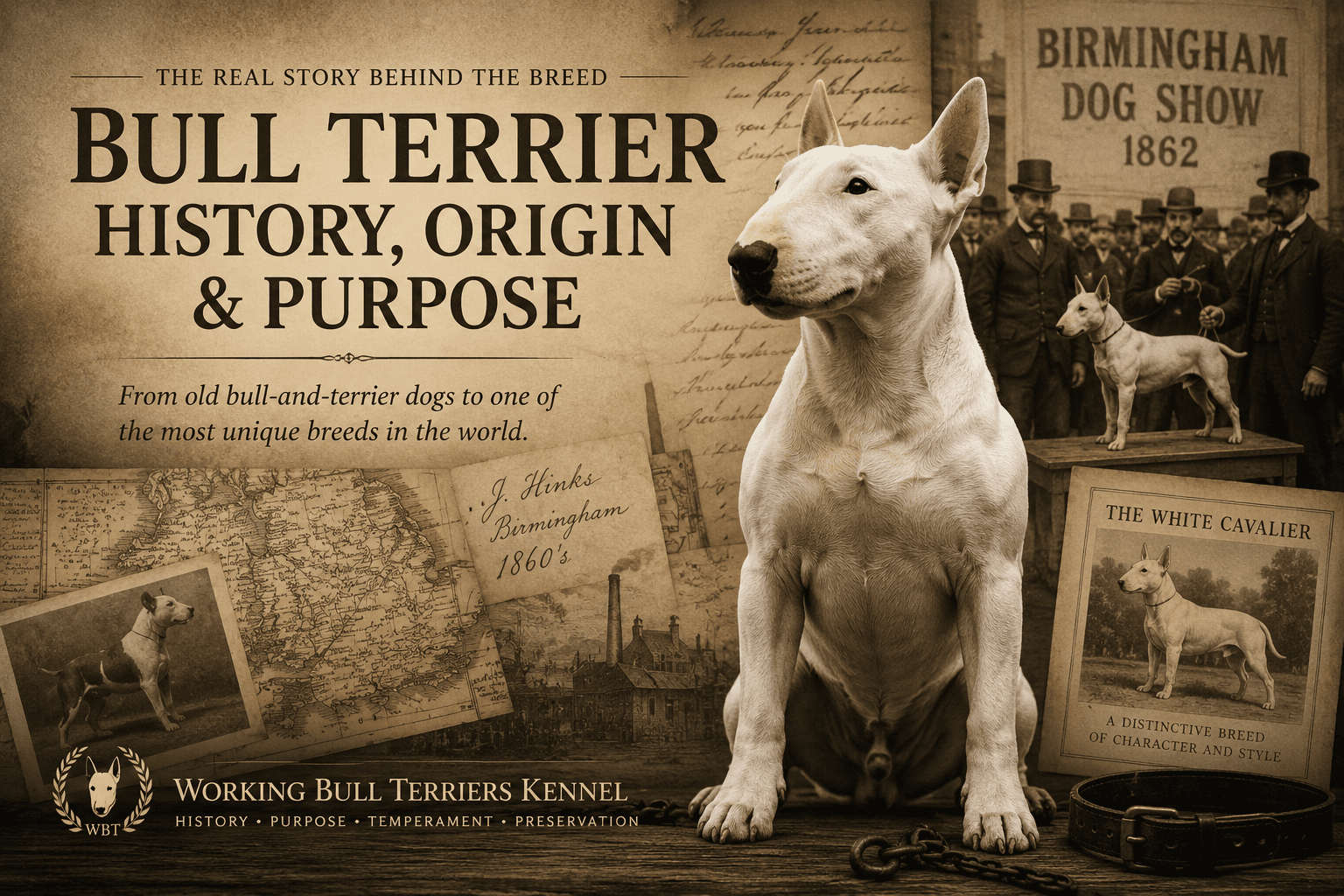
The Bull Terrier as we recognize it today is strongly connected with James Hinks of Birmingham, England. Hinks did not create the old bull-and-terrier type from nothing. Those dogs already existed. But he played a major role in refining and presenting a more recognizable, cleaner, more distinctive Bull Terrier type.
The older bull-and-terrier dogs were rougher, more mixed in appearance, and less standardized. Hinks is widely associated with the development of the white Bull Terrier: a dog that still carried courage and substance, but with a more refined public image.
This was not only breeding. It was also vision.
Victorian dog culture was changing. Dog shows were becoming more important. Appearance, status, type, and public presentation mattered more than before. The rougher sporting dog was being reshaped into something that could stand in a show ring and appeal to a different kind of owner.
This is where the Bull Terrier begins to move from rougher sporting background toward recognizable breed identity.
Old foundation
Power, determination, courage, physical ability, and terrier sharpness formed the older base behind the breed.
Refinement
James Hinks helped move the type toward a cleaner, more recognizable Bull Terrier identity.
Modern responsibility
Today, the goal is not to return to the past, but to understand the traits that history left behind.
Function and image
The Bull Terrier was shaped between working qualities and public identity.
One of the most fascinating parts of Bull Terrier history is the tension between function and image.
The old foundation valued qualities such as toughness, courage, determination, physical ability, and commitment. The developing show world valued type, style, outline, and public appeal. The Bull Terrier was shaped between these two forces.
That is why the breed is so interesting. It carries both sides.
The famous nickname “White Cavalier” belongs to this period of breed development. It suggested a dog with courage and spirit, but also style, manners, and a gentlemanly image. Of course, romantic nicknames should not hide the complexity of history. The image was partly truth, partly ideal, and partly presentation. But it tells us how the breed was being repositioned.

The Bull Terrier story includes type, colour, health, temperament, and the challenge of preserving the whole dog, not only the look.
The head became part of the breed’s identity.
Today, many people recognize the Bull Terrier mainly by its head. The long profile, filled muzzle, downface, and small triangular eyes give the breed one of the most unmistakable expressions in the dog world.
But this head did not appear fully formed at the beginning. Earlier Bull Terriers looked more moderate than the modern dog. Over time, selection pushed the breed toward the more distinctive profile that became its trademark.
This matters because it shows how breed identity changes over time. A breed is not frozen at the moment of origin. It is shaped by breeders, standards, fashion, public taste, health decisions, and selection pressure.
The head matters. The structure matters. Type matters. But if the dog loses its spirit, confidence, humour, determination, athleticism, and emotional presence, then something deeper has been lost.
A breed should not be preserved only as a shape. It should be preserved as a whole dog.
Colour, health, and preservation
The coloured Bull Terrier reminds us that preservation must be bigger than appearance.
For a long period, the white Bull Terrier became strongly associated with the breed’s identity. The white coat was part of the White Cavalier image, and it became highly valued.
But breeding heavily around a narrow visual preference can create problems. In Bull Terriers, concerns around deafness in all-white dogs became an important part of the breed’s later history. Over time, coloured Bull Terriers became more accepted and more important within breeding programmes.
This was not only about appearance. It was also connected to health, genetic variety, and the future of the breed.
The lesson is simple: when a breed becomes too focused on one visual ideal, it can lose balance.
Preservation must protect the dog.
Health, temperament, soundness, genetic variety, and stable character must matter as much as beauty.
Type should not erase essence.
The breed should keep its look, but also its courage, humour, confidence, athleticism, and emotional presence.
Past and present
What Bull Terrier history explains about modern behaviour.
The history of the Bull Terrier is not just an old story. It explains the dog in front of us today.
Many modern owners struggle because they do not understand what kind of breed they are living with. They expect a simple family clown and then become confused when the dog shows power, persistence, intensity, emotional pressure, or a strong desire to make its own decisions.
They say the dog is stubborn. Sometimes it is. But often, “stubborn” is a lazy explanation.
What the owner may actually be seeing is determination without direction. Drive without structure. Energy without an outlet. Intelligence without engagement. Arousal without regulation. Independence without a clear relationship.
This is where history becomes useful.
When we understand the old foundation of the breed, we stop being surprised that Bull Terriers need more than casual training. We stop expecting them to behave like soft companion dogs with funny heads. We begin to respect the breed as a dog with real character.
This does not mean being harsh. In fact, harshness often creates more problems with Bull Terriers. They need clarity, consistency, timing, structure, emotional control, and engagement. They need a handler who understands how to guide the mind, not just force the body.
Respect the humour. Respect the heart. Respect the power. Respect the history. Then train the dog in front of you.
The myth of the simple clown
The Bull Terrier is funny, but never shallow.
One of the biggest modern myths about the Bull Terrier is that the breed is simply a clown. This image is not completely wrong. Bull Terriers are funny. Their strange behaviour, dramatic reactions, selective hearing, and unique personality are part of why people become addicted to them.
But the clown image is incomplete.
A Bull Terrier is not only funny. It is often deeply emotional, highly physical, strong-willed, sensitive to its people, difficult to redirect when over-aroused, capable of intense focus, sometimes soft, sometimes hard, and sometimes both in the same dog.
That complexity is what makes the breed special. It is also what makes the breed misunderstood.
People who only want an easy pet may struggle with a Bull Terrier. People who only want a hard dog may also misunderstand the breed. The Bull Terrier is not a machine. It is not a soft toy. It is not a meme. It is a breed of contradiction.
That is the real Bull Terrier.
Responsible ownership
Why origin matters for modern owners, breeders, and trainers.
Understanding the origin of the Bull Terrier is not about living in the past. It is about becoming a better owner, breeder, trainer, and protector of the breed.
When you know where the breed came from, you become more realistic. You stop expecting the dog to be something it is not. You understand why structure matters. You understand why engagement matters. You understand why early training, socialization, emotional regulation, and physical outlets are so important.
You also become more respectful. Not fearful. Respectful.
You understand that behind the funny face is a serious dog with a serious history. You understand that a stable Bull Terrier is not created by accident. It is shaped through breeding, raising, training, environment, and owner understanding.
What should be preserved today?
The future of the Bull Terrier should not be built on nostalgia. We should not want to return to the harsh parts of the past. We should not glorify cruelty, instability, recklessness, or uncontrolled aggression. Those things do not protect the breed. They damage it.
But we should also not erase the breed’s essence.
- A Bull Terrier should still have courage.
- It should still have spirit, confidence, humour, and emotional presence.
- It should still have physical soundness and mental strength.
- It should still be stable enough to live in the modern world.
- It should still be unmistakably a Bull Terrier.
The goal is not to produce dangerous dogs. The goal is to preserve strong, stable, healthy, athletic, mentally alive Bull Terriers that can live in the modern world without losing the character that made the breed special.
WBT History & Origin Project
A unique Bull Terrier history book is coming soon.
This page is part of the growing Bull Terrier History & Origin project at Working Bull Terriers Kennel.
We are developing a deeper book on the real history of the Bull Terrier, the myths surrounding the breed, the old working background, the development of the modern dog, and the connection between origin, temperament, behaviour, training, ownership, breeding, and preservation.
The goal is not to create another shallow breed guide. The goal is to tell the story properly.
Because the Bull Terrier was never just a funny dog with a strange head. It is one of the most unique breeds in the dog world. To understand where the breed is going, we must first understand where it came from.
History Hub Expansion
More Bull Terrier history articles are coming.
These future articles will expand the Bull Terrier History Hub and will be linked here as they are published.
Final thought
The Bull Terrier story is still being written.
The history of the Bull Terrier is not only behind us. It is still being written.
Every breeder makes choices. Every owner shapes behaviour. Every trainer either understands the breed better or misunderstands it further. Every article, book, photo, and public discussion contributes to the image of the Bull Terrier in the modern world.
When people see only the clown, the breed becomes shallow. When people see only the old hardness, the breed becomes romanticized in the wrong way. But when people see the whole picture, something better happens.
They understand the Bull Terrier as a complete breed: humour, courage, sensitivity, strength, contradiction, history, and soul.