
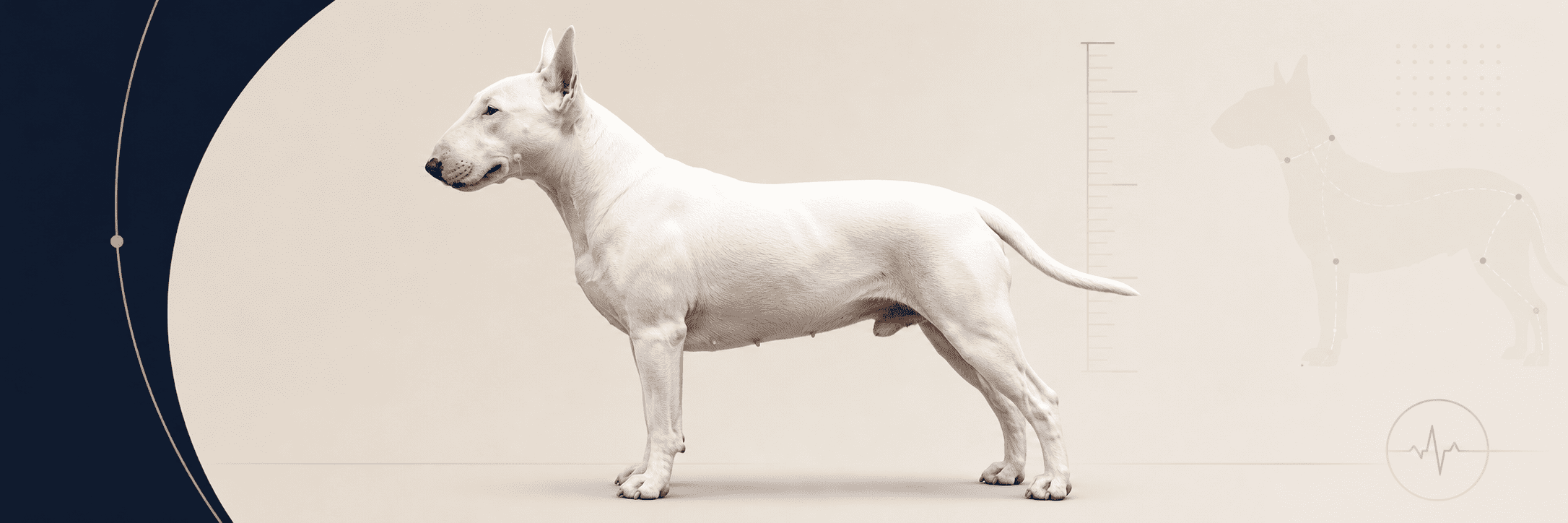
Bull Terrier Weight Chart & Growth Guide
Bull Terrier Weight Chart, Growth Guide & Condition Tracker
A practical WBT guide for understanding healthy size, growth and body condition without chasing one “perfect” number.
This Bull Terrier weight chart helps you understand healthy size and growth, but the scale is only part of the picture. Frame, sex, maturity, bone, muscle, ribs, waist, appetite, energy and steady development all matter.
Quick Answer
How Much Should a Bull Terrier Weigh?
Adult Bull Terriers are commonly listed around 23–32 kg (50–70 lb), but the official standard Bull Terrier breed standard does not set one fixed weight limit. Frame, sex, maturity, muscle and body condition matter, so weight should be used as a reference rather than a target.
Bull Terrier Weight Chart
Bull Terrier Weight Chart & Size Reference
This Bull Terrier weight chart gives owners a useful starting point while staying honest about the breed. There is no single number that every Bull Terrier should be forced to match.
Do not feed for a number
A heavier Bull Terrier is not automatically a better-built Bull Terrier. The goal is a strong, athletic, well-conditioned dog — not the biggest number on the scale.
Read The Whole Dog
Weight Alone Is Not Enough
Two Bull Terriers can weigh exactly the same and still have completely different body condition. One may be muscular, athletic and lean. The other may be soft and carrying excess fat.
Ribs
You should usually be able to feel the ribs under a light covering. Hard-to-feel ribs may suggest excess condition; sharply visible ribs, hips or spine may suggest the dog is too lean.
Waist & Tuck
From above, some waist should normally be visible behind the ribs. From the side, some abdominal tuck helps separate healthy substance from excess body fat.
Muscle & Movement
Powerful does not mean soft or overweight. Look at muscle tone, stamina, movement, recovery and how the dog carries the weight.
Interactive WBT Tool
Check Your Bull Terrier’s Growth & Condition
Enter your dog’s age, sex, weight, body condition and recent changes. The result will give you a practical WBT interpretation and next steps.
This is educational, not diagnostic.
The tracker cannot diagnose illness, pain, digestive problems, endocrine disease or growth disorders. Health-warning signs always take priority.
1. Basic dog information
Start with breed type, sex and age.
2. Current size
Enter weight and optional height.
3. Body condition
Now look at the dog rather than the number.
4. Appetite, energy & recent change
These answers help separate a simple condition question from a possible health concern.
Puppy Growth
Bull Terrier Growth Is Not a Straight Line
Bull Terrier puppies can look tall and narrow for a period and fill out later. Others look powerful early but still need time for joints, coordination, muscle and maturity to catch up.
The goal is not to force size quickly. The goal is steady development, good nutrition, controlled exercise, healthy joints, normal appetite and a puppy growing without unnecessary pressure.
Health First
When Weight Change Needs a Veterinarian
An online tracker can help you observe more clearly, but it cannot diagnose disease.
Sudden Weight Loss
Unexpected loss, especially with poor appetite, digestive problems or low energy, should not be treated as a simple feeding issue.
Sudden Weight Gain
Fast unexplained gain can also deserve investigation, especially if appetite, activity, thirst or urination has changed.
Other Warning Signs
Vomiting, diarrhea, weakness, pain, limping, abnormal thirst, poor growth or behaviour that feels medically wrong should go to a veterinarian.
Responsible Breed Education
Why WBT Does Not Give One “Perfect Bull Terrier Weight”
The standard Bull Terrier breed standard does not reduce the dog to one fixed number. Balance, substance, quality, sex and overall structure matter. Miniature Bull Terriers also have no fixed weight limit, although height is an important size restriction.
Common Questions
Bull Terrier Weight & Growth FAQ
What is the correct weight for a Bull Terrier?
There is no single correct weight for every standard Bull Terrier. Frame, sex, age, bone, muscle, structure and condition all matter. The commonly cited adult range of around 23–32 kg / 50–70 lb should be treated as a reference, not a fixed rule.
How much should a Bull Terrier puppy weigh?
Bull Terrier puppies can grow at different speeds. Instead of chasing one fixed monthly number, watch steady growth, appetite, energy, ribs, waist, joint comfort and overall development.
Is my Bull Terrier overweight?
Your Bull Terrier may be carrying extra weight if the ribs are hard to feel, the waist is not visible, the abdominal tuck is missing or movement has become heavier. Review food, treats and exercise and speak with your veterinarian if you are unsure.
Is my Bull Terrier too skinny?
Your Bull Terrier may be too lean if ribs, hips or spine are too visible, condition is dropping, appetite is poor, energy is low or weight is being lost without explanation.
Should I feed more to make my Bull Terrier bigger?
No. Do not overfeed simply to chase size. The goal is steady growth, good nutrition, controlled exercise, healthy joints and strong condition — not forced fast weight gain.
How often should I weigh my Bull Terrier?
For puppies, weekly or every two weeks is normally enough to watch trends. For healthy adults, occasional or monthly checks are usually more useful than daily weighing.
Working Bull Terriers Kennel
Build the dog in front of you, not the number in your head.
Use weight to spot trends. Use condition to understand the dog. Use your veterinarian when something changes suddenly or looks medically wrong.
Condition over ego. Health over comparison. Structure before pressure.
Unique mindset. Unmatched loyalty. Not just a breed, a lifestyle.