
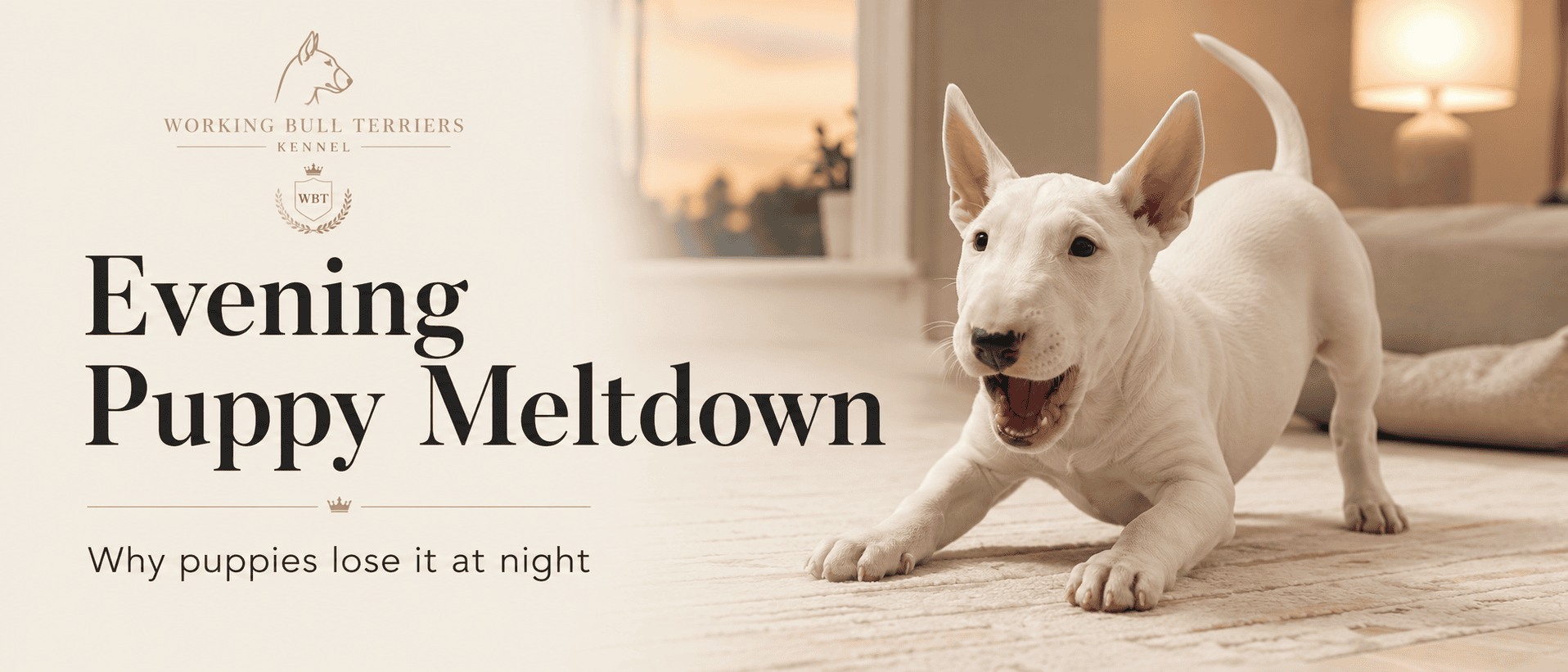
Bull Terrier Puppy Training, Evening Routine & Calm Structure
The Evening Puppy Meltdown Explained
Why Your Bull Terrier Puppy Turns Wild at Night
The evening puppy meltdown usually happens because your puppy’s nervous system is overloaded from the day. They may look energetic, but underneath the biting, zoomies, jumping, and chaos, they are often tired, overstimulated, and unable to regulate themselves. The solution is not more play or more correction. The solution is better routine, calmer transitions, enough rest, and learning when to stop before the puppy loses control.
There is a moment many Bull Terrier puppy owners know too well. The day may have gone reasonably well. Your puppy played, explored, followed you around, chewed a toy, maybe had a short walk, maybe met someone new, and maybe did a little training. Nothing dramatic. Nothing extreme.
Then evening arrives, and the same puppy who seemed manageable earlier suddenly turns into chaos. They start biting hands, grabbing trousers, jumping at your legs, chewing the leash, racing through the house, barking for attention, ignoring cues they usually understand, and behaving as if someone secretly replaced your puppy with a tiny wild animal.
Many owners look at this and think, “He still has too much energy.” But very often, that is not the truth. The evening meltdown is not always a sign that your puppy needs more activity. Very often, it is a sign that your puppy has already had too much.

Why Evenings Are So Difficult for Puppies
Puppies do not experience the day the same way we do. For us, a normal day may feel ordinary: household movement, a few noises, visitors, meals, toys, short training sessions, children, walks, smells, and small changes in routine. For a young puppy, especially a Bull Terrier puppy, all of that is information.
Their brain is constantly processing. Their nervous system is constantly reacting. Every interaction teaches something, every sound creates a response, and every exciting moment adds emotional energy. By the evening, that emotional tank can be full.
The problem is that puppies do not always show tiredness by lying down quietly. Many puppies show tiredness by becoming more physical, more mouthy, more impulsive, and harder to guide. They do not look tired. They look possessed.
That is where owners get misled. A tired puppy can look wild. An overstimulated puppy can look energetic. A puppy who needs rest can look like they need more play.
The Meltdown Is Not Random
Evening chaos usually has a build-up. It often begins earlier in the day with too much stimulation and not enough recovery. The puppy may have had several small exciting moments that seemed harmless on their own, but together they created overload.
It may be a little too much play, a little too much freedom, a visitor who excited them, a walk that was too stimulating, a training session that went a few minutes too long, a missed nap, a busy household, too many toys available, or too much attention every time they demanded it.
None of these things may seem serious by themselves, but puppies are not adults. They do not reset automatically after every event. Stimulation can stack up until the puppy’s ability to think clearly collapses.
That collapse is what many owners call “the witching hour.” But it is not magic. It is emotional overload.
Why Bull Terrier Puppies Can Look Even Wilder
Bull Terriers are intense dogs. Even as puppies, they often throw their whole body into whatever they are doing. They play hard, investigate hard, react hard, and when they lose control, they do not usually do it quietly.
This is one reason owners often misread them. A Bull Terrier puppy may still look strong, playful, and full of drive even when they are mentally exhausted. They may still chase, bite, jump, and grab, so the owner assumes the puppy must need more exercise.
But intensity is not always fresh energy. Sometimes it is the puppy’s nervous system failing to slow down. That distinction matters, because the wrong response can make the problem worse.
The Biggest Mistake: Adding More Excitement
When a puppy starts melting down in the evening, many owners try to “tire them out.” They play tug harder, throw the toy again, start another training session, take the puppy outside, correct more, talk more, and move more.
The owner is trying to help, but the puppy is already past the point where more input can be useful. At that stage, more stimulation is like adding fuel to a fire. The biting gets worse, the zoomies get faster, the puppy ignores more, the owner becomes frustrated, and the puppy becomes more frantic.
The puppy did not need more excitement. The puppy needed help coming down.
Important: Evening biting, zoomies, lead grabbing, and wild puppy behaviour should not be ignored, but they should also not be treated as a simple “bad attitude.” Many times the puppy is overloaded, not deliberately difficult. Structure matters more than shouting.
What the Evening Meltdown Usually Means
When your puppy loses control in the evening, they may be telling you several things at once. The behaviour may be loud, physical, and frustrating, but underneath it there is often a very simple message: the puppy has gone past what they can manage.
- I am tired, but I do not know how to stop.
- I have had too much stimulation today.
- I missed a proper rest period.
- I need structure now, not more freedom.
- I cannot think clearly anymore.
- I need help settling before this becomes chaos.
This is why punishment rarely fixes evening meltdowns. The puppy is not making a calm, thoughtful decision to misbehave. They are reacting from an overloaded state. When the thinking brain is offline, pressure only adds more emotional noise.
That does not mean we allow chaos. It means we respond with the right kind of leadership: calm, clear, predictable, and structured.
Rest Is Not Doing Nothing
Many owners underestimate rest because it does not look like training. But rest is one of the most important parts of puppy development. During rest, the puppy’s nervous system recovers. Their brain processes what they experienced. Their body resets. Their emotional control improves. Their ability to learn returns.
A puppy who does not rest enough does not become stronger. They become more unstable. This is why a good puppy routine is not just about keeping the puppy busy. It is about creating rhythm.
There should be time for play, but also time to stop. There should be time for training, but also time to recover. There should be time for exposure, but also time to process. There should be time for affection, but also time for independence.
A balanced puppy is not created by filling every moment. A balanced puppy is created by knowing when to stop.
The Evening Routine Matters
If evenings are always chaotic, the puppy begins to associate that part of the day with excitement and loss of control. The house becomes more active, people relax, children may become louder, dinner smells appear, everyone moves around, and the puppy feels the energy shift.
Without structure, that shift becomes a trigger. This is why evening routines are so important. A puppy needs to learn that evenings are not the time for wild play and constant entertainment. They are the time when the house starts slowing down.
The tone changes. The energy lowers. The puppy is guided toward calmness before they lose control. The goal is not to wait until the puppy becomes impossible and then try to fix it. The goal is to prevent the explosion by reading the signs earlier.
Early Signs Your Puppy Is Heading Toward a Meltdown
Most evening meltdowns give warnings before they fully appear. Watch for the moment your puppy starts becoming less thoughtful and more reactive. They may begin grabbing clothes, biting harder during play, ignoring simple guidance, moving faster, struggling to settle, or becoming suddenly frantic.
- harder biting during play
- grabbing trousers, sleeves, or hands
- chewing the leash or lead
- jumping at legs repeatedly
- racing through the house with no pause
- barking for attention
- ignoring simple cues they usually know
- struggling to settle even when nothing is happening
These signs mean the puppy is approaching their limit. That is the moment to reduce stimulation, not increase it. Many owners miss this window because the puppy still looks playful, but playful and regulated are not always the same thing.
What Helps Most
The best solution is not one magic technique. It is a better daily rhythm. Evening meltdowns improve when the whole day supports calmness, not only when the owner tries to intervene during the final explosion.
That means enough naps, shorter training sessions, structured play, controlled freedom, calm transitions, and predictable routines. It also means owners must stop measuring success by how tired the puppy looks.
A puppy can be physically tired and still emotionally overloaded. A puppy can have had plenty of exercise and still be unable to settle. What they need is not exhaustion. What they need is regulation.
That is a different goal, and it changes how you raise them.
A Simple Evening Reset Plan
If your Bull Terrier puppy regularly becomes wild at night, start adjusting the evening before the meltdown appears. The earlier you lower the pressure, the easier it is for the puppy to succeed.
- End rough play earlier than you think you need to.
- Reduce access to too many toys during the evening.
- Use a short food scatter to bring the nose down.
- Offer a safe chew or calm activity.
- Guide the puppy to a pen, crate, bed, or quiet place before they lose control.
- Keep your voice low and your movements boring.
- Do not restart exciting games once the puppy is already high.
This is not about removing the puppy’s personality. It is about teaching the puppy that the day has a rhythm. There is a time to play, a time to explore, a time to train, and a time to come down.
The Real Lesson
The evening meltdown is not just a behaviour problem. It is feedback. It tells you something about the puppy’s routine, stimulation level, rest, structure, and emotional state. If you listen to that feedback, you can adjust the day before the chaos repeats.
This is the difference between reacting and guiding. Reacting says, “How do I stop this right now?” Guiding asks, “What created this state in the first place?”
That question makes you a better handler. When you understand why the meltdown happens, you stop taking it personally. You stop seeing the puppy as difficult. You start seeing a young mind that needs help learning how to come down.
And once you teach that, everything becomes easier.

The puppy stage is not only about teaching commands. It is about building the right foundation: routine, rest, calmness, confidence, structured play, socialisation, focus, independence, and emotional balance. The Bull Terrier Puppy Training Guide was created to help owners build that rhythm from the beginning.
Trainer’s Note
A puppy who melts down in the evening is not trying to ruin your night. They are usually showing you that their mind is full, their body is tired, and their emotions have gone past what they can manage.
Teach the puppy how to come down, and the evening chaos starts becoming evening calm.
Frequently Asked Questions About Evening Puppy Meltdowns
Evening puppy meltdowns usually happen because the puppy is tired, overstimulated, and struggling to regulate after a full day of activity, noise, play, attention, training, and household movement.
Not always. Many puppies look energetic when they are actually overtired. Adding more play, tug, chasing, or training can make the meltdown worse if the puppy already needs rest and calm structure.
Common signs include harder biting, grabbing clothes, frantic movement, zoomies, ignoring simple guidance, barking for attention, chewing the lead, jumping at legs, and struggling to settle.
Reduce stimulation earlier. Use calmer transitions, predictable routines, short play sessions, enough naps, food scatter, quiet chewing, place training, crate or pen rest, and an evening rhythm that teaches the puppy how to come down.
Punishment usually adds pressure to an already overloaded puppy. The goal is not to allow chaos, but to respond with calm structure, prevention, redirection, rest, and a better daily rhythm.