
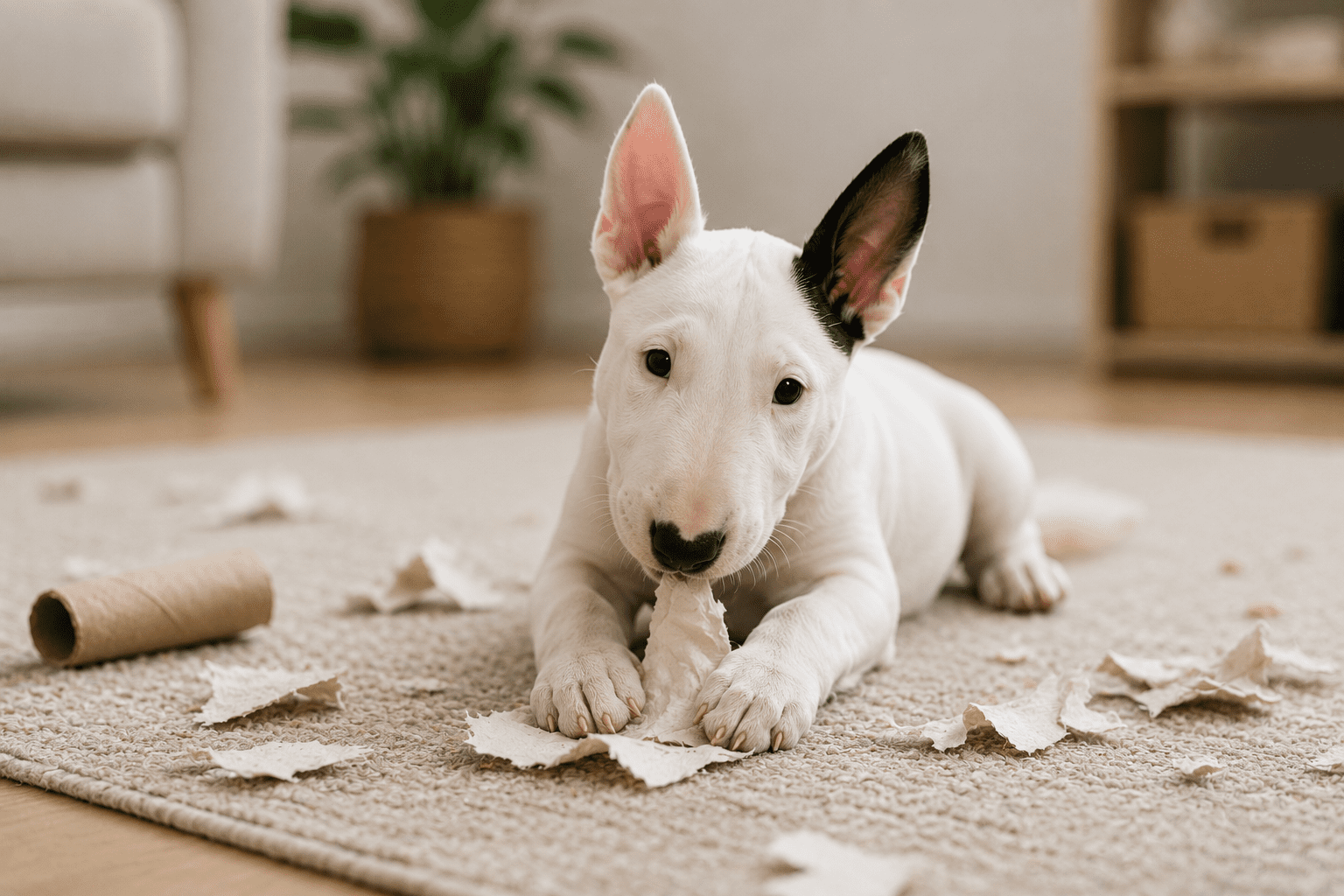
Most Bull Terrier puppy problems do not start as serious problems.
They start as small habits.
A little biting that everyone laughs at.
A little jumping because the puppy is excited.
A little chasing because the children are running.
A little stealing because it is funny.
A little pulling because the puppy is young.
A little wildness in the evening because “he just has energy.”
A little too much freedom because the puppy is cute.
A little inconsistency because everyone in the family means well.
And then, a few months later, the owner looks at the same puppy and wonders why everything feels harder.
The puppy is stronger now. Faster. More confident. More physical. More determined. The behaviours that were small and funny have become bigger, louder, and more difficult to interrupt.
This is where many Bull Terrier owners get surprised.
They thought puppyhood was only about surviving the cute chaos.
But puppyhood is not only cute chaos.
Puppyhood is foundation.
Every day, the puppy is learning what works. They are learning how the house operates, how people respond, what gets attention, what creates games, where the rules are, and whether the owner is clear enough to follow.
A Bull Terrier puppy does not need perfection from the owner.
But they do need direction.
And many early mistakes come from the same place: owners waiting too long to provide that direction.
Bull Terrier Puppy Mistakes: Why Small Habits Matter Early
Quick Answer
The most common Bull Terrier puppy mistakes include giving too much freedom too early, using more exercise instead of better structure, ignoring calm behaviour, allowing biting to become a game, overwhelming the puppy during socialization, repeating commands before focus exists, and waiting until adolescence to take training seriously. A Bull Terrier puppy needs affection, but they also need routine, rest, calmness, focus, and clear guidance from the beginning.
Bull Terrier puppy mistakes matter because this breed often grows into its habits with strength.
A small habit in a tiny puppy may not feel important. The puppy is light, funny, and easy to forgive. But Bull Terriers are physical dogs. They can become strong, intense, emotional, determined, and very committed to behaviours they have practised repeatedly.
That does not mean they are bad dogs.
It means they learn well.
They learn what brings attention. They learn what makes people move. They learn what starts a game. They learn who gives in. They learn who means what they say. They learn whether calmness has value or whether chaos is more rewarding.
This is why early mistakes matter.
Not because one mistake ruins the puppy.
But because repeated daily patterns become training.
Even when the owner does not call it training.
If biting creates excitement, the puppy learns.
If jumping creates contact, the puppy learns.
If barking brings attention, the puppy learns.
If stealing starts a chase, the puppy learns.
If pulling gets them closer to what they want, the puppy learns.
The puppy is always learning.
The only question is whether the owner is shaping the lessons on purpose.
Mistake 1: Giving Too Much Freedom Too Early
One of the biggest mistakes new owners make is giving the Bull Terrier puppy full access to the home before the puppy has earned it.
The puppy can go everywhere. Follow everyone. Bite feet. Steal objects. Chase children. Jump on furniture. Harass other pets. Run from room to room. Sleep wherever they collapse. Control the rhythm of the house.
At first, this feels natural.
The puppy is part of the family.
But young puppies are not ready for unlimited freedom.
Freedom without structure often creates rehearsal. The puppy practises the exact behaviours the owner will later want to stop.
A Bull Terrier puppy should have supervised freedom, not unlimited freedom. Use baby gates, pens, crates, house lines, place areas, and clear routines. Give the puppy access to situations they can handle, and expand freedom as they show better choices.
Freedom should grow with maturity.
Not arrive before maturity exists.
Mistake 2: Thinking More Exercise Fixes Everything
Many owners see a wild puppy and think the answer is more exercise.
More walks. More running. More play. More stimulation. More tiring the puppy out.
Exercise matters, of course. A Bull Terrier puppy needs movement, play, chewing, exploration, and appropriate activity. But more exercise is not always the answer.
Sometimes the puppy is not under-exercised.
Sometimes the puppy is overtired.
Overstimulated.
Under-structured.
Unable to settle.
Unable to recover after excitement.
A tired Bull Terrier puppy is not always a calm puppy. Sometimes a tired puppy is simply more mouthy, more frantic, and less able to think.
The goal is not to exhaust the puppy.
The goal is balance.
Activity, then recovery. Play, then calm. Exposure, then rest. Movement, then settling.
If exercise keeps making the puppy wilder, the problem may not be lack of exercise. The problem may be the routine around it.
Mistake 3: Waiting Too Long to Teach Settling
Some owners assume a puppy will naturally learn to settle as they get older.
Sometimes they do.
Often, especially with Bull Terriers, they need help.
Settling is not the absence of training. Settling is a skill. The puppy must learn that doing nothing is normal. Resting is normal. Chewing calmly is normal. Staying on a bed is normal. Recovering after play is normal.
If the puppy is entertained all day, touched every time they move, played with every time they demand attention, and allowed to follow every person around the house, calmness may never become valuable.
Then the owner complains that the puppy has no off-switch.
But nobody taught the off-switch.
Teach settling early. Use calm routines, crate or pen time, place work, quiet rewards, safe chewing, and proper rest windows. Do not wait until the puppy is already wild before trying to create calmness.
Build calm before chaos becomes the normal state.
Mistake 4: Treating the Crate Like Punishment
A crate can be a very useful tool for a Bull Terrier puppy.
But only if it is introduced properly.
The crate should not mean anger, isolation, or punishment. It should mean rest, safety, sleep, recovery, and calm time.
Many owners use the crate only after the puppy has done something wrong. The puppy bites, so crate. The puppy steals, so crate. The puppy jumps, so crate. The puppy becomes annoying, so crate.
Then the puppy learns that the crate appears when the owner is frustrated.
That is not good crate training.
The crate should be part of normal daily life. Meals can happen there. Chews can happen there. Naps can happen there. Quiet time can happen there. The puppy should learn that the crate is a safe place where the world slows down.
Used correctly, the crate helps prevent overtired chaos and unsafe freedom.
Used badly, it creates resistance.
Mistake 5: Ignoring Calm Behaviour
Many owners accidentally reward the puppy only when the puppy is difficult.
When the puppy bites, everyone reacts.
When the puppy jumps, everyone touches.
When the puppy barks, everyone talks.
When the puppy steals, everyone chases.
When the puppy lies quietly, nobody notices.
This teaches the puppy that excitement works better than calmness.
A Bull Terrier puppy needs the opposite lesson.
Reward calm behaviour when it appears. Quietly praise the puppy for lying down. Mark and reward a calm check-in. Support quiet chewing. Notice when the puppy settles after play. Reward the puppy for staying on a mat. Let calmness become valuable.
Do not make the reward so exciting that you wake the puppy back up.
Keep it quiet.
But let the puppy know that calm choices matter.
Mistake 6: Letting Puppy Biting Become a Game
Bull Terrier puppy biting is common.
But that does not mean it should be allowed to become a lifestyle.
Some biting comes from teething. Some from exploration. Some from play. Some from frustration. Some from tiredness. Some from overexcitement. Some becomes a habit because the family accidentally rewards it.
If every bite creates movement, laughter, shouting, pushing, chasing, or dramatic reaction, the puppy may learn that biting starts the best game in the house.
This is especially important with Bull Terriers because many are naturally mouthy and physical.
The answer is not to panic and label the puppy aggressive.
The answer is to understand the pattern.
Is the puppy overtired? Overstimulated? Under-rested? Playing too roughly? Chasing children? Lacking appropriate chews? Getting too much reaction? Having too much freedom?
Biting improves when the daily system improves.
Do not only correct the mouth.
Fix the routine that keeps creating the mouth.
Mistake 7: Allowing Rough Play With Hands and Clothes
Many owners create biting problems without realizing it.
They play with hands. Push the puppy around. Wrestle on the floor. Let the puppy grab sleeves. Laugh when the puppy attacks trousers. Encourage roughness because it looks funny.
Then later, when the puppy gets stronger, they want the behaviour to stop.
That is unfair to the puppy.
The puppy learned the game because the humans taught the game.
Bull Terrier puppies need play, but play needs rules. Use toys. Keep sessions short. End before the puppy loses control. Teach the puppy that human skin and clothing are not toys.
This does not make the puppy less playful.
It makes play clearer.
A Bull Terrier can be full of character without turning every interaction into a contact sport.
Mistake 8: Socializing by Overwhelming the Puppy
Socialization is one of the most misunderstood parts of puppy raising.
Many owners think socialization means meeting as many people and dogs as possible. So they take the puppy everywhere, allow everyone to touch them, let them greet every dog, visit busy places, and push the puppy through too much too soon.
That is not always good socialization.
Good socialization builds confidence, neutrality, and emotional control.
A puppy should learn that people are normal, dogs can be seen without chaos, sounds happen, surfaces are safe, and the owner still matters in the world.
The puppy does not need to greet every dog.
They do not need every stranger touching them.
They do not need to be flooded with busy environments.
Overwhelming the puppy can create fear, frustration, reactivity, or wild excitement.
Socialization should be calm, short, controlled, and followed by recovery.
Mistake 9: Letting Every Dog Greeting Happen
A puppy who greets every dog may not become better around dogs.
They may become obsessed with dogs.
This is an important difference.
If a Bull Terrier puppy learns that every dog means play, excitement, pulling, and greeting, they may become frustrated later when they cannot reach dogs on lead. This can turn into barking, lunging, whining, spinning, or lead frustration.
Socialization should include neutrality.
The puppy should learn to see dogs and not always interact.
Watch calmly. Check in. Move past. Keep distance. Stay connected to the owner.
Carefully chosen dog interactions can be useful, but random greetings with unknown dogs are not necessary and can create problems.
A well-socialized Bull Terrier does not need to play with every dog.
They need to behave sensibly around dogs.
Mistake 10: Repeating Commands Before Focus Exists
Many owners talk too much.
The puppy is distracted, and the owner says:
Come. Come. Come here. Sit. No. Leave it. Listen. Stop. Come on.
The puppy ignores most of it.
Then the owner says the puppy is stubborn.
But the puppy may not be stubborn. The puppy may simply have no focus foundation.
Before commands work well, the puppy must learn that the owner matters. Name response matters. Eye contact matters. Checking in matters. Following the hand matters. Reward timing matters.
If the owner gives commands when the puppy is not mentally connected, the puppy learns that words can be ignored.
Build focus first.
Then obedience becomes easier.
A Bull Terrier puppy who checks in with the owner is much easier to guide than a puppy who only hears repeated noise.
Mistake 11: Expecting Adult Behaviour From a Young Puppy
Some owners expect too much too soon.
They want long stays, perfect leash walking, full house freedom, calm visitor behaviour, no biting, no jumping, immediate recall, and perfect settling from a very young puppy.
That is not realistic.
A puppy is still developing physically, mentally, and emotionally. They need repetition, routine, patience, management, and small wins.
Expecting too much too early creates frustration for both sides.
The owner becomes disappointed.
The puppy becomes confused.
Training becomes pressure instead of learning.
A Bull Terrier puppy can learn a lot, but the training picture must be age-appropriate. Short sessions. Clear rewards. Simple foundations. Gradual difficulty. Plenty of rest.
Do not demand adult maturity from a baby dog.
Build the baby dog into a better adult.
Mistake 12: Being Inconsistent as a Family
In many homes, the puppy’s biggest problem is human inconsistency.
One person allows biting. Another gets angry about biting.
One person allows jumping. Another wants manners.
One person uses the crate. Another lets the puppy out every time they complain.
One person builds calmness. Another creates wild play in the evening.
One person teaches rules. Another rewards the opposite.
The puppy learns from everyone.
A Bull Terrier puppy will often find the gaps in the system. Not because they are evil. Because they are learning what works.
The family does not need to be perfect, but the basic rules should be consistent.
What happens when the puppy bites?
Where does the puppy rest?
When does play end?
Can the puppy jump?
Are children allowed to run with the puppy?
Do visitors excite the puppy?
Does barking bring attention?
Does stealing start a chase?
If the humans are unclear, the puppy will be unclear too.
Mistake 13: Waiting Until Adolescence to Get Serious
Many owners wait until the puppy becomes bigger before taking training seriously.
This is a mistake.
By adolescence, the dog is stronger, more confident, more independent, and more capable of pushing into the world. If the early foundation is weak, everything becomes harder.
The puppy who never learned calmness becomes the adolescent with no off-switch.
The puppy who greeted every dog becomes the adolescent frustrated on lead.
The puppy who bit clothes becomes the adolescent grabbing sleeves.
The puppy who had full freedom becomes the adolescent who cannot handle boundaries.
The puppy who ignored the owner becomes the adolescent who finds the environment more valuable.
Training can still improve later, of course.
But it is far easier to build the foundation early than to undo months of rehearsal later.
Do not wait for the Bull Terrier to become difficult before building the system.
Start when the puppy is still young.
Mistake 14: Blaming the Breed Instead of Reading the Pattern
Bull Terriers are often called stubborn, crazy, naughty, impossible, or hard-headed.
But many problems have a pattern.
The puppy bites at the same time every evening.
The puppy jumps when visitors arrive.
The puppy steals when bored.
The puppy pulls when overstimulated.
The puppy barks when they want attention.
The puppy refuses to settle when overtired.
The puppy ignores the owner outside because focus has not been built.
If you only blame the breed, you stop learning.
If you read the pattern, you can train.
Bull Terriers are different. They do need breed-specific understanding. But different does not mean impossible.
It means the owner must be more observant, more consistent, and more intentional.
Mistake 15: Looking for One Fix Instead of Building a System
Many owners search for one solution.
How do I stop biting?
How do I stop jumping?
How do I stop pulling?
How do I make the puppy calm?
How do I stop the puppy stealing?
But with Bull Terrier puppies, the answer is often not one trick.
It is the whole system.
Routine. Structure. Rest. Chewing. Focus. Exercise balance. Calm socialization. Crate and place training. Family consistency. Clear play rules. Better timing. Better management. Better rewards.
These pieces work together.
A puppy who has no rest will struggle with biting.
A puppy who has no focus will struggle outside.
A puppy who has too much freedom will rehearse bad habits.
A puppy who is overwhelmed by socialization may become reactive or wild.
A puppy who is never rewarded for calmness may keep choosing excitement.
The system matters.
That is why raising a Bull Terrier puppy is not about copying generic advice.
It is about understanding how the pieces connect.
So, What Should New Bull Terrier Puppy Owners Do Instead?
Start early.
Build structure before chaos becomes normal. Create a calm daily routine. Protect rest. Use crate and place training fairly. Teach the puppy to settle. Balance exercise with recovery. Reward calm behaviour. Build focus before expecting obedience. Socialize carefully without overwhelming the dog. Manage biting through the whole routine, not only the mouth. Keep the family consistent.
Do not try to make the puppy perfect.
Try to make the puppy clearer.
A Bull Terrier puppy does not need harshness, but they do need guidance. They need to know what works, what does not, where to rest, how to recover, how to engage, how to play, and how to live inside the home.
That foundation will not remove their personality.
It will make their personality easier to enjoy.
Final Thought
New Bull Terrier puppy owners usually make mistakes because they love the puppy, not because they do not care.
They give too much freedom because they want the puppy included.
They play too roughly because the puppy is funny.
They allow greetings because they want the puppy social.
They add more exercise because they want to help.
They delay rules because the puppy is young.
But love without structure can create confusion.
A Bull Terrier puppy needs affection, yes.
But they also need direction.
The goal is not to raise a robotic dog. The goal is to raise a Bull Terrier who can be funny, confident, affectionate, expressive, and loyal without turning the home into daily chaos.
That starts with the early foundation.
And the earlier you build it, the easier the future becomes.
Learn More From Working Bull Terriers Kennel
If you are raising a Bull Terrier puppy and already seeing biting, overexcitement, poor settling, pulling, social frustration, or household chaos, do not wait until the puppy becomes stronger before taking the foundation seriously.
Our Bull Terrier Puppy Training Guide was created to help owners build routine, calmness, focus, bite control, crate and place foundations, controlled exposure, and early structure step by step. Our Quirks guide helps owners understand the breed-specific behaviours that often appear as the puppy grows.
For self-guided learning, start with the Puppy Training Guide and the Quirks guide.
If your puppy is already showing intense overexcitement, reactivity, fear, biting, inability to settle, or household chaos, personalized online training may be the better next step.
Avoid the Puppy Mistakes That Become Bigger Problems Later
Most Bull Terrier puppy mistakes begin as small habits: too much freedom, rough play, poor rest, weak routine, uncontrolled socialization, or waiting too long to build focus and calmness. The earlier you understand the pattern, the easier the future dog becomes.
The Bull Terrier Puppy Training Guide helps you build that early foundation step by step, while the Quirks guide helps you understand the breed-specific behaviours that often appear as your puppy grows.

 Get the Puppy Training Guide
Explore the Quirks Guide
Related Reading
If you are raising a Bull Terrier puppy, these articles will help you avoid the most common early mistakes by building structure, routine, calmness, focus, recovery, and better puppy foundations from the beginning.
The foundation article for understanding why too much freedom, weak rules, poor rest, and unclear daily patterns can create bigger problems later.
A practical guide for creating the daily rhythm that helps prevent biting, overexcitement, poor settling, and household chaos.
A key companion article for owners whose puppy becomes wild in the evening, bites when tired, or cannot switch off after activity.
A useful article for understanding why many “stubborn” puppy moments are really a lack of focus, engagement, name response, and owner value.
A practical guide for using crate and place training to build rest, recovery, controlled freedom, and better household structure.
A practical guide for understanding puppy biting, overexcitement, tiredness, mouthiness, and when biting needs better structure instead of only correction.
Leave a Reply