
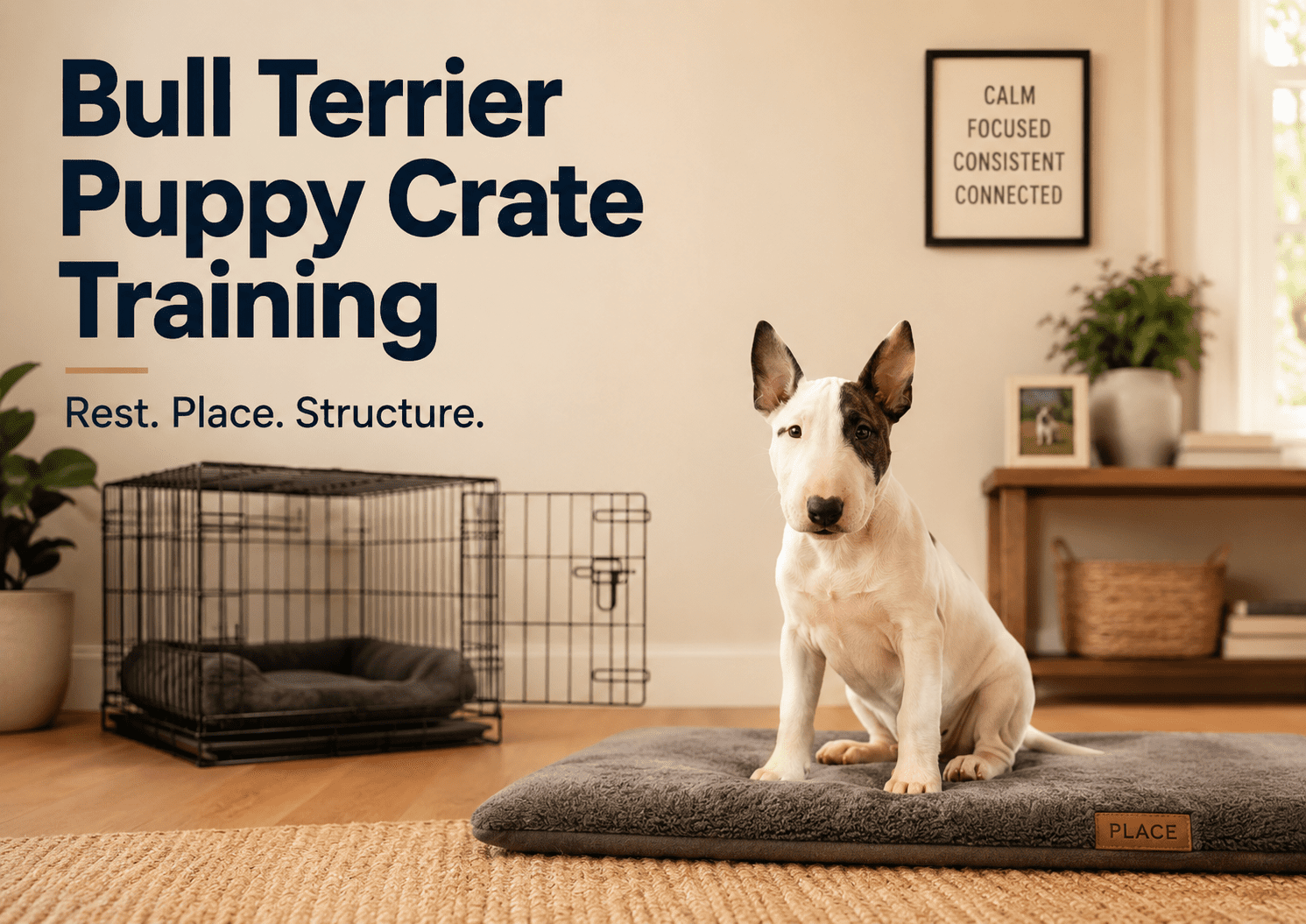
A Bull Terrier puppy needs freedom.
But not unlimited freedom.
This is one of the first lessons many owners learn the hard way.
The puppy arrives home small, funny, affectionate, and full of character. At first, everyone wants to give them access to everything. The sofa. The kitchen. The bedrooms. The children. The visitors. The toys. The garden. The whole house.
It feels loving.
But very quickly, that freedom can become chaos.
The puppy starts biting feet, stealing socks, chasing movement, jumping on people, grabbing trousers, chewing furniture, refusing to settle, and following everyone like a tiny white shadow with teeth. The owner then tries to correct each behaviour separately.
Stop biting.
Stop jumping.
Leave that.
Come here.
Calm down.
Go away.
Stop chewing.
Stop running.
But the real problem is often not one behaviour.
The real problem is that the puppy has no clear place to rest, no controlled area, no predictable off-switch, and too much freedom before they have the maturity to handle it.
This is where crate training and place training can become extremely valuable.
Not as punishment.
Not as control for the sake of control.
But as structure.
A Bull Terrier puppy needs to learn where to rest, where to settle, where to chew calmly, where to recover after excitement, and how to be part of the home without controlling the whole home.
The crate and the place mat can both help with that.
But they must be introduced properly.
Bull Terrier Puppy Crate Training: Why It Can Be So Useful
Quick Answer
Bull Terrier puppy crate training and place training help teach rest, calmness, controlled freedom, and better household behaviour. The crate is useful for sleep, recovery, safe management, and preventing overtired chaos. Place training teaches the puppy to settle calmly while still being part of the room. Both should be introduced gradually, positively, and never used as punishment.
Bull Terrier puppy crate training is not about locking the puppy away because the owner cannot handle them.
Used correctly, the crate can become a safe sleeping area, a rest space, a recovery zone, and a way to protect the puppy from rehearsing bad habits when they are too young to make good choices.
A young Bull Terrier puppy does not automatically know when to rest.
Some puppies will keep going even when they are tired. They bite harder. Move faster. Ignore redirection. Grab clothing. Run through the house. Bark. Jump. Refuse to settle.
The owner sees energy.
But very often, the puppy needs sleep.
A crate can help protect that sleep.
It can also help with toilet training, reduce destructive chewing, prevent unsafe exploration, and give the puppy a predictable area where the world slows down.
This matters because many Bull Terrier puppies are physical, curious, determined, and easily pulled into household activity. If they are allowed to follow every sound, every person, every footstep, and every exciting moment, some never properly switch off.
The crate gives the puppy a clear message:
This is where we rest.
This is where life becomes calm.
This is where you do not need to control everything.
For many Bull Terrier puppies, that lesson is incredibly important.
The Crate Should Never Feel Like Punishment
The biggest mistake is using the crate only when the owner is angry.
If the puppy bites, crate.
If the puppy steals, crate.
If the puppy jumps, crate.
If the puppy annoys the family, crate.
This teaches the puppy that the crate means frustration, isolation, or emotional conflict. Then the owner wonders why the puppy resists going in.
A crate should be introduced as a normal, safe, predictable part of daily life.
Food can happen there. Chews can happen there. Naps can happen there. Quiet moments can happen there. Short calm periods can happen there even when the puppy has not done anything wrong.
The crate should not mean, “You are bad.”
It should mean, “Now we rest.”
This difference changes everything.
A Bull Terrier puppy who sees the crate as a safe space will usually accept it much better than a puppy who only meets the crate during chaos.
Start Small and Make the Crate Easy to Understand
Crate training should begin with simple, positive experiences.
The puppy can explore the crate with the door open. Food can be tossed inside. Meals can be given near or inside the crate. A safe chew can be offered there. The puppy can go in and come out without pressure.
At first, the goal is not long duration.
The goal is comfort.
The puppy learns that the crate is normal. Not scary. Not a trap. Not a punishment.
Then the owner can slowly add short periods with the door closed. Very short at first. Calmly. Without drama. The puppy should not be thrown into a long crate session before they understand what the crate means.
Some puppies accept this quickly.
Others need more patience.
A Bull Terrier puppy may complain, protest, scratch, bark, or act like crate time is a personal insult. That does not automatically mean crate training is wrong. It may simply mean the puppy has not yet learned that rest is normal.
But the owner must stay fair.
Build gradually. Keep the routine predictable. Do not use anger. Do not create panic. Do not make every crate session too long too soon.
The crate should become part of the rhythm of the day.
Activity, then rest.
Play, then recovery.
Training, then quiet time.
Excitement, then calm.
Crate Training Helps Prevent Overtired Chaos
Many puppy problems become worse when the puppy is overtired.
This is especially common with Bull Terriers.
The puppy may look full of energy, but what you are really seeing is poor emotional control. They are too tired to think, too stimulated to rest, and too immature to stop themselves.
This is where the crate becomes useful.
Not because the puppy is bad.
Because the puppy needs help switching off.
A good crate routine can prevent the puppy from reaching the point where they bite every moving leg in the house. It can protect quiet naps before the evening madness begins. It can help the puppy recover after visitors, play, walks, training, or social exposure.
Many owners wait too long.
They try to crate the puppy only after the puppy is already wild. By then, the puppy is frustrated, overstimulated, and less able to settle.
It is much better to use crate time before the explosion.
If you know your puppy becomes wild every evening, begin the calm routine earlier. If you know visitors create excitement, plan crate recovery after the visit. If you know play leads to biting, finish play sooner and guide the puppy into rest.
The crate is not only for stopping chaos.
It is for preventing the rehearsal of chaos.
What Place Training Means for a Bull Terrier Puppy
Place training is different from crate training.
A crate is a contained rest area.
A place mat or dog bed is an open, visible area where the puppy learns to settle while still being part of the room.
Both are useful, but they teach slightly different skills.
Place training teaches the puppy:
Go to this area.
Stay connected to the owner.
Relax while life happens around you.
Do not chase every movement.
Do not put yourself in the middle of everything.
Learn that calmness has value.
For a Bull Terrier puppy, place training can be one of the best foundations for household manners.
It can help with cooking, visitors, children moving around, door activity, family meals, work-from-home moments, and general calmness inside the house.
But it must be built gradually.
A young puppy should not be expected to perform like an adult dog. The place mat is not a magical remote-control button. It is a skill that needs to be taught.
How to Start Place Training Simply
Start with the easiest possible version.
Put a mat, small bed, towel, or dog bed in a calm area. Let the puppy investigate it. Mark and reward any interest. One paw on the mat can be rewarded. Two paws can be rewarded. Standing on it can be rewarded. Sitting on it can be rewarded. Lying down can be rewarded.
At this stage, do not rush.
You are teaching the puppy that the place has value.
The puppy should think, “Good things happen here.”
Once the puppy understands that being on the place is rewarding, you can slowly build duration. One second. Three seconds. Five seconds. Then more. But always in a way the puppy can succeed.
Do not begin place training when the house is already chaotic.
Do not begin when children are running, visitors are arriving, food is on the table, and the puppy is already overstimulated.
Start when life is quiet.
Build the behaviour first.
Then slowly make it useful in real life.
Place Training Is Not Just a Command
Many owners think place training is only about sending the dog to a bed.
But the deeper value is emotional.
The place teaches the puppy to stay calm while not being the centre of everything.
That is a huge lesson for many Bull Terriers.
A Bull Terrier often wants to be involved. They want to follow, watch, push in, participate, react, investigate, and become part of whatever is happening. This can be charming, but it can also become exhausting if the puppy never learns to observe calmly.
Place training teaches controlled involvement.
The puppy is still in the room.
They can still see the family.
They are not isolated.
But they are not allowed to turn every moment into a game.
This helps the puppy learn patience, impulse control, and calm observation.
That is why place training is so valuable.
It is not just obedience.
It is household emotional control.
Crate and Place Should Work Together
The crate and the place mat are not enemies.
They are different tools for different moments.
The crate is excellent for deeper rest, sleep, recovery, safe confinement, toilet training support, and preventing unsupervised chaos.
The place mat is excellent for teaching calm presence, controlled involvement, household manners, and settling while the owner is nearby.
A Bull Terrier puppy may need both.
For example, after intense play, the puppy may need crate rest. During a quiet family evening, the puppy may practise place. After visitors, crate recovery may be best. While the owner prepares food, place training may be useful. During a nap window, the crate may help. During a calm training session, place can build focus and patience.
The skill is knowing which tool fits the moment.
A puppy who is already overtired and biting everything may not be ready for open place work. They may need a crate, pen, or quiet rest area.
A puppy who is calm enough to think may benefit from short place training.
Use the right tool for the right state.
That is good training.
Do Not Expect Too Much Too Soon
A common mistake is asking too much from the puppy too early.
The owner sends the puppy to place and expects them to stay there for twenty minutes while life happens around them. The puppy leaves. The owner repeats. The puppy bites the mat. The owner gets frustrated. The puppy becomes more excited.
The problem is not that place training does not work.
The problem is that the expectation was too high.
A young Bull Terrier puppy may start with a few seconds. That is fine.
A few seconds can become ten seconds. Ten seconds can become a minute. A minute can become several minutes. Then it becomes useful in real life.
The same applies to crate training.
Do not go from zero crate comfort to long confinement and expect the puppy to understand. Build the association. Build the pattern. Build the routine.
Strong foundations are built gradually.
Bull Terriers can be intense, but they are also very intelligent when the picture is clear. Confusion and pressure create resistance. Clarity and repetition create learning.
Use Chews Carefully With Crate and Place
Chews can help both crate and place training.
A suitable chew gives the puppy a job, helps the mouth relax, and supports the transition from activity to calmness. This is especially useful for Bull Terrier puppies because many are naturally mouthy and physical.
A chew in the crate can help the puppy relax.
A chew on the place mat can teach the puppy to stay in one area calmly.
But the chew must be safe and appropriate for the puppy’s age and chewing style. Some Bull Terriers chew intensely even when young, so supervision and good judgment matter.
The chew should support calmness, not create more excitement.
If a certain toy or chew makes the puppy frantic, possessive, or too intense, choose a calmer option or use it differently.
The goal is not simply to occupy the puppy.
The goal is to help the puppy practise quiet behaviour.
What to Do If the Puppy Protests
Many Bull Terrier puppies will protest when their freedom is limited.
This does not automatically mean something is wrong.
A puppy who has had too much freedom may complain when structure appears. A puppy who wants constant involvement may not enjoy being asked to rest. A puppy who is overtired may fight sleep. A puppy who has learned that noise brings attention may bark or cry to test the system.
The owner should be calm and fair.
Do not panic immediately. Do not reward every protest by releasing the puppy. Do not yell and turn the moment into conflict. Do not leave the puppy in genuine distress for long periods without working on the foundation.
There is a difference between a puppy complaining because they are learning a new routine and a puppy panicking because the process has been rushed.
Good owners learn to read the difference.
If the puppy is protesting mildly, stay calm and keep the routine consistent. If the puppy is genuinely distressed, reduce the difficulty and rebuild more gradually.
The goal is not to win a battle.
The goal is to teach the puppy that rest and controlled space are normal.
Crate Training, Place Training, and Children
Crate and place training become especially important in homes with children.
Bull Terrier puppies often respond strongly to movement. Children move quickly, make noise, drop toys, run, laugh, shout, and create exciting energy. A puppy may chase, bite clothes, jump, mouth hands, or become overstimulated.
This does not mean the puppy is bad with children.
It means the interaction needs structure.
The crate and place mat give the puppy breaks from children and give children boundaries around the puppy.
Children should learn that the crate is not a place to disturb the puppy. They should not poke fingers into the crate, climb near it, tease the puppy, or wake the puppy during rest.
The place mat can also teach children that when the puppy is on their place, calmness is expected.
This protects both sides.
A puppy should not be expected to handle constant child energy without support.
And children should not be expected to manage a mouthy Bull Terrier puppy without structure from the adults.
Crate Training, Place Training, and Visitors
Visitors can quickly undo puppy structure.
Many people arrive and immediately excite the puppy. They talk in high voices, bend over, touch too much, encourage jumping, laugh at biting, or reward chaos because the puppy is cute.
Then they leave, and the owner is left with the overstimulated puppy.
Crate and place training help prevent this.
Before visitors arrive, the puppy can be settled in a crate or pen if needed. After the first excitement passes, the puppy may come out on lead or practise calm place work if they are ready. If the puppy becomes too high, they can return to rest.
Not every visitor needs full access to the puppy.
Not every greeting needs to become a party.
A Bull Terrier puppy should learn that guests are part of life, not a reason to lose their mind.
This lesson starts early.
Signs Crate and Place Training Are Working
Progress may be small at first.
The puppy enters the crate more easily. They settle faster after play. They chew calmly on their mat. They stop following every movement. They nap more predictably. They recover better after visitors. They begin to understand that the bed or crate means calm time. They become easier to redirect before chaos begins.
These changes matter.
They show that the puppy is learning rhythm.
A Bull Terrier puppy with crate and place foundations is not being restricted from life. They are being taught how to live inside life without becoming overwhelmed by every part of it.
That is exactly what many puppies need.
Common Mistakes With Crate and Place Training
The most common mistake is using the crate only as punishment.
Another mistake is giving the puppy full freedom all day and then suddenly expecting them to accept confinement calmly. Some owners expect long place duration before teaching short success. Others reward protest by releasing the puppy every time they complain. Some place the crate in a stressful area. Some use the mat only when visitors arrive, instead of building the behaviour when life is easy.
Another common mistake is inconsistency.
One family member respects the crate. Another keeps waking the puppy. One person builds place training. Another encourages the puppy to jump off the mat and play. One person wants calmness. Another keeps creating excitement.
A Bull Terrier puppy learns from the whole household.
If the humans are inconsistent, the puppy’s behaviour will show it.
So, Should You Use a Crate, a Place Mat, or Both?
Many Bull Terrier puppies benefit from both.
The crate helps with rest, sleep, recovery, toilet training support, and safe management.
The place mat helps with calm presence, household manners, impulse control, and learning to relax while family life continues nearby.
Used together, they create a strong foundation.
But the tools are only as good as the way they are used.
A crate used with anger can create resistance.
A place mat used with unrealistic expectations can create frustration.
But a crate and place mat introduced calmly, fairly, and consistently can help a Bull Terrier puppy learn one of the most important lessons of all:
Life is not always movement.
Sometimes we rest.
Sometimes we watch.
Sometimes we chew calmly.
Sometimes we stay in one place.
Sometimes the world continues without us controlling it.
That is a big lesson for a young Bull Terrier.
And it is worth teaching early.
Final Thought
Crate training and place training are not about removing freedom from a Bull Terrier puppy.
They are about preparing the puppy for better freedom later.
A puppy who learns to rest can be trusted more. A puppy who learns place can be included more. A puppy who learns controlled calmness can enjoy family life without constantly creating chaos.
The goal is not to make the puppy robotic.
The goal is to give the puppy clarity.
A Bull Terrier with no structure may become funny for a while but exhausting very quickly. A Bull Terrier puppy raised with fair crate and place foundations can still be playful, affectionate, expressive, and full of character — but with a much better understanding of how to live inside the home.
That is the difference between controlling the puppy and guiding the puppy.
Good crate training and place training are guidance.
And for many Bull Terrier puppies, guidance is exactly what they need.
Learn More From Working Bull Terriers Kennel
If your Bull Terrier puppy struggles to settle, bites when tired, refuses to rest, or becomes wild whenever the home is active, crate training and place training may become important parts of the foundation.
Our Bull Terrier Puppy Training Guide was created to help owners build routine, calmness, controlled freedom, bite control, engagement, and early structure step by step. Our Quirks guide helps owners understand the breed-specific behaviours that often appear as the puppy grows.
For self-guided learning, start with the Puppy Training Guide and the Quirks guide.
If your puppy is already showing intense biting, overexcitement, inability to settle, fear, reactivity, or household chaos, personalized online training may be the better next step.
Build Calm, Rest, and Structure From the Start
Bull Terrier puppy crate training and place training are not about punishment. They are about teaching your puppy how to rest, recover, settle, chew calmly, and live inside the home without turning every moment into biting, overexcitement, and chaos.
The Bull Terrier Puppy Training Guide helps you build that early foundation step by step, while the Quirks guide helps you understand the breed-specific behaviours that often appear as your puppy grows.

 Get the Puppy Training Guide
Explore the Quirks Guide
Get the Puppy Training Guide
Explore the Quirks Guide
Related Reading
If you are using crate training or place training with a Bull Terrier puppy, these articles will help you understand the bigger foundation behind calmness, routine, rest, exercise balance, biting control, and the first months of puppy development.
The perfect companion article for understanding how puppies learn to switch off, recover after excitement, and rest without turning calmness into a battle.
A useful guide for creating the daily rhythm that makes crate time, place work, rest, chewing, and calm behaviour easier to understand.
A helpful article for understanding why more exercise is not always the answer, and why recovery matters just as much as activity.
A practical guide for understanding puppy biting, overexcitement, tiredness, mouthiness, and why biting often improves when structure and rest improve.
A strong foundation article for understanding how the first months shape routine, calmness, engagement, structure, confidence, and future behaviour.
Leave a Reply