






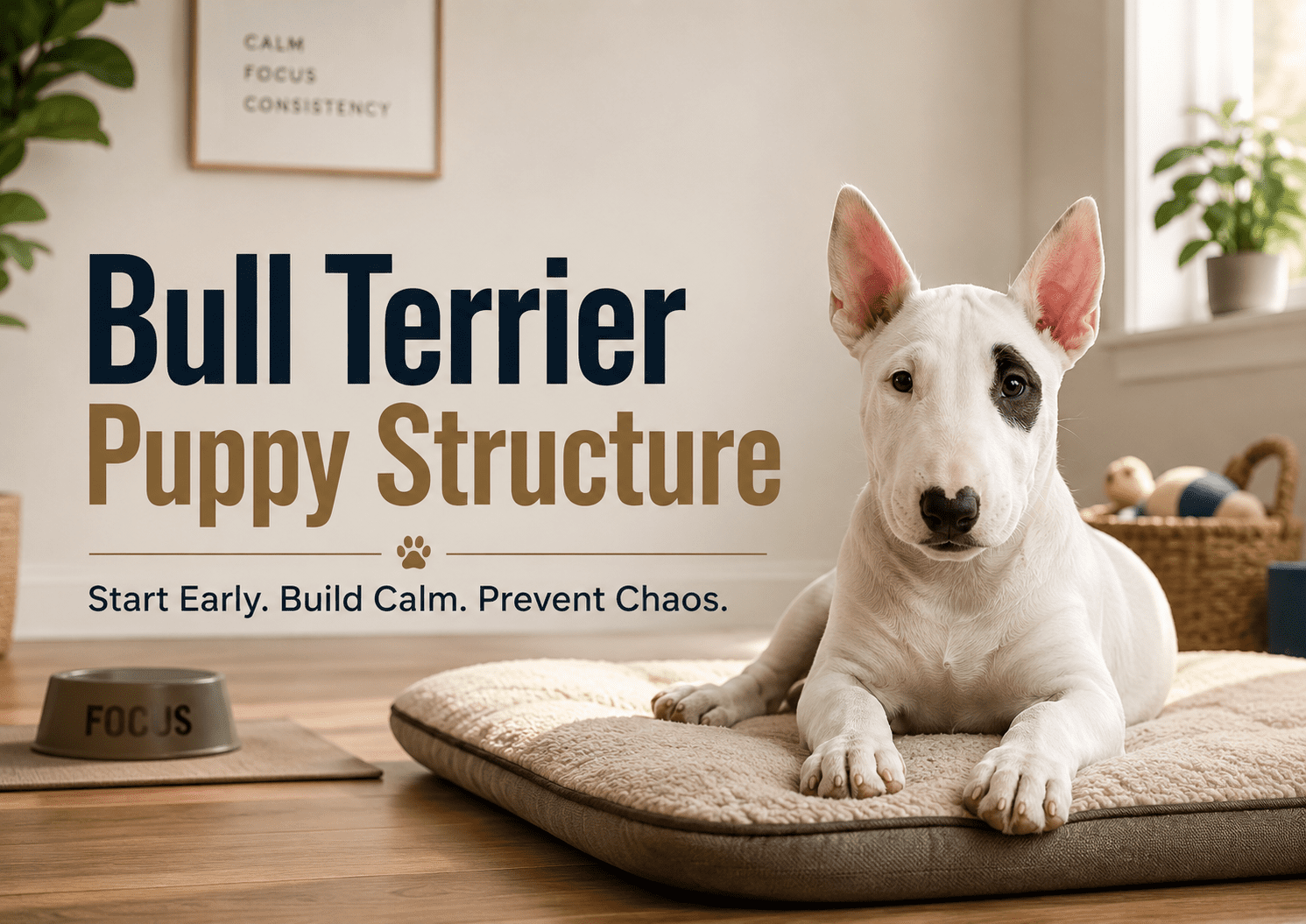
Bull Terrier puppy structure matters because the habits your puppy practises early can shape the dog they become later. A young Bull Terrier does not need harshness, but they do need routine, calm guidance, controlled freedom, fair rules, rest, and consistent daily patterns from the beginning.
A Bull Terrier puppy does not need a harsh life.
But a Bull Terrier puppy does need a clear life.
That difference matters.
Many new owners make the mistake of thinking structure means being strict, cold, or controlling. They imagine rules as something that removes the joy from puppyhood. So they let the puppy run everywhere, bite everything, jump on everyone, chase children, steal socks, sleep wherever they want, demand attention, and live as if the whole house is one big playground.
At first, it feels loving.
The puppy is small. Funny. Cute. Easy to forgive.
The biting is “normal puppy behaviour.” The jumping is “excitement.” The stealing is “character.” The wild evening chaos is “just energy.” The refusal to settle is “because he is a Bull Terrier.” The lack of listening is “because he is still young.”
And some of that is true.
A puppy is a puppy.
But a Bull Terrier puppy is also learning every day.
They are learning what works. They are learning what gets attention. They are learning how much freedom they have. They are learning whether the owner means what they say. They are learning whether biting starts a game. They are learning whether jumping gets contact. They are learning whether refusing creates negotiation. They are learning whether chaos controls the room.
This is why early structure matters so much.
A Bull Terrier puppy does not need pressure. They do not need heavy correction. They do not need adult-level obedience at ten weeks old. But they do need a daily life that teaches the right patterns from the beginning.
Because the habits that feel cute in a young puppy can become serious problems in an adolescent Bull Terrier.
And that change happens faster than many owners expect.
Bull Terrier Puppy Structure: Why It Matters So Much Early
Quick Answer
Bull Terrier puppy structure is important because puppies are learning every day, even outside formal training sessions. Early structure helps prevent biting, jumping, stealing, overexcitement, poor settling, and uncontrolled freedom from becoming strong habits. A Bull Terrier puppy does not need harshness, but they do need routine, calm guidance, fair rules, controlled freedom, rest, engagement, and consistent daily patterns.
Bull Terriers are not usually passive puppies.
They are often physical, confident, curious, emotional, funny, determined, and quick to repeat behaviours that create a reaction. Even as puppies, many of them have a strong presence in the home. They push into life. They investigate. They test. They use their mouths. They use their bodies. They follow movement. They create games out of ordinary moments.
This is part of their charm.
It is also why they need guidance early.
A Bull Terrier puppy without structure may not simply “calm down by itself.” Some do become easier with maturity, but many become stronger versions of the habits they practised as puppies.
The puppy who was allowed to bite sleeves may become the young dog who grabs clothing when excited.
The puppy who chased children through the house may become the adolescent who sees running children as an invitation to explode.
The puppy who stole socks and got chased may become the dog who turns stolen items into a daily negotiation.
The puppy who was given unlimited freedom may become the young Bull Terrier who cannot settle, cannot switch off, and does not understand why rules suddenly exist.
This is not because the puppy is bad.
It is because the puppy was learning.
Structure protects the future dog by teaching the young puppy what daily life means.
It tells the puppy when to rest, when to play, when to train, where to settle, how to interact, what behaviour gets access, and what behaviour does not work.
That is not punishment.
That is clarity.
Structure Is Not the Same as Harshness
This is where many people misunderstand puppy training.
They hear the word structure and immediately think of dominance, pressure, strict punishment, or removing affection. That is not what a Bull Terrier puppy needs.
Good structure is calm. Fair. Predictable. Kind. Consistent.
It does not crush the puppy’s personality. It gives that personality a safe framework.
A structured puppy can still play. They can still be funny. They can still be affectionate. They can still enjoy the family. They can still have freedom, explore, chew appropriate things, meet the world, and develop confidence.
The difference is that the owner guides those experiences instead of letting the puppy make every decision.
The puppy is not allowed to practise chaos all day and then be blamed for becoming chaotic.
The puppy is not allowed to bite people every evening and then be called aggressive.
The puppy is not allowed to ignore rest completely and then be blamed for being impossible to live with.
The puppy is not allowed to create bad habits for months and then suddenly expected to behave like a trained adult.
Structure simply means the owner takes responsibility early.
It means the puppy is taught how to succeed before failure becomes normal.
The Home Teaches the Puppy Before Formal Training Does
Many owners think puppy training begins when they start teaching commands.
Sit. Down. Come. Stay.
But the home is already training the puppy long before formal commands matter.
Every day, the puppy is learning from the environment.
If the puppy jumps and people touch them, jumping works.
If the puppy bites and everyone becomes loud, biting creates excitement.
If the puppy barks and someone gives attention, barking has value.
If the puppy steals and the family chases, stealing becomes a game.
If the puppy refuses to settle and someone keeps entertaining them, rest becomes unnecessary.
If the puppy gets full access to every room, every person, every object, and every exciting moment, freedom becomes normal before control exists.
This is why early structure is not optional with a Bull Terrier puppy.
The puppy is always learning, even when the owner is not holding treats, giving commands, or calling it training.
A serious owner understands this.
They do not wait for bad habits to become strong before they start guiding the puppy. They build the daily pattern early, while the puppy is still small enough, soft enough, and flexible enough to learn quickly.
Controlled Freedom Builds Better Freedom Later
One of the biggest mistakes new Bull Terrier owners make is giving too much freedom too early.
The puppy comes home and immediately has access to everything.
The sofa. The beds. The children’s toys. The kitchen. The hallway. The shoes. The visitors. The garden. The other pets. The whole family’s attention.
At first, this feels natural. The puppy is part of the home, and everyone wants them included.
But a young Bull Terrier puppy does not automatically know how to handle that level of freedom.
Freedom without guidance often creates rehearsal.
The puppy practises stealing. Practises chasing. Practises biting. Practises jumping. Practises ignoring the owner. Practises following children. Practises refusing rest. Practises becoming excited every time something moves.
Then, later, the owner wants to reduce those behaviours.
But now the puppy has history.
Controlled freedom is much smarter.
This can mean using baby gates, crates, pens, house lines, supervised room access, short periods of free time, place areas, and structured rest. It means the puppy gets access to situations they can handle and is protected from situations they are not ready to manage.
Freedom should grow as the puppy shows better choices.
A puppy who can settle earns more time in the room.
A puppy who can interact calmly earns more contact.
A puppy who can stop biting faster earns more freedom around movement.
A puppy who can rest after play earns more involvement in family life.
This teaches the Bull Terrier that freedom is connected to behaviour.
That lesson becomes extremely valuable later.
Structure Helps Prevent Overexcitement
Many Bull Terrier puppy problems are not really separate problems.
They are connected to overexcitement.
The biting, jumping, barking, stealing, grabbing clothes, refusing to settle, rough play, and evening madness often come from a puppy who has gone too high and does not know how to come back down.
This is why structure must include rest.
A Bull Terrier puppy does not only need activity. They need recovery. They need quiet time. They need predictable sleep opportunities. They need breaks from stimulation. They need to learn that doing nothing is part of life.
Many owners accidentally reward excitement all day.
They play when the puppy is wild. Talk when the puppy barks. Chase when the puppy steals. Touch when the puppy jumps. Laugh when the puppy acts ridiculous. Keep the puppy awake because the puppy seems full of energy.
Then the puppy becomes more intense.
And the owner thinks the puppy needs even more exercise.
Sometimes the opposite is true.
Sometimes the puppy needs a calmer routine, better rest, and less rehearsal of high-arousal behaviour.
A tired Bull Terrier puppy is not always a calm Bull Terrier puppy.
Sometimes a tired puppy becomes worse.
They bite harder. Move faster. Listen less. Settle poorly. React more. Become unreasonable.
This is why early structure matters. It teaches the puppy how the day works. Activity happens. Then rest happens. Play happens. Then recovery happens. Training happens. Then quiet time happens.
The puppy learns rhythm.
And rhythm creates emotional security.
Structure Makes Bite Control Easier
Bull Terrier puppy biting is one of the most common problems owners face.
Some biting is normal puppy exploration. Some comes from teething. Some comes from play. Some comes from excitement. Some comes from frustration. Some comes from tiredness. Some becomes a habit because the family accidentally rewards it.
Structure helps because it reduces the situations where biting is most likely to explode.
If the puppy is overtired, rest is provided.
If the puppy is overstimulated, the environment is lowered.
If the puppy is biting during wild play, play becomes more controlled.
If the puppy bites clothes when children run, children and puppy are managed differently.
If the puppy grabs hands for attention, the owner stops making hands the centre of the game.
If the puppy bites because they have no appropriate outlet, chewing options are provided at the right time.
Without structure, the owner is always reacting after the bite happens.
With structure, the owner starts preventing the pattern before it becomes stronger.
That is the key difference.
The goal is not to fight the puppy every time they use their mouth. The goal is to understand why the mouth is appearing so much and adjust the daily system.
A puppy who bites less because the whole routine is better is already learning more than a puppy who is corrected ten times a day but still lives in chaos.
The Puppy Must Learn That Calmness Has Value
Many owners reward the wrong version of the puppy.
When the puppy is wild, everyone pays attention.
When the puppy is calm, nobody notices.
This teaches the puppy a very simple lesson: excitement works better than calmness.
A Bull Terrier puppy needs the opposite lesson.
They should learn that calm behaviour matters. Resting gets noticed. Settling gets rewarded. Quiet observation is valuable. Lying on a bed is not ignored. Looking at the owner is worth something. Disengaging from excitement leads to good things.
This does not require long training sessions.
It requires awareness.
When the puppy lies down calmly, mark and reward quietly. When the puppy settles after play, let that moment matter. When the puppy stays calm while the family moves around, support it. When the puppy chooses a chew item instead of biting people, reinforce it. When the puppy goes to place, make that behaviour valuable.
Calmness should not only be demanded when the owner is desperate.
It should be built when the puppy is still able to learn.
A Bull Terrier that learns early how to settle will be much easier to guide through adolescence. A Bull Terrier that never learns calmness may become physically stronger while remaining emotionally immature.
That is where many problems begin.
Structure Does Not Remove Personality
Some owners worry that too much structure will make their Bull Terrier boring.
It will not.
A well-structured Bull Terrier is still a Bull Terrier.
They will still be funny. Expressive. Dramatic. Affectionate. Strange. Powerful. Emotional. Full of character.
The difference is that their personality becomes easier to live with.
A structured Bull Terrier can be funny without being uncontrollable. Playful without being dangerous. Affectionate without being pushy. Confident without being chaotic. Energetic without being impossible to settle.
That is the goal.
We are not trying to remove the breed’s spirit.
We are trying to guide it.
A Bull Terrier with no rules may entertain people at first, but the same behaviours can become exhausting when the dog matures. A Bull Terrier with fair structure can keep the humour and personality while learning how to live safely and calmly with people.
That is not less Bull Terrier.
That is better Bull Terrier ownership.
Structure Helps the Owner Become Clear Too
Early structure is not only for the puppy.
It also trains the owner.
The owner learns when the puppy becomes tired. When biting increases. What kind of play creates too much arousal. What environments overwhelm the puppy. What rewards work. How long the puppy can concentrate. How quickly they recover after excitement. How much freedom they can handle. Which situations need management.
This is extremely important.
No two Bull Terrier puppies are exactly the same.
Some are more confident. Some are more sensitive. Some are more mouthy. Some are more independent. Some are more social. Some are easily overstimulated. Some need more rest. Some need more engagement. Some push rules harder. Some become frustrated quickly.
Structure helps the owner see the puppy more clearly.
When life is random, everything looks like chaos. When there is a routine, patterns become visible.
You start to notice that the puppy bites more after too much play.
Or becomes wild when visitors arrive.
Or cannot settle if the evening routine is too loose.
Or listens better after a short nap.
Or becomes more connected when training happens before free play.
This information is valuable because it allows the owner to adjust the system instead of blaming the puppy.
Better observation creates better training.
What Early Structure Should Include
Early structure does not need to be complicated.
A Bull Terrier puppy needs a predictable daily rhythm, clear rules, controlled freedom, supervised interaction, rest periods, short training sessions, safe chewing outlets, calm exposure to the world, and consistent handling from the family.
They should begin learning that the owner matters. That calmness has value. That biting does not create endless games. That rest is normal. That freedom is guided. That people are not toys. That the home has rules. That excitement has an ending. That good choices create access.
This foundation can include simple things:
A regular sleep and toilet rhythm.
Short, positive training sessions.
Controlled play with clear starts and stops.
A crate, pen, or place area for rest.
Supervised freedom instead of full access all day.
Rewarding calm behaviour.
Teaching name response and simple engagement.
Preventing rehearsals of stealing, chasing, jumping, and biting.
Guiding children and visitors instead of letting them create chaos.
These are not advanced exercises.
They are daily habits.
And daily habits shape the dog.
The Family Must Follow the Same Rules
In many homes, the biggest problem is not the puppy.
It is inconsistency.
One person allows biting during play. Another person gets angry about biting later.
One person lets the puppy jump. Another person says the dog is becoming pushy.
One person gives the puppy sofa freedom. Another person wants boundaries.
One person encourages wild play. Another person complains that the puppy cannot settle.
This confuses the puppy.
A Bull Terrier puppy learns patterns quickly, especially when those patterns benefit them. If one rule works sometimes and not other times, the puppy may keep testing. If one family member allows chaos, the puppy may bring that chaos into the whole home.
The family does not need to be perfect.
But the basic rules should be clear.
What is allowed? What is not allowed? When does the puppy rest? Where does the puppy sleep? What happens when biting starts? How do children interact? Are visitors allowed to excite the puppy? What freedom does the puppy have? What happens after play?
When the humans agree, the puppy learns faster.
When the humans are inconsistent, the puppy becomes the mirror of that inconsistency.
Structure Prepares the Puppy for Adolescence
The real value of early structure often appears later.
Many owners survive puppyhood and then get shocked during adolescence.
The young Bull Terrier becomes stronger. Faster. More confident. More independent. More interested in the environment. More capable of pushing boundaries. Habits that were small now have more force behind them.
This is where the early foundation matters.
A puppy who has learned routine, calmness, engagement, bite control, boundaries, and controlled freedom has something to return to when adolescence becomes more difficult.
A puppy who has learned only chaos has no foundation.
That does not mean every structured puppy becomes easy.
Bull Terriers can still test. They can still have difficult phases. They can still become overexcited, selective, stubborn-looking, or challenging as they mature.
But structure gives the owner a system.
Without a system, adolescence can feel like starting from zero with a much stronger dog.
That is why the first months matter so much.
You are not only training the puppy in front of you.
You are preparing the adolescent dog you will soon have.
So, Why Do Bull Terrier Puppies Need Structure Early?
Bull Terrier puppies need structure early because they are learning every day, whether the owner realizes it or not.
They are learning how the home works. How people respond. How much freedom they have. What gets attention. What creates games. What behaviour brings access. What rules matter. What rules can be tested.
Without structure, a Bull Terrier puppy may practise the exact behaviours the owner later wants to stop.
With structure, the puppy begins learning how to live.
They learn routine. Calmness. Bite control. Rest. Engagement. Boundaries. Supervised freedom. Better choices. Respectful interaction. Recovery after excitement. Trust in the owner’s guidance.
This does not remove the puppy’s personality.
It protects it.
A Bull Terrier raised with fair structure can still become the funny, affectionate, loyal, powerful, unforgettable dog people love. But they have a much better chance of becoming that dog without turning the household into daily chaos.
The goal is not perfection.
The goal is direction.
And with a Bull Terrier puppy, direction should start early.
Learn More From Working Bull Terriers Kennel
If you are raising a Bull Terrier puppy, the early months are the best time to build the right foundation.
Our Bull Terrier puppy and training guides were created to help owners understand the breed before small habits become serious problems. They are designed for people who want to raise their puppy with structure, clarity, calmness, engagement, and breed-specific understanding — not generic advice that ignores how Bull Terriers really think and behave.
For self-guided learning, start with our Bull Terrier Puppy Training Guide or our complete Bull Terrier training books.
If your puppy is already showing intense biting, overexcitement, inability to settle, fear, reactivity, or household chaos, personalized online training may be the better next step.
Build the Right Puppy Foundation Early
A Bull Terrier puppy does not need a harsh start, but they do need a clear one. Structure, routine, calmness, controlled freedom, bite control, rest, and engagement are what help prevent small puppy habits from becoming serious problems later.
The Bull Terrier Puppy Training Guide gives you the step-by-step foundation, while the Quirks guide helps you understand the breed-specific behaviours that often appear as the puppy grows.

 Get the Puppy Training Guide
Explore the Quirks Guide
Get the Puppy Training Guide
Explore the Quirks Guide
Related Reading
If you are raising a Bull Terrier puppy, these confirmed articles will help you understand the breed, the early foundation period, and the kind of structure that prevents bigger problems later.
A strong companion article for understanding the early foundation period and how routine, biting, calmness, and engagement shape the future dog.
A deeper look at the breed’s thinking style, emotional intensity, humour, and why Bull Terriers need more than generic dog advice.
A useful article for owners who want realistic expectations about socialization, neutrality, dog selectivity, and control around other dogs.
A responsible guide for understanding prey drive, supervision, controlled introductions, and safe management around smaller animals.
Leave a Reply