

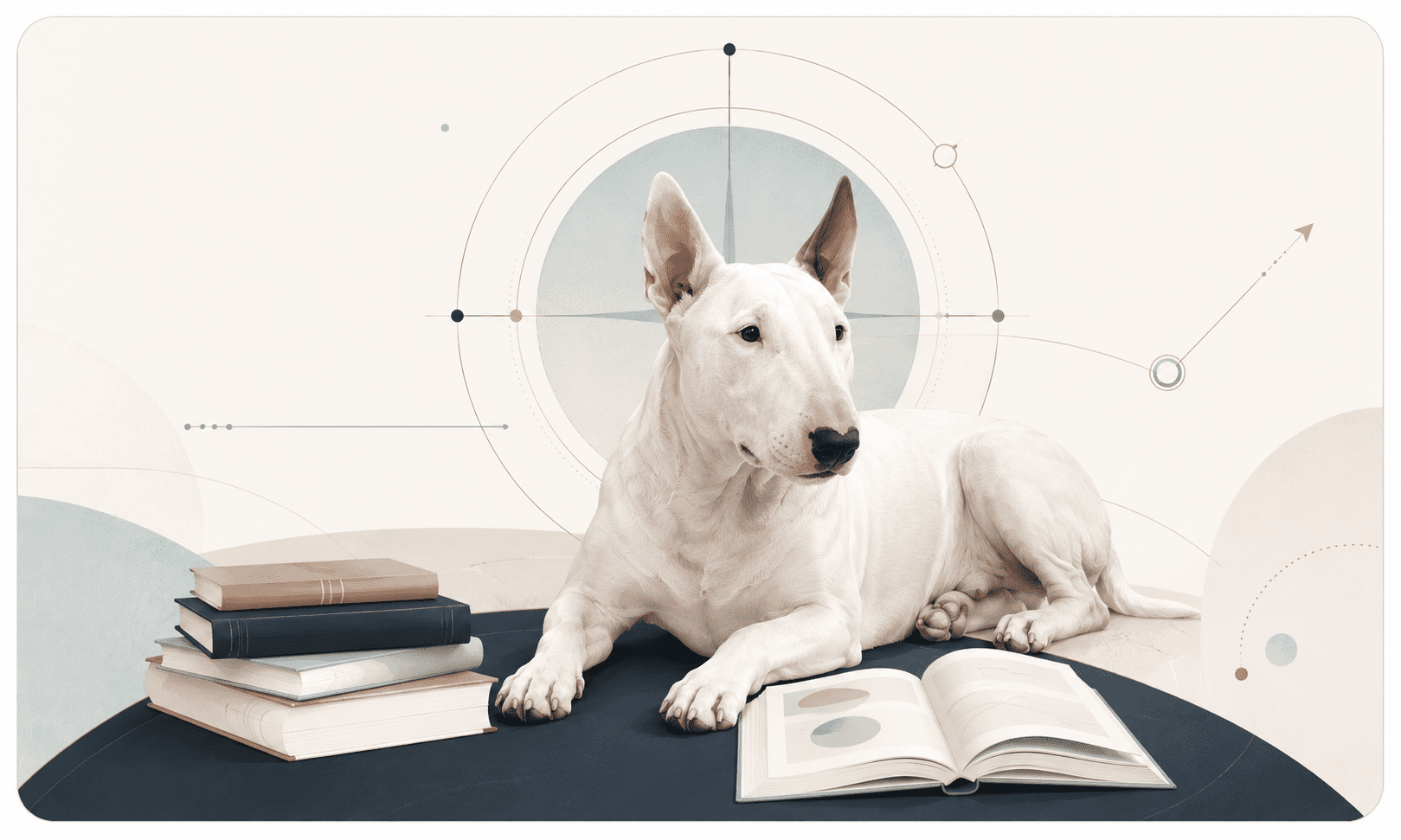





A Bull Terrier puppy does not come into the world automatically focused on the owner.
They come into the world interested in everything.
Movement. Smells. Sounds. Food. Toys. Shoes. Leaves. Children. Other dogs. Visitors. Birds. Hands. Trouser legs. The floor. The sofa. The mysterious object under the table that absolutely must be investigated.
And then the owner says the puppy is not listening.
But listening is not where training begins.
Focus begins earlier.
Before a Bull Terrier puppy can listen well, they must first learn that the owner matters. They must learn that checking in has value. They must learn that paying attention brings good things. They must learn that the person holding the lead is not just an obstacle between them and the world.
This is one of the most important foundations in Bull Terrier training.
Many owners jump too quickly into commands.
Sit.
Down.
Come.
Leave it.
Stop.
No.
But the puppy has not yet learned why the owner is worth paying attention to.
So the owner repeats commands, the puppy ignores them, frustration grows, and the puppy gets labelled as stubborn.
Sometimes the puppy is not stubborn.
Sometimes the puppy is simply more connected to the environment than to the owner.
Focus training changes that.
It teaches the puppy that the owner is not background noise.
The owner is the centre of the training picture.
Bull Terrier Puppy Focus Training: Why It Should Start Early
Quick Answer
Bull Terrier puppy focus training should start with simple name response, eye contact, follow-the-hand exercises, short sessions, and rewards for natural check-ins. The goal is not to force the puppy to stare at you, but to teach them that paying attention to the owner has value. Focus makes obedience, leash training, biting control, redirection, and outdoor training much easier later.
Bull Terrier puppy focus training should start early because focus is the foundation behind almost every useful behaviour.
A puppy who can look at the owner is easier to guide. A puppy who checks in naturally is easier to walk. A puppy who understands reward timing is easier to train. A puppy who values the owner is easier to redirect before excitement becomes chaos.
Focus does not mean the puppy must stare at you all day.
That would be unrealistic and unhealthy.
Focus means the puppy learns to reconnect with you.
They look back. They respond to their name. They follow your hand. They notice your movement. They understand that your voice matters. They begin to choose you, even when the world is interesting.
That is a powerful thing with a Bull Terrier.
Because Bull Terriers are not usually weak-minded little followers. They are often confident, physical, curious, funny, strong-willed, and very aware of what they want. If the owner is not interesting, clear, and consistent, the environment can easily win.
Focus training helps prevent that.
Not by forcing attention.
By building value.
Focus Is Not Obedience Yet
This is where many owners make the mistake.
They think focus training means demanding obedience.
But with a young puppy, focus starts much simpler.
The puppy hears their name and looks.
The puppy follows food in the hand.
The puppy turns toward the owner when the owner moves.
The puppy checks in during a walk.
The puppy comes happily for a short recall.
The puppy chooses the owner instead of immediately grabbing the environment.
These small moments matter.
Before we ask for complicated obedience, we want the puppy to understand that paying attention is rewarding.
If the owner skips this stage, training often becomes a fight for control. The owner gives commands before the puppy is mentally connected. The puppy ignores. The owner repeats. The puppy learns that words do not matter unless the owner becomes louder or more frustrated.
That is not good training.
Good focus training makes the puppy want to participate.
It creates the bridge between the puppy’s natural energy and the owner’s guidance.
Start in the Easiest Environment
Do not begin focus training in the hardest place.
This sounds obvious, but many owners do exactly that.
They try to teach attention outside, near dogs, near people, near traffic, near smells, or when the puppy is already excited. Then they say the puppy has no focus.
Of course the puppy has no focus.
The environment is too difficult.
Start where the puppy can succeed.
A quiet room. A calm part of the house. The garden. A boring hallway. Somewhere with low distraction. Somewhere the puppy is not already overloaded.
Focus is built in layers.
First, the puppy learns that looking at you pays.
Then they learn the same thing with mild distractions.
Then stronger distractions.
Then outside.
Then around movement.
Then around other dogs or people.
If you expect outdoor focus before indoor focus exists, you are skipping the foundation.
Bull Terriers do much better when the picture is clear.
Make the first picture easy.
The Name Should Mean “Look at Me”
A puppy’s name should not become background noise.
Many owners say the puppy’s name all day without meaning anything clear.
“Buddy, stop.”
“Buddy, come here.”
“Buddy, no.”
“Buddy, what are you doing?”
“Buddy, leave it.”
“Buddy, Buddy, Buddy.”
After a while, the name becomes just another sound in the house.
For focus training, the name should have value.
Say the puppy’s name once. When they look, mark and reward. Keep it simple. Do not repeat the name ten times. Do not say it when you know the puppy is too distracted to respond. Do not poison the name by using it only before frustration.
The name should predict connection.
Name.
Look.
Reward.
That is the beginning.
Later, the puppy’s name becomes a useful way to bring their brain back to you before giving more information.
But first, the name must mean something.
It must be worth responding to.
Reward Eye Contact, But Do Not Force It
Eye contact can be very powerful, but it should be built calmly.
You do not need to grab the puppy’s face, stare into their eyes, or pressure them. Just create moments where the puppy chooses to look at you.
Hold a treat calmly. Wait. The puppy may sniff, move, look around, or try to work it out. The moment they look at your face, mark and reward.
At first, even half a second matters.
The puppy is learning:
Looking at my human works.
Over time, the puppy begins offering eye contact more often. This becomes useful before food, before doors open, before play starts, during walks, and around distractions.
But keep the feeling light.
Focus should not feel like pressure.
It should feel like communication.
A Bull Terrier puppy who enjoys checking in will be much easier to guide than one who only looks at the owner because they are being forced.
Follow the Hand Builds Connection
Follow-the-hand exercises are excellent for Bull Terrier puppies.
They teach the puppy to follow the owner’s movement, understand food guidance, move their body with awareness, and stay connected without needing pressure.
This can be very simple.
Put food in your hand. Let the puppy follow the hand for a step or two. Reward. Keep it short. Do not turn it into a long drill. Do not move too fast. Do not frustrate the puppy.
You can use this later for turns, positions, recall foundations, leash focus, and moving the puppy away from distractions.
But at the beginning, the goal is simple:
My human’s hand matters.
Following the hand creates good things.
This is especially useful for Bull Terriers because they can be very physical and environmental. If you build the puppy’s desire to follow your guidance early, you give yourself a practical tool for many future situations.
Short Sessions Are Better Than Long Battles
Bull Terrier puppies do not need long focus sessions.
In fact, long sessions can easily become boring or frustrating.
A few minutes is enough.
Sometimes one minute is enough.
You are not trying to exhaust the puppy’s brain. You are trying to create successful repetitions.
Name response.
Eye contact.
Follow the hand.
Tiny recall.
Reward calm check-ins.
Then stop before the puppy loses interest.
This is important.
If the puppy learns that training is short, clear, and rewarding, they will be more willing to engage again next time. If training becomes long, repetitive, confusing, or frustrating, the puppy may start avoiding it.
Quality matters more than duration.
Bull Terrier puppies often respond well when training feels like a clear, enjoyable game with purpose.
They respond less well when training becomes nagging.
Use Food, But Do Not Become Only a Food Machine
Food is very useful for puppy focus training.
It is clear, fast, and easy to use. It helps the puppy understand exactly which behaviour created the reward.
But the goal is not to become a walking vending machine forever.
The goal is to use food to build meaning.
At first, food helps the puppy understand that looking, checking in, following, and responding are valuable. Later, the owner can also use praise, play, movement, access, sniffing, and real-life rewards.
But in the beginning, do not be proud and refuse to use food because the puppy “should listen.”
The puppy is learning.
Pay them for the work.
Then, as the behaviour becomes stronger, the rewards can become more varied and more natural.
A Bull Terrier puppy should learn that the owner is valuable in many ways.
Food helps open that door.
Focus Before Freedom
This is a very important rule.
Before giving the puppy access to something exciting, ask for a small moment of focus.
Before opening the door, name and eye contact.
Before putting the food bowl down, a tiny calm pause.
Before starting play, a brief check-in.
Before letting the puppy explore, a small connection.
Before greeting someone, if the puppy is capable, a moment of attention.
This teaches the puppy that focus opens life.
The owner is not blocking access to good things. The owner is the path to good things.
That is a much better lesson than fighting the puppy after they are already overstimulated.
Do not make this too hard. We are not asking a young puppy for military obedience. We are simply teaching them that a little connection comes before freedom.
This becomes extremely useful later during walks, doorways, visitors, and distractions.
Outdoor Focus Starts Small
Outside is difficult.
Many puppies who focus well indoors appear to forget everything outside. This does not mean the training failed. It means the environment became harder.
Smells, sounds, movement, wind, dogs, people, cars, birds, and new surfaces all compete for the puppy’s attention.
So start small.
Do not expect long eye contact in a busy place. Reward tiny check-ins. Reward the puppy for looking back. Reward name response when the distraction is mild. Use distance. Move away from things that are too hard. Let the puppy sniff, but keep moments of connection alive.
Outdoor focus should not mean the puppy is never allowed to investigate.
A puppy needs to explore the world.
But they should also learn that the owner still exists in that world.
That is the balance.
Explore.
Check in.
Move together.
Reward.
Continue.
Over time, those small check-ins become a habit.
Do Not Repeat Commands When the Puppy Is Not Connected
Many owners damage focus by talking too much.
They give commands when the puppy is not listening, then repeat them again and again.
Come.
Come.
Come.
Come here.
Come here now.
No.
Leave it.
Listen.
The puppy learns that words can be ignored.
Before giving a command, ask yourself:
Is the puppy mentally available?
Do I have their attention?
Is this environment too difficult?
Have I built this behaviour in easier places first?
If the answer is no, then repeating commands will not help.
Get focus first.
Name response. Movement. Food. Distance. Simpler task. Better timing.
Then ask.
This is especially important with Bull Terriers because many will not respond well to meaningless repetition. They need clarity. They need motivation. They need to understand why the owner matters in that moment.
Less talking.
Better timing.
More value.
Focus Training Helps With Biting and Overexcitement
Focus training is not only for obedience.
It can also help with common puppy problems.
A puppy who has learned to reconnect with the owner is easier to redirect when they start biting. A puppy who follows the hand can be moved away from trouser legs. A puppy who responds to their name can be interrupted before jumping. A puppy who checks in outside is less likely to drag the owner toward every distraction.
Focus gives the owner a way back into the puppy’s brain.
Without focus, every problem becomes physical management.
Pull the puppy away.
Remove the puppy.
Stop the puppy.
Grab the puppy.
Block the puppy.
Sometimes management is necessary, but the long-term goal is better communication.
Focus training gives you that communication.
It does not fix everything by itself, but it makes everything else easier.
Focus and Calmness Work Together
Focus should not always be high-energy.
Some owners create focus by becoming very exciting all the time. They use loud voices, fast movement, constant food, big reactions, and high energy. This may get the puppy’s attention, but it can also create more arousal.
With Bull Terriers, we must be careful.
We want focus that can become calm.
Not only focus that becomes madness.
The puppy should learn both active engagement and quiet attention.
They can follow food. They can play. They can move. But they should also learn calm eye contact, quiet reward, place focus, and relaxed check-ins.
A balanced puppy can engage without exploding.
That is the goal.
Focus training should build connection, not constant excitement.
The Owner Must Become More Interesting Than the Environment
This does not happen by accident.
If the owner only says “no,” repeats commands, pulls on the lead, and becomes frustrated, the environment will often be more rewarding.
The owner must become clear, valuable, and worth choosing.
This does not mean acting silly all day. It means being present in the training. Rewarding well. Moving with purpose. Using the puppy’s food and play intelligently. Creating little wins. Teaching the puppy that checking in with you makes life better.
A Bull Terrier puppy will not respect boring, unclear repetition.
They respond much better when the owner becomes an active part of the learning picture.
Not emotional.
Not harsh.
Not chaotic.
Clear.
Engaging.
Consistent.
Worth listening to.
Common Mistakes With Bull Terrier Puppy Focus Training
One common mistake is starting in places that are too difficult.
Another is repeating the puppy’s name until it means nothing. Some owners only reward focus when they are training formally and miss natural check-ins during the day. Others expect too much duration too soon. Some use food without timing, so the puppy eats but does not understand what earned the reward.
Another big mistake is trying to build focus only after the puppy is already overstimulated.
If the puppy is already biting, jumping, barking, or pulling toward something exciting, it is much harder to get attention. Build focus when the puppy can still think.
Then use it earlier next time.
Focus training is not a rescue tool only for emergencies.
It is a daily foundation.
So, How Do You Start Focus Training With a Bull Terrier Puppy?
Start simply.
Teach the puppy that their name matters. Reward eye contact. Use follow-the-hand exercises. Practise in easy places first. Keep sessions short. Reward natural check-ins. Ask for a tiny moment of focus before giving access to food, play, doors, freedom, or exploration.
Then gradually build difficulty.
More distractions. Different rooms. Garden. Quiet outdoor places. Mild movement. Visitors at a distance. Other dogs at a safe distance. More real-life situations.
Do not rush.
Do not force attention.
Build value.
A Bull Terrier puppy who learns early that the owner matters becomes much easier to guide later. Commands become clearer. Walks become easier. Redirection becomes smoother. Biting becomes easier to interrupt. Outdoor distractions become less powerful.
Focus is not everything.
But without focus, everything becomes harder.
Final Thought
A Bull Terrier puppy is not born knowing that the owner is the most important thing in the world.
That relationship is built.
Every small check-in, every clear reward, every short focus session, every calm name response, every moment where the puppy chooses you instead of chaos — these are not small details.
They are the foundation.
Before you demand obedience, build connection.
Before you complain that the puppy is stubborn, ask whether the puppy understands why focusing on you is valuable.
And before you expect calm, controlled behaviour in difficult situations, teach the puppy how to reconnect with you in easy ones.
That is where real Bull Terrier training begins.
Learn More From Working Bull Terriers Kennel
If your Bull Terrier puppy ignores you, bites when excited, pulls toward distractions, or seems more interested in the world than in you, the answer is not always stronger correction.
Often, the puppy needs better focus foundations.
Our Bull Terrier Puppy Training Guide was created to help owners build routine, calmness, engagement, focus, bite control, and early structure step by step. Our Quirks guide helps owners understand the breed-specific behaviours that often appear as the puppy grows.
For self-guided learning, start with the Puppy Training Guide and the Quirks guide.
If your puppy is already showing intense overexcitement, reactivity, biting, inability to settle, or household chaos, personalized online training may be the better next step.
Build Focus Before You Ask for Obedience
Bull Terrier puppy focus training is not about forcing the puppy to stare at you. It is about teaching your puppy that checking in, listening, following your guidance, and choosing you over distractions all have value.
The Bull Terrier Puppy Training Guide helps you build early focus, routine, calmness, bite control, and engagement step by step, while the Quirks guide helps you understand the breed-specific behaviours that often appear as your puppy grows.

 Get the Puppy Training Guide
Explore the Quirks Guide
Get the Puppy Training Guide
Explore the Quirks Guide
Related Reading
If you are starting focus training with a Bull Terrier puppy, these articles will help you understand the bigger foundation behind attention, calmness, routine, exercise balance, biting control, and early puppy development.
A helpful article for understanding why focus and calmness work together, and why a puppy must learn how to switch off after excitement.
A useful guide for creating the daily rhythm that makes focus training easier, because the puppy understands when to play, rest, chew, and engage.
A strong companion article for understanding why more activity is not always the answer, and why balanced exercise and recovery support better focus.
A practical guide for understanding puppy biting, mouthiness, overexcitement, tiredness, and why better focus can make redirection easier.
A foundation article for understanding how the first months shape engagement, routine, calmness, confidence, structure, and future behaviour.
Leave a Reply