
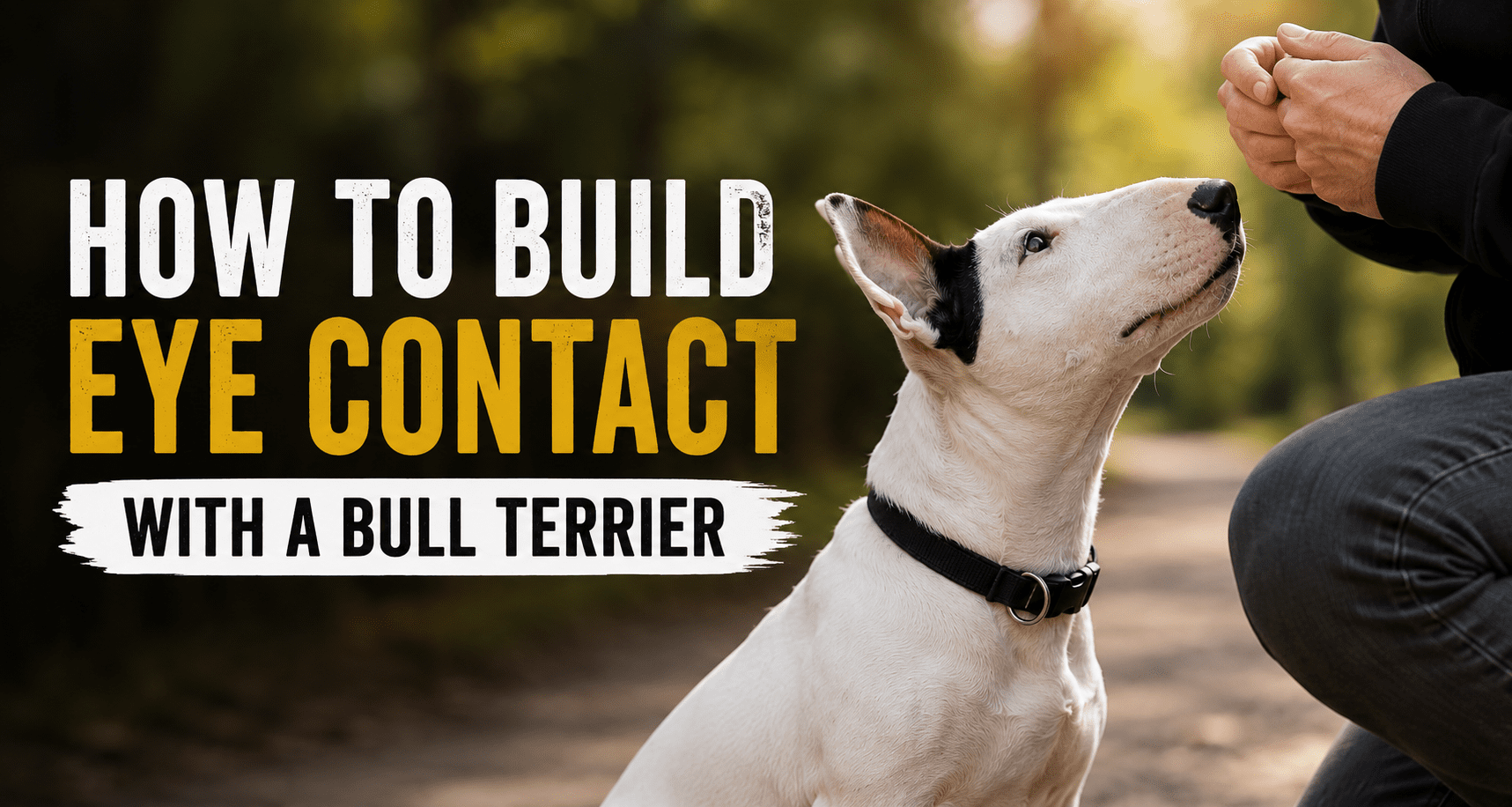
Bull Terrier Focus, Engagement & Training Foundations
How to Build Eye Contact With a Bull Terrier
Bull Terrier eye contact training is not about forcing a dog to stare at you. It is about teaching your Bull Terrier to reconnect with you before the environment takes over. Before reliable obedience, before better leash control, before recall, before calm redirection, the dog must first learn that looking back at the owner has value.
Many owners try to teach commands before the dog has learned to look at them. They ask for sit, down, come, heel, leave it, stop, and stay, but the dog’s mind is already somewhere else. The dog is watching the environment, sniffing the ground, looking at another dog, waiting for movement, staring at a visitor, or scanning the world for something more interesting.
Then the owner says, “He is not listening.”
But listening usually begins with attention. And attention often begins with the eyes.
Bull Terrier eye contact training should begin in a quiet place with short, voluntary moments. Wait for your dog to look at you, mark the exact moment, and reward. Then build name response, natural check-ins, calm focus, eye contact before access, and attention around mild distractions. The goal is not forced staring. The goal is a Bull Terrier who chooses to reconnect with the owner.
Bull Terrier Eye Contact Training: Why It Matters
Bull Terriers are physical, curious, emotional, determined dogs. Many become very interested in the environment. They may lock onto movement, smells, people, dogs, cats, toys, food, leaves, doorways, visitors, children, or anything that creates excitement.
When the dog’s attention is fully outside the owner, commands become harder. You can say the word. The dog may even know the word. But if the dog is not mentally with you, the command is already starting from a weak place.
Eye contact gives you a way back into the dog’s brain. It tells you the dog is available. It tells you the dog has noticed you. It tells you the dog is not only physically attached to the lead, but mentally connected to the handler.
That is why we build eye contact before expecting difficult obedience.
A Bull Terrier who never checks in will often make decisions based on whatever has the most value in the environment. That is not stubbornness alone. It is a missing foundation.
Eye Contact Should Be Offered, Not Forced
Good eye contact training should not feel like pressure. Do not grab the dog’s face. Do not force the head up. Do not stare into the dog’s eyes in a confrontational way. Do not turn eye contact into a battle.
The best eye contact is offered voluntarily. The dog chooses to look at you because looking at you has a history of value.
With some dogs, forced eye contact can create discomfort. With confident Bull Terriers, pressure can create resistance or turn the moment into a physical contest. Neither is useful.
We want the dog to think: looking at my human works. Looking at my human makes good things happen. Looking at my human helps me understand what comes next.
That kind of eye contact becomes powerful because it is chosen. Chosen attention is stronger than demanded attention.
Start in a Quiet Place
Do not start eye contact training in the hardest environment. This is one of the biggest mistakes owners make.
They try to build focus outside, around dogs, around smells, around visitors, around noise, or when the dog is already excited. Then they say the Bull Terrier has no attention span. But the environment is too difficult.
Start where the dog can succeed: a quiet room, calm hallway, garden, boring corner of the house, or low-distraction space. The first goal is not long eye contact. The first goal is understanding.
The dog learns that looking at your face is rewarding. Once that picture is clear, you can slowly take it into more difficult places.
If your Bull Terrier ignores you outside, pulls toward distractions, or struggles to respond when excited, do not start by adding more commands. Start by building value for checking in and looking back.
The First Exercise: Wait for the Look
Stand or sit calmly with your Bull Terrier. Have a few small rewards ready. Let the dog know you have something valuable, but do not put the food directly in front of the nose forever.
Wait.
The dog may sniff your hand, look at the food, look around, move a little, or try to work out what makes the reward happen. The moment he looks at your face, mark it and reward.
At first, the look may only last half a second. That is enough. Mark the exact moment. Reward. Repeat.
The dog starts learning the rule: looking at the human makes the reward appear.
Do not rush to duration yet. Do not ask for five seconds, ten seconds, or long staring. First, build the idea that eye contact itself has value. Once the dog understands, duration can grow naturally.
Use a marker if you have one. A clean “Yes” at the exact moment the dog looks up helps the dog understand which behaviour earned the reward.
Use the Dog’s Name Carefully
A Bull Terrier’s name should not become background noise. Many owners use the dog’s name constantly: “Solo, no,” “Solo, come,” “Solo, stop,” “Solo, what are you doing?” After a while, the name becomes weak.
For eye contact training, the name should mean: look at me.
- Say the dog’s name once.
- When he looks, mark and reward.
- Do not repeat the name five times.
- Do not use the name mostly when you are frustrated.
- Do not say the name when the dog is already too distracted to respond.
Name, look, mark, reward. This simple pattern builds one of the most useful tools you will ever have.
Reward Natural Check-Ins
Do not only train eye contact during formal sessions. Reward natural check-ins during daily life.
If your Bull Terrier looks at you on a walk, reward it. If he looks back before moving forward, reward it. If he glances at you before going through a doorway, reward it. If he checks in after hearing a sound, reward it. If he looks at you instead of pulling toward something, reward it.
These moments are gold. Many owners miss them because they are waiting to give commands. But spontaneous attention is one of the best signs that the dog is starting to include the owner in his decisions.
A dog who naturally checks in is much easier to guide than a dog who never thinks to look back.
Keep the Energy Calm
Eye contact should not always be high-energy. Some owners become so excited when the dog looks at them that they accidentally push the dog into more arousal.
Big voice, fast movement, too much excitement, too much food movement, and too much energy can make the dog animated but not necessarily focused.
With Bull Terriers, this matters. We do want enthusiasm in training, but we also want the dog to think. If eye contact always becomes a party, the dog may learn excitement instead of calm connection.
Use quiet rewards too: a calm marker, a small food reward, gentle praise, or a controlled release. This teaches the dog that looking at the owner does not always mean explosion. Sometimes it means clarity. Sometimes it means calm. Sometimes it means wait.
Eye Contact Before Access
A powerful way to build eye contact is to use everyday access as a reward. Before opening the door, wait for a small look. Before putting the food bowl down, wait for a calm glance. Before releasing to play, ask for a moment of eye contact. Before moving forward on a walk, reward a check-in.
This teaches the Bull Terrier that eye contact opens life. The owner is not blocking the dog from everything good. The owner becomes the gateway to good things.
Do not make this too difficult at first. A young or inexperienced dog may only offer a quick glance. That is fine. Reward the small beginning. Later, you can ask for better calmness, longer focus, or more control.
Build Duration Slowly
Once the dog understands that eye contact has value, you can slowly build duration. At first, mark and reward the quick look. Then wait half a second longer. Then one second. Then two. Then three.
Do not jump too quickly. If the dog looks away, you may have asked for too much too soon. Make it easier and rebuild.
Duration should grow from understanding, not pressure. Short, successful repetitions are better than long, frustrating ones.
Add Movement
Once eye contact is easy in a still position, add movement. Take one step back. If the dog looks at you, reward. Turn slightly. If the dog follows and checks in, reward. Walk a few steps. Reward the dog for looking up.
This matters because real life does not happen while everyone stands still. A dog who can look at you while moving is easier to guide outside. He can turn with you, follow your direction, and stay connected during walks.
For Bull Terriers, movement-based engagement is often useful because many of them are physical dogs. Use that movement intelligently. Make the owner part of the action.
Take Eye Contact Outside Gradually
Outside is harder. The dog is dealing with smells, sounds, movement, dogs, people, vehicles, birds, surfaces, weather, and all the information that comes with the environment.
Do not expect indoor-level eye contact immediately outside. Start in quiet places. Reward tiny check-ins. Use distance from distractions. Do not stand too close to another dog and then ask for perfect focus. Do not start in the busiest park and expect success.
A quick look outside may be a big achievement. Reward it. The dog is learning that even in the world, the owner still matters.
For an external training reference, the American Kennel Club explains that a “watch me” cue can help a dog make eye contact and switch focus back from distractions to the handler: AKC guide to the “watch me” cue.
Eye Contact Around Dogs and People
When dogs or people are involved, eye contact becomes more difficult but also more valuable. Do not wait until your Bull Terrier is already pulling, barking, jumping, or fully locked onto the distraction.
Work earlier, at a distance. The dog sees a person and looks back before he explodes. Mark and reward. The dog notices another dog and glances at you. Mark and reward. The dog hears movement and checks in. Mark and reward.
This teaches the dog that distractions do not erase the owner. But distance matters. If the dog cannot take food, cannot respond to his name, cannot look away, or becomes stiff and locked, you are probably too close or asking too late.
Eye contact around dogs, people, or movement is not built by fighting the dog at the edge of explosion. Use distance, lower difficulty, better timing, and reward the first small check-ins before the Bull Terrier is fully locked on.
Do Not Overuse the Command “Watch Me”
A “watch me” cue can be useful, but it should not replace the dog learning to offer attention naturally. If you say “watch me” every time you need attention, the dog may only look when asked. He may not learn to check in on his own.
Spontaneous eye contact is often more valuable. The dog chooses to look without being told. That choice tells you the dog is becoming engaged.
You can still have a cue. But build voluntary attention first. Reward offered eye contact. Reward check-ins. Reward the dog for including you in the picture.
What Eye Contact Helps With
Many leash problems begin when the dog moves forward without caring where the owner is. A dog who checks in is easier to guide, easier to turn, and less likely to hit the end of the lead.
Recall starts with attention. A dog who naturally checks in is already partly connected, which makes coming back easier.
Eye contact can become a small pause before the dog goes too high. It gives the owner a bridge back to the dog before jumping, biting, spinning, or pulling takes over.
A Bull Terrier who can look back can be redirected earlier and more calmly. That matters around visitors, dogs, doorways, food, toys, and movement.
Eye contact gives you many easy opportunities to mark and reward the exact moment the dog reconnects. This strengthens timing and communication.
Commands work better when the dog is mentally available. Eye contact helps create that availability before you ask for the next behaviour.
Common Mistakes With Eye Contact Training
This creates pressure instead of voluntary attention and can turn training into a physical contest.
Busy parks, dogs, visitors, and heavy smells are not good starting points for a dog that has not learned the foundation.
If the name becomes background noise, it loses value as an attention cue.
If you miss the eye contact and reward after the dog has looked away, the lesson becomes unclear.
Build the quick glance first. Duration comes later.
If every look becomes a party, the dog may learn arousal instead of calm focus.
How to Build Eye Contact With a Bull Terrier Step by Step
- Start in an easy, quiet place.
- Have small rewards ready, but do not glue food to the dog’s nose.
- Wait for the dog to look at your face.
- Mark the exact moment with “Yes” or your chosen marker.
- Reward immediately after the marker.
- Repeat short, successful sessions.
- Use the dog’s name carefully: name, look, mark, reward.
- Reward natural check-ins during daily life.
- Build duration slowly after the dog understands the game.
- Add movement, then mild distractions, then outdoor environments gradually.
- Use eye contact before access to food, doors, play, walks, sniffing, or movement.
- Do not force, rush, or argue. Make the behaviour worth choosing.
Final Thought
Eye contact may look simple, but it changes the training relationship. It tells the dog that the owner matters. It gives the owner a way to connect before giving direction. It helps with leash work, recall, overexcitement, focus, and obedience.
Most importantly, eye contact teaches the Bull Terrier that training is not just commands being thrown into the air. Training is a conversation.
And for that conversation to begin, the dog must first learn to look back.
Frequently Asked Questions About Bull Terrier Eye Contact Training
Start in a quiet place. Wait for the dog to look at your face, mark the exact moment with “Yes,” and reward. Keep the first sessions short and build difficulty gradually.
No. Eye contact should be offered, not forced. Do not grab the face, lift the head, or stare confrontationally. Make looking at you rewarding so the dog chooses it.
Outside, the environment may have more value than the owner. Smells, dogs, people, movement, and excitement can take over. Eye contact and check-ins help build owner value outside.
You can use a cue, but do not depend only on it. Reward voluntary eye contact and natural check-ins so your Bull Terrier learns to reconnect without being told every time.
Yes. A Bull Terrier who checks in is easier to guide, redirect, and turn before reaching the end of the lead. Eye contact is one foundation behind better leash focus.
Yes, when trained early and calmly. Eye contact can create a small pause before the dog escalates, making it easier to redirect before jumping, pulling, barking, or grabbing begins.
Leave a Reply