
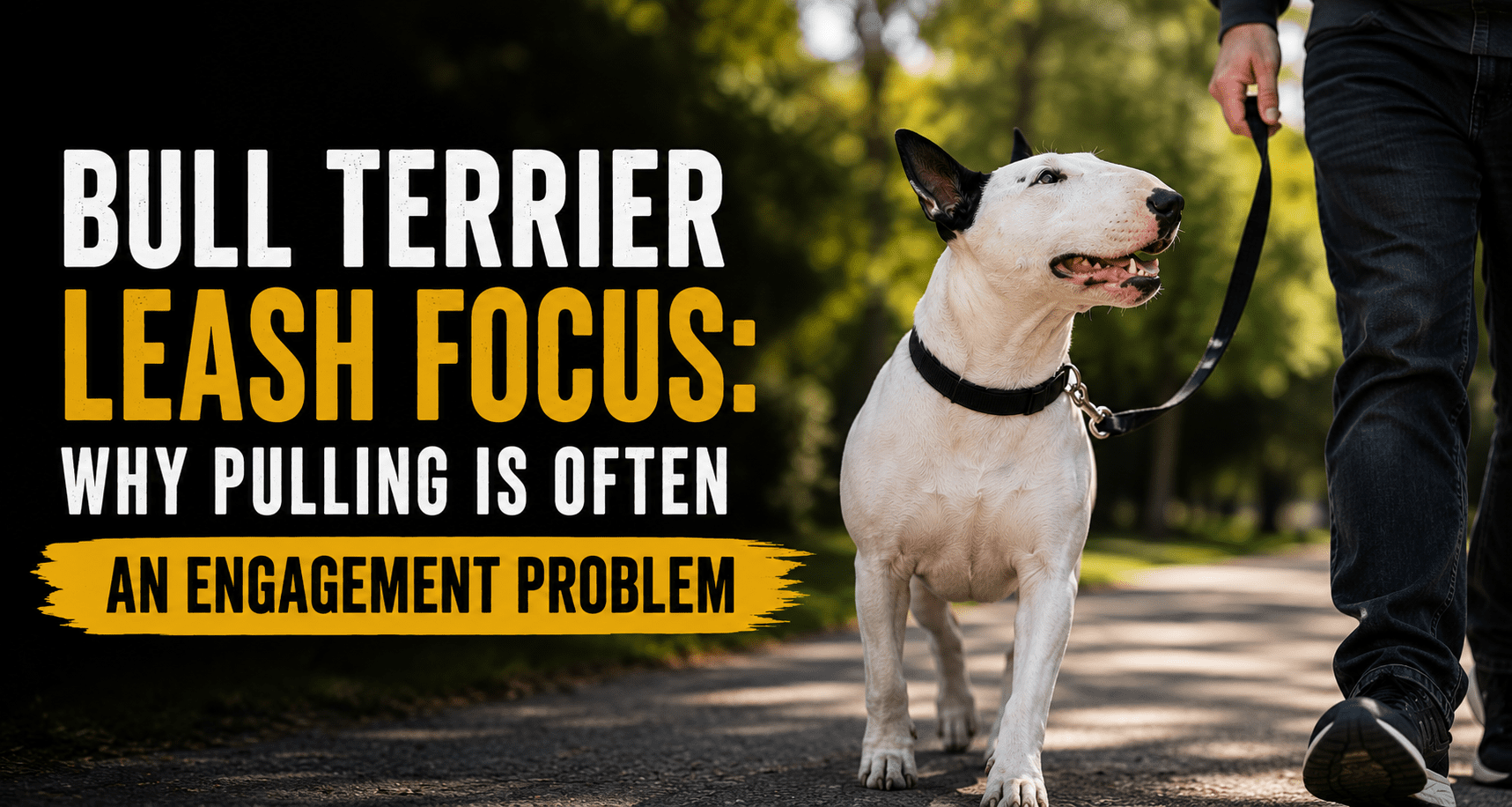
Bull Terrier Focus, Engagement & Leash Training
Bull Terrier Leash Focus: Why Pulling Is Often an Engagement Problem
Bull Terrier leash focus is not only about stopping a dog from pulling. It is about teaching the dog to stay mentally connected to the owner while moving through an interesting world. The lead is where the problem becomes visible, but the real issue often begins before the walk starts.
Most owners see leash pulling as a leash problem. The dog pulls. The owner pulls back. The dog pulls harder. The owner changes equipment, shortens the lead, says “heel,” stops walking, turns around, corrects, repeats, gets frustrated, and wonders why the Bull Terrier still wants to move ahead.
But with Bull Terriers, pulling is often not only about the leash. It is often an engagement problem.
The dog is more connected to the environment than to the owner. The smell ahead has more value. The dog in the distance has more value. The person walking past has more value. The grass, the gate, the car, the cat, the bird, the pavement, the corner, or the memory of something exciting has more value.
The owner is physically attached to the dog. Mentally, the dog is already somewhere else.
Bull Terrier leash focus means teaching your dog to stay mentally available to you during walks. Pulling is often an engagement problem because the dog finds the environment more rewarding than the owner. Better leash focus starts with calm exits, check-ins, name response, owner value, movement rewards, controlled sniffing, short training sessions, and rewarding the dog for reconnecting before he reaches the end of the lead.
Bull Terrier Leash Focus Starts Before the Walk
Bull Terrier leash focus is not something that begins halfway down the street when the dog is already pulling.
It starts before the walk begins. It starts when the lead appears. It starts at the door. It starts in the hallway. It starts before the dog explodes into the outside world.
Many owners accidentally create pulling before the walk even begins. The dog sees the lead, becomes excited, jumps, spins, bites the lead, pushes through the door, rushes out, and immediately starts the walk in a high state.
Then the owner expects calm leash behaviour.
But the dog has already learned the pattern: lead means excitement, door means rush, outside means forward, and the owner follows.
The walk does not begin on the pavement. It begins with the dog’s state of mind.
Pulling Is Often a Value Problem
Dogs move toward what has value. That sounds simple, but it explains a lot.
If the smell ahead is valuable, the dog pulls toward it. If another dog is valuable, the dog pulls toward it. If forward motion is valuable, the dog pulls to keep moving. If pulling has worked in the past, the dog repeats it.
A Bull Terrier who pulls is not always trying to be difficult. Very often, he is choosing the thing with the highest value in that moment.
The environment wins because the environment has more reward history. The owner says “heel,” but the smell says “come here.” The owner says “slow,” but the dog has learned that pulling reaches the next interesting thing. The owner says “leave it,” but the world is more exciting than the human voice.
This is why engagement matters. If the owner has low value outside, leash training becomes a fight against the environment. If the owner has value, the dog has a reason to reconnect.
Leash focus is not only about stopping the dog from moving forward. It is about making the dog care enough to move with you.
If your Bull Terrier pulls, ignores you outside, explodes toward dogs, or cannot stay connected during walks, the problem may not be the lead alone. Build owner value, attention, check-ins, and movement together before expecting reliable walking in hard environments.
A Loose Lead Does Not Always Mean Engagement
Some dogs are physically on a loose lead but mentally disconnected. They are not pulling at that moment, but they are scanning, hunting for smells, watching movement, waiting for the next thing, or ignoring the owner.
A truly engaged walk is different.
The dog does not need to stare at the owner every second. That would be unnatural and unfair. But the dog should be able to check in, turn with the handler, respond to his name, adjust speed, follow movement, recover from mild distractions, and notice the owner before hitting the end of the lead.
That is leash focus.
Not robotic heelwork. Not constant eye contact. Not obedience theatre. Leash focus means the dog remains available to the handler during movement.
For Bull Terriers, this matters because many of them can be very powerful in their intention. When they decide the world matters more, they can move with serious commitment. If the owner has no engagement foundation, the lead becomes a physical argument.
Stop Fighting the Lead and Start Rewarding Connection
Many owners spend the whole walk reacting to pulling.
The dog pulls, so they stop. The dog pulls, so they turn. The dog pulls, so they correct. The dog pulls, so they say “heel.” The dog pulls, so they shorten the lead.
There is a place for stopping, changing direction, and managing the lead. But if the whole walk becomes a constant correction loop, the dog may not learn what to do instead. He only learns conflict.
A better question is: where are the moments I can reward connection?
- The dog looks back.
- The dog slows down.
- The dog walks beside you for one step.
- The dog turns when you move.
- The dog notices a distraction and then checks in.
- The dog chooses not to hit the end of the lead.
These are the moments that build leash focus. If you only respond to failure, the dog learns mostly from pressure. If you reward moments of connection, the dog learns what works.
Bull Terriers need clarity. Show them the picture you want, then reward the dog when he chooses that picture.
How to Build Bull Terrier Leash Focus Step by Step
Build the skill before asking for it in the hardest environment. A busy street, dog-filled park, crowded path, exciting field, or place full of smells may be too difficult at first.
Start where the dog can win.
Reward calm behaviour when the lead appears. Do not let the dog explode through the door. Ask for a small check-in before movement. If the first step is chaos, the walk has already begun in the wrong state.
Use a quiet garden, driveway, calm street, empty car park, or low-distraction path. Take a few steps. Reward the dog for moving with you. Turn. Reward the follow. Say the name. Reward the look.
A check-in is when the dog reconnects with you mentally. He looks back, slows down, turns with you, or chooses you over the environment for a moment. These small decisions are the foundation of leash focus.
For many Bull Terriers, forward movement is powerful. The dog checks in, then you move forward. The dog gives a loose lead, then you continue. The dog turns toward you, then you release him to sniff.
More smells, more people, dogs at a distance, new surfaces, and busier areas should come later. Do not increase difficulty faster than the dog can still think.
Five minutes of focused leash work can teach more than thirty minutes of dragging. Do not rehearse pulling for the whole walk and then wonder why pulling becomes stronger.
Use Movement and Sniffing as Rewards
Many owners think rewards only mean food. Food is useful, especially when building new behaviour, but movement can also be a powerful reward.
For many Bull Terriers, forward motion and sniffing are part of the reward system. Use that intelligently.
The dog checks in, then you move forward. The dog walks with you for a few steps, then you allow controlled exploration. The dog notices a smell but reconnects first, then you release him to sniff.
This teaches the dog that engagement opens access to the world. The owner is not only stopping fun. The owner becomes the path to fun.
Sniffing is not the enemy. Dogs need to sniff. Sniffing is natural, enriching, and part of how they experience the world. The problem is not sniffing. The problem is the dog dragging the owner to sniff with no connection, no permission, no awareness, and no ability to move on.
A good walk can include both structure and freedom: walk with me, check in, release to sniff, come back, move again.
Pulling Around Dogs Is Usually More Than Pulling
When a Bull Terrier pulls toward another dog, the issue may be excitement, frustration, social desire, concern, arousal, habit, or lack of neutrality.
It is not always simple leash pulling.
If the dog has learned that other dogs are highly valuable, he may pull harder. If he is frustrated because he cannot reach the dog, he may bark, lunge, whine, or spin. If he is unsure, he may become tense. If the owner tightens the lead and becomes emotional, the situation can escalate.
This is why socialization and leash focus must work together. A Bull Terrier should not learn that every dog on a walk means greeting or play. He should learn that dogs can be seen without interaction. He should learn to check in, move past, create distance, and stay neutral.
Do not wait until the dog is already at the end of the lead. Work earlier, at a distance, and reward calm observation before the dog explodes.
Pulling toward dogs, barking on lead, spinning, freezing, or exploding at movement may be more than a loose-leash issue. It may involve frustration, reactivity, arousal, fear, or poor neutrality.
Overexcitement Destroys Leash Focus
A dog who is too excited often cannot think clearly. This is why leash pulling becomes worse when the Bull Terrier is overaroused.
He may pull, jump, bite the lead, grab clothes, zigzag, bark, spin, or ignore everything. In that state, the owner may think the dog is being difficult, but the dog may simply be too high to process.
Better leash work often starts with better emotional regulation.
- Calmer exits.
- Shorter sessions.
- Better rest before walks.
- More frequent check-ins.
- Less chaotic beginnings.
- More recovery after stimulation.
- Clear structure before freedom.
A Bull Terrier who can regulate better will usually walk better. This connects directly to the WBT Method: state, relationship, clarity, and structure come before reliable obedience.
Equipment Can Help, But It Cannot Replace Training
The right equipment can make walks safer and easier. A well-fitted harness, collar, lead, long line, or other appropriate tool may help depending on the dog and situation.
But equipment is not the foundation.
A dog can pull on a harness. A dog can pull on a collar. A dog can fight a head halter. A dog can ignore the owner on almost any equipment if the training underneath is missing.
The tool may help you manage the body. Training must reach the brain.
For a general external reference on loose-leash walking foundations, the American Kennel Club also explains that dogs should not continue earning forward movement while pulling and that attention back to the handler matters before walking continues: how to stop leash pulling.
Common Mistakes With Bull Terrier Leash Pulling
Many owners make the same mistakes with Bull Terrier leash pulling because they focus only on the physical lead and ignore the dog’s mind.
Equipment can help with management, but it does not automatically make the owner valuable outside.
If the dog rehearses dragging at the start of every walk, that becomes the normal pattern.
If the dog is not mentally available, repeated words become background noise and lose meaning.
If you miss the small check-ins and only react to pulling, the dog gets little information about what works.
If every dog becomes access, greeting, or excitement, neutrality becomes harder.
Long walks full of pulling can strengthen pulling. Short focused sessions often teach more.
So, Why Is Pulling Often an Engagement Problem?
Pulling is often an engagement problem because the dog is choosing the environment over the owner.
The lead shows the choice physically. But the choice begins mentally.
If the dog is fully connected to smells, dogs, people, movement, or forward motion, the owner becomes less important. Commands become weaker. Corrections become more frequent. The walk becomes a contest.
Engagement changes the walk. The dog learns to check in, respond, move with the owner, earn access through connection, and stay mentally available even when the world is interesting.
That does not mean the dog never sniffs or enjoys the walk. It means the dog learns to enjoy the walk with the owner, not against the owner.
That is the difference between dragging and walking together.
Final Thought
A Bull Terrier pulling on the leash is not always trying to dominate the walk. Very often, he is simply more engaged with the environment than with the handler.
The answer is not only a stronger arm, a shorter lead, or another command. The answer is better engagement.
Build value. Reward check-ins. Teach movement together. Use access wisely. Start in easier places. Manage excitement. Practise before the dog is already at the end of the lead. Make the owner meaningful during the walk.
When that changes, leash training becomes less of a fight. The dog is no longer only being held back from the world. He is learning how to move through the world with you.
That is real Bull Terrier leash focus.
Frequently Asked Questions About Bull Terrier Leash Focus
Many Bull Terriers pull because the environment has more value than the owner in that moment. Smells, dogs, people, movement, and forward motion can become more rewarding than staying connected to the handler.
Sometimes, but not always. Leash pulling is often an engagement problem first. The dog may know commands in easy places but lose connection when the outside world becomes more exciting.
Start in easy environments, reward check-ins, teach name response, use movement as a reward, practise calm exits, keep sessions short, and slowly add distractions only when the dog can still think.
No. A useful walk does not require constant formal heelwork. A Bull Terrier should be able to move with the owner, check in, respond, sniff with permission, and stay mentally available without needing robotic eye contact every second.
Equipment can help with safety and management, but it does not create engagement by itself. A Bull Terrier can pull on almost any equipment if the training foundation is missing.
Pulling toward dogs may come from excitement, frustration, social desire, concern, reactivity, lack of neutrality, or habit. It is often more than a loose-leash issue and should be addressed with distance, check-ins, calm observation, and proper engagement work.
Leave a Reply