
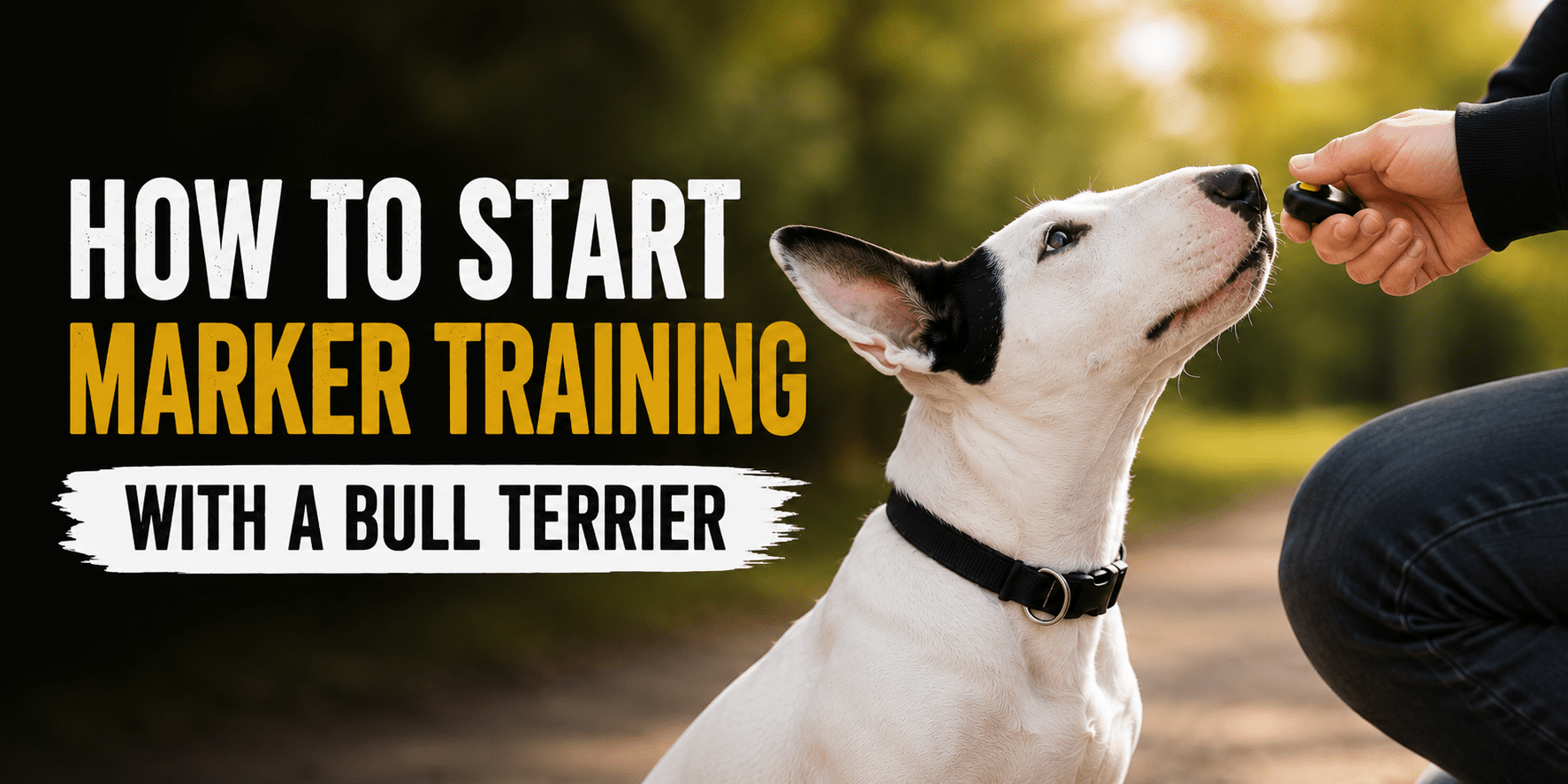
Bull Terrier Training, Timing & Clear Communication
How to Start Marker Training With a Bull Terrier
Bull Terrier marker training helps your dog understand the exact moment he made the right choice. This matters because a Bull Terrier does not only need to know what is wrong. He needs to understand exactly what is right.
This is where many owners struggle. They correct late. They reward late. They talk too much. They repeat commands. They say “good” at random moments. They give food after the dog has already moved on to another behaviour. Then they wonder why the Bull Terrier seems confused, stubborn, distracted, or inconsistent.
Often the dog is not the problem. The timing is.
A Bull Terrier needs clarity. He needs to know which behaviour earned the reward. He needs to understand the exact moment the owner liked. He needs communication that is clean, simple, and consistent. Marker training helps with that.
Bull Terrier marker training uses a clear signal, such as “Yes” or a clicker, to tell the dog exactly which behaviour earned the reward. The correct order is behaviour, marker, reward. Marker training improves timing, eye contact, focus, recall, leash work, calmness, place training, and obedience because the Bull Terrier learns what worked instead of guessing.
Bull Terrier Marker Training: Why Timing Matters
Dogs learn from consequences, but those consequences must be connected to the correct behaviour. If your Bull Terrier sits and you reward three seconds later after he has already stood up, he may not understand that the sit earned the reward.
If he looks at you, then sniffs the ground, then receives food, he may not understand that eye contact was the valuable behaviour. If he comes toward you, then jumps, then gets the reward, he may think jumping was part of the answer.
The marker captures the exact moment. The dog looks at you: “Yes.” Reward. The dog puts his paws on the place mat: “Yes.” Reward. The dog turns when you say his name: “Yes.” Reward. The dog walks beside you for one step: “Yes.” Reward.
That kind of precision is extremely useful with Bull Terriers because they often move quickly, think physically, and offer behaviour with intensity. If the owner is late, the dog may attach the reward to the wrong thing.
Good marker timing turns training into a clear conversation. Bad timing turns training into guessing.
What Is a Marker in Dog Training?
A marker is a clear signal that tells the dog: “Yes. That behaviour. That moment. That is what I wanted.”
It can be a word like “Yes.” It can be a clicker. It can be another short sound, as long as it is consistent.
The marker bridges the gap between the behaviour and the reward. Without that bridge, many dogs simply eat the food but do not understand what they did to earn it.
With Bull Terriers, this matters because when the breed understands the game, many become more engaged, focused, and willing to participate. But when the picture is unclear, they can quickly become frustrated, distracted, overexcited, or uninterested.
For a general external explanation, the American Kennel Club describes clicker training as “mark and reward” training, where a clicker or marker is repeatedly associated with a treat or reward so reinforcement can become more precise: clicker training and mark-and-reward training.
A Marker Is Not the Reward
The marker is not the reward itself. The marker is the signal that a reward is coming.
Many owners say “yes” but then do not reward consistently. The word becomes weak. The dog hears it but does not care. Other owners click or mark randomly without following through. The marker loses meaning.
At the beginning, the marker must be followed by something valuable. Usually food is easiest. Say “Yes,” then give food. Or click, then give food. The dog learns that the sound predicts reward.
Once that association is strong, the marker becomes powerful because it creates expectation. The dog hears the marker and understands that he did something right.
Do not weaken the marker too early. At the beginning, marker means reward is coming. Keep that promise clear before you start varying rewards.
Choosing a Marker Word
For most owners, a verbal marker is easier than a clicker because it is always available. The word “Yes” works very well. It is short, clear, easy to say, and easy to use in real life.
- Use one clear marker at first.
- Do not use five different words randomly.
- Do not stretch the marker into emotional praise.
- Do not say the marker casually if the dog is still learning the meaning.
- Mark once, then reward.
A clicker can also work well because the sound is precise and consistent. But many real-life moments happen during walks, play, calmness work, leash focus, recall foundations, crate training, and everyday household routines. A verbal marker is always with you.
The tool does not matter as much as clarity. One marker. Same meaning. Good timing. Reward follows.
Charging the Marker
Before using the marker for training, the dog must learn what it means. This is often called charging the marker. It simply means pairing the marker with reward until the dog understands the connection.
Start somewhere boring. No other dogs, no visitors, no heavy distractions, no pressure. The goal is clean association, not performance.
Say “Yes” clearly, or click once if using a clicker. Do not ask for sit, down, eye contact, or anything complicated yet.
After the marker, give a small food reward. Pause, then repeat. Keep the rhythm simple: marker, reward. Marker, reward.
A Bull Terrier does not need a long lecture. He needs clean repetition. A few short sessions are better than one long, messy session.
The Simple Formula: Behaviour, Marker, Reward
Once the marker has meaning, begin using it with simple behaviours.
The dog looks at you. “Yes.” Reward. The dog comes toward you. “Yes.” Reward. The dog sits. “Yes.” Reward. The dog steps onto the place mat. “Yes.” Reward.
The key is this: mark first, then reward. Do not move the food before marking if the movement of the food distracts the dog. Do not reward first and mark after. The marker should identify the moment, then the reward should follow.
The order matters: behaviour, marker, reward. This simple order builds clean communication.
Start With Easy Behaviours
Do not begin marker training in the hardest situation. Start with easy behaviours in a calm environment.
Say the dog’s name. Mark the moment he turns toward you. Reward.
Mark the exact second your Bull Terrier looks at you, even if the glance is very short at first.
Mark when the nose touches your hand. This becomes useful for redirection and movement.
Mark the moment paws touch the mat, bed, platform, or place board.
Mark calm choices, not only active obedience. Calmness also needs clarity.
Mark the moment the dog looks back, slows down, or reconnects during easy walking.
If you begin around heavy distractions, the dog may be too excited, too stimulated, or too locked into the environment to learn clearly. Build the system where the dog can succeed first, then bring it into harder places gradually.
If your Bull Terrier struggles with attention, leash focus, recall foundations, or engagement outside, marker training gives you a cleaner way to reward the exact moment the dog reconnects with you.
Where Marker Training Helps Most
Marker training is not only for tricks. It supports the foundation behind better Bull Terrier training because it gives the dog clean information in real moments.
Instead of feeding randomly, you can mark the exact second the dog looks at you. Over time, the dog learns that attention pays.
Outside, your Bull Terrier may check in for half a second before looking back at the environment. With a marker, you can capture it and reward reconnection.
Marker training lets you reward loose lead moments, moving beside you, turning with you, slowing down, or checking in before pulling.
Do not wait for perfect long-distance recall. Mark small pieces: the dog turns toward you, takes one step in your direction, arrives close, or checks in during movement.
You can mark lying quietly, staying on place, watching movement without jumping, settling after play, or choosing a chew instead of biting hands.
Bull Terriers can become frustrated when they do not understand the game. A marker reduces guessing and helps the dog understand which behaviour worked.
Marker Training Helps Build Calmness
Many owners only use marker training for active obedience, but calm behaviours also need clarity.
The dog lies quietly. “Yes.” Reward calmly. The dog stays on the place mat. “Yes.” Reward. The dog watches movement without jumping. “Yes.” Reward. The dog settles after play. “Yes.” Reward.
With Bull Terriers, this is important because many of them get attention when they are loud, physical, funny, or dramatic. Marker training allows the owner to show the dog that calm choices are valuable too.
Do not make the reward too exciting when marking calmness. Use quiet food delivery, calm praise, or gentle reward placement. The marker gives clarity, but the reward style should match the behaviour you want to encourage.
Do Not Confuse the Marker With the Release Word
For many owners, it is better to keep the marker and release word separate.
The marker means: that was correct, reward is coming. The release word means: you may leave that position now.
If your marker always releases the dog, then marking a sit, down, place, or stay may cause the dog to move before you want him to. That can create confusion later when building duration.
You can use “Yes” as the marker and “Free” as the release. The exact words matter less than the dog understanding the difference.
Common Marker Training Mistakes
Marker training is simple, but timing and consistency matter. These are the mistakes that most often weaken the system.
If the dog sits, then jumps, and you mark after the jump, the timing may reward the jump.
At the beginning, this weakens the marker. The word becomes noise instead of a promise.
“Yes, good, nice, okay, well done” can become messy if the dog does not know which word matters.
If the treat hand appears before the marker, the dog may follow food instead of learning what earned it.
Do not teach the marker for the first time around dogs, visitors, heavy smells, or high excitement.
Keep it clean. One marker. Reward follows. Save the long praise for later.
How to Start Marker Training Step by Step
- Choose your marker word, usually “Yes.”
- Start in a quiet place with small food rewards.
- Say the marker, then give food.
- Repeat over short sessions until the dog understands that the marker predicts reward.
- Begin marking easy behaviours like eye contact, name response, sit, hand target, or place.
- Mark the exact moment the dog does the right thing.
- Reward after the marker.
- Keep sessions short and successful.
- Gradually use the marker in real life: walks, calmness, recall foundations, leash focus, and household routines.
The formula stays simple: behaviour, marker, reward. That is the foundation.
If your Bull Terrier is inconsistent, distracted, overexcited, or confused during training, do not only add more commands. Improve timing, reward clarity, state, structure, and engagement first.
How You Know Marker Training Is Working
- Your Bull Terrier hears “Yes” and expects reward.
- He begins offering behaviours more clearly.
- He checks in more often.
- He understands training faster.
- He becomes easier to redirect.
- He connects the reward to the correct moment.
- He shows less confusion during simple training tasks.
This does not mean the dog instantly becomes perfect. It means communication becomes cleaner. Cleaner communication creates better training.
Final Thought
Marker training is not magic. But it is one of the simplest ways to make training clearer.
A Bull Terrier does not need endless talking, late rewards, repeated commands, and emotional correction. He needs precise communication. He needs to know what worked. He needs the owner to mark the right moment and reward in a way that makes sense.
When the marker is clear, the dog starts understanding faster. When the dog understands faster, training becomes less frustrating. And when training becomes less frustrating, the Bull Terrier becomes more willing to engage.
That is why marker training is such a valuable foundation. Not because it replaces relationship, structure, or consistency, but because it gives all of them better timing.
Frequently Asked Questions About Bull Terrier Marker Training
Bull Terrier marker training uses a clear signal, such as “Yes” or a clicker, to mark the exact moment the dog does the right behaviour. The marker tells the dog a reward is coming for that specific choice.
“Yes” is usually a good marker word because it is short, clear, and easy to use. The exact word matters less than consistency, timing, and always rewarding after the marker at the beginning.
No. The marker is not the reward. The marker tells the dog that the reward is coming and identifies which behaviour earned it.
In a quiet place, say your marker word or click once, then give food. Repeat several times over short sessions until the dog understands that the marker predicts reward.
Yes. Marker training can help you reward check-ins, loose lead moments, turning with the handler, and slowing down before the dog pulls. It helps the dog understand what works during the walk.
Yes. You can mark calm behaviours such as lying quietly, staying on place, watching movement without jumping, or settling after play. Use calm reward delivery so the reward style supports the behaviour you want.
Leave a Reply