
Bull Terrier Quirks, Communication & Owner Understanding
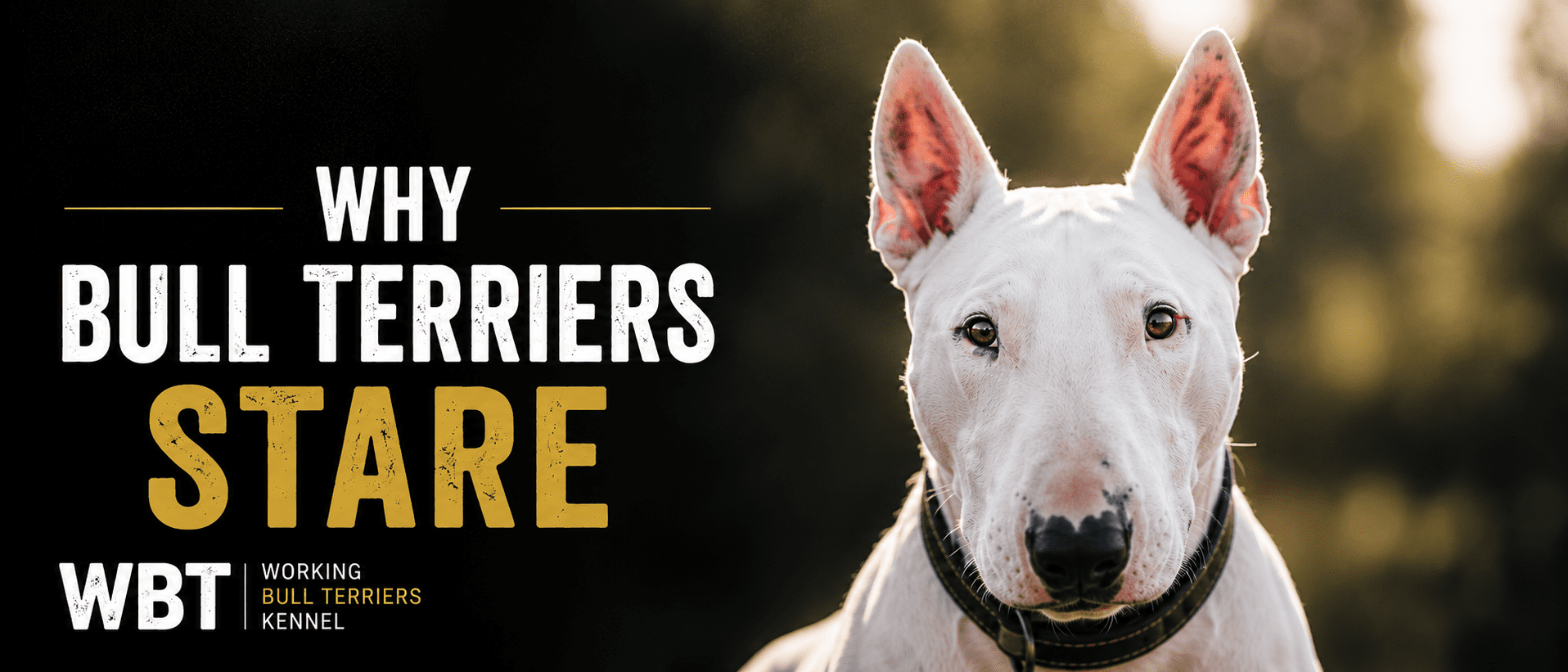
Why Bull Terriers Stare
Bull Terriers stare in a way that can feel funny, intense, dramatic, and sometimes slightly uncomfortable. They may stare from across the room, stare while standing beside you, stare at a door, stare at food, stare before zoomies, stare when they want something, or stare with the full seriousness of a dog who believes a major negotiation is about to begin.
For many owners, the Bull Terrier stare is one of the most recognizable breed behaviours. It can be charming. It can be confusing. And in some cases, it can also be useful information about the dog’s state of mind.
The mistake is treating every stare as the same thing. Sometimes a Bull Terrier is communicating. Sometimes he is waiting. Sometimes he is studying you. Sometimes he is building excitement. Sometimes he is stuck, frustrated, or beginning to fixate. The owner’s job is not to panic, but to read the pattern.
Bull Terriers stare because they are highly expressive, observant, and pattern-driven dogs. A stare can mean attention, expectation, affection, confusion, food interest, play anticipation, frustration, fixation, or a learned way to get a response from the owner. Most staring is normal, but staring becomes more important when it is intense, stiff, difficult to interrupt, connected to guarding, or followed by reactive or pushy behaviour.
Is Staring Normal in Bull Terriers?
Yes, staring can be completely normal in Bull Terriers. This breed is visually expressive and often very aware of people, routines, objects, and patterns. Many Bull Terriers do not simply exist quietly in the background. They watch. They study. They wait. They notice what usually happens next.
If you touch the lead, they may stare. If you open the treat cupboard, they may stare. If you sit in “their” chair, they may stare. If dinner time is approaching, they may stare with the emotional intensity of a dog preparing legal arguments.
This kind of staring is usually harmless. It often belongs to the wider group of Bull Terrier quirks and breed-specific behaviour. It becomes part of life with the breed.
The stare itself is not the whole story. The important question is what the body is doing with the stare: relaxed, soft, playful, expectant, stiff, frustrated, guarding, or locked on.
Seven Reasons Bull Terriers Stare
A Bull Terrier stare can have different meanings depending on the situation. The same dog may stare for affection in one moment, stare for food in another, and stare because he is locking onto a trigger outside.
That is why context matters.
Bull Terriers are often very good at learning household routines. They know which shoes mean a walk, which cupboard means food, which tone means attention, and which movement means something interesting is about to happen.
When your Bull Terrier stares at you, he may be reading the next step. He is not only looking at your face. He is watching your hands, your posture, your routine, your timing, and the small details you may not even notice yourself.
Sometimes the Bull Terrier stare is not mysterious at all. The dog wants food, a toy, a walk, a door opened, your seat, your attention, or the thing you are holding.
If staring has worked before, the dog may use it again. Many owners accidentally reinforce the stare by laughing, feeding, talking, moving, or giving the dog exactly what he wanted. The dog learns that intense eye contact can operate the human.
Not every stare is demanding. In a well-built relationship, a Bull Terrier may stare because he is waiting for information. He may be asking, “What now?” or checking whether the owner is about to give a cue.
This is where staring can connect positively to focus and engagement. A dog who naturally checks in can become easier to guide if the owner gives that attention a clear training purpose. For that route, continue through Bull Terrier Focus & Engagement.
Some Bull Terriers stare because they are connected to their person. They may watch you quietly from the sofa, stare while leaning against you, or follow you with their eyes when you move around the house.
If the body is soft, the face is relaxed, the dog is loose, and the stare is easy to interrupt, this is usually not a concern. It is often part of the dog’s relationship with the owner.
A Bull Terrier may stare when he does not understand what the owner wants. This can happen during training, household rules, doorway routines, visitor situations, or moments where the owner sends mixed signals.
If one person allows a behaviour and another person corrects it, the dog may stare because he is reading the room. He is trying to work out which rule applies today.
Some stares happen before action. The Bull Terrier freezes for a second, locks his eyes, and then launches into zoomies, toy grabbing, jumping, spinning, or rough play.
This does not always mean there is a serious problem, but it tells the owner something important: arousal is rising. If the dog often goes from staring to chaos, the owner should intervene earlier with structure, movement, a calm cue, or a different outlet.
This is the stare owners must read carefully. Fixation is different from relaxed watching. A fixed stare may come with a stiff body, closed mouth, forward weight, hard eyes, slow breathing, tension, guarding, or difficulty responding to the owner.
Fixation can appear around dogs, visitors, food, toys, movement, cats, children running, or anything the dog finds too exciting or threatening. This is where staring moves from quirky to important.
If the staring is soft, relaxed, and easy to interrupt, it is often just communication or personality. If the stare is hard, stiff, repeated, difficult to break, or followed by lunging, guarding, barking, snapping, chasing, or rough behaviour, read the wider pattern before guessing.
Soft Stare vs Hard Stare
The difference between a normal Bull Terrier stare and a concerning stare is usually found in the rest of the body.
A soft stare may come with a loose body, relaxed mouth, normal blinking, curved posture, wagging tail, easy movement, and quick recovery when the owner speaks or moves away. The dog is watching, asking, waiting, or connecting.
A hard stare is different. The dog may become still, tall, stiff, silent, forward, closed-mouthed, and difficult to interrupt. The eyes may look locked rather than curious. The body may stop moving. The dog may ignore the owner because the target has become more important.
- Soft stare: loose body, relaxed face, easy to interrupt, often social or expectant.
- Hard stare: stiff body, fixed eyes, closed mouth, difficult to interrupt, often linked to rising arousal or fixation.
- Soft stare usually belongs to communication, affection, habit, or curiosity.
- Hard stare needs more attention because it may appear before chasing, guarding, reactivity, or conflict.
Do not punish the stare without understanding it. A stare is information. If you suppress the signal without changing the pattern underneath, the dog may stop showing you useful warning signs while the emotion remains.
When Should You Interrupt a Bull Terrier Stare?
You do not need to interrupt every stare. If your Bull Terrier is relaxed, calm, and simply watching you, there may be nothing to fix. But you should interrupt earlier when the stare is becoming intense, pushy, demanding, or connected to behaviour you do not want.
The best interruption is not panic. It is calm redirection before the dog escalates.
- Call the dog away before the stare becomes locked.
- Use a known hand target, name response, or movement cue.
- Create distance from the trigger if the dog cannot disengage.
- Reward the dog for turning back to you.
- Do not wait until the dog is already barking, lunging, grabbing, or guarding.
- Do not turn the stare into a long argument or emotional confrontation.
If your Bull Terrier struggles to turn away from distractions, the issue may not be the stare itself. It may be an engagement problem. In that case, the next route is Bull Terrier Focus & Engagement and practical focus work.
How Owners Accidentally Reinforce Staring
Bull Terriers are excellent at finding patterns that work. If staring produces food, attention, movement, laughter, access, or negotiation, the dog may use it again.
This does not mean owners should ignore the dog completely. It means owners should be conscious about what the stare is earning.
If the dog stares at your plate and receives food, the stare becomes a begging tool. If the dog stares at a toy and you immediately play every time, the stare may become a demand. If the dog stares at the door and you always open it, the stare becomes a button.
The solution is not to remove communication. The solution is to add structure. Teach the dog that calm behaviour, clear cues, and appropriate waiting create access — not pressure.
With Bull Terriers, the question is not only what the dog is doing. The question is what the dog has learned that behaviour achieves.
Can You Use the Bull Terrier Stare in Training?
Yes, but only if you shape it properly. Many owners fight for attention when the dog is distracted, but ignore all the moments when the dog naturally offers attention at home.
If your Bull Terrier looks at you calmly, mark and reward that moment sometimes. If he checks in on a walk, acknowledge it. If he looks back before pulling toward something, reward the choice to reconnect. This turns natural staring into useful engagement.
The goal is not to create a dog who stares at you every second. The goal is to create a dog who knows how to come back to you mentally.
This connects directly to the WBT Method: relationship, clarity, structure, and state matter before obedience becomes reliable.

If your Bull Terrier’s strange habits confuse you, the WBT Quirks guide helps you understand what is normal, what needs structure, and what should not be ignored.
When Bull Terrier Staring Becomes a Concern
Staring becomes more concerning when it is no longer relaxed, social, or easy to interrupt. The stare matters more when it appears as part of a bigger behaviour pattern.
Pay attention if staring is connected to:
- Guarding food, toys, furniture, stolen objects, people, or spaces.
- Stiffness around other dogs, cats, children, or visitors.
- Hard fixation before lunging, chasing, barking, or grabbing.
- Slow, tense staring when someone approaches the dog’s resting area.
- Staring that cannot be interrupted with normal cues.
- Staring followed by snapping, biting, redirecting, or rough behaviour.
- A sudden change in behaviour that feels unusual for that dog.
These signs do not mean the dog is bad. They mean the owner should stop treating the stare as a joke and start reading the pattern more carefully.
For serious or confusing cases, use the WBT Quick Diagnostic so the next step is based on your actual dog, not guesswork.
What Not to Do When Your Bull Terrier Stares
Many owners either laugh at every stare or become uncomfortable and overreact. Neither extreme is ideal. The goal is calm interpretation.
- Do not assume every stare is aggression.
- Do not assume every stare is harmless.
- Do not reward demanding staring every time the dog wants something.
- Do not punish warning signals without understanding the underlying state.
- Do not stare back intensely at a dog who is stiff, guarding, or already tense.
- Do not wait until fixation becomes lunging, chasing, or grabbing.
- Do not ignore repeated patterns just because they look funny at first.
Final Thought
Bull Terriers stare because they are expressive, observant, emotional, and highly tuned into patterns. Sometimes the stare is affection. Sometimes it is expectation. Sometimes it is communication. Sometimes it is a demand. And sometimes it is the first visible sign that arousal, frustration, or fixation is rising.
The stare itself is not the enemy. It is information.
A good owner learns to read whether the dog is soft, connected, curious, pushy, confused, tense, or locked on. That is where real understanding begins. Not by labelling every behaviour as bad, and not by excusing everything as “just Bull Terrier personality,” but by reading the dog in front of you.
The Bull Terrier stare may always be part of the breed’s charm. But with the right owner, it can also become part of better communication, better engagement, and a stronger relationship.
Frequently Asked Questions About Bull Terriers Staring
Your Bull Terrier may stare because he wants something, expects a routine, is looking for direction, feels connected to you, is confused, or has learned that staring gets a response. The meaning depends on the body language and situation.
Yes, staring can be normal for Bull Terriers. They are expressive, observant dogs that often watch people and routines closely. It becomes more important when the stare is stiff, intense, difficult to interrupt, or connected to guarding, reactivity, or rough behaviour.
Not always. Many Bull Terrier stares are harmless or social. However, a hard stare with stiffness, closed mouth, forward weight, guarding, or fixation may be a warning sign and should be taken seriously.
If the dog is relaxed and social, normal eye contact is usually not a problem. If the dog is stiff, guarding, tense, or fixated, do not turn it into a staring contest. Calmly create distance, redirect, or change the situation.
Do not automatically give the dog what he wants every time he stares. Teach a clearer behaviour such as sitting, waiting, going to place, or checking in calmly before access to food, toys, doors, or attention.
Worry when staring is hard, fixed, stiff, difficult to interrupt, connected to guarding, or followed by barking, lunging, chasing, snapping, biting, redirecting, or rough behaviour. In those cases, read the wider behaviour pattern.