
Bull Terrier Quirks, Trance-Like Behaviour & Pattern Reading
Bull Terrier Trancing: Harmless Quirk, Breed Oddity, or Behavioural Warning Sign?
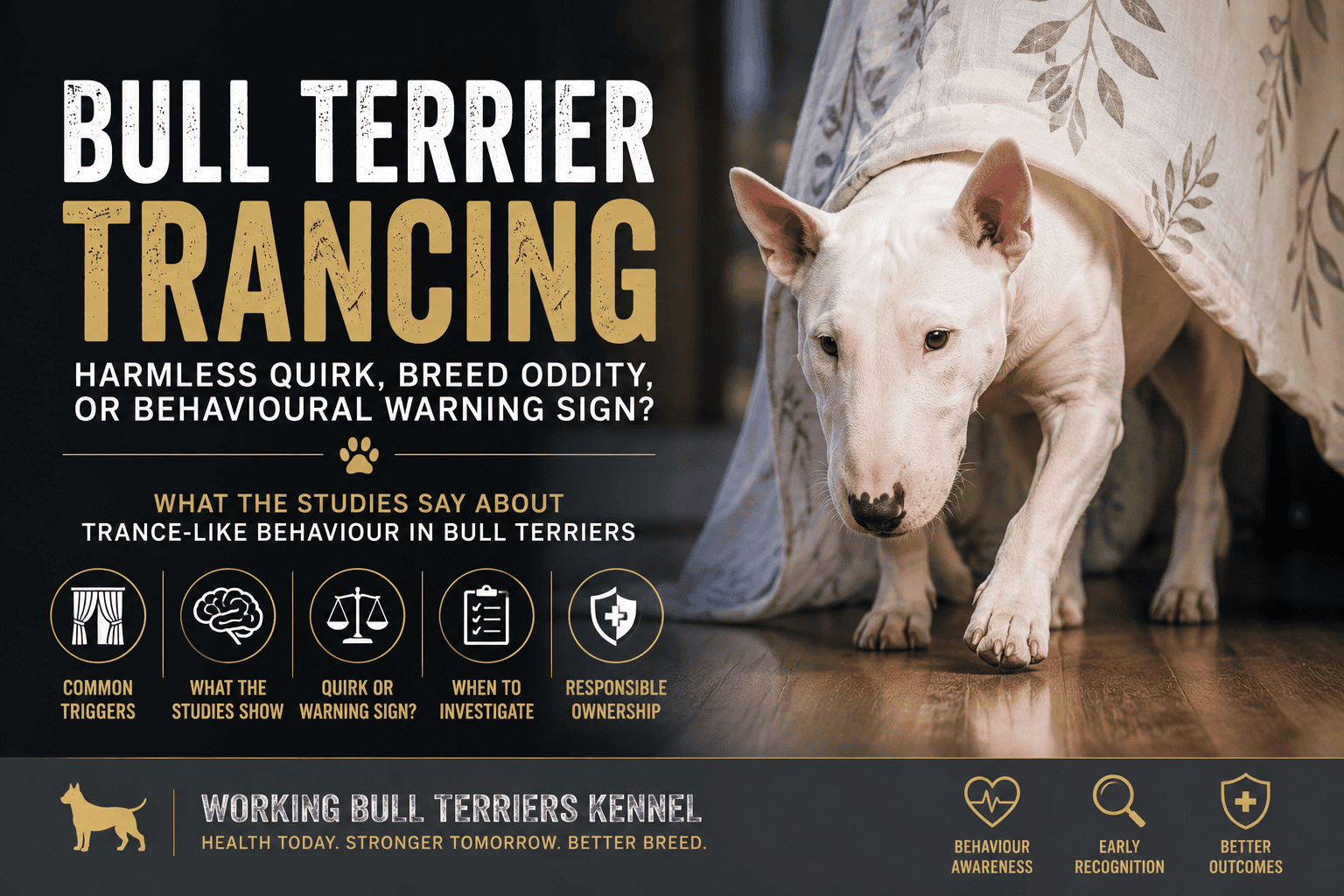
Bull Terrier trancing is one of the breed’s strangest and most fascinating behaviours. The dog slows down, moves deliberately under curtains, plants, hanging clothes, tablecloths, or anything that lightly brushes along the back, and may look as if it has entered another world.
Owners call it trancing, ghost walking, weed walking, or simply “that weird Bull Terrier thing.” In many dogs, that may be exactly what it is: a strange, harmless breed-associated behaviour that causes no obvious distress and ends without consequence.
But the serious question is this: when is trancing just a quirk, and when is trance-like behaviour part of a deeper behavioural or neurological pattern?
This article does not claim that every Bull Terrier who trances is sick. It also does not dismiss altered-state behaviour as comedy by default. Serious Bull Terrier education must separate harmless breed oddities from behaviours that deserve closer attention.
Bull Terrier trancing can be harmless when the dog slowly ghost-walks under curtains or plants, remains responsive, shows no distress, and returns to normal. It becomes more concerning when the dog freezes, becomes hard to interrupt, seems disconnected, shows glazed eyes, becomes aggressive when interrupted, or also shows tail chasing, fly snapping, light chasing, pacing, obsessive licking, collapse, seizures, or abnormal recovery.
Important note: This article is educational and breed-specific, but it is not a diagnosis. If your Bull Terrier shows loss of awareness, collapse, seizure-like activity, sudden aggression, severe disorientation, or escalating repetitive behaviours, involve a veterinarian and bring video if possible.
Why Bull Terrier Trancing Deserves a Serious Article
Most online discussions about Bull Terrier trancing are casual. They describe it as funny, strange, harmless, or mysterious. Owners laugh about the dog walking slowly under curtains or becoming hypnotized by a plant. In many cases, that relaxed attitude may be reasonable.
But veterinary literature uses a more serious phrase: trance-like behaviour.
In the 2011 JAVMA study “Characteristics of compulsive tail chasing and associated risk factors in Bull Terriers,” the researchers studied 333 Bull Terriers, including 145 dogs with tail-chasing behaviour and 188 unaffected dogs. Although the paper focused on tail chasing, one important finding was a close association between tail chasing, episodic aggression, and trance-like behaviour.
That does not mean trancing causes tail chasing. It does not mean every trancing Bull Terrier will become compulsive. It does not mean every ghost-walking dog has a neurological disorder.
The responsible position is balanced: normal trancing may be harmless, but trance-like behaviour combined with other concerning signs deserves attention.
What We Mean by Bull Terrier Trancing
In everyday Bull Terrier language, trancing usually describes a dog that moves slowly and deliberately under or against something that lightly touches the body.
Curtains, hanging clothes, plants, bushes, tablecloths, low branches, fabric edges, or anything brushing along the back.
The dog may look absorbed, dreamy, slow, careful, or detached while moving in a very deliberate way.
Many dogs return to normal immediately after the episode and show no distress or dysfunction.
The same word may also describe freezing, staring, unresponsiveness, or altered awareness.
This kind of trancing is usually very different from panic, rage, collapse, or obvious seizure activity. However, the word “trancing” can be used loosely by owners. One person may use it to describe harmless ghost walking under a curtain. Another may use it to describe a dog freezing, staring, becoming unresponsive, or showing altered awareness before another behavioural episode.
The Key Study: Trance-Like Behaviour in 333 Bull Terriers
The 2011 JAVMA study is important because it did not simply collect funny owner stories. It used survey and case-control methods to compare affected and unaffected Bull Terriers.
The researchers collected information on tail chasing, sex, coat colour, phobias, noise sensitivity, owner-directed aggression, episodic aggression, seizure history, skin allergies, and trance-like behaviour.
In the final analysis, trance-like behaviour showed a significant interaction with tail chasing. The paper concluded that a close association of tail chasing with trance-like behaviour and episodic aggression was identified.
This does not prove that trancing is dangerous. It does not prove that trancing causes compulsive behaviour. It does not prove that trancing is always pathological. What it shows is that, in this Bull Terrier study population, trance-like behaviour was one of the behaviours discussed seriously enough to matter.
A harmless ghost walk is one thing. Trance-like behaviour appearing together with tail chasing, fly snapping, freezing, light chasing, pacing, obsessive licking, aggression, or poor responsiveness deserves better pattern reading.
Harmless Trancing vs Concerning Trance-Like Behaviour
A Bull Terrier slowly ghost-walking under a curtain for a minute and then returning to normal may not be a problem. But trance-like behaviour becomes more concerning when it appears with other signs.
The dog slowly walks under curtains, plants, clothing, or fabric, remains responsive, appears relaxed, stops easily, shows no distress, and returns to normal behaviour afterwards.
The dog freezes, becomes difficult to interrupt, seems unaware of the environment, stares blankly, has glazed eyes, becomes aggressive when interrupted, or also shows tail chasing, fly snapping, shadow chasing, pacing, obsessive licking, collapse, seizures, or abnormal recovery.
The 2011 JAVMA paper described episodic aggression as sudden, violent, unpredictable attacks with little or no provocation, sometimes preceded by a short transition state in which the eyes glaze. That does not mean normal trancing equals aggression, but it does show why altered-state behaviours in Bull Terriers must be described accurately, not casually.
A slow ghost walk under curtains is one thing. A dog that freezes, disconnects, becomes unresponsive, then explodes or enters another repetitive behaviour is another.
Why Owners Should Not Panic
Many Bull Terriers trance and live normal lives. A dog that occasionally walks slowly under a plant or curtain, remains responsive, shows no distress, and returns to normal behaviour is not automatically a medical case.
Owners should not read one study and start diagnosing their dog. The mistake would be to say, “My Bull Terrier trances, therefore something is wrong.” A better response is: “My Bull Terrier trances. I should observe the context, responsiveness, frequency, and whether any other concerning signs are present.”
Why Owners Should Not Laugh Everything Off Either
The opposite mistake is also common. Some owners dismiss every strange Bull Terrier behaviour as comedy.
“He is just being a bully.” “They are all weird.” “That is just the breed.” “He has always done that.” “It is funny.”
Sometimes that is true. But sometimes “funny” is the first stage of something that deserves attention. Serious Bull Terrier people should avoid two extremes: do not panic over every trance, and do not dismiss every altered-state behaviour as harmless.
Is Trancing a Seizure?
Not usually. Many dogs that trance remain partly responsive, return to normal quickly, and show no collapse, paddling, loss of consciousness, drooling, urination, disorientation, or post-seizure confusion.
However, the Bull Terrier literature has discussed seizure-related hypotheses around certain abnormal behaviours, especially when trance-like episodes appear with altered awareness, episodic aggression, or compulsive patterns.
The 2011 JAVMA paper notes that one possible explanation for the relationship between tail chasing, trance-like behaviour, and episodic aggression is that they may stem from underlying complex partial seizures. The authors also stated that trance-like behaviour may represent a form of partial seizure in which consciousness is altered but not lost.
This is not a diagnosis for every trancing Bull Terrier. It is a warning against oversimplification.
Is Trancing a Compulsive Behaviour?
Sometimes it may simply be a repetitive, self-soothing, sensory behaviour. Sometimes it may be part of a broader compulsive pattern. Sometimes it may be harmless and isolated.
The current evidence does not allow us to put all Bull Terrier trancing into one box. This is why context matters.
A dog that occasionally ghosts under curtains and then goes back to normal life is very different from a dog that spends large amounts of time in repetitive behaviours, cannot settle, becomes distressed when interrupted, or has multiple related patterns such as tail chasing, fly snapping, light chasing, freezing, or pacing.
- Frequency matters.
- Intensity matters.
- Responsiveness matters.
- Whether the dog appears distressed matters.
- Whether the behaviour disrupts normal life matters.
- Whether it appears with aggression or other repetitive behaviours matters.
The Autism-Like Discussion: Use Careful Language
Some Bull Terrier research has discussed parallels between certain Bull Terrier behavioural clusters and features seen in human autism spectrum disorder.
This must be handled carefully. It is not correct to say, “Bull Terriers have autism.” Better wording is that some researchers have discussed whether certain Bull Terrier behavioural phenotypes, including repetitive behaviour, altered responsiveness, trance-like behaviour, object fixation, and episodic aggression, may share features with human neurodevelopmental or neuropsychiatric conditions.
For owners, the practical lesson is not to label the dog. The practical lesson is to observe the dog clearly.
How to Document Trancing Properly
If your Bull Terrier trances, do not just say “he does the weird thing.” Document it.
- Age when it started.
- How often it happens.
- How long each episode lasts.
- What triggers it.
- Whether the dog seeks specific objects.
- Whether the dog responds to name or touch.
- Whether the dog looks relaxed or distressed.
- Whether the dog can stop easily.
- What happens immediately before.
- What happens immediately after.
- Whether there is tail chasing, fly snapping, light chasing, freezing, pacing, or aggression.
- Whether episodes are increasing.
Short videos can also help a veterinarian, veterinary behaviourist, or experienced breed professional understand what is happening. The point is not to overreact. The point is to describe the behaviour accurately.
If trancing becomes hard to interrupt, appears with sudden aggression, freezing, tail chasing, seizure-like signs, or abnormal recovery, treat it as a pattern that deserves proper documentation and support.
When to Ask a Veterinarian
A veterinarian should be involved if trancing appears with sudden adult onset, loss of awareness, collapse, seizure-like movement, glazed eyes followed by aggression, episodes from sleep into sudden attack, severe disorientation after the episode, increasing frequency, distress, panic, injury, other neurological signs, or compulsive behaviours that interfere with normal life.
If possible, bring video. A vet cannot always interpret a strange Bull Terrier episode from a vague description. A clear video can be extremely useful.
What Owners Should Not Do
The wrong response can turn a harmless oddity into a bigger problem, or make a concerning pattern harder to understand.
- Do not punish the dog for trancing.
- Do not shout at the dog.
- Do not repeatedly startle or grab the dog during the episode.
- Do not encourage the behaviour for social media if the dog looks distressed or disconnected.
- Do not assume every trance is harmless.
- Do not assume every trance is disease.
- Do not diagnose epilepsy, autism, OCD, or neurological disease from a video online.
- Do not let breed humour replace breed responsibility.
The WBT Interpretation: Strange Does Not Always Mean Sick, But It Should Be Understood
Bull Terriers are strange dogs in beautiful ways. They sleep strangely, stare strangely, play strangely, move strangely, invent rituals, become obsessed with objects, and can be hilarious, intense, sensitive, stubborn, and deeply individual.
Trancing fits that world.
But serious Bull Terrier ownership means knowing the difference between a harmless ritual and a pattern that deserves attention. At Working Bull Terriers, we do not want owners to panic over every odd behaviour. But we also do not want owners to hide behind the phrase “it is just a Bull Terrier thing” when the dog may be showing a real behavioural or neurological pattern.
Final Thought
Bull Terrier trancing is one of the most fascinating behaviours in the breed. In many dogs, it may be harmless ghost walking — strange, slow, and oddly charming.
But in the scientific literature, trance-like behaviour also appears beside more serious behavioural patterns in Bull Terriers, including compulsive tail chasing and episodic aggression.
That does not make trancing dangerous by default. It makes context important.
A Bull Terrier who trances occasionally, stays responsive, and returns to normal is probably very different from a Bull Terrier who freezes, disconnects, becomes difficult to interrupt, shows glazed-eye episodes, or has sudden aggression or other repetitive behaviours.
The serious Bull Terrier owner does not laugh everything off. The serious Bull Terrier owner also does not panic. They watch. They record. They understand. And when the pattern looks wrong, they ask for proper help.
References and Study Links
- Moon-Fanelli AA, Dodman NH, Famula TR, Cottam N. Characteristics of compulsive tail chasing and associated risk factors in Bull Terriers. Journal of the American Veterinary Medical Association. 2011;238(7):883–889. Publisher link / PubMed
- CABI Animal Behaviour and Welfare Cases. Trancing-related case resource — pending title verification before detailed summary. Study link
Frequently Asked Questions About Bull Terrier Trancing
Bull Terrier trancing usually describes slow, deliberate ghost-walking under curtains, plants, clothing, tablecloths, or other objects that lightly brush the dog’s back.
In many dogs it may be harmless if the dog remains responsive, shows no distress, stops easily, and returns to normal. Context matters, especially if other abnormal behaviours are present.
Worry if the dog becomes unresponsive, freezes for long periods, shows glazed eyes, becomes aggressive when interrupted, has abnormal recovery, or also shows tail chasing, fly snapping, light chasing, pacing, obsessive licking, collapse, or seizure-like signs.
Usually no. Many trancing dogs remain partly responsive and return to normal quickly. But if episodes involve loss of awareness, collapse, severe disorientation, aggression, or seizure-like movement, veterinary assessment is sensible.
A 2011 Bull Terrier study found a close association between tail chasing, trance-like behaviour, and episodic aggression in the studied population. This does not mean trancing causes tail chasing, but it does mean context should be observed carefully.
Do not punish or startle the dog. If it is harmless and brief, calm observation may be enough. If it is hard to interrupt, increasing, distressing, or linked to other concerning signs, document it and ask for professional advice.