
Bull Terrier Behaviour, Compulsion & Neurological Warning Signs
Tail Chasing in Bull Terriers: Quirk, Compulsion, or Neurological Warning Sign?
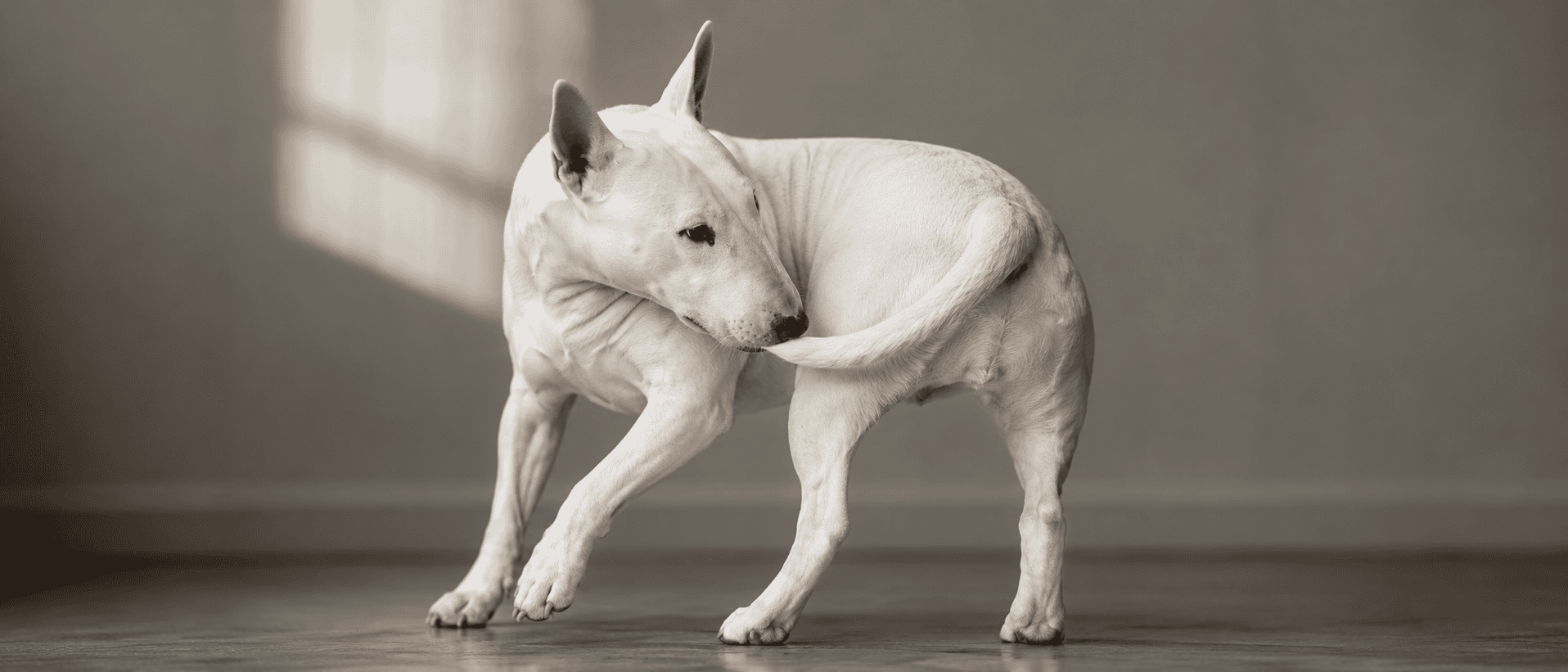
Bull Terrier tail chasing is one of the most misunderstood behaviours in the breed. To a casual observer, it may look funny. To an owner, it may look like a harmless quirk. But in some Bull Terriers, repetitive tail chasing can raise a much more serious question: is this play, stress, compulsion, or a neurological warning sign?
The answer is not always simple. Not every Bull Terrier who spins has a medical disorder. That would be irresponsible. But it is also wrong to dismiss every repetitive spinning pattern as “just a funny Bull Terrier thing.”
Bull Terriers are a breed where tail chasing has been studied seriously for decades. The scientific literature includes Bull Terrier-specific case reports, questionnaire studies, neurological findings, treatment reports, and research comparing tail chasing with compulsive and neurodevelopmental patterns.
The evidence sits in the middle. That is exactly where serious Bull Terrier owners, breeders, trainers, and veterinarians need to look.
Bull Terrier tail chasing can range from brief playful spinning to a serious repetitive behaviour pattern. Owners should worry when the dog chases daily, becomes hard to interrupt, seems disconnected, injures itself, shows trance-like behaviour, reacts aggressively when stopped, or also shows fly snapping, light chasing, freezing, pacing, or obsessive licking. Severe cases may need veterinary, behavioural, or neurological assessment.
Important health note: This article is educational and breed-specific, but it is not a diagnosis. If your Bull Terrier is injuring itself, losing awareness, showing seizure-like episodes, becoming aggressive when interrupted, or suddenly developing repetitive behaviour, speak with a veterinarian and consider a veterinary behaviourist or neurologist.
Why Bull Terriers Matter in the Tail-Chasing Literature
Tail chasing can occur in several breeds, but Bull Terriers appear repeatedly in the scientific literature because the behaviour has been observed with unusual frequency and severity in the breed.
A 2012 PLOS ONE study on compulsive tail chasing included Standard Bull Terriers, Miniature Bull Terriers, Staffordshire Bull Terriers, and German Shepherd Dogs. The authors described tail chasing as a classic compulsive behaviour and noted that it is suggested to have a genetic predisposition because it appears more often in certain breeds, including Bull Terriers.
This matters because Bull Terrier tail chasing is not simply treated as a cute breed habit in the literature. It has been examined as part of a broader clinical picture involving repetitive behaviour, arousal, responsiveness, neurological questions, and breed-specific risk.
The serious position is not panic and not dismissal. The serious position is pattern recognition.
The Difference Between Playful Spinning and Concerning Tail Chasing
Not every Bull Terrier who spins needs to be treated as a clinical case. Some dogs spin briefly during excitement. Some puppies discover their tail and chase it for a moment. Some Bull Terriers perform short bursts of silly behaviour and then stop easily when redirected.
That is very different from a dog who repeatedly disappears into the behaviour.
The dog spins briefly, remains aware of the owner, stops easily, can be redirected, does not injure itself, and returns to normal activity. This may still be worth monitoring, but it is not the same as a compulsive-looking pattern.
The dog chases repeatedly or daily, becomes hard to interrupt, seems disconnected, injures the tail or body, becomes distressed when stopped, or shows other repetitive behaviours such as fly snapping, light chasing, pacing, licking, or freezing.
One of the most important owner lessons is this: the question is not only “does the dog chase its tail?” The question is what happens to the dog’s awareness, control, and welfare when it does.
The Bull Terrier Case Report That Changed the Conversation
One of the most important early Bull Terrier papers is the 1993 case report “Tail chasing in a bull terrier” by Dodman, Bronson, and Gliatto.
This was not a casual behaviour note. The Bull Terrier was examined clinically, by electroencephalography, and by computed tomography of the head. According to the abstract, the dog appeared dissociated from its surroundings, the EEG revealed a seizure pattern most marked over the temporal lobe, and CT revealed mild hydrocephalus. Diazepam controlled the tail chasing, while naloxone did not. The dog was later euthanized after aggression developed.
This case does not prove that all Bull Terrier tail chasing is epilepsy. It does not prove that every spinning Bull Terrier has hydrocephalus. It does not mean every case should be treated with anticonvulsants.
But it does prove something important: in at least some Bull Terrier cases, severe tail chasing has been serious enough to justify neurological investigation.
If your Bull Terrier seems disconnected during tail chasing, becomes aggressive when interrupted, injures itself, or shows seizure-like or trance-like episodes, this is not a normal training question. Start documenting and involve a veterinarian.
The Compulsive Side: Tail Chasing as a Repetitive Behaviour Pattern
Another important research direction treats tail chasing as part of canine compulsive disorder. The 2012 PLOS ONE study described canine compulsive disorder examples such as excessive tail chasing, light or shadow chasing, and flank sucking.
Compulsive behaviour is not simply “bad behaviour.” It is not stubbornness. It is not the dog being naughty. A compulsive pattern is repetitive, difficult to interrupt, and often connected to arousal, stress, frustration, genetic predisposition, or altered behavioural regulation.
For Bull Terrier owners, this matters because trying to punish or physically fight the behaviour can make the overall problem worse. A dog already stuck in a repetitive loop may become more aroused, more defensive, or more frantic when the owner panics, shouts, chases, grabs, or repeatedly interrupts without changing the context.
Triggers: Boredom, Stress, Excitement, Frustration, and Arousal
The research does not support one single cause for all tail chasing. Owners in the PLOS ONE study most often linked tail chasing to boredom or lack of activity, stressful events, excitement, food, or frustration.
This matches what experienced Bull Terrier people often see in real life. A Bull Terrier may start spinning when under-stimulated, over-stimulated, frustrated, confined without enough decompression, unable to access something it wants, exposed to stress, overloaded by noise or movement, living without a clear routine, or repeatedly rehearsing the behaviour until it becomes self-reinforcing.
That last point matters. A behaviour can begin for one reason and continue for another. A dog may first chase its tail because of stress or arousal. But if the behaviour gives relief, releases energy, gains owner attention, or becomes neurologically rewarding, it may continue even when the original trigger is gone.
Other Behaviours That May Appear With Tail Chasing
Tail chasing should rarely be evaluated in isolation. In the PLOS ONE study, tail chasers were more likely than controls to show other repetitive or compulsive-type behaviours, including invisible fly or light chasing, licking, repetitive pacing, and freezing or trance-like behaviour.
This is a major point for Bull Terrier owners. A dog who chases the tail, stares at walls, freezes under curtains, snaps at invisible flies, chases shadows, or enters trance-like episodes is not necessarily showing five separate funny quirks.
Those behaviours may be different expressions of a wider arousal, sensory, neurological, or compulsive pattern.
- When does it happen?
- How long does it last?
- Does the dog respond to its name?
- What happens before the episode?
- What happens after?
- Can the dog eat, rest, sleep, and function normally?
- Is the behaviour increasing?
Good notes and videos can help a veterinarian, veterinary behaviourist, neurologist, or experienced breed specialist see patterns that a stressed owner may miss.
If tail chasing appears together with freezing, fly snapping, light chasing, obsessive licking, pacing, fear, aggression, or poor responsiveness, use the WBT behaviour routes to organize the pattern before guessing.
The Autism-Like Discussion: What We Can and Cannot Say
Some Bull Terrier tail-chasing research has discussed similarities between affected Bull Terriers and features seen in human neurodevelopmental conditions, including autism spectrum disorder.
This is a sensitive area and must be written carefully. It is not correct to casually say, “Bull Terriers have autism.” Dogs should not be given human psychiatric labels as if they are direct diagnoses.
The more responsible wording is that certain Bull Terrier tail-chasing cases have been explored as models or phenotypes that may share features with human neuropsychiatric conditions, especially repetitive behaviour, altered responsiveness, sensory sensitivity, and trance-like episodes.
For owners, the practical lesson is not to label the dog. The lesson is to take repetitive, hard-to-interrupt, sensory-linked behaviour seriously.
Noise Sensitivity, Shyness, and Sensory Patterns
Research also suggests that tail-chasing dogs may differ in personality and sensitivity. The PLOS ONE study reported that tail chasers were generally shyer than non-tail-chasers, and when breeds were analyzed separately, the statistically significant personality difference was found in Bull Terriers.
This challenges the simplistic idea that tail chasing is only caused by “too much energy.” Energy can be part of the picture, but some affected dogs may also be more sensitive, more easily stressed, more reactive to noise, or more likely to retain frightening experiences.
A serious plan should include physical outlets, yes, but also predictable routine, decompression, sleep, calm structure, environmental management, and veterinary screening when red flags are present.
Genetics: Likely Influence, But Not a Simple Answer
The studies suggest a genetic component, but not a simple one. The PLOS ONE authors reported pedigrees with several affected individuals across litters and generations, suggesting genetic influence. However, their candidate gene analysis did not find an association between tail chasing and the CDH2 locus in the studied breeds.
It is fair to say that Bull Terrier tail chasing may have genetic and breed-related influences. It is not fair to say there is one simple tail-chasing gene that explains every case.
Genetics may load the gun, but environment, stress, arousal, early development, health, owner response, and repetition may all help pull the trigger.
Zinc, Copper, and the Old Bull Terrier Question
Bull Terriers also have a history of research around zinc, lethal acrodermatitis, and tail-chasing behaviour. One study linked in the research chain looked at serum concentrations of zinc and copper in Bull Terriers with lethal acrodermatitis and tail-chasing behaviour.
The PLOS ONE paper notes that this earlier investigation did not find an association between zinc, copper, iron, and compulsive tail chasing in Bull Terriers.
That matters because zinc is often discussed casually in Bull Terrier circles. Zinc is important in the breed, especially in relation to skin and lethal acrodermatitis, but we should not turn every tail-chasing case into a simple “zinc problem.”
Responsible distinction: nutritional status may be relevant in some cases, but the Bull Terrier zinc/copper study did not prove that tail chasing is simply caused by zinc deficiency.
Treatment: Why Medication Appears in the Literature
Some of the studies and case reports include medication, including anticonvulsants, clomipramine, fluoxetine, diazepam, and other approaches. This does not mean owners should medicate dogs casually.
It means severe cases have sometimes been treated as clinical disorders rather than ordinary training problems.
Training matters, but some cases are not only training cases. If the dog is injuring itself, losing awareness, becoming aggressive when interrupted, chasing daily, showing seizure-like episodes, or failing to respond to proper management, the owner should involve a veterinarian and preferably a veterinary behaviourist or neurologist.
A good trainer should know when the case has moved beyond ordinary obedience.
What Owners Should Watch For
A Bull Terrier who spins once in a while during play is not the same as a Bull Terrier who disappears into repetitive tail chasing.
Frequency matters. A behaviour that repeats often deserves documentation and assessment.
If the dog cannot respond to name, food, movement, or normal redirection, take it more seriously.
Trance-like staring, freezing, dissociation, or odd recovery afterwards are important warning signs.
Tail wounds, foot damage, skin trauma, head impacts, or exhaustion mean the behaviour is affecting welfare.
Fly snapping, light chasing, pacing, freezing, obsessive licking, or wall staring may be part of a larger pattern.
If interruption triggers aggression, do not physically fight the episode. Get professional help.
What Owners Should Not Do
Owners often make the problem worse by responding emotionally. The wrong response can add arousal, fear, attention, frustration, or conflict, all of which may strengthen the loop.
- Do not laugh and encourage the behaviour for entertainment.
- Do not repeatedly film and excite the dog during episodes.
- Do not shout at the dog.
- Do not chase the dog around the room.
- Do not grab the dog roughly mid-episode.
- Do not punish the dog for a behaviour it may not fully control.
- Do not use exhaustion as the only solution.
- Do not assume it is “just Bull Terrier madness.”
- Do not assume it is always OCD, epilepsy, autism, or zinc deficiency without assessment.
A Serious WBT Interpretation
Tail chasing in Bull Terriers should be understood as a spectrum.
At one end, there is brief playful spinning. At the other end, there are dogs with repetitive, hard-to-interrupt, distressing, self-injurious, or neurologically suspicious episodes.
Between those two ends are many dogs whose behaviour is shaped by genetics, arousal, frustration, stress, sensory sensitivity, boredom, owner response, and daily routine.
The serious Bull Terrier approach is not panic and not dismissal. It is pattern recognition.
- How often does it happen?
- Can the dog stop?
- Does the dog respond during the episode?
- What triggers it?
- Is the behaviour increasing?
- Are there other repetitive behaviours?
- Is the dog’s welfare affected?
- Does this need veterinary investigation?
If your Bull Terrier is showing repetitive tail chasing together with arousal, poor focus, reactivity, fear, freezing, overexcitement, or difficult interruption, the first step is not guessing. Use WBT routes to organize the case, then involve veterinary support when red flags are present.
Final Thought
Tail chasing is one of the best examples of why Bull Terriers need breed-specific knowledge.
In another breed, it may be treated as a simple funny habit. In Bull Terriers, the literature tells us to look deeper.
Not every spinning Bull Terrier is sick. Not every tail chaser needs medication. Not every case is neurological. Not every case is compulsive.
But when a Bull Terrier repeatedly chases its tail, becomes difficult to interrupt, loses responsiveness, shows trance-like behaviour, or develops aggression, fear, or self-injury, the behaviour deserves respect.
Because sometimes the tail is not the real story. Sometimes it is the visible sign of a deeper pattern.
References and Study Links
- Moon-Fanelli AA, Dodman NH, Famula TR, Cottam N. Characteristics of compulsive tail chasing and associated risk factors in Bull Terriers. Journal of the American Veterinary Medical Association. 2011;238:883–889. PubMed
- Dodman NH, Bronson R, Gliatto J. Tail chasing in a bull terrier. Journal of the American Veterinary Medical Association. 1993;202(5):758–760. PubMed
- Moon-Fanelli AA, Dodman NH. Description and development of compulsive tail chasing in terriers and response to clomipramine treatment. Journal of the American Veterinary Medical Association. 1998;212:1252–1257. PubMed
- Uchida Y, Moon-Fanelli A, Dodman NH, Clegg MS, Keen CL. Serum concentrations of zinc and copper in bull terriers with lethal acrodermatitis and tail-chasing behavior. American Journal of Veterinary Research. 1997;58:808–810. PubMed
- Dodman NH, Knowles K, Shuster L, Moon-Fanelli A, Tidwell A, et al. Behavioral changes associated with suspected complex partial seizures in Bull Terriers. Journal of the American Veterinary Medical Association. 1996;208:688–691. PubMed
- Tsilioni I, Dodman N, Petra AI, Taliou A, Francis K, et al. Elevated serum neurotensin and CRH levels in children with autistic spectrum disorders and tail-chasing Bull Terriers with a phenotype similar to autism. Translational Psychiatry. 2014. PubMed
- Tiira K, Hakosalo O, Kareinen L, Thomas A, Hielm-Björkman A, Escriou C, Arnold P, Lohi H. Environmental Effects on Compulsive Tail Chasing in Dogs. PLOS ONE. 2012;7(7):e41684. Study link
Frequently Asked Questions About Bull Terrier Tail Chasing
Brief playful spinning can happen, but repetitive tail chasing in Bull Terriers should not automatically be dismissed as normal. If it is frequent, hard to interrupt, linked to distress, or causing injury, it deserves closer assessment.
Worry if the behaviour happens daily, is increasing, is hard to interrupt, causes self-injury, appears with trance-like behaviour, or is connected to aggression, freezing, fly snapping, light chasing, pacing, or obsessive licking.
No. Tail chasing can be playful, stress-related, compulsive-looking, neurological, sensory-linked, or shaped by routine and arousal. Serious cases need assessment rather than a single label.
In some Bull Terrier cases, severe tail chasing has been serious enough to justify neurological investigation. If the dog seems dissociated, unresponsive, seizure-like, or aggressive when interrupted, veterinary assessment is important.
Punishing, shouting, chasing, or grabbing the dog can add arousal, fear, conflict, or attention and may worsen the loop. Owners should document the pattern, reduce triggers, improve routine, and seek professional support when red flags are present.
Training, structure, enrichment, calm routine, and better management can help some cases, especially when arousal, boredom, stress, or rehearsal are involved. But some cases are not only training cases and may require veterinary or neurological involvement.