
Bull Terrier Hyper-Fixation, Arousal & Trigger Control
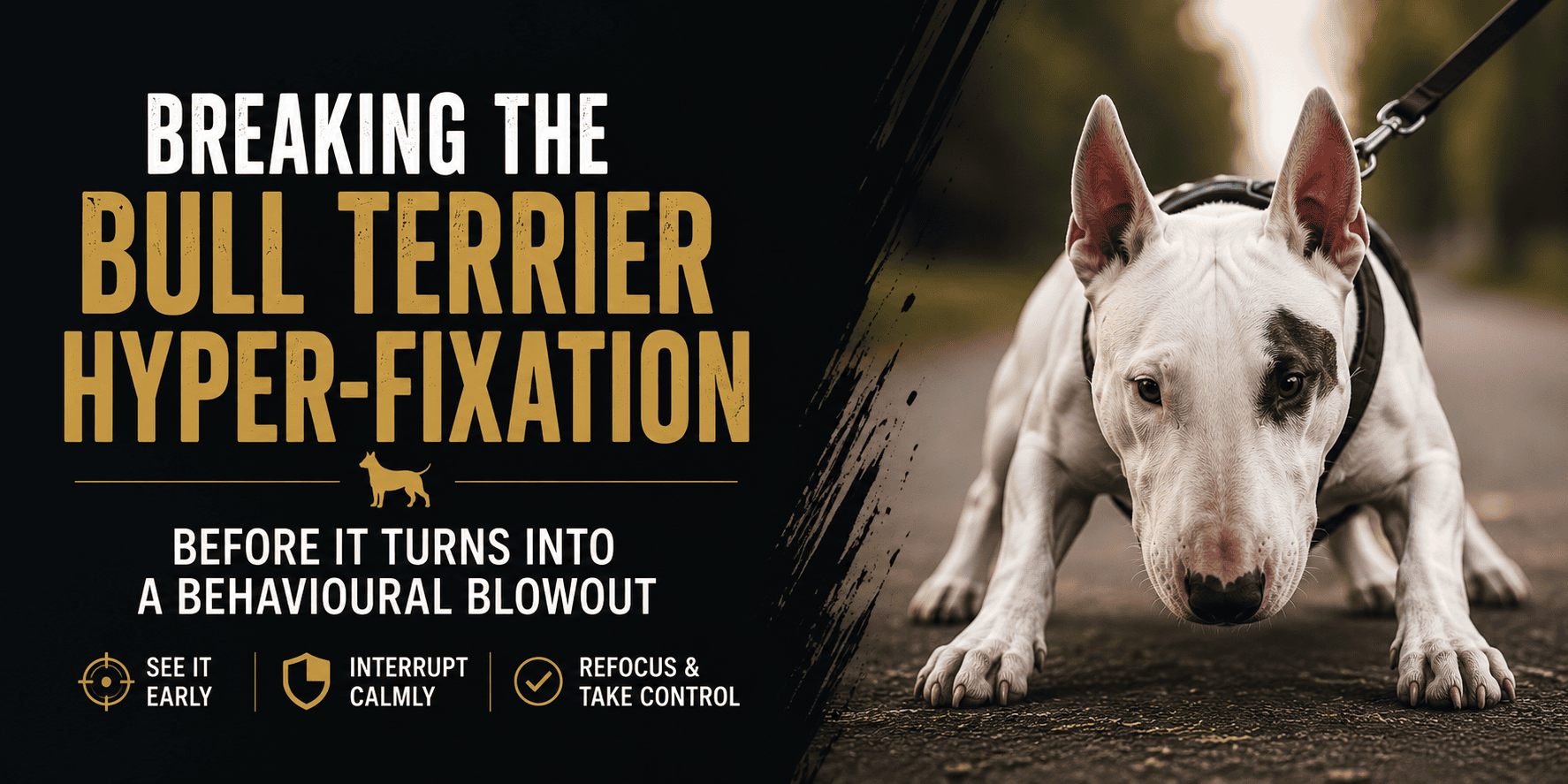
Breaking the Bull Terrier Hyper-Fixation Before It Turns Into a Behavioural Blowout
Bull Terriers can focus with frightening intensity. One second, your dog is normal. The next second, the body stiffens, the eyes lock, the ears change, the breathing shifts, and everything else in the world disappears.
The target might be another dog, a cat, a child running, a visitor entering the house, a toy, a ball, a shadow, a bird, a scooter, a food bowl, a closed door, a person leaving, a dog behind a fence, or a moving object on the street.
The Bull Terrier locks in. Then the owner says the dog’s name. Nothing. The owner says “leave it.” Nothing. The owner pulls the leash. The dog loads harder. The owner says “no.” The dog explodes.
This is the Bull Terrier hyper-fixation problem. The most important thing to understand is simple: once the dog is fully locked, you are already late.
To break Bull Terrier hyper-fixation, act before the dog is fully locked. Watch for hard staring, mouth closing, body stiffening, weight shifting forward, ears fixing on the trigger, and loss of natural check-ins. Create distance, change the angle, use a trained U-turn, reward disengagement, use “find it” before the dog explodes, and build check-ins as a daily habit.
What Bull Terrier Hyper-Fixation Looks Like
Hyper-fixation is not ordinary interest. A dog noticing something is normal. A dog looking at something is normal. A dog being curious is normal.
Hyper-fixation is different. It looks like the dog’s brain narrows down to one point. The rest of the world becomes less important. The handler becomes less important. Food may become less important. Known commands may disappear. The dog may become stiff, silent, and unreachable.
- Hard staring.
- Closed mouth.
- Stiff body.
- Weight shifting forward.
- Ears fixed toward the target.
- Tail high, still, or tight.
- Slow stalking movement.
- Sudden freezing.
- Ignoring the owner’s voice.
- Refusing food.
- Leash tension increasing.
- Explosive lunge after several seconds of stillness.
Many owners only notice the lunge. But the lunge is the last chapter. The story started earlier.
Why Bull Terriers Can Be So Intense
Bull Terriers are not casual dogs. They are powerful, emotional, physical, stubborn, playful, sensitive, and often extreme in the way they commit to what has caught their attention.
This intensity can be beautiful when it is guided properly. It can create focus in training, drive in work, commitment in play, strong bonding with the owner, huge character, and real enthusiasm.
But the same intensity can become a problem when the dog locks onto the wrong thing. A Bull Terrier who hyper-focuses may not simply look. The dog may load pressure inside the body until it has to come out somewhere.
Hyper-Fixation Is Not Always Dominance
Owners often describe fixation as dominance, stubbornness, or defiance. Sometimes a Bull Terrier is absolutely trying to get what it wants. But many fixation episodes are driven by arousal, frustration, prey interest, fear, uncertainty, overexcitement, habit, sensory sensitivity, or lack of impulse control.
That matters because the wrong explanation leads to the wrong handling. If you think the dog is only challenging you, you may add pressure, pull harder, shout louder, or turn the moment into a fight.
But if the dog is already overloaded, more pressure can push it over the edge. A Bull Terrier in fixation does not need emotional drama from the owner. It needs clean interruption, distance, movement, and a trained alternative behaviour.
The Critical Window
There is a small window where the dog is interested but not yet gone. This is where you can still reach the brain.
At this stage, the dog may look at the trigger but can still hear you. It may take food. It may respond to its name. It may turn its head. It may move with you. It may still be physically loose.
That is the moment to act. Not after the dog is already lunging. Not after the dog is screaming. Not after the leash is tight. Not after the body is stone.
The goal is not only to stop the explosion. The goal is to teach your Bull Terrier to notice the world and still come back to you before the lock becomes behaviour.
Distance Is Not Failure
One of the best ways to break fixation is to create distance. Many owners resist this because they feel like they are giving in. They want to prove the dog can handle the situation. So they stay too close for too long.
Then the dog blows up. That is not training. That is rehearsal.
Distance is not failure. Distance is information. If your Bull Terrier cannot hear you at three metres from another dog, train at ten metres. If ten metres is too close, train at twenty. If the dog can work at twenty metres, that is your starting point.
The correct distance is the distance where your dog can still think. Training only works when the brain is available.
Do Not Stare at What the Dog Is Staring At
Owners often accidentally join the fixation. The dog locks onto another dog. The owner also stares at the other dog. The leash tightens. The owner’s body stiffens. The owner starts predicting disaster.
Now both ends of the leash are locked onto the same trigger. Your dog feels that.
Instead, look at your dog, your route, your exit, and the space you can use. You are not there to admire the trigger. You are there to guide the dog out of the lock.
Keep the Leash Loose Enough to Think
A tight leash can make fixation worse. When the leash tightens, the dog feels restriction. Restriction can increase frustration. Frustration can increase drive. Drive can turn into a lunge.
This is especially true with Bull Terriers because many of them respond to opposition with more opposition. If the dog leans and you pull straight back, the dog may lean harder.
Instead of dragging backward, change the angle. Move sideways. Turn in a curve. Use a trained U-turn. Step away from the line of fixation. Create movement without turning it into a pulling contest.
Teach the Emergency U-Turn Before You Need It
A clean U-turn is one of the most valuable skills for hyper-fixation. The dog sees a trigger. You say your cue, turn, and the dog turns with you.
But this must be trained before the emergency. Start at home or in a quiet street. Say your cue, such as “this way,” turn your body, move in the opposite direction, and reward the dog when it follows.
The U-turn should not mean panic. It should mean, “change direction with me now.” For many Bull Terriers, this works better than standing still and arguing.

Hyper-fixation improves when the dog already understands attention, leash communication, U-turns, check-ins, handler focus, and structured rewards. The Bull Terrier Training Guide gives owners the step-by-step obedience and focus foundation behind those skills.
Use this guide when you need the training layer: name response, movement with the handler, focus, obedience, leash work, and daily habits that make the dog easier to interrupt before the blowout.
Use the Name Before the Lock, Not After
Many owners say the dog’s name when the dog is already gone. The dog does not respond. So the owner says it louder. Still nothing. Eventually the dog’s name becomes background noise.
Train the name as an attention cue when the dog is calm. Say the name, reward the dog for looking, and repeat in the house, garden, quiet street, and gradually around mild distractions.
The rule is that name means turn back to me. It should not mean the owner is about to shout while the dog ignores them.
The “Look, Break, Reward” Method
You do not need your Bull Terrier to never notice the world. That is unrealistic. The goal is for the dog to look at something and then be able to break away.
The dog sees the thing, but the body is not fully locked yet.
You act before the stare becomes hard and unreachable.
This is the break in the fixation pattern.
Reward the disengagement, then move away or continue calmly.
This teaches the dog: “I can see the thing and still stay connected to my owner.” That is very different from forcing the dog to ignore everything until it explodes.
Food Works Only If the Brain Is Still Online
Some owners say food does not work. Sometimes that is true because the dog is already over threshold.
A Bull Terrier who refuses food near a trigger is giving you useful information: the dog is too close, too aroused, too locked, too stressed, too frustrated, or too far gone.
Do not blame the food. Change the setup. Use more distance, an easier trigger, higher-value rewards, movement, shorter exposures, and training before the dog reaches the breaking point.
Use “Find It” to Drop the Head and Break the Stare
A food scatter can be excellent for fixation because it pulls the dog’s nose down and breaks the eye lock. Say “find it,” then scatter a few pieces of food on the ground away from the trigger.
The dog lowers the head, sniffs, eats, and shifts out of the stare. This works best before the dog is fully locked. The nose can rescue the brain from the eyes.
Teach an Alternative Job
A Bull Terrier in fixation needs a job that competes with the lock. The job depends on the dog, but it must be trained before the world tests it.
Moves the dog’s nose and brain back toward the handler.
Creates movement and exits pressure before the dog loads.
Drops the head and breaks the visual lock.
Gives the dog a structured position near the owner.
Useful for some dogs, but only if it regulates rather than adds fire.
Useful indoors for visitors, doorbells, windows, and household triggers.
Be Careful With Toys
Some Bull Terriers can use a toy to break fixation. Others become more fixated because of the toy.
If your dog redirects beautifully onto a tug toy and then can release, recover, and continue, a toy may be useful. If your dog becomes obsessed with the toy, guards it, screams for it, or cannot calm down afterward, the toy may not be the right tool for that moment.
The question is not whether the dog likes the toy. The question is whether the toy helps the dog regulate, or whether it adds more fire.

Hyper-fixation is often one of the places where Bull Terrier quirks, drive, frustration, sensitivity, overexcitement, and owner reaction mix together. The Quirks guide helps owners understand why these patterns happen and how to handle them without turning every moment into a fight.
Use this guide for the breed-specific layer: fixation, overexcitement, pulling, selective hearing, strange rituals, toy obsession, arousal patterns, and daily management.
Intercept Fixation at Home Too
Hyper-fixation does not only happen outside. It can happen in the house with the doorbell, visitors, the cat, another dog’s toy, food preparation, a child running, a ball under the sofa, shadows on the wall, light reflections, the owner leaving, a closed door, or guests sitting on the sofa.
Indoor fixation can become dangerous because the dog is close to people, furniture, and other animals. Use gates, place command, a lead if necessary, food scatter, calm greeting routines, and controlled access to triggers.
Doorways and Windows Can Create Fixation
Many Bull Terriers become obsessed with watching through windows, fences, balconies, or gates. They stare, bark, load, scan, and wait for movement.
Owners think the dog is entertaining itself. Sometimes the dog is rehearsing arousal. Use window film, curtains, gates, barriers, structured rest, and planned observation training.
Fixation on Other Dogs
Dog fixation is one of the most common problems. It may come from excitement, frustration, fear, social conflict, prey-like arousal, previous bad experiences, or lack of impulse control.
The solution is not to march directly into failure. Work at a distance where your dog can notice the other dog and still respond. Use the pattern: look, break, reward, move, create distance, repeat.
Fixation on Cats, Birds, and Moving Objects
Some fixation is prey-related. Cats, birds, scooters, bikes, running children, small dogs, and fast movement can trigger a strong chase response.
Do not treat this casually. Use secure equipment, do not allow rehearsal, do not gamble off lead, reward disengagement, and avoid situations where the dog gets to practice launching.
Fixation on Toys and Balls
Some Bull Terriers become obsessed with toys, especially balls. The dog stares at the toy, trembles, screams, cannot hear you, cannot release, cannot rest, and cannot interact normally because the object owns the brain.
This is not healthy play. The toy should appear by invitation, the game should have a start cue, the game should have a release cue, and the dog should learn to settle after play.
Fixation Before Aggression
Many aggressive incidents begin with fixation. The dog does not instantly explode. First it stares. Then it stiffens. Then it loads. Then it stops responding. Then the owner misses the window. Then the dog lunges or bites.
If your Bull Terrier has a history of aggression, fixation must be treated as an early warning sign. Do not wait for growling, barking, or the lunge. Hard staring, stiffness, and silence can be louder warnings than noise.
Fixation and Redirection Onto the Owner
Some Bull Terriers redirect when blocked. The dog fixates on another dog, cat, person, or object. The owner prevents access. The dog cannot reach the target. The pressure has to go somewhere.
The dog may grab the leash, jump at the owner, bite sleeves, or mouth hands. This is not always personal aggression. Often it is frustrated arousal, but it can still hurt.
If your dog redirects, work farther away from triggers and reduce the intensity before the dog reaches that point. Redirection is a warning that the dog is going over threshold. Respect it.
When a Bull Terrier becomes unreachable, redirects onto the owner, bites the leash, injures another dog, or has repeated aggressive blowouts, this is no longer just a funny breed quirk. The dog needs a structured plan.
The Owner Must Stop Waiting for Disaster
Many owners only act after the dog has already failed. They wait until the bark, the lunge, the bite, the scream, the spin, the lead grab, or the explosion. Then they correct the dog.
But the dog already rehearsed the whole pattern. A serious handler acts earlier.
You should be thinking: I see the eyes starting. I see the body slowing. I see the mouth closing. I see the weight shift. I see the ears lock. I see the breathing change. I see the dog stop checking in.
That is when you move. The best correction is often not a correction at all. It is an early interruption that prevents the dog from needing one.
Build Check-Ins as a Lifestyle
A dog who never checks in during normal walks will not magically check in around triggers. Reward your Bull Terrier for looking back at you voluntarily.
- The dog glances at you: reward.
- The dog hears a noise and looks back: reward.
- The dog sees a person and checks in: reward.
- The dog disengages from a smell when you move: reward.
- The dog notices another dog and turns back: reward heavily.
This builds a habit: when something happens, reconnect with my owner. That habit is gold.
Do Not Overexpose the Dog to “Socialize” It
Some owners try to fix fixation by flooding the dog with triggers. They take the dog closer to other dogs, busier streets, more people, more chaos, and more pressure.
The dog does not improve. It rehearses fixation and explosion. Exposure only helps when the dog stays under threshold and learns successfully. Bad exposure makes the pattern stronger.
A Simple Interception Plan
Watch for the stare, stillness, mouth closing, ears fixing, and loss of check-ins.
Do not march straight toward the trigger just to test the dog.
Side-step, curve, U-turn, or move away before the dog explodes.
Name response, “this way,” hand target, “find it,” or another behaviour the dog already knows.
Reward the moment the dog comes back to you, even for one second.
The goal is not to test the dog to failure. The goal is to rehearse recovery.
What Not to Do
- Do not stare at the trigger with your dog.
- Do not tighten the leash and freeze.
- Do not repeat commands the dog cannot hear.
- Do not pull straight backward against a loaded body.
- Do not punish the dog after the explosion and ignore the build-up.
- Do not use toys that create more obsession.
- Do not let the dog rehearse window, fence, or gate fixation all day.
- Do not walk directly toward triggers just to see what happens.
- Do not mistake silence for calmness.
- Do not wait until the dog is already gone.
When to Get Help
Get professional help if your Bull Terrier redirects onto you, has bitten another dog or person, becomes unreachable around triggers, fixates on lights, shadows, or invisible stimuli, injures itself during episodes, guards objects intensely, has sudden adult-onset fixation, shows seizure-like signs, has repeated aggressive blowouts, or becomes more intense despite training.
Some fixation patterns are simple training problems. Others involve fear, compulsive behaviour, neurological concerns, pain, or serious aggression risk. Do not guess when safety is involved.
The WBT View: The Eyes Tell You Before the Body Does
With Bull Terriers, the eyes often tell the story before the body explodes. The inexperienced owner sees the lunge. The experienced handler sees the stare.
This is the difference between constantly correcting behaviour and actually changing it. A Bull Terrier with intensity is not a bad dog. But intensity without guidance becomes trouble.
The goal is not to remove focus from the dog. Focus is valuable. Drive is valuable. Commitment is valuable. The goal is to make that focus available to the owner, not stolen by every trigger in the environment.
Final Thought
Hyper-fixation is the moment before the storm. It is the stare before the lunge, the freeze before the explosion, the silence before the bark, the body lock before the redirection, and the loaded second before the behaviour blows open.
Most owners try to solve the storm. Better owners learn to read the weather.
If your Bull Terrier locks onto something, do not wait until the dog is unreachable. Act early. Create distance. Change the angle. Use trained cues. Reward disengagement. Build check-ins. Control rehearsal. Teach the dog that seeing a trigger does not mean losing itself.
A Bull Terrier who can break fixation is safer, calmer, easier to handle, and far more connected to the owner. That is the real goal: not a dog who notices nothing, but a dog who notices the world and still comes back to you.
Frequently Asked Questions About Bull Terrier Hyper-Fixation
Bull Terrier hyper-fixation is when the dog locks intensely onto a target and becomes stiff, silent, hard to interrupt, and less responsive to the owner. It may appear before lunging, barking, spinning, lead grabbing, chasing, or redirecting.
Act before the full lock. Create distance, change the angle, use a trained U-turn, reward disengagement, use “find it” if the dog can still eat, and build check-ins during normal walks.
The dog may be too close, too aroused, too frustrated, too fearful, or too locked to process your cue. Move farther away and train at the distance where the dog can still respond.
No. Fixation can come from arousal, frustration, prey interest, fear, uncertainty, overexcitement, habit, sensory sensitivity, or lack of impulse control. The cause matters because the wrong handling can make the pattern worse.
Sometimes. A toy can help some dogs redirect and regulate, but it can make others more obsessed. Use toys only if the dog can release, recover, and calm down afterward.
Get help if your Bull Terrier redirects onto you, has bitten, becomes unreachable around triggers, injures itself, fixates on lights or shadows, guards objects intensely, shows seizure-like signs, or has repeated aggressive blowouts.