
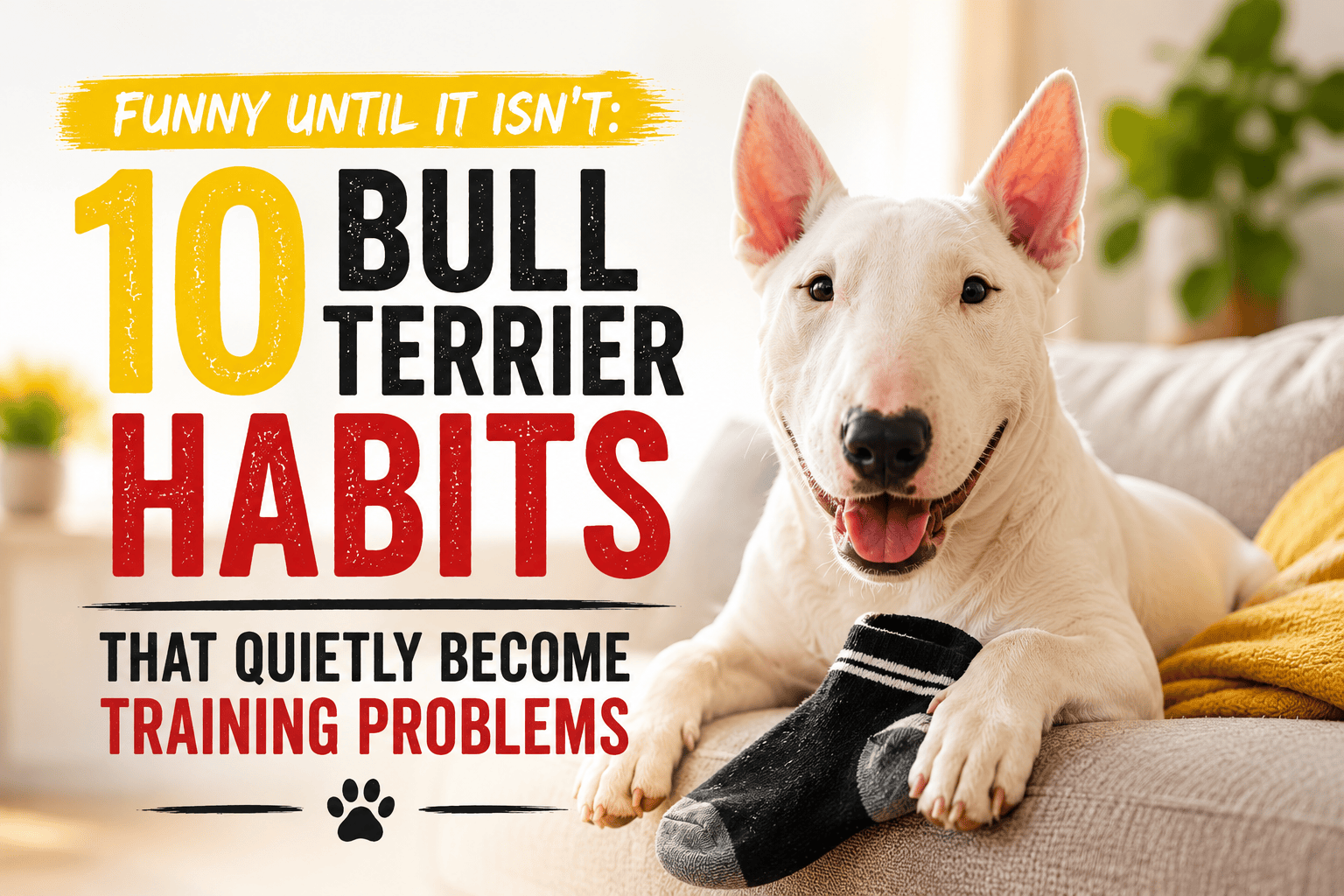
The things that make you laugh today may be running your household tomorrow.
Bull Terrier habits that become training problems often begin as the exact moments that make owners laugh. The sofa dispute, the stolen sock, the evening transformation and the selective hearing may begin as comedy. Repeated every day, they become household policy.
That does not mean you should stop laughing. Bull Terrier humour is part of the breed’s magic. It means paying attention to what happens after the laugh—and whether the behaviour is becoming stronger, more disruptive or harder to interrupt.
Many funny Bull Terrier habits become problems through accidental rewards. Attention strengthens demanding, chasing strengthens stealing, repeated cues teach delay, visible treats reward negotiation, and continued play can strengthen over-arousal. The solution is not removing the dog’s personality. It is preventing rehearsal, rewarding a better alternative and making household rules clear before the habit becomes difficult.
Why Bull Terrier Habits That Become Training Problems Start as Comedy
Bull Terriers are intelligent, persistent and excellent at noticing consequences. If a behaviour creates movement, attention, access, delay or better payment, it becomes profitable. The owner sees one funny incident. The dog sees a repeatable business model.
A habit normally passes through three stages: first it is amusing, then it becomes expected, and finally the owner reorganises life around it. Catching the pattern early allows you to keep the humour while preventing the household from becoming a full-time support department.
1. The Command Negotiation
You say “Off.” Your Bull Terrier hears you, reviews the request and remains exactly where they are. You repeat it with more emotion. Nothing. Your hand reaches toward food, and suddenly the dog understands perfect English.
The reward is not the problem. The timing is. When food appears only after several refusals, the dog learns that waiting improves the contract.
2. The Stolen-Sock Hostage Crisis
Your Bull Terrier takes a sock. You approach. They run. You follow. A high-speed tour of the dining table begins, followed by a treat exchange. The next day, another sock disappears.
Stealing becomes powerful because it creates attention, movement and often food. The owner thinks they are recovering property. The dog thinks they have successfully launched a game.
3. The Friendly Visitor Body Slam
A guest enters. Your Bull Terrier launches forward with pure love and almost removes the visitor’s knees. Everyone laughs and says, “He’s friendly.” That may be true. The visitor is still being struck by a muscular dog travelling at speed.
Friendliness does not automatically create self-control. When visitors receive safety instructions while the dog changes nothing, the greeting is being managed rather than trained.
4. The Concrete Statue on Walks
Five minutes ago, your Bull Terrier was pulling like a small vehicle. Now you choose another direction and four feet lock into the ground. The neck disappears. Management is not moving.
Stopping can reflect pain, fear, heat, fatigue or environmental pressure, so first understand why it happened. Some dogs also learn that planting their feet changes the route or produces increasingly valuable food.
5. The Evening Transformation
All day, your Bull Terrier has been reasonably civilised. Evening arrives and the house suddenly contains a high-speed land animal with no brakes. Cushions are attacked, clothing is grabbed and furniture becomes part of the track.
Owners often add more exercise, but evening wildness can come from accumulated arousal, poor sleep and an inability to recover after activity.

6. The Paw-Powered Customer-Service System
You are sitting quietly. A paw lands on your leg. You begin petting. You stop, and the paw returns with greater authority. Then comes the stare, the noise and the head pushed under your hand.
Affection is not the issue. The problem begins when pawing, whining, barking or climbing always controls when attention starts.
7. The Sofa Legal Dispute
You ask your Bull Terrier to get down. They look at you as though you have misunderstood the ownership documents, roll onto their back and somehow become three times heavier.
Sofas are not the problem. A dog can be allowed on furniture. The issue is whether access has rules and whether the dog cooperates when asked to move.
8. The Velcro Supervisor
You stand up. Your Bull Terrier stands up. You visit the kitchen, bathroom or another room, and management follows to supervise the meeting.
Following is not automatically a problem. The concern begins when closeness becomes dependence and the dog cannot settle without touching, watching or following you.
9. The Visible-Payment Contract
Your Bull Terrier knows Sit. First, they inspect your hands. No visible food? The employee is unavailable. The moment your hand enters a pocket, the full training history returns.
Food is one of the best training tools available. The problem is displaying it before every known behaviour, allowing the dog to evaluate the offer before deciding whether to respond.
10. The Household Starts Avoiding the Dog’s Reactions
This is the habit that is no longer funny. You stop asking the dog to leave furniture, end play, release objects, accept handling or greet visitors because the reaction may be difficult. Normal life begins shrinking around the dog.
Pain, fear, frustration, guarding, over-arousal or missing training may contribute. Avoidance may keep everyone safe temporarily, but it cannot become the permanent plan.
How Many Habits Did You Recognise?
Your Bull Terrier is not bad. They are efficient. If stealing starts a chase, they steal. If pawing creates attention, they paw. If refusal produces better payment, they refuse. This is learning—which means the answer is not becoming harsher. It is becoming clearer.
Clearer cues. Clearer rules. Clearer rewards. Clearer consequences. Clearer routines. A Bull Terrier does not need an owner who shouts louder. They need an owner whose words and actions consistently mean the same thing.
Reward-based training does not mean allowing every behaviour. The American Veterinary Society of Animal Behavior supports humane training approaches that teach desired behaviour without intimidation.
Understand the Quirk. Fix the Pattern.
The funny behaviour and the difficult behaviour are often the same behaviour at different stages. That is why the right guidance must explain what drives the habit, what keeps rewarding it and what the dog should do instead.

The Quirks Guide helps you understand why the behaviour happens. 20 Essential Rules rebuilds structure around attention, freedom, play and household life. The Training Guide teaches the practical skills that replace the problem.
Together, the full library provides a connected system rather than another collection of disconnected tips.
Explore The Complete Bull Terrier LibraryContinue Learning
Frequently Asked Questions
No. Humour is part of life with the breed. Pay attention to whether the behaviour is becoming stronger, disruptive or necessary for the dog to get what they want.
Treats are not the problem. Repeatedly displaying better food after refusal can teach the dog that delaying cooperation improves the offer.
It has become a problem when it regularly disrupts walks, visitors, handling, rest, household freedom or your ability to ask for normal cooperation.
Get professional support for biting, aggression, serious guarding, unsafe handling reactions or situations in which normal life is shrinking because the dog’s response feels difficult or unsafe.
Final thought: Laugh at your Bull Terrier. You should. Their humour, drama and complete lack of embarrassment are part of what makes them unforgettable.
But remember: a funny moment repeated once is a story. A funny behaviour repeated every day is a habit. And a habit that controls the household is a training problem.
Do not remove the personality. Give the personality direction.
One response to “Funny Until It Isn’t: 10 Bull Terrier Habits That Quietly Become Training Problems”
[…] Funny Until It Isn’t: 10 Bull Terrier Habits That Quietly Become Training Problems KategorienInfo […]