
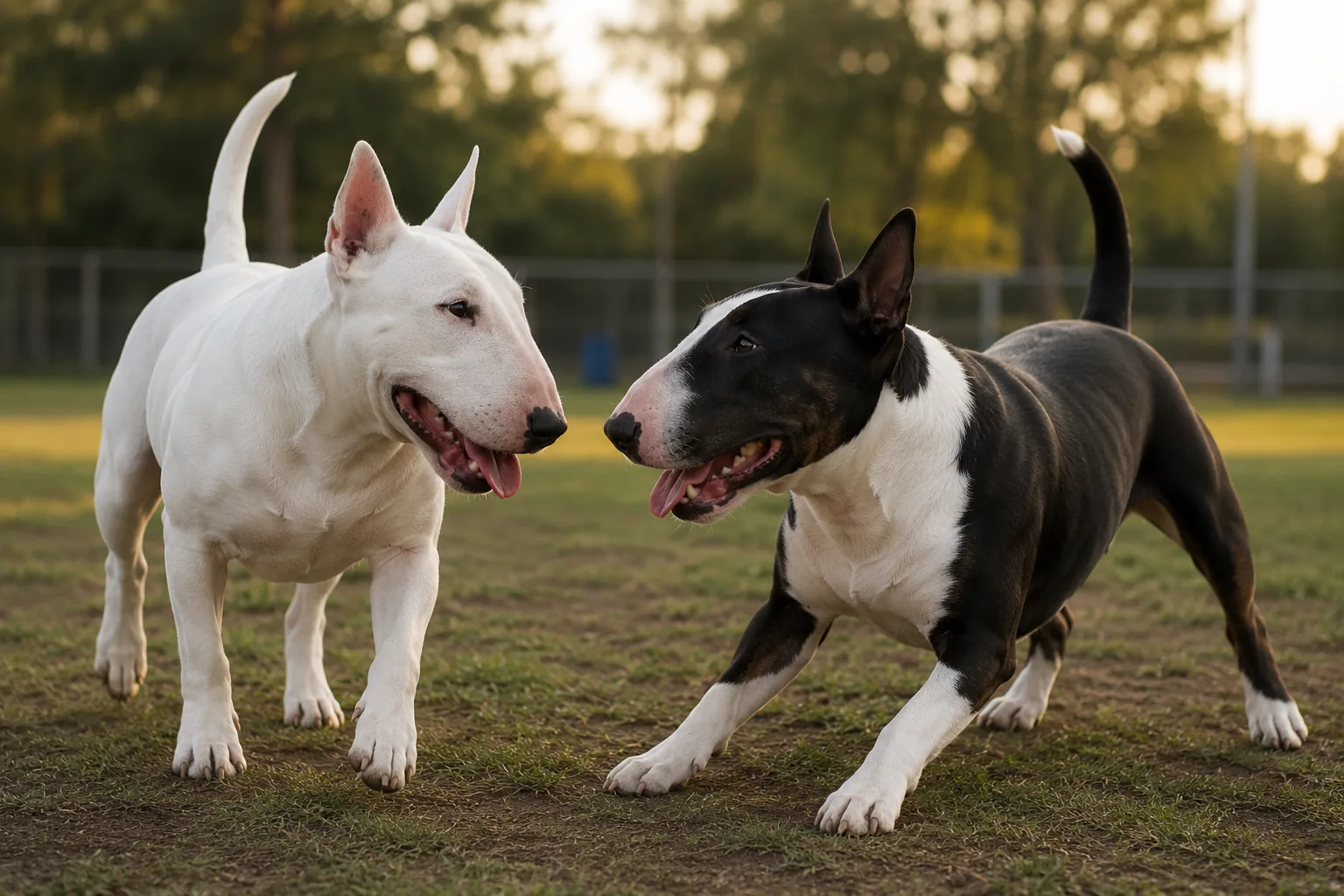
Are Bull Terriers Good With Other Dogs? The Honest Answer
Friendliness is individual. Calm coexistence can be taught. A serious, practical guide to dog selectivity, thoughtful introductions and learning to share a world with other dogs.

There is a question behind nearly every Bull Terrier introduction: “Will my dog get along with yours?” The temptation is to answer yes or no. But anyone who has lived closely with this breed knows the answer deserves more care than that.
One Bull Terrier may share a home happily with another dog for years. Another may enjoy two familiar friends and refuse the company of everyone else. A third may appear desperate to reach dogs on a walk, yet become too excited to handle a greeting sensibly. Those dogs are not displaying one simple personality trait. They are reacting to different situations, histories and emotions.
Not every Bull Terrier needs dog-park friends or daily off-leash play.
Passing other dogs calmly and staying connected to you is a useful real-world skill.
Thoughtful supervision, suitable matches and clear management protect both dogs.
Are Bull Terriers Good With Other Dogs? Four Real-Life Patterns
Yes, they can. But the question that matters more is which dogs, in which environment, at which stage of life, and with how much freedom? A calm household relationship is different from an unpredictable meeting in a narrow street. Friendly play with a known dog is different from tolerating a strange dog at close range.
Some Bull Terriers are naturally open and sociable. Some become more selective with age. Some prefer people, while others form strong bonds with particular canine companions. None of these patterns automatically makes a dog good or bad.
The American Kennel Club’s explanation of dog selectivity is useful here: social comfort exists on a spectrum. Puppy friendliness does not guarantee that the same dog will enjoy every unfamiliar adult dog later in life.
Enjoys many dogs
Frequently seeks and enjoys appropriate dog company. Still needs consent, breaks and supervision.
Can coexist
Usually comfortable sharing space without necessarily wanting interaction or play.
Chooses companions
Comfortable with certain dogs or settings, but not all. This can be a manageable normal preference.
Needs assessment
May bark, lunge, freeze, threaten or fight. The underlying motivation and risk need careful evaluation.
Dog-selective does not mean dog-aggressive. Equally, enthusiasm does not always mean friendliness. Some intense greetings are really frustration, uncertainty or over-arousal wearing a very excited disguise.
A well-mannered Bull Terrier does not have to love every dog. They do need to learn how to exist around other dogs safely.

Can a Bull Terrier Live With Another Dog?
Absolutely possible—but not guaranteed. The right match matters more than a breed-name shortcut. A dog that is socially flexible, recovers well from excitement and respects space may be easier to live with than one that constantly pushes for contact. The resident dog’s comfort matters just as much as the incoming Bull Terrier’s.
A second dog is not a treatment for boredom, separation difficulties or a lack of training. If your existing dog is struggling, solve or manage that problem first. Two unsettled dogs do not automatically create one settled household.
Introducing a Bull Terrier to a Resident Dog
For dogs without a history of serious conflict, a cautious introduction can follow these foundations. The AKC’s guide to introducing dogs similarly emphasizes neutral environments and supervision.
Choose a quiet neutral area, preferably with two calm adults and secure, comfortable equipment. Avoid narrow spaces or crowding.
Walk in the same general direction with enough distance for both dogs to remain relaxed. There is no deadline to meet face to face.
Look for loose movement, natural breathing and the ability to turn away. If either dog stiffens or fixates, increase space.
If both are comfortable, a short, unforced interaction may be possible. Interrupt excitement early and return to calm movement.
Initially separate feeding, chews and resting areas. Manage doorways, visitor excitement and high-value items. Use gates where appropriate.
Short supervised periods and predictable breaks are more useful than expecting instant friendship or leaving the dogs together unsupervised.
Successful multi-dog ownership often looks almost boring: each dog can eat, sleep, receive attention and move through the home without being pressured by the other. That quiet stability is worth far more than a dramatic video of dogs wrestling.
How to Tell Comfortable Play From Rising Tension
Bull Terriers can be physical players. Bouncing, chasing and body contact may be normal between compatible dogs—but intensity makes it essential to read both participants. A dog that repeatedly tries to leave is not enjoying the game simply because the Bull Terrier is wagging its tail.
- Loose, curved movements and soft expressions
- Willing approaches with room to retreat
- Pauses, role changes and natural breaks in play
- Both dogs return voluntarily after separating
- They can disengage and respond to their handlers
- Freezing, hard staring or an abruptly stiff body
- One dog trying repeatedly to escape or hide
- Continuous chasing, pinning or blocking
- Increasing tension around toys, food or people
- Ignoring withdrawal signals or failing to settle
One isolated signal cannot tell the whole story. Read the sequence, the environment and the response of both dogs. A wagging tail, for example, can accompany different levels of arousal. If you are unsure, create space. You do not need to wait for a growl or snap to end an interaction.
What if My Bull Terrier Becomes Selective With Age?
Adjust expectations. Keep compatible friendships if they are genuinely enjoyable, but stop asking your dog to tolerate strange, pushy or overly intense interactions. Practise neutral walks and maintain safe routines. If changes are abrupt, extreme or accompanied by pain, fear or unusual behaviour, investigate those causes rather than assuming it is merely a phase.
Why Some Bull Terriers React to Other Dogs on Lead
Not every bark or lunge has the same meaning. One Bull Terrier may be frustrated because it expects to greet everyone. Another may be afraid of an approaching dog. Another may guard distance or respond to a history of frightening encounters. In a strong dog, these different emotions can produce movements that look surprisingly similar.
That is why the first question is not “How do I stop the barking?” It is “What happens before it, and what is this dog trying to achieve or avoid?” The answer determines whether the dog needs more distance, a different route, carefully planned behaviour work or a broader assessment.
The WBT Calm-Passing Foundation
For a dog that is safe to practise with and still able to think, begin well below the point where it loses control. The following is a foundational skill sequence, not a treatment plan for a dog with a bite history.
Start far enough from another dog that your Bull Terrier can still eat, turn, breathe normally and respond to its name.
When your dog notices the other dog and then checks back in, use your familiar “Yes” marker and reward calmly.
Use a simple follow-hand cue or practiced turn to move away before excitement rises. Do not insist on a greeting.
Several easy successes at a comfortable distance are more useful than one close pass ending in a struggle.
When the dog cannot disengage, refuses familiar rewards, repeatedly lunges or becomes rigid, the exercise is too difficult or inappropriate for that moment. Increase distance and prioritise safety. For dogs with escalating reactions or a history of dog-to-dog injury, seek in-person professional assessment.
Reward-based training and careful management are consistent with the AVSAB’s humane dog-training guidance. Forcing exposure or using intimidating corrections to suppress visible reactions can leave the underlying fear or frustration unresolved.
A Bull Terrier can be over-aroused, fearful, dog-selective or genuinely unsafe. Those are not interchangeable explanations, even when the behaviour looks loud and dramatic.
Read: Are Bull Terriers Aggressive? →What Should You Actually Aim For?
If you are planning to live with more than one dog, aim for a household where everyone has space, predictable routines, enough rest and clear human guidance. If your Bull Terrier lives as an only dog, aim for calm neutrality outside: passing dogs without panic or frantic pulling, choosing to return to you and staying emotionally available even when the world gets interesting.
Some Bull Terriers will enjoy a small circle of compatible canine friends. Some will prefer people and their own family. A dog does not need a full social calendar to have a good life. Appropriate exercise, meaningful engagement, sniffing, learning, rest and a safe relationship with its human matter enormously.
Structure before freedom is not about making a Bull Terrier less expressive. It is about giving that expression enough direction to keep everyone safe.
So, are Bull Terriers good with other dogs? They can be, and many are. But the right answer is never a blanket promise. Respect the individual dog. Choose introductions carefully. Train for calm behaviour, not compulsory friendship. And never mistake an exciting interaction for a successful one.
Frequently Asked Questions
Are Bull Terriers good with other dogs?
Many are comfortable with familiar dogs, and some are very sociable. Others prefer selected companions or need distance from unfamiliar dogs. Breed alone cannot predict individual behaviour. Calm neutrality and safe management are reliable goals regardless of social preference.
Do Bull Terriers get along with other dogs in the same house?
They can, particularly when the individual dogs are compatible, introductions are gradual and owners manage resources, rest and arousal. Never assume two dogs will become friends simply because they live together.
Are Bull Terriers aggressive towards other dogs?
Not automatically. Dog-directed aggression, fear, frustration, social selectivity and over-arousal are different issues. A dog that threatens, bites or repeatedly fights needs individual assessment and a safety plan, regardless of breed.
Are Bull Terrier puppies more social than adults?
Many puppies are open to new dogs, but preferences can change during adolescence and adulthood. Early positive experiences matter, yet they do not guarantee unrestricted adult dog sociability.
Can two male Bull Terriers live together?
It is possible, but sex or breed combinations cannot guarantee compatibility. Individual temperament, previous history, resources, health, environment and management are more useful considerations. Households with tension should seek tailored advice.
Should I take my Bull Terrier to a dog park?
Not as a default socialization exercise. Busy parks with unknown dogs can be overwhelming or unsafe. A stable, sociable individual may enjoy suitable settings, while many dogs benefit more from structured walks and selected companions.
Why does my Bull Terrier bark and pull towards other dogs?
Possible causes include excitement, leash frustration, fear, defensive behaviour or learned reactions. Observe the context and body language. If your dog cannot disengage or has harmed another dog, get qualified help rather than relying on a generic online tip.
Does neutering guarantee a Bull Terrier will get along with dogs?
No. Reproductive status can affect some behaviours but does not reliably solve social incompatibility, reactivity or learned conflict. Discuss individual medical and behavioural factors with your veterinarian and qualified professional.

When Other Dogs Become a Problem, Start With the Pattern.
Does your Bull Terrier fixate on dogs outside, struggle to settle after play, guard space around another dog or react on the lead? Our Quick Diagnostic offers an individual written starting point. Online Training builds a longer-term plan around the dog, the handler and the actual situations.
Important: active dog-fight risk, injuries or sudden serious behaviour changes need immediate safety management and appropriately qualified local or veterinary support first.
Leave a Reply