
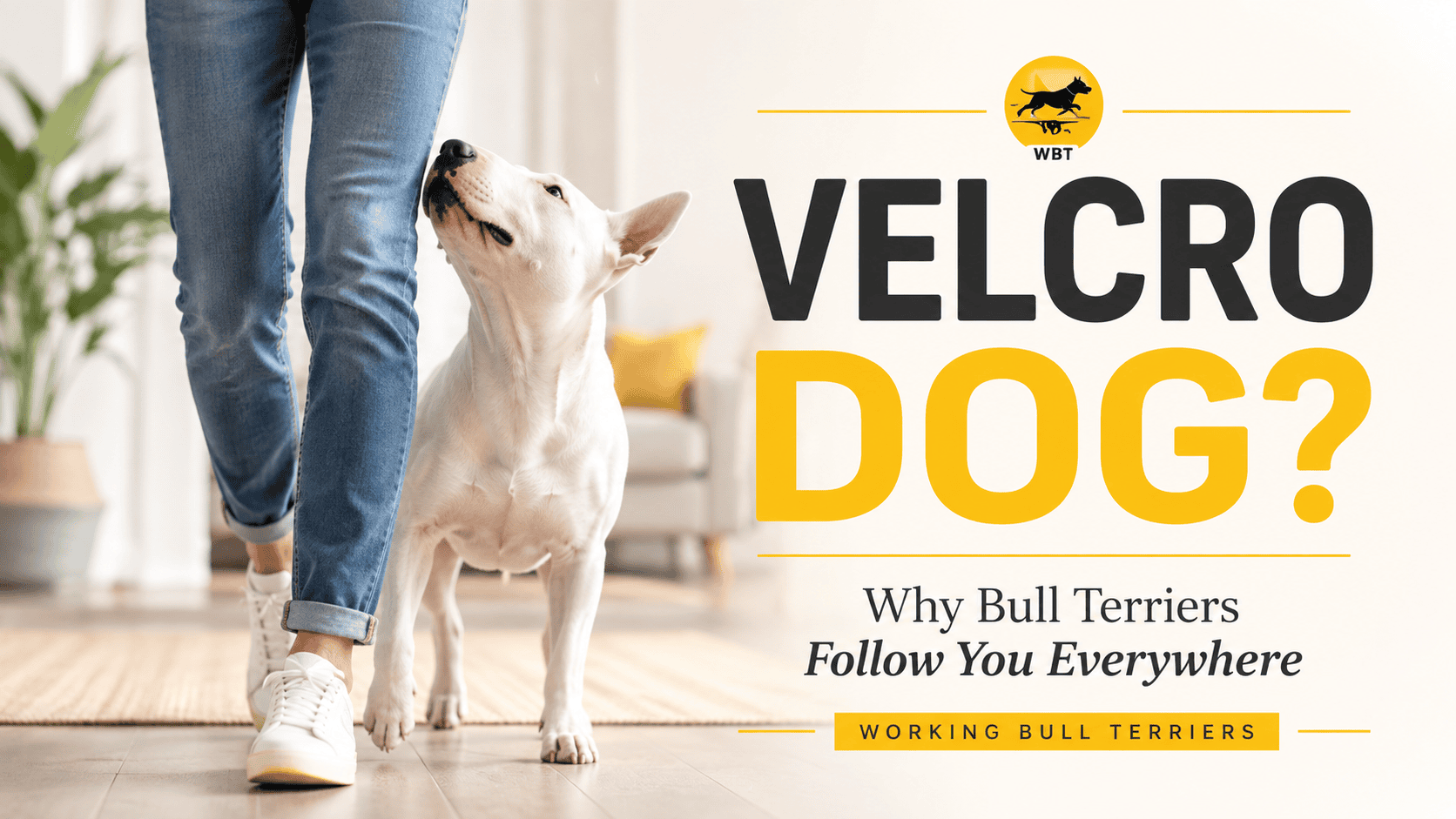
When your Bull Terrier believes every room you enter is a team meeting.
Why are Bull Terriers so clingy? If your Bull Terrier follows you everywhere, you are not imagining it. Bathroom, kitchen, shower, office, garden — many Bull Terriers seem convinced that their job description includes permanent supervision of their human.
It is funny, affectionate and very typical of the breed. It is also worth understanding properly, because there is an important difference between a dog who likes being close to you and a dog who genuinely cannot cope when you are unavailable.
The goal is not to make your Bull Terrier less loving. The goal is to keep the bond strong while teaching one equally important skill: being close to you is wonderful, but being apart from you is safe.
Why does your Bull Terrier follow you everywhere? Bull Terriers are strongly people-oriented dogs. They often follow their owners because proximity is rewarding, interesting and emotionally important to them. Normal “Velcro” behaviour becomes a concern when the dog cannot settle independently, becomes distressed when access to the owner is blocked, or shows panic-related behaviour when left alone. Healthy independence does not weaken the bond — it makes the bond more secure.
Why Are Bull Terriers So Clingy?
Bull Terriers are rarely background characters in their own homes. If something is happening, many of them believe they should be directly involved in it. That is the simplest starting point when owners ask, “Why are Bull Terriers so clingy?”
1. They Are Intensely People-Oriented
Many Bull Terriers form very strong relationships with their people. They enjoy physical contact, attention, interaction and simply being part of whatever the household is doing.
A more independent dog may be satisfied knowing that you are somewhere nearby. A Bull Terrier may prefer to know exactly what you are doing, why you are doing it, and whether their participation has somehow been overlooked.
2. Following You Has Probably Been Rewarded Hundreds of Times
Dogs repeat behaviour that works. Following you into the kitchen may occasionally produce food. Following you to the sofa produces affection. Following you outside creates activity. Following you into the office means proximity and attention.
None of that is wrong. But over time, staying close can become one of the most consistently rewarded behaviours in the dog’s life.
3. Curiosity Is Part of the Breed
Bull Terriers are often spectacularly nosy. A cupboard opens. A bag arrives. Somebody walks toward another room. A strange sound comes from the kitchen. Investigation begins immediately.
Some apparent clinginess is therefore not insecurity at all. It is curiosity, habit and a Bull Terrier version of fear of missing out.
4. Routine Turns Following Into an Automatic Pattern
If your Bull Terrier has followed you from room to room every day for months, the behaviour can become almost automatic.
You stand up; the dog stands up. You move; the dog moves. Nobody deliberately trained this sequence, but repetition did.
5. Some Dogs Have Never Practised Calm Independence
A loving household can unintentionally create this gap. A puppy follows somebody all day, sleeps touching a person, receives frequent attention and is almost never separated by a door, gate or distance.
Then adolescence arrives, life changes, and suddenly the dog is expected to remain alone comfortably despite having had very little practice doing it.
The answer is not becoming distant. It is creating small, successful experiences of independence before independence becomes difficult.
When “Why Are Bull Terriers So Clingy?” Becomes a Bigger Question
This is where owners often become confused. When people search why are Bull Terriers so clingy, they often assume the answer must be separation anxiety. Following you everywhere does not automatically mean separation anxiety.
The better question is not, “Does my Bull Terrier follow me?” It is:
What happens when my Bull Terrier cannot follow me?
A Bull Terrier can be extremely affectionate and still have healthy independence. Equally, a dog does not need to destroy the whole house before we take separation-related distress seriously.
Signs the Clinginess Needs More Attention
Pay attention to repeated patterns such as:
- Persistent whining, barking or howling after separation.
- Pacing, panting or drooling that is not explained by heat or exercise.
- Scratching, biting or throwing the body at doors, gates or crates.
- Destructive behaviour concentrated around exits.
- Refusing food the dog would normally consider highly valuable.
- Indoor toileting specifically associated with being left alone.
- Strong agitation when keys, shoes, bags or departure routines appear.
- An inability to settle unless the dog is touching, watching or tracking you.
One more thing: if clinginess appears suddenly in a Bull Terrier who was previously comfortable being independent, especially alongside changes in appetite, sleep, movement, toileting, confusion or general behaviour, speak with your veterinarian. A sudden behavioural change deserves a physical-health check before it is treated as a training problem.
How to Help When Your Bull Terrier Is Too Clingy
If you have been wondering why are Bull Terriers so clingy, the answer is only useful if it leads to a practical plan. The objective is not to turn a Bull Terrier into a distant dog. We want a dog who enjoys closeness but does not depend on constant physical access to feel safe.
1. Use Place Training to Break the Automatic Following Pattern
Place training is one of the most useful exercises for a Velcro Bull Terrier because it gives the dog a clear alternative to following.
Begin while you are still in the room. Ask your dog to settle on a bed or mat. Reward calm behaviour there. Then make tiny movements around the room.
2. Practise Micro-Separations Before Long Separations
Do not jump from “my dog follows me everywhere” to “I will leave for two hours so they learn.” If the dog is genuinely distressed, flooding them with a long absence can make the problem worse.
Instead, build tiny repetitions that are easy enough to succeed.
- Step behind a baby gate for a few seconds.
- Close a door briefly while the dog is already calm.
- Walk out of sight and return before the dog escalates.
- Repeat short successful separations instead of pushing one session too far.
The dog learns through experience that separation is predictable, temporary and safe.
3. Reward Independent Choices
Owners naturally reward closeness. The dog approaches, nudges a hand, climbs beside us and receives affection.
Start noticing the opposite behaviour too.
If your Bull Terrier chooses their own bed, settles a few metres away, stays relaxed when you stand up or remains occupied while you move around the room, quietly reinforce it.
4. Use Chews and Food Toys as Support — Not as the Whole Solution
A stuffed food toy, safe chew or enrichment activity can help create a positive association with independent time.
But a food toy is not a complete treatment for serious separation distress.
If your dog happily works on the toy after you leave, excellent. If a Bull Terrier who normally loves food refuses to touch it once you disappear, that information matters. The dog may be too distressed to eat.
5. Make Departure Cues Less Important
Dogs are excellent pattern readers. Keys, shoes, a particular jacket, closing windows or picking up a bag can become predictors that you are about to leave.
Occasionally perform some of those actions without leaving.
- Pick up your keys and sit down again.
- Put on your shoes and make coffee.
- Open the front door, close it and continue your day.
The goal is to reduce the emotional weight attached to the departure sequence.
6. Keep Arrivals and Departures Calm — Not Cold
You do not need to pretend your Bull Terrier does not exist when you return home.
Simply avoid making every departure an emotional ceremony and every arrival an explosion. Come and go normally. If your dog is highly aroused when you return, allow a little regulation before turning the greeting into a full-contact celebration.
7. Balance Activity With Recovery
A bored dog may follow the owner because the owner is the most interesting thing available. But endlessly exhausting the dog is not the answer either.
Bull Terriers need an intelligent balance of physical activity, mental work, engagement, sniffing, play, structure and proper rest.
A dog who can work, disengage and recover is much better prepared to learn independence than a dog living in a constant cycle of boredom and over-arousal.
A Simple 5–10 Minute Independence Exercise
Over time, increase only one difficulty at a time: distance, duration, visual separation or departure-like cues.
WBT principle: build the behaviour while the dog can still think. Once a Bull Terrier is already panicking, you are no longer practising calm independence.
What Not to Do With a Clingy Bull Terrier
- Do not punish following. Teach an alternative instead of making proximity to you unsafe. The RSPCA guidance on separation-related behaviour also advises against punishing dogs for behaviour linked to distress.
- Do not suddenly isolate the dog for long periods. Independence is built progressively.
- Do not assume destruction is revenge. Boredom, frustration, distress and poor management can all produce destructive behaviour.
- Do not provide constant entertainment. Bull Terriers also need to learn that some parts of the day are quiet.
- Do not confuse affection with missing boundaries. A dog can have enormous affection and still be expected to settle separately when asked.
- Do not keep increasing difficulty after the dog is struggling. Return to a level where learning is possible.
Can You Still Let Your Bull Terrier Follow You Around?
Of course.
We are not trying to eliminate one of the most enjoyable parts of living with the breed.
If your Bull Terrier lies at your feet while you work, supervises dinner preparation, waits outside the bathroom or joins you from room to room, that can simply be normal Bull Terrier life.
If the answer is yes, enjoy your shadow.
If the answer is no, that is the skill we need to build.
The Bull Terrier Twist
Even a well-trained, emotionally stable Bull Terrier may still appear in the bathroom, lean their entire body weight against your legs, stare at you while you work or release the most theatrical sigh imaginable because you moved to another chair.
That is not something we need to fix.
The breed’s loyalty, physical affection and determination to participate in your life are part of what makes Bull Terriers so addictive to the people who understand them.
Healthy independence does not weaken the relationship. It allows the dog to feel secure even when the relationship is not physically available every second.
Keep the Bond. Build the Structure.
Clinginess is only one example of a Bull Terrier behaviour that makes more sense when you understand the breed behind it. The right training is not about removing personality. It is about giving that personality structure, direction and better habits.

Six WBT guides covering training, puppy foundations, breed-specific behaviour, everyday structure and the quirks that make Bull Terriers different.
Use them as a connected system rather than another collection of random tips.
Explore The Complete Bull Terrier LibraryContinue Learning
Frequently Asked Questions
Usually because following you is rewarding, familiar and part of the dog’s normal routine. If your Bull Terrier can remain relaxed when prevented from following, it is generally normal attachment rather than evidence of a serious separation problem.
When owners ask why are Bull Terriers so clingy, the usual answer is a combination of strong social attachment, curiosity, routine and reinforcement. Bull Terriers are commonly very people-oriented and physically affectionate, although individual temperament still matters.
No. Separation anxiety is about distress associated with separation, not simply a preference for staying close. Watch what your dog does when left alone or when access to you is blocked.
Not automatically. Sleeping arrangements alone do not create or cure separation anxiety. The more useful question is whether your dog can also settle independently when needed.
Yes. Used correctly, Place teaches the dog to remain settled while the owner moves around, which directly challenges the automatic habit of standing up and following every time the owner moves.
That depends on the dog and the severity of the pattern. A simple following habit may improve relatively quickly. A dog showing genuine panic during separation needs a slower, more individual progression.
Final thought: understanding why are Bull Terriers so clingy does not mean your Bull Terrier needs to stop loving your company.
Let them supervise the cooking. Let them lie at your feet. Laugh when they appear outside the bathroom as if you disappeared for three years.
Just make sure that underneath all that attachment is a dog who has also learned one quiet, powerful lesson:
“I love being with you — and I am still safe when you are not beside me.”
Leave a Reply