
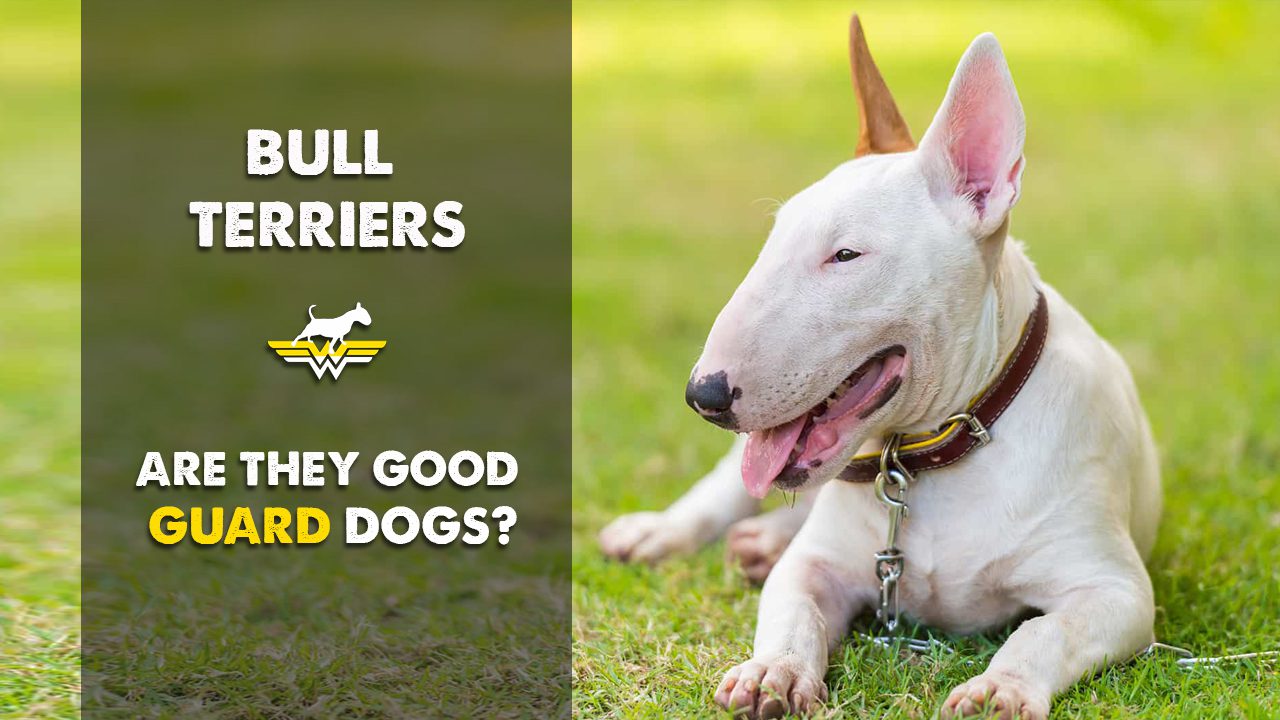
Are Bull Terriers Good Guard Dogs? The Honest Answer
They may notice something unusual. That does not make them a security system. Here is what a Bull Terrier can realistically offer—and why appearance, loyalty and protection are three very different things.

A Bull Terrier can look like the perfect guardian. The head is unmistakable, the body is powerful, and the dog may seem intensely devoted to its people. It is tempting to connect those facts and conclude: surely this dog will protect me. But are Bull Terriers good guard dogs in ordinary family life? Real life is less predictable—and more interesting.
Some Bull Terriers are remarkably aware of unfamiliar sounds or visitors. Others greet the delivery driver as if an old friend has returned. The same dog may bark behind a gate and then become enthusiastic and friendly once introduced. That is not a contradiction. It is normal canine behaviour shaped by context.
Some individuals notice and announce unfamiliar activity. Others are comparatively quiet.
A solid-looking dog may make someone pause, but appearance cannot create reliable security.
Neither loyalty nor barking predicts what a dog will do in a genuine emergency.
Are Bull Terriers Good Guard Dogs—or Just Watchdogs?
People use these terms interchangeably. That creates unrealistic expectations, especially when a dog has a powerful build. Before asking whether Bull Terriers make good guard dogs, decide what job you actually mean.
Watchdog
Notices an unfamiliar sound, person or movement and may alert the household through barking or attention. Alerting is not confrontation.
Guard Dog
A dog expected to deter or defend a space under particular conditions. Suitability and behaviour vary; looks alone prove nothing.
Protection Dog
A dog selected and prepared for highly specialised controlled work. This is not a household obedience trick, and it is not a default breed trait.
For many households, the useful question is simply: Will my Bull Terrier alert me if someone approaches the door? That is a much more realistic discussion than expecting a pet to assess threats, make safe decisions under pressure and physically protect a person.
What Bull Terrier Temperament Actually Tells Us
Modern Bull Terriers are commonly described as affectionate, playful and devoted companions. They can also be intense, determined and physically enthusiastic. Those qualities explain why the breed attracts people who admire a bold personality—but none of them proves that a dog is suited to guarding.
The American Kennel Club’s Bull Terrier breed notes even discuss the breed as a relatively quiet watchdog. That does not mean every Bull Terrier is silent. It means there is no honest basis for promising that every dog will automatically patrol and bark at strangers.
Do Bull Terriers Bark at Strangers?
Some do. A doorbell, a voice behind the fence or a vehicle arriving at night may trigger an alert. Others rarely bark, even when the house is busy. Age, previous learning, confidence, excitement, frustration and the immediate environment all influence the response.
Barking also has different meanings. It might signal surprise, uncertainty, excitement or an attempt to create distance. A loud bark can sound intimidating, but its volume cannot tell you whether a dog feels confident, frightened or merely overstimulated.
Are Bull Terriers Naturally Protective?
Many form strong bonds with their families and may stay close when something feels unusual. Yet attachment is not a promise of protection. A dog that loves its owner may seek reassurance, freeze, retreat, approach out of curiosity or bark from a safe distance when faced with unfamiliar pressure.
That range of reactions is not a moral judgment on the dog. It is a reminder that the animal did not sign up for a human security role. The best Bull Terrier companion should be able to feel safe, respond to guidance and recover from surprises—not live in a permanent state of suspicion.
“Loyalty is a relationship. Guarding is a behaviour. Reliable protection is a specialised responsibility. They should never be confused.”
Will a Bull Terrier Protect Its Owner?
No responsible breeder or trainer can guarantee how an individual dog will react to a genuine threat. Real incidents unfold suddenly. The dog may not understand what is happening, and a response that looks brave in a video may be unpredictable or unsafe in another setting.
Yes, there are stories of family dogs intervening when someone was threatened. Stories, however, do not create a dependable safety plan. The same caution applies to every breed: never put yourself or your dog in danger to test a supposed protective instinct.
A dog can look imposing and still be socially confident and friendly. If you are researching whether the breed is dangerous or aggressive, that deserves a separate, more careful explanation.
Read: Are Bull Terriers Aggressive? →Could Their Appearance Deter an Intruder?
Possibly. A stranger may hesitate at the sight of a sturdy, athletic dog behind a secure gate. But deterrence depends on the person and the circumstances. A dog’s presence is not a replacement for a properly secured property, outdoor lighting, sensible visitor management and other reliable home-security measures.
Think of your Bull Terrier as a loved family member who may notice things—not as the first or only line of defence.

What Training Makes a Bull Terrier a Better, Safer Companion?
If your goal is a dependable household dog, work on calmness, communication and everyday cooperation. A useful watchdog does not need to be suspicious of every visitor. In fact, teaching a dog how to respond after noticing something is often more valuable than encouraging more barking.
At WBT, we believe in structure before freedom. That means clear, humane routines, useful skills and a dog who understands how to disengage from excitement. It does not mean trying to manufacture aggression.
Reward your dog for noticing everyday sounds, people and movement without needing to escalate. Calm curiosity is a strength.
Practise coming away from distractions in safe, controlled settings. A dog you can redirect is more manageable than one that makes every decision alone.
A comfortable mat or resting area helps your dog switch off when visitors arrive. Build this skill gradually, with patience and rewards.
Use secure fencing, doors, leads and appropriate separation when needed. Management protects the dog, guests and household alike.
Use reward-based methods to teach these foundations. For a wider welfare perspective, see the American Veterinary Society of Animal Behavior’s training position statements. Harsh corrections or deliberate intimidation can make an already concerned dog feel less safe and can worsen a difficult situation.
What About Professional Protection Training?
Personal protection is a specialist field with serious behavioural, welfare, safety and legal implications. It is not something to improvise at home, and a dog should never be encouraged to threaten strangers for entertainment. If someone has a genuine professional requirement, selection, suitability and risk must be assessed by appropriately qualified specialists operating within local law.
For the overwhelming majority of Bull Terrier owners, excellent obedience, emotional stability, safe handling and good household manners are the more sensible goals.
When “Protective” Behaviour Is Actually a Warning Sign
Sometimes owners describe a Bull Terrier as “protective” when the dog is actually frightened, frustrated or guarding access to a person, sofa, doorway or resource. These situations need interpretation, not praise for being a brave bodyguard.
Take repeated growling, lunging at visitors, blocking family members, snapping or an inability to calm down seriously. The trigger may be fear, pain, guarding, accumulated stress or a pattern the dog has learned. The right response is to reduce the immediate risk and understand the cause.
Unexplained, extreme episodes should not be casually grouped together with fear, territorial barking or resource guarding. We keep that topic separate because its assessment is different.
Understand Sudden Rage Syndrome →Is a Bull Terrier the Right Dog for Home Security?
If you want an expressive, engaging and devoted companion and are prepared for the breed’s needs, a Bull Terrier may be a wonderful match. If your main purpose is reliable property or personal protection, it would be a mistake to choose this breed—or any dog—based on silhouette, toughness or internet anecdotes. When people ask whether Bull Terriers are good guard dogs, the most useful answer begins with the individual dog’s temperament and the job they actually have in mind.
- Choose for temperament and compatibility, not for an intimidating appearance.
- Meet the actual dog, and ask honest questions about confidence, sociability, recovery and previous behaviour.
- Plan for exercise, enrichment and rest. An under-stimulated or overwhelmed dog is not a better guardian.
- Prioritise safe family life. Visitors, children and other animals must never become training props for “protection.”
- Use proper home security. Secure entrances and sensible precautions do not depend on an animal’s reaction.
The strongest version of this breed is not a dog taught to see every person as a threat. It is a Bull Terrier with character, confidence, a steady routine and an owner who can guide it well.
Bull Terrier Guard Dog FAQ
Are Bull Terriers good watchdogs?
Some are. A Bull Terrier may notice unfamiliar activity and alert its family, but barking frequency and alertness vary by individual. You should not expect every Bull Terrier to be naturally vocal or territorial.
Will a Bull Terrier bark at an intruder?
It might, but there is no guarantee. A dog’s reaction depends on temperament, past experiences, context and what it perceives. Never rely on barking as a complete security plan.
Are Bull Terriers naturally protective of their owners?
They can be strongly attached to their families, but affection and closeness are not proof of reliable protective behaviour. Some dogs react by barking, others retreat or seek reassurance.
Can Bull Terriers be trained as protection dogs?
Suitability for specialised protection work is an individual professional assessment, not something to assume from breed. It carries significant safety and welfare responsibilities. Most owners are better served by building stable temperament and everyday obedience.
Are Bull Terriers good guard dogs for families with children?
Choose a Bull Terrier for safe, compatible family life—not to guard children or confront visitors. A dog that alerts at the door may still be a wonderful companion, but no child should be expected to control a dog’s protective behaviour. Adults must supervise interactions and manage visitors safely.
Are Bull Terriers aggressive towards strangers?
Do not assume aggression from breed, appearance or one barking incident. Individual Bull Terriers differ. Growling, lunging or biting deserves careful attention to the context, welfare and safety—not automatic praise as protective behaviour.
Should I train my Bull Terrier to bark at the door?
Most households benefit more from teaching a dog to acknowledge an arrival and then settle, come when called or move to a designated place. Encouraging uncontrolled barking can create problems without improving security.
The bottom line: Are Bull Terriers good guard dogs? Some can be useful watchdogs, but protection should never be assumed. The much bigger achievement is raising a dog who feels secure, behaves safely and trusts your guidance.

Understand Your Bull Terrier Before You Try to Change Their Behaviour.
Is your dog barking at visitors, becoming tense at the gate or reacting unpredictably? Start by identifying the pattern. Our Quick Diagnostic offers a focused review; Online Training is designed around the individual dog and household. For immediate bite risk or abrupt behavioural change, seek appropriate in-person and veterinary support first.


Leave a Reply