
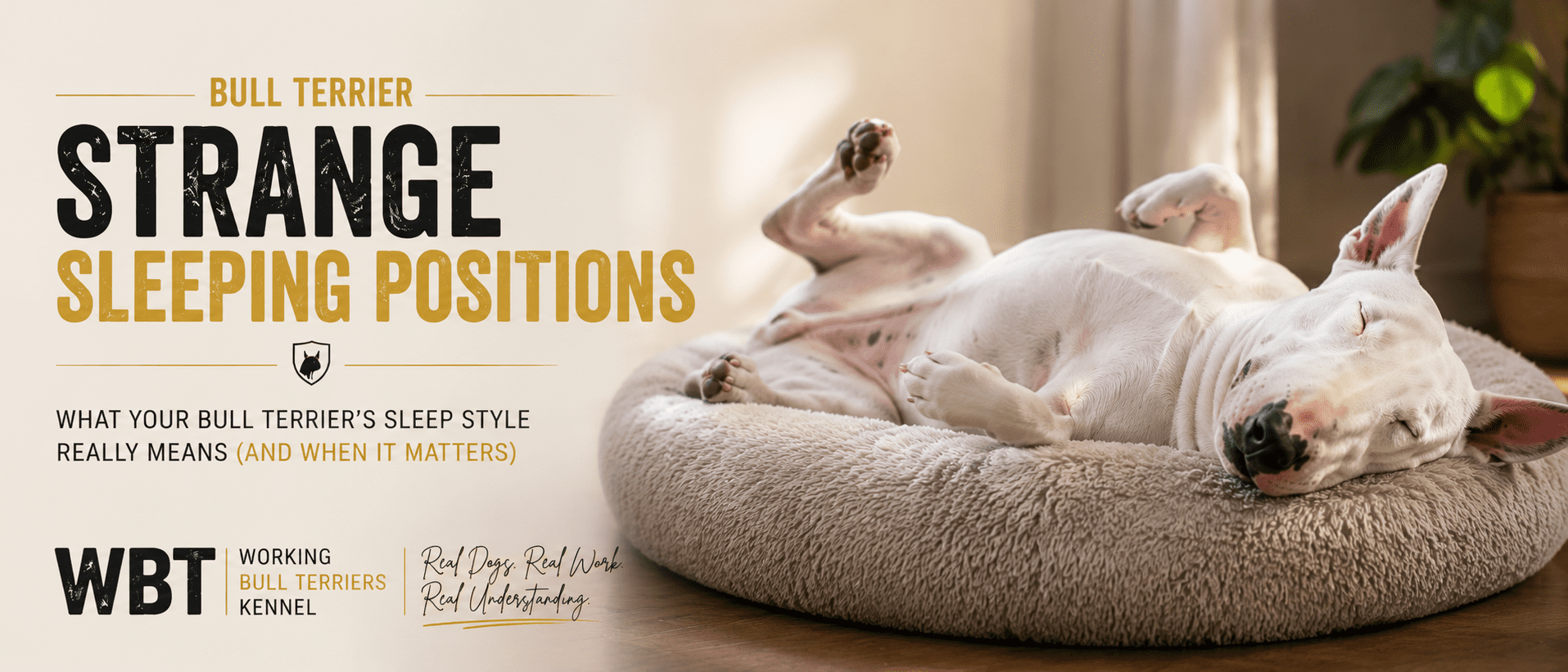
Bull Terrier Quirks, Sleep & Breed-Specific Behaviour
Bull Terrier Strange Sleeping Positions
Bull Terriers can sleep in positions that look impossible. Upside down. Folded in half. Pressed against a wall. Head hanging off the sofa. Legs in the air. Body twisted like a pretzel. Sometimes they sleep so dramatically that new owners wonder whether something is wrong.
Most strange sleeping positions are completely normal. They are part of the breed’s physical confidence, comfort-seeking behaviour, personality, and relationship with the home environment. But like every Bull Terrier quirk, the important thing is not only what the dog is doing. The important thing is whether the pattern is relaxed, comfortable, easy, and normal for that individual dog.
A funny sleeping position is usually just a funny sleeping position. A sudden change in how your Bull Terrier sleeps, rests, breathes, moves, or avoids pressure on part of the body may deserve more attention.
Bull Terrier strange sleeping positions are usually normal and often reflect comfort, temperature regulation, trust, flexibility, pressure-seeking, habit, or simple breed personality. Many Bull Terriers sleep upside down, curled tightly, stretched out, pressed against furniture, under blankets, or with their head hanging off a bed. Owners should pay closer attention if the sleeping position changes suddenly, the dog seems painful, restless, stiff, weak, overheated, struggling to breathe, or unable to settle.
Are Strange Sleeping Positions Normal in Bull Terriers?
Yes. Strange sleeping positions are very common in Bull Terriers. This is a breed with a strong body, expressive personality, high physical confidence, and a talent for making normal life look slightly ridiculous.
Many Bull Terriers do not simply lie down politely like a decorative dog in a catalogue. They collapse, twist, wedge, roll, lean, stretch, burrow, and somehow sleep peacefully in shapes that do not look comfortable to humans.
This belongs naturally inside the wider world of Bull Terrier quirks and breed-specific behaviour. The breed often expresses comfort, excitement, frustration, affection, and rest in ways that can look unusual if you are not used to them.
The key question is not “Does this look strange?” The key question is “Is this normal for my dog, is the body relaxed, and does the dog move normally afterwards?”
Why Bull Terriers Sleep in Strange Positions
A sleeping position can be about comfort, temperature, security, habit, pressure, confidence, or emotional state. Bull Terriers are not subtle dogs. Their resting style often shows exactly how safe, tired, warm, playful, or deeply relaxed they feel.
Here are the most common reasons behind those strange positions.
A Bull Terrier sleeping on his back with the belly exposed often looks dramatic, but it can also be a sign of deep relaxation. The dog is not trying to protect every part of the body. He is loose enough to let go.
This does not mean every belly-up dog is perfectly calm in every situation, but in a familiar home, a relaxed upside-down sleep is usually a good sign. The dog feels secure enough to sleep without guarding himself.
Some Bull Terriers sleep stretched out, belly exposed, or pressed against cooler surfaces because they are warm. This is especially common after activity, in summer, or in homes where the dog chooses tiles, shaded corners, or airflow.
A stretched sleeping position can simply be the dog’s way of releasing heat and finding comfort. Always make sure your Bull Terrier has shade, water, airflow, and the ability to move away from heat.
The opposite can also happen. A Bull Terrier may curl tightly, burrow under blankets, press against a human, or push into soft bedding because he wants warmth and contact.
Many Bull Terriers love warmth. They may behave like professional blanket inspectors, searching for the warmest possible sleeping spot in the house.
Some Bull Terriers sleep pressed against walls, furniture, other dogs, or their owner. This can be about pressure, security, warmth, closeness, or simple habit.
A dog who sleeps with his body wedged into a corner or pushed against your leg may not be uncomfortable at all. He may be choosing that pressure because it helps him settle.
Bull Terriers can be surprisingly flexible. They may fold themselves into positions that look awkward to humans but feel normal to the dog.
If the dog gets up normally, walks normally, stretches normally, and shows no sign of stiffness or pain, the strange position is probably just another example of Bull Terrier logic.
A dog who has had proper activity, structure, and mental engagement may sleep deeply and heavily. Some Bull Terriers look almost melted after a satisfying day.
This is different from a dog who is exhausted, overstimulated, overheated, or unable to settle. Good rest should look peaceful, not distressed. For balance between activity and recovery, use the Bull Terrier Exercise & Mental Stimulation route.
Some Bull Terriers have favourite sleeping routines. They circle. They dig the blanket. They fall asleep with a toy. They sleep half on and half off the bed. They choose the most inconvenient spot in the house.
If the pattern is consistent and the dog is healthy, it may simply be part of his individual personality.
Strange sleeping positions are often harmless, but sudden changes, pain signs, restlessness, overheating, stiffness, or difficulty breathing should not be dismissed as “just a Bull Terrier thing.” Learn to separate funny personality from patterns that deserve attention.
Common Bull Terrier Sleeping Positions and What They Usually Mean
Sleeping positions are not a perfect diagnostic tool. You cannot look at one photo and know everything about the dog. But patterns can still tell you useful things about comfort, temperature, confidence, and routine.
The Bull Terrier lies on his back with the legs open, belly exposed, sometimes with the head tilted to one side. This often means the dog is relaxed, warm, comfortable, and not worried about protecting himself.
It can also help the dog cool down. If the breathing is normal and the dog looks peaceful, this is usually nothing to worry about.
The body is twisted, the legs are placed in impossible directions, and the head somehow rests where it should not. Humans see discomfort. The Bull Terrier sees sleep architecture.
If the dog wakes up normally and moves freely afterwards, the pretzel position is usually just comfort and flexibility.
Some Bull Terriers sleep with their back, legs, or head pressed into a wall, sofa, crate side, or furniture. This can be about pressure, security, body support, or habit.
If the dog is relaxed and chooses this position voluntarily, it is usually harmless. If head pressing appears while the dog seems disoriented, unwell, confused, or abnormal, that is not the same thing and should be discussed with a vet.
Many Bull Terriers sleep with the head hanging off a sofa, bed, cushion, or chair. It looks uncomfortable, but some dogs choose it repeatedly.
This can simply be how the dog likes to rest. Make sure the dog cannot fall awkwardly, especially puppies, older dogs, or dogs recovering from injury.
The dog curls into a tight circle with the nose tucked toward the tail. This often helps preserve warmth and can feel secure.
A tight curl is very normal, especially in cooler weather or during lighter rest. If a dog who usually sleeps open suddenly curls tightly and seems uncomfortable, look at the wider picture.
The Bull Terrier lies flat on the side, belly, or back with the body stretched long. This often appears when the dog is warm, deeply relaxed, or fully comfortable in the environment.
Side sleeping and stretched sleeping are often signs of proper rest, especially after a balanced day of physical and mental activity.
Some Bull Terriers love sleeping under blankets, inside bedding, or buried into soft material. This can be about warmth, security, scent, darkness, and comfort.
Make sure the dog can breathe easily, move out freely, and does not overheat. Blanket love is normal, but safety and airflow still matter.
Many Bull Terriers sleep touching their owner. A paw on your leg, the whole body pressed into your side, the head on your foot, or the full body weight of a small concrete block placed across you.
This can be affection, warmth, pressure, habit, or connection. It is not automatically a problem unless the dog becomes possessive, controlling, or unable to settle without constant human contact.
Sleeping Positions Can Reflect the Dog’s State
Sleep is not separate from behaviour. A Bull Terrier’s ability to settle, sleep deeply, change positions comfortably, and recover after activity tells you something about the dog’s nervous system and daily rhythm.
A dog who sleeps peacefully in strange positions may simply feel secure and fulfilled. A dog who cannot settle, changes position constantly, pants heavily, wakes repeatedly, guards resting places, or seems restless may need a closer look.
This is where Bull Terrier ownership becomes more than laughing at quirks. The owner learns to observe patterns. Is the dog tired or regulated? Comfortable or restless? Relaxed or guarding? Warm or overheated? Sleeping deeply or crashing from chaos?
That is why the WBT Method always looks at the whole dog: state, structure, environment, relationship, and daily rhythm before jumping to conclusions.
A funny sleep photo is one moment. A repeated sleep pattern tells you more. Watch what is normal for your dog so you can recognize when something changes.
When Strange Sleeping Positions May Be a Warning Sign
Most strange sleeping positions are normal. But owners should not ignore sudden or repeated changes that suggest discomfort, pain, heat stress, breathing difficulty, anxiety, neurological signs, or poor recovery.
Pay closer attention if you notice:
- Your Bull Terrier suddenly avoids a sleeping position he used to enjoy.
- The dog struggles to lie down, rise, turn, stretch, or get comfortable.
- There is limping, stiffness, weakness, trembling, yelping, or sensitivity to touch.
- The dog changes position constantly and cannot settle.
- The dog pants heavily at rest, seems overheated, or seeks cold surfaces excessively.
- Breathing sounds abnormal, strained, or unusual during rest.
- The dog guards resting areas, snaps when approached, or becomes tense around touch.
- The dog seems confused, disoriented, unwell, or very different from normal.
- An older dog suddenly sleeps differently after a fall, injury, illness, or change in mobility.
In these cases, do not explain everything away as a breed quirk. If the dog appears uncomfortable, painful, weak, overheated, distressed, or abnormal, contact your veterinarian.
Bull Terriers are funny dogs, but responsible ownership means noticing when a familiar behaviour changes. Sleep, movement, breathing, appetite, energy, and behaviour all belong to the same picture.
Should You Let a Bull Terrier Choose His Own Sleeping Place?
In many homes, yes, as long as the choice is safe and does not create conflict, guarding, overheating, or household problems. A Bull Terrier can have preferred sleeping places while still living inside clear rules.
The problem is not the dog sleeping on a sofa, in a crate, in a bed, or under a blanket. The problem is when the sleeping place becomes a source of possession, tension, pushiness, or loss of structure.
A healthy setup gives the dog comfort and clarity.
- Provide a comfortable bed or resting area.
- Make sure the dog has a cool option and a warm option when possible.
- Do not let resting places become guarding zones.
- Teach the dog to move calmly when asked.
- Give puppies and young dogs enough structured rest, not constant stimulation.
- Support older dogs with easier access, stable bedding, and safe surfaces.
For puppies and young Bull Terriers, sleeping places connect strongly to routine and early structure. If your dog is young, continue through Bull Terrier Puppy Structure and Bull Terrier Puppy Training.
Sleep, Structure, and the Bull Terrier Mind
Bull Terriers need more than exercise. They need the ability to switch off. A dog who is always entertained, always touched, always stimulated, or always allowed to escalate may struggle to rest properly.
Strange sleeping positions are funny when the dog is genuinely relaxed. But a dog who crashes after chaos is different from a dog who settles after a balanced day.
This is why calm routines matter. Food rhythm, exercise rhythm, mental work, boundaries, place training, quiet time, and recovery all influence how a Bull Terrier rests.
If your dog struggles to relax unless exhausted, or only sleeps after becoming wild, the next step is not more chaos. The next step is better structure.

The WBT Quirks guide helps owners understand strange Bull Terrier behaviours without overreacting, excusing everything, or missing patterns that need structure.
Final Thought
Bull Terrier strange sleeping positions are usually part of the breed’s charm. The upside-down sleep, the pretzel, the wall press, the blanket cave, the head-hanging-off-the-bed position, and the full-body human contact nap are all familiar scenes to many Bull Terrier owners.
Most of the time, these positions mean comfort, trust, warmth, cooling, pressure, habit, or deep relaxation. They are not something to worry about simply because they look unusual to humans.
But good ownership means knowing the difference between a harmless quirk and a meaningful change. If the dog moves normally, sleeps peacefully, breathes comfortably, wakes easily, and behaves like himself, enjoy the comedy. If the pattern changes suddenly or comes with discomfort, stiffness, restlessness, breathing difficulty, guarding, or pain signs, take it seriously.
A Bull Terrier can be funny and still deserve careful observation. That balance is where real breed understanding lives.
Frequently Asked Questions About Bull Terrier Sleeping Positions
Bull Terriers often sleep in strange positions because they feel comfortable, safe, warm, cool, physically relaxed, or because they enjoy pressure and contact. Many strange sleeping positions are normal for the breed.
Yes, many Bull Terriers sleep upside down. It can mean the dog feels relaxed, secure, warm, or is trying to cool down. It is usually normal if the dog breathes comfortably and moves normally afterwards.
Many Bull Terriers like sleeping under blankets for warmth, security, scent, darkness, and comfort. Make sure the dog can breathe easily, move out freely, and does not overheat.
A Bull Terrier may sleep pressed against you for warmth, affection, pressure, comfort, or connection. It is usually harmless unless the dog becomes possessive, pushy, or unable to settle without constant contact.
Worry if the sleeping position changes suddenly or comes with pain, stiffness, limping, weakness, restlessness, heavy panting, breathing difficulty, guarding, confusion, or abnormal behaviour. In those cases, contact your vet.
Sometimes, especially if the dog suddenly avoids normal positions, struggles to lie down or rise, changes position constantly, limps, yelps, or seems sensitive to touch. A single funny position is usually not enough to diagnose pain, but changes in pattern matter.