
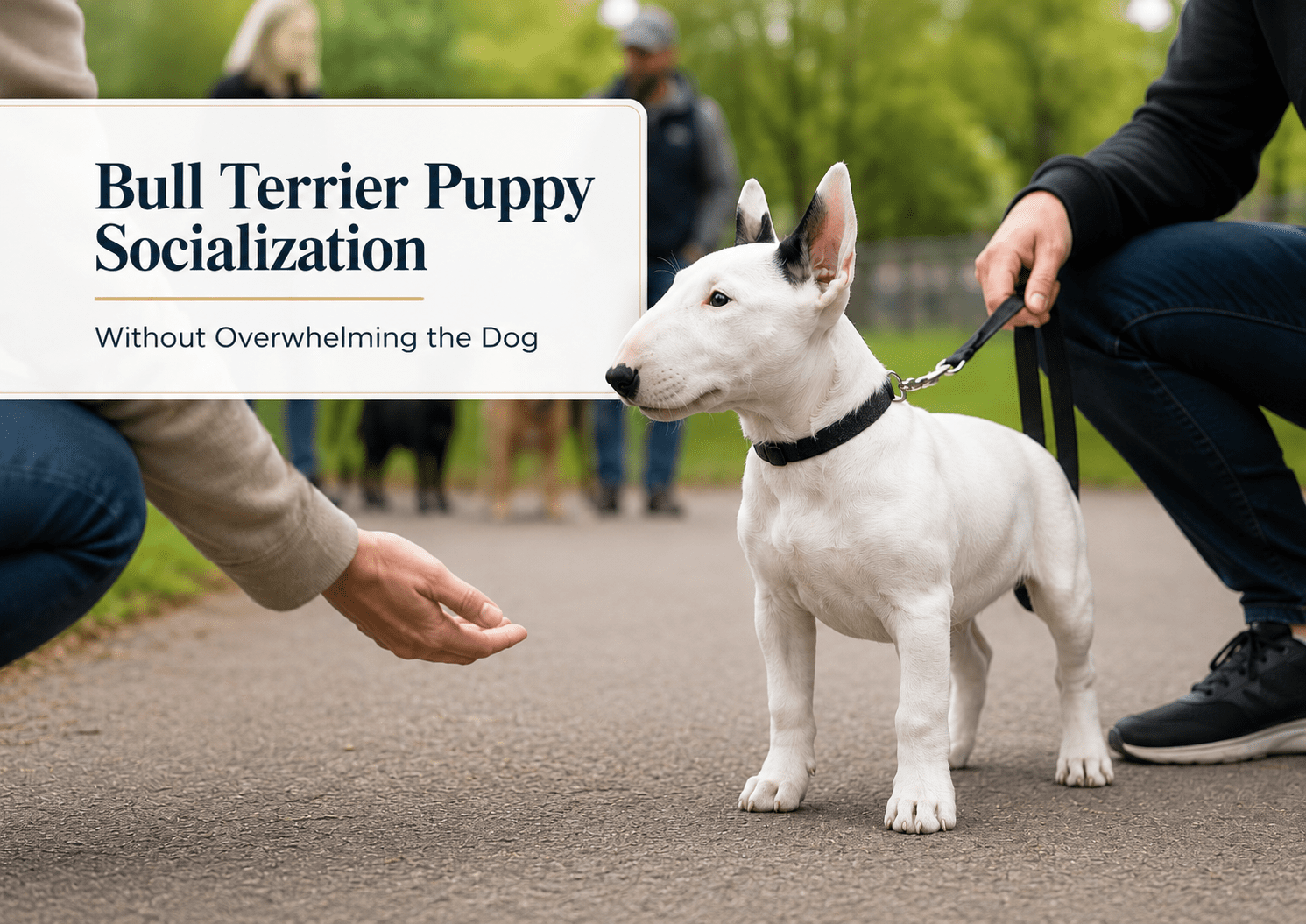
Bull Terrier puppy socialization does not mean throwing the puppy into every dog, person, sound, and busy environment as quickly as possible. It means teaching the puppy that the world is safe, manageable, and not something they need to chase, fear, or explode toward.
A Bull Terrier puppy needs exposure, but exposure alone is not enough. The experience must be calm enough for the puppy to process what is happening, stay connected to the owner, and recover afterward. When every outing becomes intense, long, chaotic, or overexciting, the puppy may not become more confident. They may become frustrated, reactive, fearful, pushy, or unable to settle around normal life.
This distinction matters with Bull Terriers because many puppies are bold, physical, curious, emotional, and easily pulled into excitement. Some want to investigate everything. Some love people so much that every greeting becomes a full-body event. Others look brave while quietly becoming overloaded underneath.
Bull Terrier puppy socialization should be short, controlled, positive, and focused on confidence, neutrality, connection, and recovery. Your puppy does not need to greet every person or dog. They need to learn that people, animals, sounds, surfaces, movement, and new environments can exist without causing fear, frustration, or uncontrollable excitement.

Bull Terrier Puppy Socialization: What It Really Means
Exposure means the puppy sees or experiences something. Socialization means the puppy learns something useful from that experience. Those are not the same thing.
A puppy can see ten dogs and learn to pull, bark, lunge, or become frustrated whenever a dog appears. They can meet twenty people and learn that every human means jumping, mouthing, and wild excitement. They can visit a crowded place and learn that the world is too much. They can be passed from person to person and learn that they have no control over what happens to them.
Good socialization teaches a different lesson. Different people exist. Dogs can be seen without chaos. Sounds and movement can happen without chasing. New surfaces can be investigated calmly. The owner remains relevant even when the environment is interesting.
Quality of Experience Matters More Than Quantity
More exposure is not automatically better. A puppy does not need to experience everything in one week. They need the right experiences at an intensity they can handle.
One calm meeting with a respectful person can be more valuable than ten excited greetings. Watching one stable dog from a sensible distance can teach more than chaotic group play. A five-minute visit to a new place can be better than an hour-long outing that leaves the puppy exhausted and biting everyone at home.
Confidence grows when the puppy can process what is happening. When the puppy is too scared, too excited, too tired, or too stimulated, the lesson changes. The owner may believe they are building confidence while the puppy is actually rehearsing overload.
- They can take food normally.
- They look back at the owner.
- They sniff and explore without rushing.
- Their body remains reasonably loose.
- They recover quickly after a surprise.
- They can leave the situation without a fight.
- They freeze, hide, shake, or pull away.
- They refuse food they normally value.
- They bark, lunge, spin, or become frantic.
- Mouthing and jumping suddenly increase.
- They stop responding to familiar guidance.
- They remain wired long after returning home.
Neutrality Is Part of Good Socialization
Many owners believe a social puppy should greet everyone. That is one of the easiest ways to create future frustration.
A well-socialized Bull Terrier should be able to notice people, dogs, children, bicycles, animals, and movement without believing that every sight is an invitation. Neutrality means the puppy can observe something without needing to rush toward it, hide from it, or become completely disconnected from the owner.
This is especially important for a naturally social or physical puppy. A young Bull Terrier who learns that every dog means play may later bark, pull, or lunge when a lead prevents access. A puppy who learns that every person means intense greeting may become difficult around visitors. A puppy who is encouraged to chase every moving child may become unsafe as their body becomes stronger.
Sometimes the best socialization session is sitting at a comfortable distance, allowing the puppy to watch the world, rewarding calm check-ins, and leaving before excitement climbs too high.
Why Dog Parks Are a Poor Starting Point
Dog parks are usually too uncontrolled to be a reliable puppy-socialization plan. The owner cannot choose every dog, control every interaction, or know whether another dog is tolerant, frightened, rough, sick, or socially appropriate.
A Bull Terrier puppy does not need random group chaos to become good around dogs. They need carefully chosen experiences with stable dogs, calm parallel walks, short controlled interactions, and practice observing dogs without always reaching them.
The goal is not to make the puppy obsessed with other dogs. It is to help them behave sensibly around dogs. Because Bull Terriers can become more selective as they mature, early socialization should build confidence, manners, recovery, and neutrality rather than the expectation of unrestricted play.
Meeting People and Children Without Creating Chaos
Bull Terrier puppies attract attention. Strangers may bend over them, speak loudly, encourage jumping, touch the face, or try to pick the puppy up. The owner’s job is to protect the quality of the experience, not to satisfy every person who wants a greeting.
Short, calm interactions are more useful than a crowd of excited hands. The puppy should not be grabbed, surrounded, or forced to accept contact. A confident puppy still needs manners, while a hesitant puppy needs space and choice rather than pressure.
- People can be present without demanding a reaction.
- Four paws on the ground keep the interaction calm.
- The owner remains worth checking in with.
- Moving away is allowed when the puppy needs space.
- Not every person is available for greeting.
Children need even more structure because they run, wave their hands, shout, drop food, and react loudly when a puppy jumps or bites. That movement can turn into a powerful game for a Bull Terrier puppy.
The puppy should not be allowed to chase children, bite clothing, jump toward faces, or practise rough behaviour because they are young. Children should not tease, grab, climb on, or overstimulate the puppy. A controlled five-minute experience is more valuable than an hour of unmanaged chaos.
Socialization Includes the Environment
Socialization is not only about people and dogs. A puppy also needs calm experience with normal life: grass, gravel, wood, tile, safe steps, household appliances, collars, harnesses, leads, car travel, grooming tools, vet-style handling, umbrellas, wind, rain, bicycles at a distance, doorways, and different rooms.
The puppy does not need to be forced through a checklist. Let them investigate. Reduce pressure when needed. Give them time to recover from surprise. Make success more important than quantity.
A Bull Terrier puppy who feels comfortable with surfaces, handling, everyday sounds, and new environments will be easier to guide later. The purpose is not to make the puppy fearless. It is to teach them that uncertainty can be approached, processed, and recovered from.
Learn to Read Overwhelm Before It Becomes Chaos
Not every overwhelmed puppy looks frightened. Some become louder, faster, mouthier, and more difficult to control. This is particularly easy to misread in Bull Terriers because overload can look like clownish excitement.
The puppy may begin biting the lead, jumping at the owner, racing in circles, ignoring cues, grabbing clothing, or attacking every object within reach. Owners often assume the puppy needs even more exercise, when the nervous system may already be overloaded.
When this happens, reduce the difficulty. Increase distance, move somewhere quieter, allow calm sniffing, shorten the session, or leave. Do not keep pushing because the puppy must “get used to it.” Flooding can create the opposite of confidence.
The same principle applies at home. If outings regularly lead to evening biting, zoomies, and an inability to settle, review the puppy’s complete routine through the Bull Terrier puppy structure guide rather than simply adding more activity.
Keep Sessions Short and Build Recovery
Puppy socialization should not become an expedition. A few successful minutes in a new place can be enough. A brief car ride, one calm greeting, a short observation session, or a gentle introduction to a new surface may provide all the learning the puppy needs that day.
Novel experiences stack. A puppy may handle the first new thing well, remain functional through the second, and unravel during the fourth or fifth. This is why owners sometimes see a sudden explosion that appears to come from nowhere.
Recovery is part of socialization. After an outing, the puppy may need water, a toilet break, calm chewing, crate time, a place session, or a proper nap. The experience is not finished when you leave the environment. It is finished when the puppy has returned to a balanced state.
The articles on crate and place training and teaching a Bull Terrier puppy to settle explain how to create that recovery at home.
Keep the Owner Relevant in the Environment
A puppy should not only learn about the world. They should learn how to remain connected to the owner while the world is present.
Reward spontaneous check-ins, name response, eye contact, calm following, and the decision to turn away from a distraction. Do not turn every outing into a strict obedience session, but do not allow the environment to become the only source of value.
The lesson should be: the world is interesting, but my owner still matters.
This is where early Bull Terrier puppy focus training becomes part of socialization. Connection built around mild distractions can prevent pulling, frustration, selective hearing, and chaotic greetings later.
Match the Socialization Plan to the Puppy
Not every Bull Terrier puppy needs the same plan. A naturally bold puppy may need less direct interaction and more neutrality. A sensitive puppy may need slower confidence-building and greater distance. An overly social puppy needs to learn that access is not automatic. A puppy who becomes mouthy when excited needs shorter sessions and earlier recovery.
Train the puppy in front of you. Do not copy another owner’s schedule blindly, and do not assume that hesitation means weakness. Confidence is not created by proving that a puppy can endure pressure. It is created by helping them succeed at a manageable level and gradually expanding what they can handle.
Prevent Frustration Around Other Dogs
Lead frustration often begins innocently. The puppy sees dogs, pulls toward them, and is allowed to greet sometimes but not others. The dog becomes increasingly valuable, while the lead becomes the barrier preventing access.
Later, this may appear as barking, whining, spinning, lunging, freezing, or dragging the owner toward every dog. The behaviour may look aggressive even when it began as excitement and frustration.
Teach calm distance from the beginning. Let the puppy watch dogs without always greeting. Reward turning back to the owner. Practise moving away. When greetings do happen, choose appropriate dogs, keep the interaction brief, and finish before the puppy becomes too high.
Bull Terrier puppies need to learn how to exist around dogs, not only how to play with them.
A Practical Socialization Session
- Choose one objective. A quiet street, one calm person, a new surface, or observing dogs from a distance is enough.
- Begin below the puppy’s limit. Start far enough away that the puppy can take food, sniff, and look back at you.
- Reward useful choices. Mark calm observation, check-ins, loose-body exploration, and moving with you.
- Protect the puppy from unwanted contact. Say no to greetings that are too rough, crowded, or intense.
- Leave while the puppy is still functioning. Do not wait for the explosion before ending.
- Plan the recovery. Return to a predictable routine with water, toilet, calm activity, and rest.
For puppies in their first days at home, begin even more gently. The first 48 hours guide explains why security, routine, and decompression should come before unnecessary exposure.
Common Socialization Mistakes
- Forcing too much exposure too quickly.
- Confusing intense excitement with confidence.
- Allowing every person and dog to greet the puppy.
- Using dog parks as the main socialization plan.
- Keeping sessions going after the puppy has stopped processing.
- Ignoring wild behaviour as a possible sign of overwhelm.
- Failing to build rest and recovery after outings.
- Letting the world become more valuable than the owner.
- Avoiding all exposure because the puppy once appeared worried.
- Comparing one puppy’s progress with another puppy’s temperament.
Thoughtful socialization does not mean being afraid of every experience. It means making deliberate choices, watching the puppy, and changing the plan before a manageable challenge becomes a damaging one.
When the Puppy Needs More Than Exposure
If your puppy becomes increasingly fearful, reactive, impossible to settle, intensely frustrated around dogs, or aggressive when overwhelmed, repeating the same exposure is unlikely to solve the problem. The puppy may need a better routine, stronger focus foundations, controlled distance, and a more individual plan.
Use the Bull Terrier Quick Diagnostic when the behaviour feels layered or when you are unsure whether you are seeing normal puppy excitement, fear, frustration, or a developing behaviour problem.
Build the Foundation Behind Calm Socialization
The Puppy Training Guide gives you the complete early structure behind socialization, while the Quirks Guide helps you understand the breed-specific patterns that can appear as confidence, excitement, fixation, mouthiness, or frustration.

A complete breed-specific foundation for routine, confidence, socialization, crate training, focus, impulse control, leash manners, and the first six months.
- 196 pages
- 23 detailed chapters
- Instant PDF download
- $30.00 USD
- Available now

Understand the breed-specific mindset behind zoomies, overexcitement, mouthing, fixation, selective hearing, clinginess, frustration, and other familiar Bull Terrier patterns.
- 252 pages
- 50 detailed chapters
- Instant PDF download
- $30.00 USD
- Available now
Continue Learning
Frequently Asked Questions
There is no useful target number. A smaller number of calm, positive, well-managed experiences is more valuable than many intense greetings. Focus on how the puppy responds and recovers rather than collecting interactions.
No. A puppy should learn that seeing a dog does not always lead to interaction. Calm observation, moving past dogs, checking in with the owner, and carefully selected greetings help prevent frustration and pulling later.
Dog parks are usually too uncontrolled to be a good starting point. Carefully chosen dogs, parallel walks, short interactions, and calm observation provide safer and more useful learning.
Increase distance, reduce pressure, and allow the puppy time to observe. Reward calm investigation and leave if the puppy cannot recover. Avoid dragging, trapping, or forcing the puppy to remain close to the trigger.
Many useful sessions last only a few minutes. End while the puppy can still think, take food, and respond. The appropriate length depends on the puppy, the environment, and how much novelty has already occurred that day.
The puppy may be tired, overstimulated, or unable to recover from too much novelty. Shorten the outing, reduce intensity, and follow it with a predictable routine, calm activity, and proper rest.
Socialization is not about creating a puppy who reacts to everything. It is about raising a puppy who can live around everything.
A Bull Terrier puppy should learn confidence without obsession, curiosity without chaos, and engagement with the world without losing connection with the owner. When that foundation is built thoughtfully, the dog enters adolescence with better recovery, clearer habits, and a far stronger ability to handle normal life.
Leave a Reply