
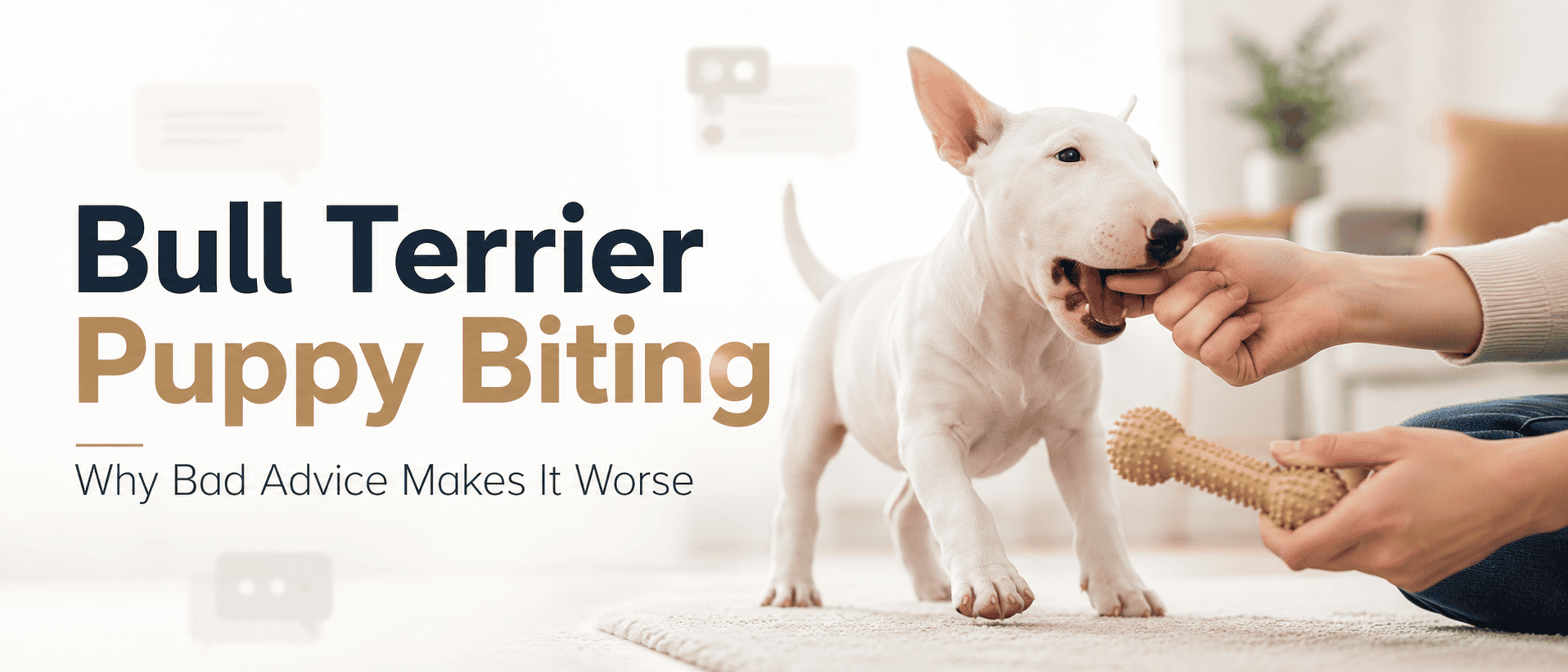
Bull Terrier Puppy Training, Bite Inhibition & Owner Education
Bull Terrier Puppy Biting: When Bad Online Advice Becomes the Bigger Problem
Bull Terrier puppy biting can be intense, painful, and frightening for new owners. But sometimes the bigger danger is not the 15-week-old puppy using his mouth. It is the advice the owner receives when they ask for help.
I was tagged several times in a Facebook group post about a 15-week-old Bull Terrier puppy whose biting had become so hard that the owner said she was covered in bruises on her arms and legs. The puppy was not the part that shocked me. The comments did.
Some people genuinely tried to help. A few comments mentioned useful ideas such as redirection, sleep, crate resets, no rough play, calm consistency, and appropriate chewing outlets. But those useful fragments were buried inside a much larger pile of punishment, dominance myths, spray bottles, “he’ll grow out of it” minimising, and casual normalisation of bruises, scars, torn clothing, and overwhelmed owners.
This article is not written to publicly shame individual commenters. Names and personal details in the screenshots are blurred. The issue is bigger than one person. The issue is the advice culture new Bull Terrier owners are exposed to when they ask for help.
Bull Terrier puppy biting is common, but it should not be ignored or handled with violence. A hard-biting puppy usually needs better sleep, structure, redirection, calm consequences, legal chewing outlets, bite-inhibition work, and an off-switch routine. Bad advice such as hitting, biting back, spray bottles, dominance battles, or simply waiting for the puppy to “grow out of it” can make the problem worse.
Important safety note: This article is about young puppy biting and poor online advice. If your dog is older, causing serious injury, guarding, snapping around children, redirecting onto people, or showing sudden dangerous aggression, use safe separation and get professional help. Do not rely on comments, tricks, or internet arguments.
The Original Problem Was Serious — But Not Unusual
The original post described a 15-week-old puppy who was loved, beautiful, full of personality, and also biting hard enough that the owner felt repeatedly attacked and physically bruised.
That is not a rare question. Many Bull Terrier puppies go through a hard mouthy stage. They are physical, excitable, persistent, easily overstimulated, and often slower to switch off than softer breeds. They use their mouths to explore, play, protest, demand, redirect frustration, and discharge excess arousal.
So no, a 15-week-old puppy biting hard does not automatically mean aggression. But it also does not mean “ignore it.”
Normal puppy behaviour can still become a serious pattern if it is rehearsed every day.
The right question is not only “Is this normal?” The better question is “What is this puppy learning every time the biting happens?”
The Comment Section Showed the Bigger Problem
From the captured comments available at the time of review, the pattern was already clear enough to matter. There were repeated spray-based suggestions, direct physical handling suggestions, dominance-based advice, punishment-heavy comments, and dozens of “baby shark / land shark / it will pass” replies.
Reassurance has value. Owners should not be made to panic and believe every hard-biting puppy is ruined. But reassurance without structure can become dangerous. A puppy may grow out of the sharpest teething phase, but he may also grow into stronger jaws, better timing, more confidence, and a rehearsed pattern of using his mouth whenever he becomes excited or challenged.
If puppy biting, overarousal, zoomies, rough play, poor off-switch, or hard mouth pressure is already becoming stressful, start with a proper Bull Terrier framework. A young puppy needs structure early, not violence, panic, or months of guessing.
When “Advice” Becomes Abuse
Some comments crossed a line completely. Suggestions involving kicking, smacking, biting back, pinning, scruff-shaking, grabbing the muzzle, pinning the tongue, frightening the puppy, or forcing physical submission are not training. They are conflict.
A 15-week-old Bull Terrier puppy does not need to learn that humans are unpredictable, painful, frightening, or physically confrontational. He needs to learn that human hands are calm, rules are consistent, arousal has limits, teeth do not control the room, and there are clear outlets for his mouth and energy.
Violence may interrupt a behaviour in the moment. That does not mean the puppy has learned self-control. It does not mean he understands what to do instead. It may simply mean the puppy has learned to associate the owner’s hands, movement, proximity, or emotional tone with threat.

Experienced Bull Terrier people need to be clear: being firm is not the same as being violent.
Firm means clear boundaries, repetition, timing, prevention, routine, management, and calm consequence. It does not mean hurting, scaring, overpowering, or humiliating a puppy.
The “Alpha” Advice Problem
Another pattern in the comments was dominance-based advice: show him who is boss, show him who is the leader, dominate him, behave like the alpha, or copy old television-style correction methods.
This is especially dangerous with Bull Terriers because they are intense, physical, persistent dogs. Turning early puppy biting into a dominance battle can create exactly the conflict the owner is trying to avoid.
A young puppy biting hard is usually not plotting to take over the house. More often, he is teething, tired, overstimulated, over-handled, frustrated, hungry, under-structured, accidentally reinforced, or simply has never been shown a better pattern.

If an owner approaches a Bull Terrier puppy as an opponent, the puppy often becomes more of an opponent. If the owner approaches the puppy as a state to read, a routine to shape, and a nervous system to guide, the dog has a much better chance.
Spray Bottles Are Not a Training Framework
Spray bottle advice appeared again and again. Water bottle. Squirty bottle. Spray in the face. Spray on the nose. Bitter spray. Sour spray. Water gun. The wording changed, but the idea was the same: make biting unpleasant enough that the puppy stops.
The problem is simple: a spray bottle may interrupt the behaviour, but it does not explain the behaviour.
It does not teach bite inhibition. It does not teach calmness. It does not teach the puppy how to settle. It does not teach the owner when the puppy is crossing from play into overstimulation. It does not fix poor sleep, rough handling, accidental reward, or lack of structure.
Some puppies become more excited. Some become hand shy. Some learn to avoid the bottle but continue the behaviour elsewhere. Some simply learn that humans become unpredictable when the puppy is already aroused.
That is not education. That is suppression.
When Good Advice Gets Mixed With Bad Advice
Not every harmful comment looked obviously cruel. Some comments contained useful elements and bad elements in the same paragraph. This is why new owners struggle.
A comment may mention redirection, naps, or removing attention — all potentially useful — and then mix that with spray bottles, physical correction, dominance claims, or “welcome to Bull Terrier life” normalisation. That kind of mixed advice is dangerous because it sounds practical.

This is one of the biggest problems in online dog groups. Advice is not organised by cause. It is organised by whoever comments first, loudest, or with the most confidence.
“He’ll Grow Out of It” Is Not a Plan
Another massive pattern was the “it will pass” category. Baby shark. Land shark. He is only a pup. It is normal. They grow out of it. Wait until the adult teeth come through. Mine did it for months. Mine did it for years. Welcome to Bull Terrier life.
Some of those comments were meant kindly. But common does not mean harmless. Puppyhood is not an excuse to let a behaviour rehearse itself until the dog is bigger, stronger, more practised, and harder to interrupt.

The question is not only, “Will this pass?” The better question is, “What is this puppy learning while we wait?”

Scars Should Not Be Treated as a Rite of Passage
One of the most worrying patterns was how casually people mentioned scars, bruises, ripped clothes, battered hands, blood, and months of being bitten.
There is a strange culture in some breed groups where being injured by a puppy becomes almost a badge of honour. People laugh about it, call it “Bull Terrier life,” and tell the new owner to hang in there.
I understand the affection behind some of those comments. Bull Terrier people love their dogs deeply. Many owners remember the hard puppy months and now laugh because the adult dog became wonderful.
But a new owner reading that thread may learn the wrong lesson: if I am bruised, bleeding, overwhelmed, and unsure what to do, that is just normal and I should simply endure it.
That is not responsible breed education.
Bruises are feedback. Scars are feedback. Torn clothes are feedback. A puppy repeatedly reaching that state is feedback. It does not mean panic, but it does mean the routine needs to be read properly.
The Missing Piece: A Framework
The most important thing missing from the thread was not love for the breed. There was plenty of that. The missing piece was a proper framework.
Almost nobody began with diagnostic questions.
- When does the biting happen — morning, evening, after play, after walks, before food, after guests, during handling?
- How much sleep is the puppy actually getting?
- Is there rough hand play or tug that spills into skin contact?
- What does the owner do immediately after the puppy bites?
- Does the puppy get attention, shouting, chasing, toys, freedom, or more excitement after biting?
- Is the puppy hungry, teething, overstimulated, frustrated, or unable to settle?
- Does the puppy know a calm place routine, or is he loose until he explodes?
- Is the biting directed at movement, hands, clothing, feet, visitors, children, or restraint?
Without those questions, advice is guessing. You cannot solve a pattern you have not read.
If you are not sure whether your puppy biting is teething, overarousal, poor sleep, rough play, frustration, lack of structure, or a more serious pattern, use the WBT routes that help owners read the whole dog before guessing.
What a 15-Week-Old Bull Terrier Puppy Actually Needs
A hard-biting Bull Terrier puppy needs structure, not panic. He needs prevention, not random punishment. He needs calm repetition, not emotional chaos.
Teeth on skin must not become a game. The owner should calmly end the interaction, redirect to appropriate outlets, and prevent the puppy from rehearsing the same behaviour again and again.
Many owners try to exercise a biting puppy more, when the puppy may actually be overtired and overstimulated. A tired Bull Terrier is not always calmer. Sometimes he becomes more frantic.
Chews, toys, food puzzles, tug rules, and controlled mouth outlets can help, but they must be part of a system, not thrown at the puppy only after he bites.
Place, crate, pen, tether, calm handling, and recovery time can all be useful when introduced correctly. The goal is not imprisonment. The goal is regulation.
For a Bull Terrier puppy, the answer is rarely one magic trick. It is usually the daily structure around sleep, arousal, handling, play, food, attention, and consequences.
For a general external reference, the American Kennel Club also explains that puppy biting needs early teaching, bite inhibition, redirection to chew toys, and appropriate time-outs rather than allowing the behaviour to become a problem. Read AKC’s puppy biting and bite inhibition guide.
“It Worked for My Dog” Is Not Proof That It Was Right
Many people give advice because they did something with their own dog and the dog eventually improved. That personal experience may be sincere, but it is not automatically a training framework.
Maybe the dog improved because of the method. Maybe the dog improved despite the method. Maybe the dog matured. Maybe the owner forgot the cost. Maybe the adult dog still carries hidden conflict, sensitivity, avoidance, or mistrust that the owner does not connect to the puppy phase.
Surviving a phase with one dog does not make every method used during that phase correct.
Why This Matters for the Breed
This article is not only about one puppy. It is about the future of the breed.
When powerful, intense, physical dogs are raised with poor advice, the dog eventually gets the blame. The puppy grows bigger. The biting becomes more frightening. The owner becomes more emotional. Family members become worried. The dog gets labelled difficult, aggressive, impossible, dominant, dangerous, or “too much.”
Then the rescue posts appear. Then the rehoming posts appear. Then the breed gets another black mark in the eyes of the public.
The Bull Terrier does not need excuses. The Bull Terrier needs better education.
Responsible owners, breeders, trainers, and breed lovers must stop romanticising chaos as “just what they do.” Loving the breed means telling the truth about the breed. They are not bad dogs. But they are not dogs for lazy advice either.

If puppy biting, overarousal, rough play, poor off-switch, or daily chaos is already becoming stressful, the first self-guided route is the WBT Bull Terrier Puppy Training Guide. It gives new owners the puppy-specific foundation behind structure, routine, early rules, calmness, focus, handling, and clearer communication.
For owners who want the wider system, the full WBT books and training guides continue the work beyond puppy biting. If the puppy is already overwhelming the household or you need help reading the pattern, the online training route is the better next step.
The Few Good Comments Were Useful — But Still Incomplete
To be fair, some comments did point in the right direction. The best ones mentioned no rough play, toy redirection, crate or room resets, sleep, overarousal, consistency, and stopping interaction when teeth touch skin.
Those are useful ideas.
But even good advice becomes weak when it is not connected to a framework. “Redirect him” is not enough if the owner does not know when to redirect, what to redirect to, whether the puppy is too tired to learn, what happens after the redirect, and how to prevent the same explosion tomorrow.
That is why Bull Terrier owners need more than comment sections. They need breed-specific education that explains cause, timing, state, routine, and consequence.
If you know someone with a young Bull Terrier puppy who is overwhelmed by biting, share this article before they are buried under hundreds of random comments.
They do not need to be told to kick, smack, bite back, dominate, frighten, spray, or simply wait years. They need to understand what is happening. They need structure early. They need to know that puppy biting can be normal without being ignored, serious without panic, and fixable without violence.
Final Word
The puppy in that post was 15 weeks old.
Fifteen weeks.
And already, the comment section contained spray bottles, smacking, biting back, dominance talk, frightening methods, and advice to simply accept injury as part of the breed.
That is not good enough.
Bull Terriers are not easy dogs, but they are not excuses for bad handling. They are strong, funny, stubborn, affectionate, physical, intense, and deeply misunderstood when owners lack structure.
The answer is not softer ownership. The answer is better ownership.
Normal does not mean acceptable. Common does not mean harmless. Breed character does not mean no training.
Frequently Asked Questions About Bull Terrier Puppy Biting
Bull Terrier puppy biting is common, especially during teething, play, frustration, and overarousal. But common does not mean harmless. Owners should shape the pattern early with structure, calm consequences, legal chewing outlets, sleep, and clear rules around teeth.
A puppy should not be kicked, smacked, bitten back, pinned, frightened, or physically dominated. These methods can create conflict, fear, mistrust, or more arousal. The goal is to teach what to do instead, not scare the puppy into temporary suppression.
The sharpest teething phase may improve with age, but waiting is not a training plan. If a puppy rehearses hard biting every day, the habit can become stronger and harder to interrupt as the dog matures.
Useful foundations include enough sleep, calmer handling, no rough hand play, appropriate chew outlets, clear rules around teeth, redirection before escalation, short resets, place or crate routines, and consistent responses from every person in the home.
Evening biting is often linked to overtiredness, overstimulation, hunger, frustration, or a puppy who has not learned how to switch off. Many puppies need more structured rest and calmer evening routines, not more excitement.
Get help if the biting is escalating, causing serious injury, targeting children, connected to guarding, impossible to interrupt, or making the household unsafe. Early guidance is much easier than waiting until the puppy is older, stronger, and more rehearsed.