

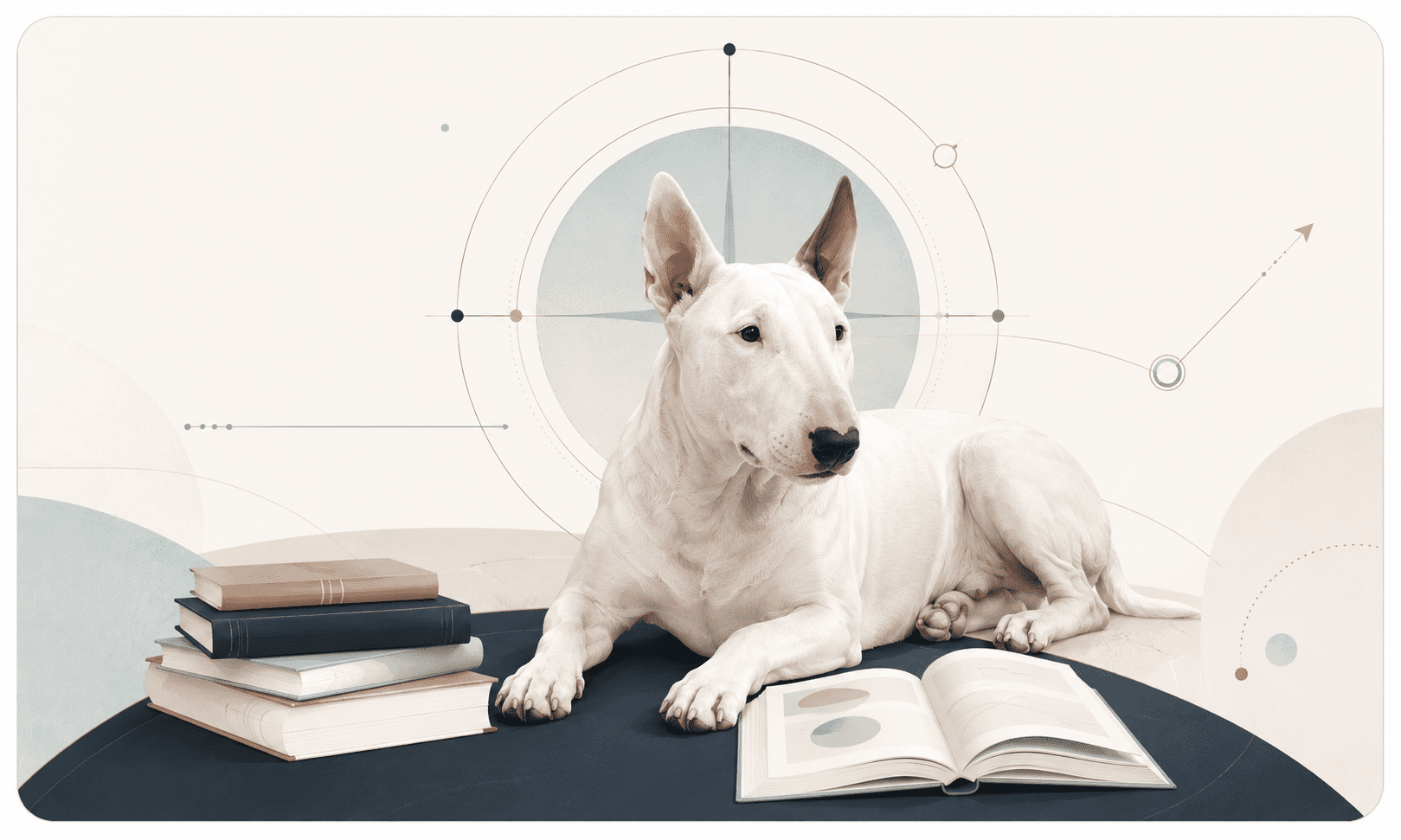


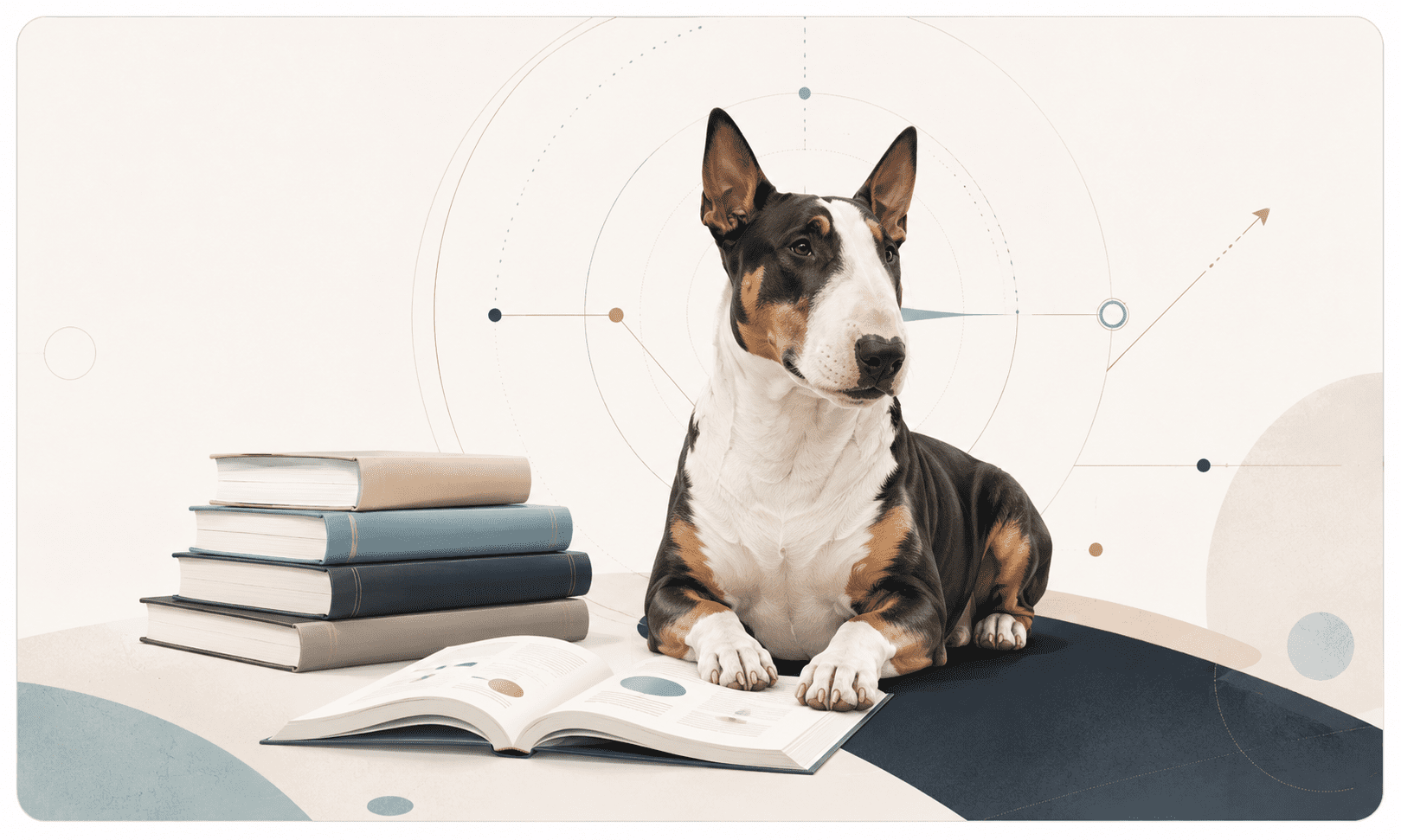


The Bull Terrier Was Never Just a Clown: The Forgotten History Behind the Breed
The forgotten working history behind one of the most misunderstood dog breeds

The Bull Terrier is often called the clown of the dog world. And honestly, it is not difficult to understand why. Anyone who has lived with one knows exactly where that reputation comes from. The strange expressions. The dramatic reactions. The sudden zoomies. The selective hearing. The way a Bull Terrier can turn a normal living room into a theatre stage without even trying.
They are funny dogs. There is no point denying it.
They sleep in ridiculous positions, argue without words, sit like strange little humans, and somehow manage to make even the most serious person laugh. A Bull Terrier does not simply enter a house. It changes the atmosphere of the house. So yes, the Bull Terrier is a clown.
But the Bull Terrier was never just a clown.
Behind the humour, behind the famous head, behind the strange habits and the dramatic personality, there is a much deeper story. A story shaped by courage, physical toughness, determination, athleticism, human connection, and working purpose. And if we only look at the Bull Terrier as a funny companion dog, we miss one of the most important truths about the breed.
This article is the first part of our Bull Terrier History Series a deeper look at the origin, character, working background, development, and future of one of the most misunderstood breeds in the dog world. This is not a romantic version of history. It is not a sanitized version either. And it is certainly not an attempt to glorify cruelty or pretend that every part of the past should be admired. Some parts of the past belong in the past. But ignoring history completely leaves us with a shallow understanding of the breed.
At Working Bull Terriers Kennel, after many years of living with Bull Terriers, breeding them, training them, studying old books, observing different lines, and working with owners from around the world, one thing becomes clearer and clearer:
To understand the modern Bull Terrier, you must understand where the breed came from.
Because history does not disappear.
It remains in temperament, in instinct, in drive, in body language. It remains in the way a breed learns, reacts, bonds, handles pressure, and expresses itself.
And with the Bull Terrier, that connection between past and present is impossible to ignore. A modern Bull Terrier may sleep on the sofa, steal your blanket, demand attention, and behave like the family comedian. But underneath that modern lifestyle, there are still traces of a much older dog. A dog created in a world where courage mattered. Where physical strength mattered. Where determination mattered. Where the relationship between dog and human mattered.
That is why the Bull Terrier deserves to be understood with more depth.
Understood. Not just laughed at, admired for appearance, described as stubborn. Understood.
The modern image is only one layer
Today, many people meet the Bull Terrier first through short videos, memes, funny photos, and social media clips. They see the dog doing zoomies across the house. They see the dog refusing to move during a walk. They see the dog sleeping upside down. They see the dog trancing under curtains. They see the dog staring into space like it is receiving messages from another planet. And of course, this side of the breed is real.
Bull Terriers are naturally entertaining dogs. There is a theatrical quality in them that is difficult to explain to someone who has never lived with one. They are expressive in a way that feels almost human. They do not simply live in the house; they become part of the house’s personality.
A Labrador may be happy. A German Shepherd may be focused. A Border Collie may be busy. A Bull Terrier is an event. That is part of their charm. But when a breed becomes known only for its funny side, something dangerous happens. People begin to underestimate it.
They forget that humour is not the same as softness. They forget that comedy is not the same as simplicity. They forget that a dog can be silly and serious at the same time. And this is one of the biggest misunderstandings around the Bull Terrier. The same dog that makes you laugh can also be incredibly determined. The same dog that rolls on the sofa like a clown can become intensely focused when aroused. The same dog that looks ridiculous during play can show surprising physical power, persistence, and emotional intensity.
Many owners discover this only after they bring one home. At first, they expect funny. Then the dog grows. The pulling starts. The selective listening appears. The overexcitement becomes harder to control. The dog becomes powerful, emotional, independent, and extremely committed to whatever has captured its mind.
Then people say: “My Bull Terrier is stubborn.” But often, what they are seeing is not simple stubbornness. They are seeing a breed with history.
The past still speaks through the modern dog
Every breed carries the shadow of its original purpose. Even when modern life changes, the influence of selection does not vanish in a few generations. A breed shaped for herding may still chase movement. A breed shaped for guarding may still notice strangers. A breed shaped for retrieving may still carry objects. A breed shaped for independent hunting may still make decisions without constantly asking the handler for permission.
The Bull Terrier is no different. The breed did not appear from nowhere as a strange-looking pet dog with a funny personality. It was developed from older working and sporting dogs, including the bull-and-terrier types of Britain. Those dogs came from a harder world, where physical courage, tenacity, strength, and determination were highly valued.
That does not mean we should admire every human activity connected to that past. We should not. Some parts of dog history are harsh, and it would be irresponsible to pretend otherwise. But if we remove the past completely, we also remove the explanation for many traits we still see today.

The Bull Terrier’s determination did not come from nowhere. Its physical boldness did not come from nowhere. Its emotional intensity, strong attachment to people, its ability to become obsessed, committed, and difficult to interrupt did not come from nowhere. They are connected to the breed’s development. And when we understand that, we stop looking at the Bull Terrier as a broken version of an easier breed. That is very important.
A Bull Terrier is not a Labrador that refuses to behave, not a German Shepherd with a strange head, not a Border Collie that does not care enough about obedience.
The Bull Terrier is its own breed, with its own history, its own instincts, its own strengths, and its own challenges. When people do not understand this, they often train the dog in the wrong way. They either treat the Bull Terrier as a joke and give too little structure, or they treat it like a mechanical obedience breed and apply pressure without first building engagement, clarity, and relationship.
Both approaches fail. One underestimates the dog. The other misunderstands the dog. The Bull Terrier needs something more intelligent than that.
Courage is not the same as aggression
Whenever we speak about old working traits, we must be careful with language. Courage does not mean uncontrolled aggression. Drive does not mean dangerous behaviour. Determination does not mean a dog should be hard to live with. A stable Bull Terrier should not be a reckless, chaotic, uncontrollable animal. That is not preservation. That is poor breeding, poor training, poor management, or all three together.
When we speak about preserving the deeper qualities of the breed, we are not talking about creating dogs that cannot function in modern life. We are talking about preserving strength of character. There is a difference.
A Bull Terrier with good courage is not a dog looking for trouble. It is a dog that does not mentally collapse easily. A dog with nerve. A dog with confidence. A dog with presence. A dog that can handle pressure without falling apart.
A Bull Terrier with good drive is not a dog that is constantly out of control. It is a dog with energy, motivation, desire, and intensity that can be shaped through intelligent training.
A Bull Terrier with determination is not a dog that should ignore its owner. It is a dog that needs the right kind of relationship, engagement, timing, structure, and clarity so that its determination works with the human, not against the human.
That is the difference between understanding a breed and simply reacting to its behaviour. The modern Bull Terrier owner often sees the surface problem.
“He pulls.”
“He ignores me.”
“He gets too excited.”
“He jumps.”
“He bites the lead.”
“He does not listen outside.”
“He becomes obsessed with something and I cannot get him back.”
But behind many of these behaviours is a deeper question: What kind of dog are you actually dealing with? Because if you think you are dealing with a silly clown, you will be surprised by the power. If you think you are dealing with a stubborn idiot, you will be unfair to the intelligence. If you think you are dealing with a normal pet dog in a funny costume, you will miss the breed. The Bull Terrier is not simple. That is exactly why it is fascinating.
The danger of reducing the breed to appearance
Another modern problem is that many people know the Bull Terrier mainly by its look. The head, the profile, the small triangular eyes, the muscular body and the unique expression.
The appearance is iconic. There is no question about that. Few breeds are as instantly recognizable. A Bull Terrier does not look like a slightly different version of another breed. It looks like itself.
But when a breed becomes famous for appearance, people can begin to forget function. And when function is forgotten, selection can become shallow.
This is not only a Bull Terrier problem. It has happened in many breeds. When the show ring, fashion, or public image becomes stronger than working understanding, breeds can slowly drift away from the qualities that once made them what they were.
The Bull Terrier should be beautiful, yes. But beauty alone is not enough. A Bull Terrier without character is only a shape. The breed must still have spirit. It must still have confidence. It must still have athletic ability. It must still have emotional strength. It must still have that unmistakable Bull Terrier presence.
This does not mean every Bull Terrier must be a working dog in the old sense. Modern life is different. Most owners today want a family companion, not a dog used for historical purposes. That is natural. The breed must live in the modern world. But the modern world should not erase the essence of the breed.
A good Bull Terrier should be able to live as a companion without becoming mentally weak, physically useless, or completely disconnected from the qualities that created the breed. That balance matters.
And it is one of the reasons this history series is important. Because if people do not know what the breed was, they cannot understand what should be preserved.
The clown and the warrior can exist in the same dog

One of the most interesting things about the Bull Terrier is the contrast inside the breed.
This is a dog that can be absurdly funny and deeply serious. A dog that can behave like a comedian at home and show incredible intensity when motivated. A dog that can be affectionate, needy, and ridiculous with its family, yet powerful and determined in action.
That contrast confuses people. They expect one thing or the other. They want the dog to be either soft family clown or hard working animal. But the Bull Terrier has always been more complicated than that. The humour does not cancel the courage. The affection does not cancel the drive. The sensitivity does not cancel the toughness. The stubborn-looking independence does not cancel the ability to bond deeply with people. In fact, much of the breed’s magic is in this contradiction.
A Bull Terrier can be emotionally soft with its owner and physically bold in the world. It can be sensitive to the mood of the house and still be difficult to interrupt when its mind is locked on something. It can adore its people and still need very clear structure.
It can be hilarious and demanding, loving and intense, ridiculous and powerful. This is why the breed is not for everyone. But for the right people, it becomes addictive. Once you understand the Bull Terrier properly, other breeds can feel too ordinary. That does not mean better or worse. It means different.
The Bull Terrier has a personality that fills the room. And that personality did not develop in isolation from history.
Why this matters for training
Some people may ask: “Why does history matter? I just want my dog to listen.” It matters because training is never separate from breed understanding. You can teach commands to any dog, but if you do not understand the type of dog in front of you, your training will always be limited. With Bull Terriers, this is especially true.
Many owners try to train the command, but they never build the connection behind the command. They repeat “sit,” “come,” “heel,” or “leave it,” but the dog’s mind is somewhere else. Then they blame the dog for being stubborn. But very often, the real problem is not the command.
The real problem is engagement.
The dog has not learned that the handler matters more than the environment. The dog has not learned how to control arousal. The dog has not learned how to switch from excitement into cooperation. The dog has not learned that listening is valuable, clear, and rewarding.
And because the Bull Terrier can be so determined, these missing foundations become obvious very quickly. A softer or more handler-sensitive breed may still follow along even with imperfect training. A Bull Terrier often exposes the weakness in the system.
That is why this breed teaches people so much. It forces the handler to become clearer, more consistent, more interesting, more patient, more structured, and more honest. You cannot fake good training with a Bull Terrier for long. The breed has a way of showing you exactly where your relationship, timing, structure, or engagement is weak. This is not a flaw. It is part of the truth of the breed.
And once you understand the history behind the dog, you stop seeing this as random difficulty. You begin to understand why the Bull Terrier needs a different level of respect. Not fear, respect.
A breed should not be preserved only in photographs
Breed preservation is not only about keeping a dog’s appearance alive. It is about keeping the whole dog alive. The body, yes. The health, absolutely. The temperament, without question. The mind, most importantly. A breed can still look like itself while losing the deeper qualities that made it special. That is one of the quiet dangers in modern breeding. A dog can keep the outline but lose the essence. With Bull Terriers, the essence is not only the head or the body. It is the character.
The confidence.
The humour.
The boldness.
The physical power.
The human attachment.
The determination.
The emotional intensity.
The strange intelligence.
The ability to be both clown and warrior in the same skin.
Of course, not every Bull Terrier is the same. Lines differ. Families differ. Individual dogs differ. Some Bull Terriers are softer, easier, and more sensitive. Others are extremely high-drive, intense, physical, and demanding. Anyone who has seen enough of the breed knows this variety exists. And that is another reason why history matters. Without understanding the roots of the breed, people often do not understand why such differences exist. They see only the modern label: “Bull Terrier.” Yet behind that label, there can be very different dogs.
Different drives.
Different nerve.
Different levels of intensity.
Different working ability.
Different levels of softness or hardness.
Different needs in training and management.
This is why serious breed discussion must go deeper than appearance and funny stories. The Bull Terrier deserves that depth.
We do not study the past to return to it

This point must be clear. Studying Bull Terrier history does not mean wanting to bring back every part of that history. A mature breed lover must be able to do two things at the same time: Look honestly at the past. And choose responsibly for the future.
We can acknowledge that the Bull Terrier came from a harder world without glorifying cruelty. We can respect courage without promoting aggression. We can value drive without wanting unstable dogs. We can preserve strength without losing control. We can admire the breed’s old toughness while still breeding and training for modern life. That is the balance.
Too many people go to one extreme or the other. Some want to erase the past completely and present every breed as if it was created only to be a family pet. That may feel comfortable, but it is not truthful. Others romanticize the past so much that they forget ethics, stability, and the needs of modern owners. That is not responsible either. The truth is in the middle. The Bull Terrier’s past should be studied, not worshipped. Its old qualities should be understood, not blindly repeated. Its future should be built with knowledge, not nostalgia. That is the spirit of this series.
The funny dog on your sofa has a serious story
Look at a modern Bull Terrier resting on the sofa and it is easy to forget all of this. The dog may be under a blanket. Snoring. Dreaming. Completely spoiled. Possibly taking up more space than any dog of that size has a right to take. It may look like the least serious creature in the world. But that dog carries a story.
A story of old Britain.
A story of working and sporting dogs.
A story of human selection.
A story of courage and controversy.
A story of refinement, change, fashion, purpose, misunderstanding, and survival.
The Bull Terrier did not become unique by accident. Its personality was shaped. Its body was shaped. Its instincts were shaped. Its reputation was shaped. Then, over time, its image changed. Today, many people see the clown first.
This series is about looking behind the clown. Not to destroy the humour of the breed. We love that humour. Anyone who truly loves Bull Terriers must love their madness a little. The comedy is part of the charm. But the humour becomes even more interesting when you understand what lives underneath it. Because then the Bull Terrier is no longer just funny. It becomes meaningful.
You begin to see why the dog is so determined. Why it bonds so deeply. Why it can be both sensitive and powerful. Why it needs more than basic obedience. Why it should be trained with engagement, structure, and understanding. Why preserving the breed means preserving more than a head shape.
And you begin to see why this breed has inspired such loyalty from the people who truly understand it.
This is where the story begins
This first article is not the full history of the Bull Terrier. It is the doorway. Before we speak about the old bull-and-terrier dogs, the crosses, the development of the breed, the famous White Cavalier image, the changes between working and show direction, the question of protection work, the differences between lines, and the future of preservation, we must begin with one simple truth:
The Bull Terrier was never just a clown. The clown is real. The humour is real. The strange personality is real. But it is only one layer. Behind it stands a breed with a serious past, a complicated development, and a character that cannot be understood through memes, stereotypes, or appearance alone. To understand the Bull Terrier properly, we must be willing to look deeper.
In the next article, we will begin where the breed itself began: with the old bull-and-terrier dogs, the world that created them, and the ingredients that eventually shaped the Bull Terrier into one of the most unique breeds in dog history.
Before we can understand where the Bull Terrier is going, we must first look honestly at where the breed came from.


Leave a Reply