
Bull Terrier Health, Structure & Responsible Breeding
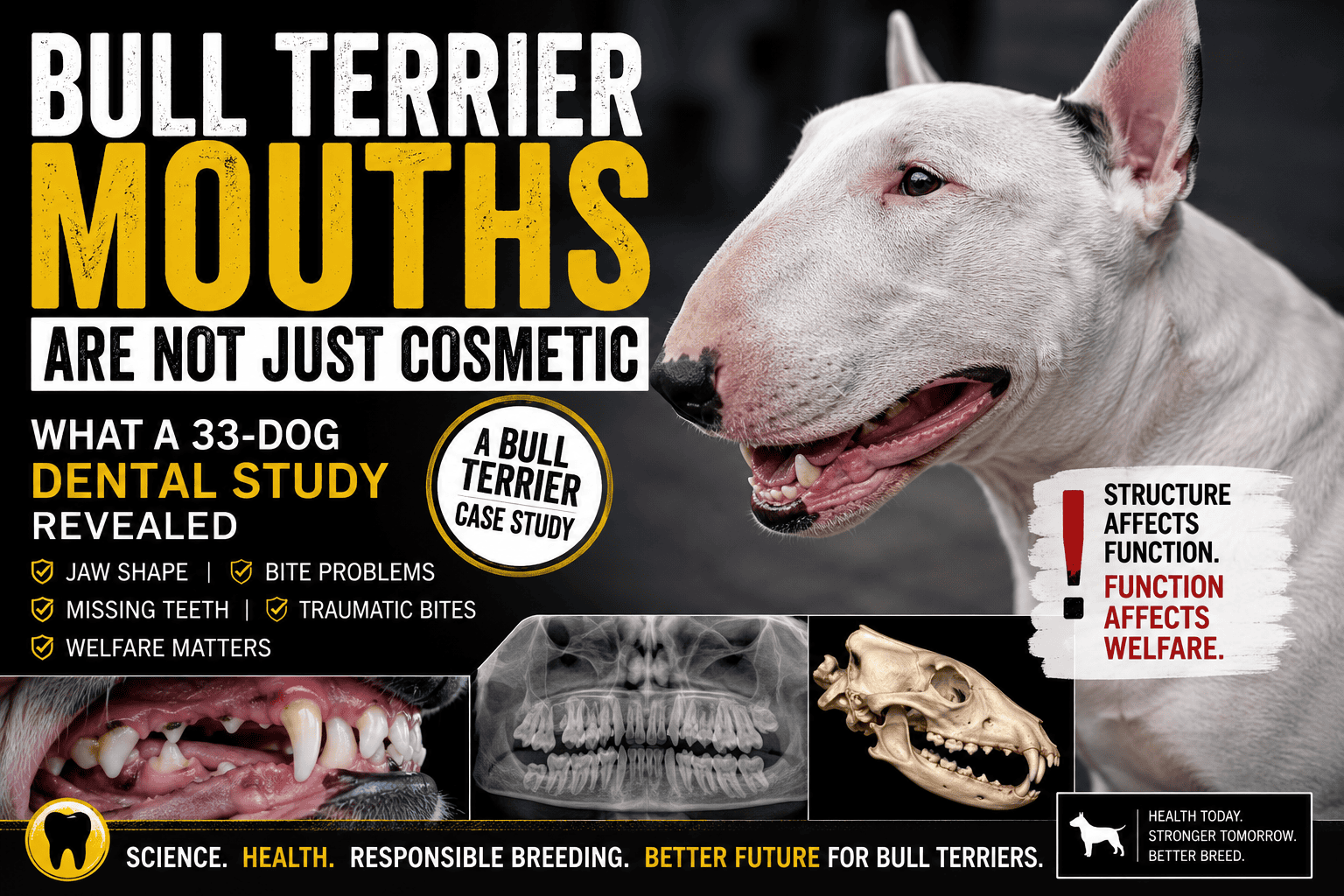
Bull Terrier Mouths Are Not Just Cosmetic: What a 33-Dog Dental Study Revealed
The Bull Terrier head is one of the most recognizable shapes in the dog world. But when we talk about Bull Terrier structure, we must be careful not to treat the head only as a show feature or cosmetic identity.
A mouth is not decoration. A jaw is not decoration. A bite is not decoration.
The mouth is where the dog eats, grips, chews, breathes comfortably, plays, communicates discomfort, and lives every day. When dental and skeletal structure are abnormal, the issue is not just appearance. It can become a welfare issue.
That is why the 2022 veterinary study “Skeletal-dental features in 33 bull terrier dogs” deserves serious attention from Bull Terrier owners, breeders, judges, and anyone who cares about the future of the breed.
A 2022 Bull Terrier-specific dental study reviewed 33 Bull Terriers presented for dental consultation and found dental or skeletal malocclusion in every dog in that clinical group. The study does not prove that all Bull Terriers have dental disease, but it does show why Bull Terrier mouth structure should be treated as a health and welfare subject, not only a cosmetic or show-ring feature.
Important veterinary note: This article is educational and breed-specific. It is not a diagnosis. If your Bull Terrier has mouth wounds, bad breath, missing teeth, inward-pointing lower canines, chewing changes, drooling, jaw asymmetry, or pain when the mouth is handled, speak with your veterinarian and consider referral to a veterinary dentist.
The Study: 33 Bull Terriers Presented for Dental Consultation
The study was published in BMC Veterinary Research in 2022 by Monica C. Martins, Sara A. Valadares, Jerzy P. Gawor, and Lisa A. Mestrinho. The researchers reviewed the skeletal-dental features of 33 Bull Terriers that had been presented for dental consultation.
Out of those 33 dogs, 24 had full-mouth radiography or cone-beam computed tomography. That matters because many mouth problems are not fully visible from the outside. Some involve tooth roots, unerupted teeth, abnormal spacing, jaw alignment, or structures hidden below the gumline.
First lesson from the study: in Bull Terriers, the mouth should not be judged only by what the owner can see when the dog opens its mouth.
What the Study Found
The study found that all 33 Bull Terriers in this selected dental-consultation group had some type of dental or skeletal malocclusion. This sentence is powerful, but it must be handled responsibly.
It does not mean every Bull Terrier in the world has a serious dental disorder. It means that in this clinical group of Bull Terriers presented for dental consultation, every dog examined had some form of dental or skeletal malocclusion.
Missing teeth were reported in 54.1% of the 24 dogs that had full-mouth radiography or cone-beam CT.
Eruption changes were reported in 29.2% of the imaged dogs, meaning some teeth did not come through normally.
Tooth-shape abnormalities were reported in 33.3% of the imaged dogs.
The study reported neutroclusion, mandibular mesioclusion, maxillo-mandibular asymmetry, and mandibular distoclusion among the dogs.
In normal owner language, the study found a clinical group of Bull Terriers with a range of mouth-structure problems: missing teeth, teeth in the wrong position, abnormal eruption, abnormal tooth shape, jaw alignment problems, and canine teeth positioned in ways that could create trauma.
Why Lingually Displaced Mandibular Canines Matter
One of the most important findings involved the mandibular canine teeth. The mandibular canines are the lower canine teeth. “Lingual displacement” means those lower canine teeth are displaced toward the tongue side of the mouth.
This is not a small cosmetic detail. When lower canine teeth sit too far inward, they can strike the roof of the mouth or soft tissues instead of fitting properly into the space between the upper teeth.
Over time, this can cause pain, trauma, ulcers, puncture wounds, abnormal wear, and chronic discomfort. The study found that lingual displacement of the mandibular canine teeth was associated with malocclusion causing trauma.
For Bull Terrier owners, this matters because some dogs are extremely stoic. A Bull Terrier may keep eating, playing, and acting normal even while living with mouth discomfort. A dog with traumatic occlusion may not scream. It may not refuse food. It may simply adapt.
If your Bull Terrier has missing teeth, inward-pointing lower canines, mouth wounds, bad breath, chewing changes, or obvious jaw asymmetry, this is not a cosmetic question. It is a health and welfare question that deserves proper veterinary assessment.
The Bull Terrier Head: Beauty, Function, and Responsibility
The Bull Terrier head has been shaped by generations of selective breeding. The breed’s profile is part of its identity, but identity must never be separated from function.
A strong Bull Terrier head should still be a functional head. A powerful jaw should still close comfortably. A full muzzle should still allow healthy tooth placement. A dramatic profile should not be used as an excuse for painful mouth structure.
Breed type matters, but health matters too. The answer is not to destroy breed identity. The answer is to protect the breed from exaggeration that damages comfort, function, or long-term welfare.
The 33-dog dental study does not attack the breed. It gives Bull Terrier people evidence that mouth structure deserves real attention. That is not anti-Bull Terrier. It is pro-Bull Terrier.
Missing Teeth: Why Hypodontia Should Not Be Ignored
Hypodontia means missing teeth. In some dogs, missing teeth may seem minor. The owner may simply say, “He has a few teeth missing,” and move on.
But missing teeth deserve proper veterinary evaluation because a tooth that appears missing may not always be truly absent. It may be unerupted, impacted, abnormal, or hidden below the gumline. In some cases, unerupted teeth can be associated with cyst formation or other dental complications.
This does not mean every missing tooth is an emergency. It means missing teeth should be documented properly, especially in a breed where dental abnormalities have been discussed in veterinary literature.
Eruption Problems and Tooth-Shape Abnormalities
Eruption changes mean the teeth may not come through normally. Tooth-shape abnormalities mean the teeth themselves may be formed differently from what is expected.
These problems matter because they can affect how the teeth meet, how the dog chews, whether food and debris collect abnormally, whether teeth are more prone to disease, and whether the mouth functions comfortably.
Again, the owner may not always notice. A dog can have abnormal tooth position and still eat. A dog can have dental discomfort and still tug a toy. Bull Terrier toughness is not proof of comfort.
What This Study Does Not Prove
This part is very important. The study does not prove that all Bull Terriers have dental disease. It does not prove that every Bull Terrier has a painful mouth. It does not prove that every downfaced head is unhealthy.
The authors themselves were careful. They stated that the findings cannot be generalized to the global Bull Terrier population and that further studies are needed to understand the true expression of these anomalies in the wider breed population.
The dogs in this study were already presented for dental consultation. This was not a random sample of Bull Terriers from the general population. A clinical consultation group is more likely to contain dogs with problems.
Honest conclusion: in a group of 33 Bull Terriers presented for dental consultation, dental and skeletal abnormalities were common and sometimes welfare-relevant. The study does not tell us the exact rate in the whole breed, but it does show that Bull Terrier mouth structure deserves serious attention.
Why This Matters for Owners
Owners should not look at this study and become afraid of their dog’s mouth. They should become more aware.
- teeth that look missing;
- lower canine teeth pointing inward;
- teeth touching or puncturing the palate;
- wounds, ulcers, or dark marks on the roof of the mouth;
- difficulty chewing on one side;
- dropping food, bad breath, pawing at the mouth, or excessive drooling;
- reluctance to chew hard items;
- rotated or crowded teeth;
- obvious jaw asymmetry;
- pain when the mouth is handled.
Dental checks should be part of responsible Bull Terrier ownership, especially for young dogs as the adult teeth develop.
Why This Matters for Breeders
For breeders, this study is not something to hide from. It is something to learn from.
The Bull Terrier is a breed where head type carries cultural and historical importance. But good breeding is not about producing dramatic structure at any cost. Good breeding is about balancing type, temperament, health, function, and welfare.
A beautiful head still needs a mouth that closes comfortably and functions well.
Canine teeth or other contacts causing trauma should never be ignored as cosmetic.
Repeated patterns across related dogs deserve careful documentation.
Jaw asymmetry and narrowing should be considered as part of welfare, not only type.
The study should not be used as a weapon against breeders. It should be used as a mirror. Serious breeders document, evaluate, improve, and make better decisions over time.
Why This Matters for Judges and Breed Discussion
Breed judging and breed culture influence what breeders produce. If exaggerated features are rewarded without enough attention to function, the breed can slowly move in the wrong direction.
A Bull Terrier should not be rewarded only for profile, head fill, and expression while the functional bite is ignored. The ideal dog should carry breed type and functional health together.
The best version of the Bull Terrier is not generic. It is not softened into another breed. It is still a Bull Terrier. But it is a Bull Terrier whose structure works.
The WBT Interpretation: Function Is Part of Breed Type
At Working Bull Terriers, we do not believe serious breed education means attacking the breed. We believe the opposite.
You cannot truly protect a breed by pretending its risks do not exist. The Bull Terrier is powerful, unique, stubborn, athletic, emotional, funny, intense, and deeply misunderstood. But loving the breed means being honest about the areas where it needs careful stewardship.
This study belongs in that conversation. It reminds us that the Bull Terrier mouth is not just part of the silhouette. It is part of the dog’s daily welfare.
Practical Takeaways for Bull Terrier Owners
If you own a Bull Terrier, do not obsess over the mouth in fear, but do not ignore it either.
- Have the puppy’s mouth checked as the adult teeth come in.
- Ask your veterinarian to look specifically for traumatic occlusion.
- Watch the lower canine teeth and whether they strike the palate.
- Do not assume missing teeth are harmless without proper assessment.
- Take mouth wounds, bad breath, chewing changes, or pawing seriously.
- Consider referral to a veterinary dentist if the bite looks abnormal or painful.
- Keep records if several related dogs show similar dental patterns.
- Remember that a Bull Terrier acting tough does not prove the mouth is comfortable.
The head is part of the Bull Terrier’s identity, but health must live inside that identity. Owners, breeders, and serious breed people should treat dental structure as part of welfare, not as an afterthought.
Final Thought
The Bull Terrier head is iconic. But an iconic head must still serve the dog living behind it.
The 33-dog skeletal-dental study gives Bull Terrier people an important reminder: dental and jaw structure are not cosmetic details. They can influence comfort, chewing, trauma, veterinary care, breeding choices, and welfare.
The serious path is not to exaggerate the study and claim every Bull Terrier is affected. The serious path is also not to dismiss it.
In a clinical group of Bull Terriers presented for dental consultation, malocclusions and tooth abnormalities were common, and some were associated with trauma. That is enough reason for owners to check, enough reason for breeders to pay attention, and enough reason for Bull Terrier people to treat the mouth as part of the dog’s health, not just part of the dog’s look.
Reference
Frequently Asked Questions About Bull Terrier Mouths and Dental Structure
No. Some dental or jaw abnormalities can affect comfort, chewing, tooth trauma, palate trauma, veterinary care, and welfare. A bad bite can be more than a bad-looking bite.
No. The study involved Bull Terriers presented for dental consultation, so the findings cannot be generalized to the whole breed. But it does show that mouth structure deserves serious attention.
Lower canine teeth displaced toward the tongue can strike the palate or soft tissues, causing trauma, ulcers, puncture wounds, abnormal wear, and chronic discomfort.
Yes. A tooth that appears missing may be absent, but it may also be unerupted, impacted, abnormal, or hidden below the gumline. Proper veterinary assessment can clarify the situation.
Watch for mouth wounds, bad breath, dropping food, chewing on one side, pawing at the mouth, drooling, reluctance to chew, crowded teeth, jaw asymmetry, or pain when the mouth is handled.
Yes. Breed type matters, but function and welfare matter too. Repeated patterns of traumatic occlusion, missing teeth, jaw narrowing, or severe asymmetry in related dogs deserve attention.