
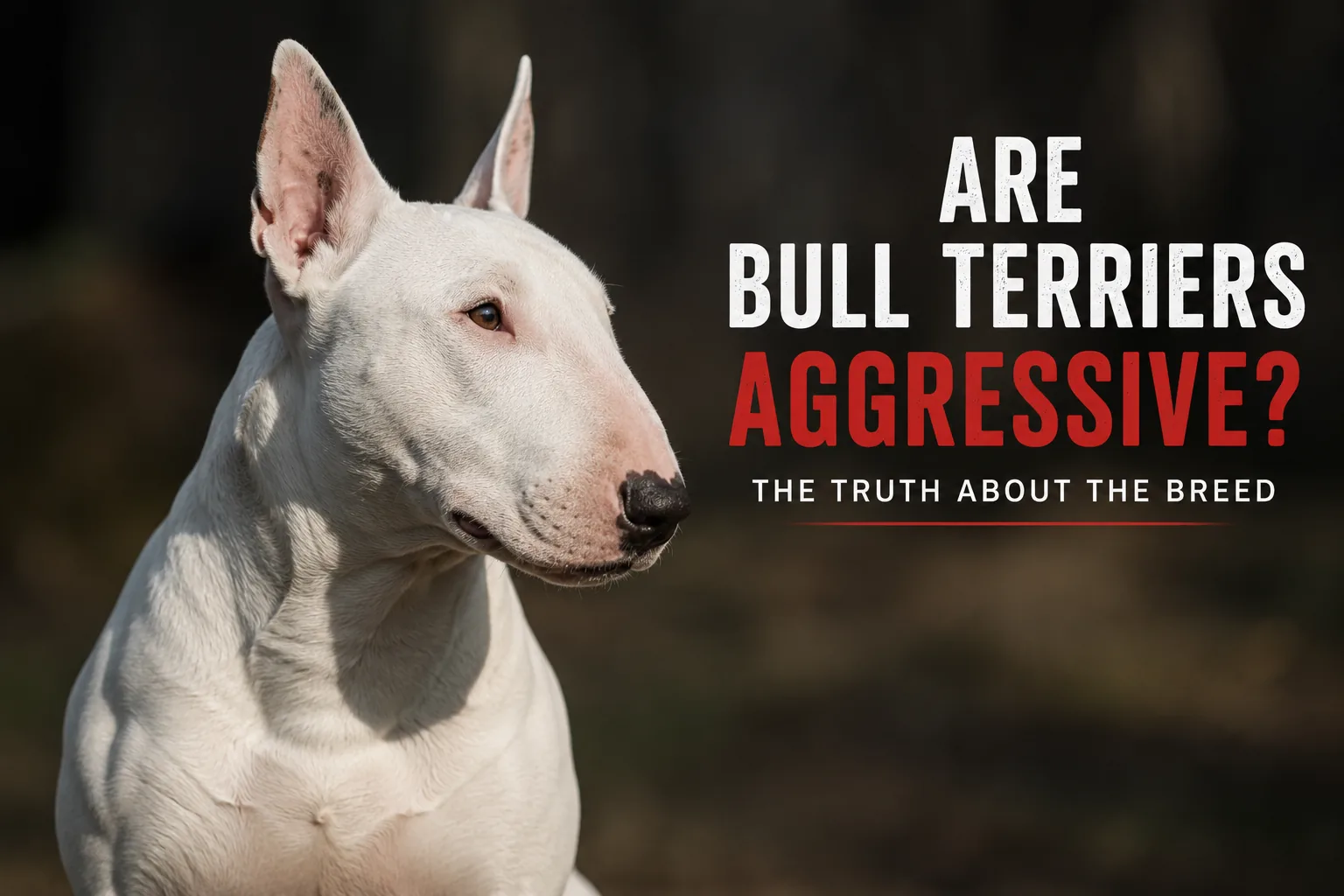
Are Bull Terriers Aggressive? The Honest Truth About the Breed
Power does not equal aggression. But pretending this breed is easy or harmless in every situation is not honesty either. Here is what responsible Bull Terrier ownership really requires.

There is a question we hear constantly at Working Bull Terriers Kennel: “Are Bull Terriers aggressive—or are people simply afraid of how they look?” The trouble is that the internet often gives two equally unhelpful answers.
One side describes the breed as naturally dangerous. The other insists Bull Terriers are harmless clowns who would never hurt anyone. Neither answer respects the dog—or the person asking the question.
I have lived with and worked with Bull Terriers for years. I know the affectionate dog that wants to be under the blanket, the comic who turns a simple instruction into a negotiation, and the determined animal who can become remarkably physical when excitement takes over. I also know that real aggression must never be dismissed as “just a Bull Terrier thing.”
The honest conversation starts when we separate breed traits, individual temperament, overarousal and actual aggressive behaviour. Those are not interchangeable.
Are Bull Terriers Naturally Aggressive?
No breed label can tell you with certainty whether an individual dog will behave aggressively. Bull Terriers are often affectionate with their people, playful, socially expressive and strongly bonded to familiar humans. Their courage, persistence and physical style do not automatically mean hostility.
At the same time, it would be irresponsible to promise that every Bull Terrier will be safe with every person or dog. Temperament varies. Breeding decisions, inherited tendencies, social development, health, learning history, living conditions and everyday handling can all shape how a dog responds to pressure.
The WBT position: Do not condemn a Bull Terrier because he looks powerful. Do not excuse dangerous behaviour because you love the breed. Learn to read the dog in front of you.
Are Bull Terriers Dangerous?
A Bull Terrier can be dangerous in the same practical sense that any strong dog can be dangerous when aggression, poor control, panic or irresponsible management creates a serious situation. Strength and determination affect the possible consequences of an incident. They do not, by themselves, prove the dog intends to harm someone.
A relaxed, well-managed Bull Terrier can be a wonderful companion. A dog that repeatedly threatens, bites, guards people or resources, or cannot recover from conflict needs a much more serious response. We should not reduce either dog to a breed stereotype.
“They Look Dangerous”
A muscular body and distinctive head are visual characteristics. They are not a behavioural diagnosis.
“Strength Raises the Stakes”
When a large, powerful dog loses control or bites, responsible prevention and safety management become especially important.
The real question is not whether the breed is “good” or “bad.” It is whether this individual dog has a stable temperament, is being handled responsibly and has any behaviour that threatens safety.
Aggression, Reactivity or Just Bull Terrier Intensity?
Many owners use the word aggressive when they actually mean energetic, rough, frustrated, overexcited or reactive. Sometimes the behaviour is a warning sign; sometimes it is an unmanaged but non-aggressive pattern. Looking only at how dramatic a moment appears is not enough.
| What you see | What it may involve | Responsible first step |
|---|---|---|
| Rough play / mouthing | High excitement, immature impulse control or rehearsed physical play, without necessarily intending harm. | Interrupt safely, lower arousal and teach clearer play boundaries. |
| Barking / lunging on lead | Fear, frustration, distance-seeking or learned reactivity; motivation needs assessment. | Increase distance, avoid forced encounters and record the triggers. |
| Growling over a resource | Resource guarding and a meaningful warning that the dog feels conflict or threat. | Stop confrontation, prevent access conflicts and get guidance. |
| Snapping / biting / repeated threats | A real safety issue that may involve fear, pain, guarding, conflict or other causes. | Separate safely, seek veterinary assessment and qualified behaviour support. |
None of these short descriptions can diagnose a dog. The context, body language, intensity, history, recovery and target of the behaviour matter. That is exactly why we encourage owners to describe what happens instead of attaching a single emotional label.
Are Bull Terriers Aggressive Towards People?
A stable Bull Terrier should be able to live comfortably with humans under responsible conditions. Many enjoy close contact, affection, routine and attention. But human-directed threats or biting are never something to romanticize, even if the dog is affectionate the rest of the day.
Growling when touched, snapping near a resting place, defending food, reacting to visitors or escalating during handling can arise for different reasons. A dog may be frightened, guarding something, uncomfortable, in pain, stressed or repeating behaviour that has worked before. A detailed history helps identify what is happening.
Children need an additional layer of protection. No child should be left unsupervised with a dog, whatever the breed, and a child should never be expected to manage a growling, guarding or overwhelmed Bull Terrier. Safe spaces, adult supervision and respecting canine boundaries are essential.
Are Bull Terriers Aggressive Towards Other Dogs?
Dog-directed behaviour deserves its own conversation. Some Bull Terriers are very social. Others become dog-selective with maturity or are uncomfortable with certain dogs, handling styles or interactions. Some can share a home successfully, while others require careful separation and management.
Strong play is not the same as safe play. A Bull Terrier may enjoy physical contact more than another dog does, and a mismatch in play style can create conflict even without a dog deliberately trying to hurt another.
We do not believe every Bull Terrier must greet every dog. Calm neutrality is often a better goal than forced friendliness. The ability to walk past another dog, stay engaged with the owner and recover after excitement is far more useful than collecting chaotic greetings.

Six Warning Signs Owners Should Never Ignore
One sign in isolation does not establish a diagnosis. Repeated combinations, an escalating pattern or any bite history deserve prompt attention.
Freezing or Stiffening
A sudden rigid body, hard stare or stillness around a person, dog or resource may signal conflict, stress or a warning.
Threats Around Valuables
Repeated growling, snapping or blocking access near food, toys, resting spots, spaces or people deserves careful management.
Reactions Are Getting Stronger
Episodes become more frequent, intense, hard to interrupt or begin causing injuries.
The Dog Cannot Settle
Distress or high arousal remains elevated long after the original event, leaving the dog unable to recover.
A New Behaviour Appears
An otherwise familiar dog suddenly becomes defensive, touch-sensitive or unpredictable, raising concern about pain or illness.
Biting or Near Misses
Any bite, repeated snap at a person or situation requiring physical separation calls for immediate risk management.
A growl is communication. Punishing the warning without addressing the reason can leave owners with less information about the dog’s discomfort. The safer goal is to reduce conflict and understand what is driving the response.
Why Can Aggressive Behaviour Develop?
There is rarely one convenient explanation. Breed background does not replace an individual assessment. Relevant factors can include inherited temperament, early experiences, fear, frustration, chronic stress, resource guarding, repeated conflict, social history, poor recovery from arousal and medical problems.
For example, a Bull Terrier that repeatedly lunges on walks may need better distance management and gradual learning around triggers. A dog that snaps when lifted may be in pain. A dog that guards food needs an entirely different safety plan. Treating all three as “dominance” or “stubbornness” would miss the important details.
Medical Causes Must Be Considered
If aggression is new, worsening, unpredictable or associated with sensitivity to touch, changes in awareness or other health signs, arrange a veterinary examination. Pain and some medical conditions can influence aggressive behaviour.
Do not attempt to provoke the dog to test whether the aggression happens again. This can create immediate risk and teaches us less than careful, safe documentation.
How Responsible Breeding and Training Change the Picture
Responsible breeders pay attention to temperament, health, parent behaviour and the way young puppies experience the world. Owners then build on those foundations with consistent handling, age-appropriate social exposure, rest, calm routines, useful skills and a relationship where the dog understands what is expected.
Socialization does not mean pushing a puppy into every dog park or allowing strangers to crowd him. It means safe, controlled experiences that build confidence without overwhelming the dog. Likewise, training is not a licence to force a frightened or aggressive dog through a situation.
At WBT we return to a simple principle: structure before freedom. The dog learns how to engage, regulate excitement, follow clear boundaries and choose useful behaviour before we expect reliability in difficult environments.
Training can improve many behaviours, but no responsible professional should promise that every serious aggression case can be fixed with one method or one online article. Safety and welfare determine the plan.
What Should You Do if Your Bull Terrier Is Showing Aggression?
First, protect people and animals. Avoid the triggers you can safely avoid. Use doors, distance, barriers or controlled separation to prevent another incident. Keep children and vulnerable visitors away from the risk, and do not demand that the dog “prove” he can handle an encounter.
Next, document the sequence: what happened before, who was involved, what the dog did, whether there was physical contact, how quickly he recovered and whether anything changed in his health or routine. Book a veterinary assessment when pain, illness or sudden behaviour change might be involved. For biting, dangerous guarding or repeated threatening behaviour, work with a suitably qualified professional who can assess risk and guide a safe plan.
Do not rely on an online quiz or AI tool to assess an immediate danger, and do not use punishment or physical confrontation to “test” the dog. Any educational diagnostic should support—not replace—veterinary or in-person risk assessment when safety is at stake.

The WBT Perspective: Responsibility Over Reputation
We love this breed far too much to pretend that strength, intensity and determination come without responsibility. We also refuse to let appearance and sensational stories define the character of every Bull Terrier.
The goal is not to make a strong dog look less strong. It is to help owners understand what behaviour means, recognize concern early, create better everyday structure and seek the right help when the stakes are high.
Our bottom line: A Bull Terrier should be respected for what he is—not feared because of a stereotype, and not excused when behaviour becomes unsafe.
The Final Answer: Are Bull Terriers Aggressive?
They should not be judged aggressive simply because they are Bull Terriers. Many are affectionate, loyal and playful companions. But some individual dogs can display serious aggression, particularly in certain contexts, and the breed’s strength means poor decisions can have real consequences.
Know the dog. Respect warning signs. Build structure and engagement. Protect safety. Ask for professional help when the behaviour demands it. That is a much more honest—and much more useful—answer than either fearmongering or denial.
Frequently Asked Questions
Are Bull Terriers aggressive by nature?
No blanket label accurately describes every Bull Terrier. Individual temperament, genetics, learning history, health and environment matter. Many Bull Terriers live as affectionate companions, while individual dogs may develop aggressive behaviours that need careful attention.
Are Bull Terriers dangerous dogs?
A Bull Terrier can cause serious harm if a dangerous situation develops, as can other strong dogs. Physical strength affects potential consequences, but appearance alone does not establish aggressive intent. Responsible supervision, management and training are important.
Are Bull Terriers aggressive towards their owners?
Many are deeply attached to their owners. Repeated growling, threats or biting towards family members is not something to dismiss as normal breed personality. Protect safety, consider medical causes and seek qualified behaviour support.
Are Bull Terriers aggressive towards other dogs?
It varies. Some enjoy dog company, some are selective and some require careful management. Dog-directed reactivity should be evaluated in context. Calm neutrality and safe handling are often more valuable goals than forced greetings.
Are Bull Terriers safe around children?
Some are excellent family companions, but all dog-child interactions require adult supervision. Children must not be left alone with dogs or expected to manage guarding, fear or overarousal. Individual history and safety come first.
Does growling mean my Bull Terrier is aggressive?
Growling can be a warning or a sign of conflict, pain, fear or discomfort; context matters. Do not punish the warning or challenge the dog. Give space and investigate what is happening.
Can training help a reactive or aggressive Bull Terrier?
Many dogs can make meaningful progress with appropriate management and behaviour work, but prognosis depends on the individual case. Serious aggression requires risk assessment, sometimes veterinary treatment, and a qualified professional plan.
Is Sudden Rage Syndrome the same as ordinary aggression?
No. The term refers to a rare, controversial pattern of extreme, apparently unprovoked episodes sometimes discussed alongside neurological causes. Ordinary reactivity, guarding, fear or overexcitement should not automatically be labelled Sudden Rage Syndrome.


Leave a Reply