
Bull Terrier Reputation, Safety & Responsible Ownership
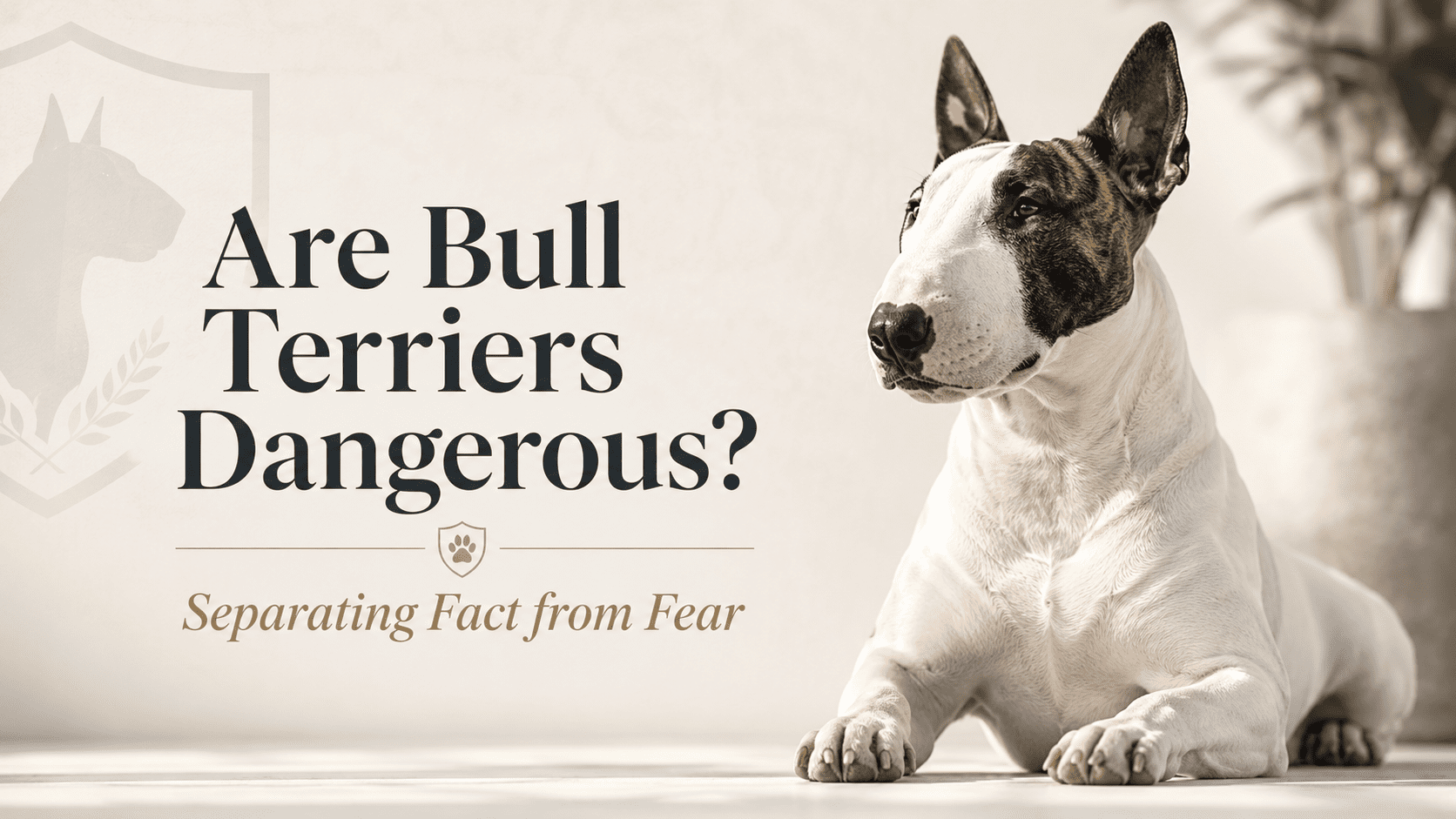
Are Bull Terriers Dangerous? Separating Fact from Fear
Are Bull Terriers dangerous? It is one of the most loaded questions people ask about the breed. Some people see the egg-shaped head, muscular body, intense expression, and confident movement, and immediately assume danger. Others live with Bull Terriers every day and know them as affectionate, funny, loyal, clownish, deeply emotional dogs who often want nothing more than to be close to their people.
The truth sits between fear and fantasy.
Bull Terriers are not automatically dangerous dogs. But they are also not soft, decorative, low-effort pets that can be raised without structure, socialization, training, or responsible handling. They are powerful, physical, determined, emotionally expressive dogs. In the right hands, those traits can create an incredible companion. In the wrong hands, or with poor management, those same traits can become difficult, risky, and unfair to the dog.
This article is not written to defend the breed blindly. It is written to tell the truth. The Bull Terrier does not need excuses. The Bull Terrier needs understanding, responsible owners, realistic expectations, and people willing to represent the breed properly.

Bull Terriers are not dangerous simply because they are Bull Terriers. However, they are strong, intense, physical dogs that require responsible ownership, early socialization, clear structure, proper training, and realistic management. A well-raised Bull Terrier can be affectionate, stable, loyal, and safe. A poorly raised, poorly managed, undertrained, frustrated, or reactive Bull Terrier can become a serious problem because of the breed’s strength and determination.
The Honest Answer: No Breed Is Safe Without Responsibility
The wrong question is, “Is this breed dangerous by default?” The better question is, “What does this dog require in order to become safe, stable, and well managed?”
Any dog with teeth can bite. Any dog can become unsafe under the wrong conditions. Small dogs can bite. Large dogs can bite. Nervous dogs can bite. Overconfident dogs can bite. Poorly socialized dogs can bite. Dogs in pain can bite. Dogs placed in chaotic situations can bite. Dogs pushed beyond their tolerance can bite.
The difference with a Bull Terrier is that the consequences of poor ownership can be more serious than with a very small, fragile, or low-drive dog. This breed is muscular, strong, determined, and often highly committed once aroused. That does not make the breed evil. It means the owner must take responsibility seriously.
The real danger is not the Bull Terrier’s head shape, appearance, or reputation. The real danger is a powerful dog in a household that does not understand structure, socialization, boundaries, arousal, management, and early behaviour intervention.
Why Bull Terriers Get a Dangerous Reputation
Bull Terriers are visually powerful dogs. They do not look delicate. They do not move like fragile lap dogs. They have a strong body, a distinctive head, and an expression that can look intense to people who do not know the breed.
Appearance matters because humans judge quickly. A nervous person may see a Bull Terrier pulling toward them and assume aggression, even if the dog is excited. A neighbour may see two Bull Terriers wrestling and assume violence, even if the dogs are playing. A person unfamiliar with the breed may see the muscular body and believe the dog is automatically dangerous.
But reputation is not built only by outsiders. Owners also shape the public image of the breed. Every uncontrolled walk, every dog allowed to drag its owner, every chaotic greeting, every loose dog rushing another dog, every social media video that glorifies intensity without control — all of these things affect how the breed is seen.
Bull Terrier owners cannot control every stereotype. But they can control how they represent the breed.
Seven Facts Owners Must Understand
If we want to answer the dangerousness question properly, we need more than emotion. We need clear thinking. Bull Terriers are not monsters. They are not harmless toys either. They are dogs with real strengths, real needs, and real responsibility attached to them.
A dog’s behaviour is shaped by genetics, early development, environment, socialization, training, owner handling, health, stress, previous experiences, and daily structure. Breed matters, but breed is not the whole dog.
Two Bull Terriers can be very different depending on how they were bred, raised, handled, trained, exercised, socialized, and guided. Responsible owners look at the individual dog, not just the breed label.
A strong dog is not automatically a dangerous dog, but strength changes the level of responsibility. A powerful dog cannot be allowed to rehearse the same behaviour that might be tolerated in a tiny dog. Jumping, pulling, charging, guarding, biting during excitement, or reacting toward other dogs becomes more serious when the dog has muscle and determination behind it.
Good owners do not pretend strength does not exist. They respect it and train accordingly.
Proper socialization is not throwing a Bull Terrier into every situation and hoping he “gets used to it.” Socialization means controlled exposure, good experiences, neutral behaviour, safe distance, careful handling, and teaching the dog how to process the world without panic, chaos, or overexcitement.
A Bull Terrier should learn to be around people, children, noises, surfaces, vehicles, dogs, visitors, and public environments without believing every situation requires conflict, excitement, or pressure.
A Bull Terrier who sits at home for a treat but ignores the owner outside is not trained in a meaningful way. Real training must hold up under distraction, movement, excitement, frustration, and competing motivation.
This does not mean the dog needs to be robotic. It means the owner must build engagement, focus, recall, leash control, impulse control, and calm recovery in real life, not only in easy moments.
Some Bull Terriers can live peacefully with other dogs. Some are selective. Some are social when young and less tolerant as they mature. Some do not enjoy close pressure from unfamiliar dogs. Some same-sex combinations can be difficult. Owners must be honest about the dog in front of them.
A responsible Bull Terrier owner does not force dog-park fantasies onto a dog who needs neutrality, structure, and controlled exposure. Not every Bull Terrier needs random dog friends. Every Bull Terrier needs safe management.
A good Bull Terrier can be loving with children, but no child should be left to manage a dog’s body language, stress, excitement, pain, space, or tolerance. Children move quickly, make noise, hug, grab, fall, scream, and often miss warning signs.
Responsible ownership means teaching both sides: the dog must have structure and boundaries, and children must be taught respect, space, and safe behaviour around dogs.
Every Bull Terrier owner becomes part of the breed’s public image. A stable, well-handled dog changes minds. An uncontrolled dog confirms fears. This is unfair, but it is real.
If we want the world to respect the breed, we have to produce dogs that can be trusted in real life — not just admired in photos.
Before asking whether a Bull Terrier is dangerous, owners should ask whether they understand the breed properly. Bull Terriers need structure, engagement, exercise, boundaries, socialization, and realistic handling.
Start with the WBT breed foundation pages and learn what this dog really needs before problems begin.
Dangerous or Misunderstood?
Bull Terriers are often misunderstood because their personality does not always match their appearance. They can look serious and act ridiculous. They can look intense and be deeply affectionate. They can look stubborn when they are actually confused, overstimulated, undertrained, or testing a pattern that has worked before.
But misunderstanding the breed in a positive direction can be just as dangerous as fearing it. Owners who say “he is just being funny” while the dog is guarding, biting during excitement, bullying another dog, or losing control outside are not helping the breed. They are ignoring important information.
The truth is simple: Bull Terriers deserve neither fear-based hatred nor careless romanticising. They deserve owners who can see the whole dog.

Where Real Risk Comes From
Real risk usually does not come from one single trait. It comes from combinations. A strong dog with poor socialization. A reactive dog with no management. A frustrated dog with no outlet. A pushy dog with no boundaries. A fearful dog forced into pressure. A dog with pain that nobody has checked. A dog allowed to rehearse guarding, lunging, chasing, or biting until the pattern becomes normal.
That is why the conversation about danger must move beyond breed labels. Labels are simple. Behaviour is not.
- A dog that cannot be controlled on lead is a risk.
- A dog that guards food, toys, furniture, people, or spaces is a risk.
- A dog that redirects onto the owner during excitement is a risk.
- A dog that repeatedly reacts to people, dogs, or movement is a risk.
- A dog that cannot recover after stress or stimulation is a risk.
- A dog that is repeatedly placed in situations he cannot handle is a risk.
- An owner who ignores warning signs is a risk.
The breed is not helped by pretending risk does not exist. The breed is helped when owners understand risk early and handle it responsibly.
What Real Socialization and Training Look Like
Real socialization is not a puppy being passed around by strangers, rushed by dogs, dragged through busy places, or forced into overwhelming situations. Real socialization teaches the puppy that the world is normal, manageable, and not something to explode at.
For Bull Terriers, this means calm exposure to everyday life: different people, surfaces, environments, sounds, vehicles, visitors, children at a safe distance, dogs under control, vet handling, grooming, home boundaries, and public behaviour.
Training should build more than commands. A Bull Terrier needs relationship, engagement, impulse control, leash manners, recall, place training, calm recovery, frustration tolerance, and respect for daily structure.
A Bull Terrier who has only learned commands in easy conditions may still fail in the real world. A Bull Terrier who has learned how to stay connected to the owner under pressure is much safer, calmer, and easier to live with.

If you want a Bull Terrier who is easier to guide, safer in daily life, calmer around pressure, and more connected to you, the foundation matters.
The Ultimate Bull Terrier Library Bundle brings together the core Working Bull Terriers Kennel guides for owners who want to understand, train, and live better with the breed.
Dog-Dog Aggression and Realistic Expectations
One area where Bull Terrier owners must be especially realistic is dog-dog behaviour. Some Bull Terriers are social. Some are selective. Some are fine with familiar dogs but not strange dogs. Some mature into lower tolerance. Some same-sex pairings can be difficult. Some dogs need careful management for life.
This does not make the Bull Terrier a bad breed. It means owners must stop measuring success by whether the dog can be thrown into every dog park, every random greeting, or every social situation.
Neutrality is often a better goal than forced friendship. A Bull Terrier does not need to love every dog. He needs to be safe, controllable, and guided. For many dogs, that is the responsible standard.
Owners must also understand that dog-dog conflict can escalate quickly when a strong, determined breed is involved. Prevention matters. Management matters. Early intervention matters. Reading body language matters.
Can Bull Terriers Be Good Family Dogs?
Yes, a well-raised Bull Terrier can be a wonderful family dog. Many are affectionate, playful, loyal, sensitive, and deeply attached to their people. But family dog does not mean unmanaged dog.
A family Bull Terrier still needs rules. He needs to learn not to jump on children, not to grab clothing, not to steal and guard objects, not to explode around visitors, and not to treat excitement as permission to use his body however he wants.
The family must also do their part. Children should not climb on the dog, disturb him while sleeping, take food or toys, hug him tightly, scream in his face, chase him into corners, or ignore his need for space. A good family environment protects both the child and the dog.
The Problem With Bad Ownership
Many breed reputations are damaged less by the dogs and more by the owners. Owners who choose a powerful dog for image, ego, intimidation, or online attention often create exactly the kind of behaviour that makes the public afraid.
Bull Terriers do not need owners who enjoy chaos. They need owners who enjoy responsibility. They need people who understand that power without control is not impressive. It is dangerous.
A Bull Terrier should not be used to scare people, impress strangers, prove toughness, or create dramatic social media content. The breed deserves better than that.
Real strength is not an uncontrolled dog at the end of the lead. Real strength is a powerful dog who can walk calmly, recover quickly, listen under pressure, and trust the owner’s guidance.
When Bull Terrier Behaviour Becomes a Concern
Owners should take behaviour seriously when it becomes repeated, escalating, unsafe, or difficult to interrupt. Waiting too long can allow the dog to rehearse the same pattern until it becomes much harder to change.
- Hard lunging toward dogs, people, vehicles, or visitors.
- Guarding food, toys, furniture, people, or spaces.
- Snapping, biting, or threatening behaviour.
- Redirecting onto the lead, clothing, or owner.
- Repeated reactivity outside or inside the home.
- Inability to settle after excitement or stress.
- Conflict with children, visitors, dogs, cats, or other pets.
- An owner who feels physically unable to manage the dog.
These signs do not mean the dog is hopeless. They mean the owner should act responsibly before the behaviour becomes part of normal life.
If your Bull Terrier is becoming reactive, intense, unsafe, difficult to interrupt, or hard to control, the next step should be clear and responsible. Start with a proper route instead of guessing from random advice.
So, Are Bull Terriers Dangerous?
No, Bull Terriers are not dangerous simply because they are Bull Terriers.
But a Bull Terrier can become dangerous if the dog is poorly bred, poorly raised, poorly socialized, poorly trained, badly managed, repeatedly placed in the wrong situations, ignored when warning signs appear, or owned by someone who does not respect the breed’s strength and intensity.
That answer may not satisfy people who want a simple yes or no. But simple answers are usually where bad ownership begins. Responsible owners understand nuance.
The Bull Terrier is not a dog for everyone. That is not an insult to the breed. It is respect for the breed. These dogs are funny, affectionate, loyal, intense, physical, determined, and full of character. They can be incredible companions when raised correctly. But they deserve owners who are prepared to guide the whole dog, not only enjoy the funny parts.
Building the Right Kind of Reputation
The future reputation of the Bull Terrier will not be changed by arguments alone. It will be changed by the dogs people meet in real life.
Calm Bull Terriers change minds. Well-handled Bull Terriers change minds. Owners who control their dogs in public change minds. Dogs who can pass distractions, ignore pressure, behave around visitors, and live safely inside family life change minds.
Every responsible owner becomes part of the breed’s defence. Not through shouting at critics, but through producing better examples.
The world does not need more excuses for Bull Terriers. It needs more well-raised Bull Terriers.
Final Thought
Bull Terriers are not dangerous by nature in the way fear-based stereotypes suggest. But they are not casual dogs either. They are powerful, emotional, intelligent, physical, and determined. That combination demands respect.
The safest Bull Terrier is not the one whose owner insists the breed is harmless. The safest Bull Terrier is the one whose owner understands the breed honestly.
Train the dog. Socialize the dog properly. Manage the dog responsibly. Respect his strength. Build his confidence. Teach neutrality. Give structure. Intervene early when behaviour becomes concerning. And never forget that every Bull Terrier owner carries part of the breed’s reputation at the end of the lead.
The breed is not asking to be feared. It is asking to be understood.
Frequently Asked Questions About Bull Terrier Safety
Bull Terriers are not dangerous simply because of their breed. However, they are strong, intense, physical dogs that require responsible ownership, proper training, socialization, structure, and realistic management.
Bull Terriers are not automatically aggressive, but aggression can occur in any dog when genetics, poor socialization, bad experiences, lack of training, frustration, fear, pain, or poor management are involved. Dog-dog conflict and reactivity should be taken seriously.
A well-raised Bull Terrier can be an affectionate and loyal family dog, but the breed needs clear rules, supervision around children, proper exercise, socialization, and training. No child should be expected to manage a dog without adult supervision.
Bull Terriers benefit from breed-specific training that focuses on engagement, impulse control, leash manners, recall, calm recovery, boundaries, and owner value. Basic obedience alone is often not enough if the dog cannot respond under distraction.
Some first-time owners can succeed with a Bull Terrier if they are committed, realistic, consistent, and willing to learn. However, this is not the easiest breed for casual ownership. Anyone considering the breed should understand the responsibility before bringing one home.
You should seek guidance if your Bull Terrier is reactive, guarding, lunging, biting, redirecting, becoming difficult to control, or making people or animals unsafe. Early intervention is usually easier than waiting until the behaviour becomes stronger.

Leave a Reply