

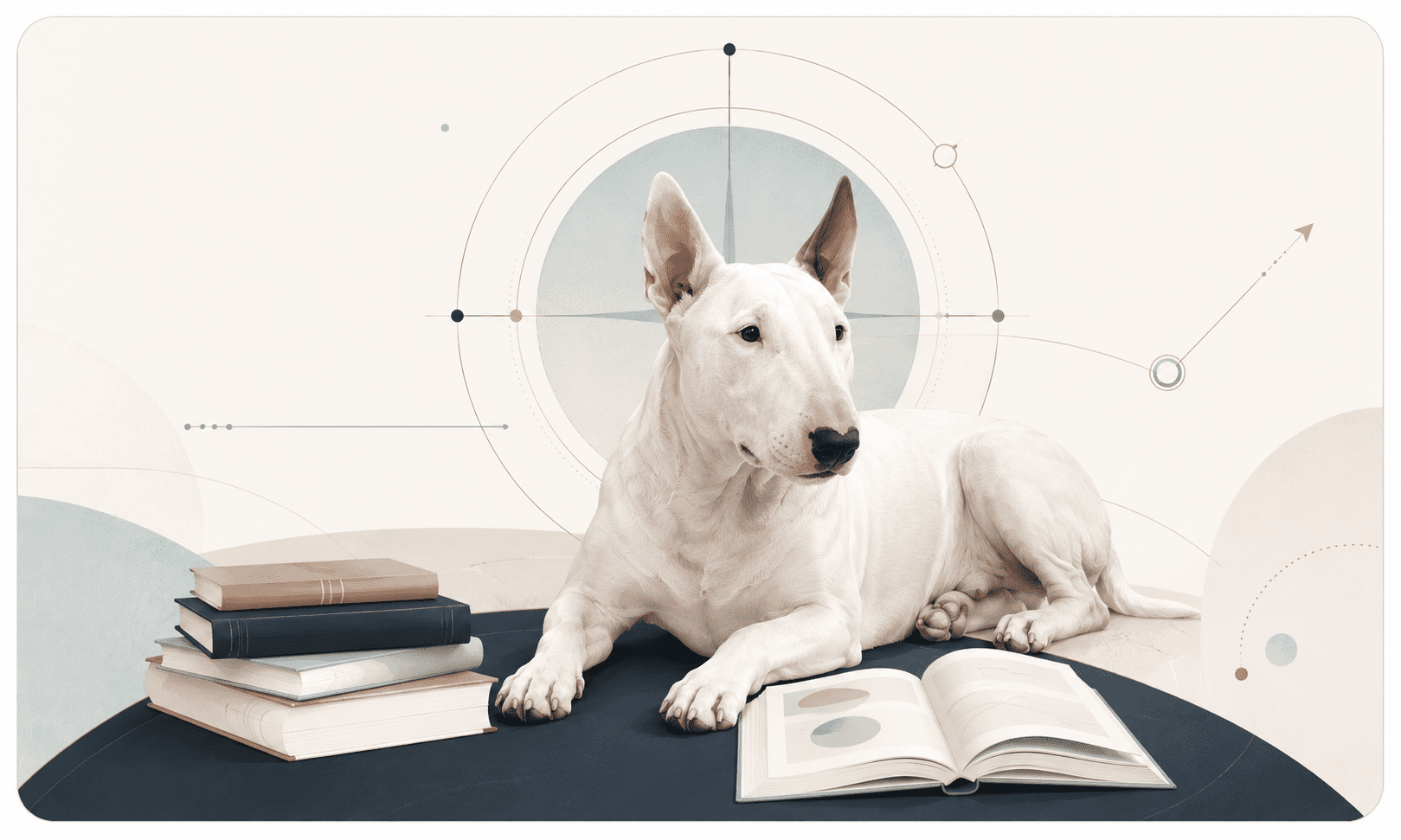






Many Bull Terrier owners describe their dogs as hyper, crazy, wild, impossible to tire out, or completely over the top.
Many Bull Terrier owners describe their dogs as hyper, crazy, wild, impossible to tire out, or completely over the top.
And at first glance, it is easy to understand why.
A Bull Terrier can be sleeping peacefully one minute and then suddenly launch across the room as if the house has been invaded by invisible enemies. He may sprint from the sofa to the doorway, grab a toy, crash into your leg, stare at you like he has urgent business, spin in circles, bark at nothing obvious, and then five minutes later collapse upside down on the sofa as if nothing unusual happened.
To someone unfamiliar with the breed, this looks like simple excess energy.
To a Bull Terrier owner, it looks like Tuesday.
But in many cases, the problem is not simply that the dog has too much energy.
The deeper issue is regulation.
When a Bull Terrier is not hyper but unregulated, the real problem is usually not energy alone. It is the dog’s ability to process excitement, frustration, pressure, stimulation, and owner guidance in that moment.
That distinction matters.
A truly energetic dog needs appropriate outlets. An unregulated dog needs something deeper. He needs help learning how to move from excitement back into calmness, how to think when arousal rises, how to recover after stimulation, and how to stay connected to the owner when the world becomes interesting.
Once owners understand this difference, they often stop seeing the dog as “crazy” and start seeing the pattern behind the behavior.
Bull Terrier Not Hyper: What Is Really Happening?
Bull Terrier not hyper is not just a catchy idea it is often the difference between seeing a dog as crazy and understanding that the dog is struggling with regulation.
A Bull Terrier that is simply energetic can still think. He can become excited, but he can also return to you. He can play, run, explore, and enjoy himself, but he still has some ability to respond, settle, and recover.
An unregulated Bull Terrier is different.
Once arousal rises, the dog keeps climbing. Movement creates more movement. Excitement feeds more excitement. The dog becomes less able to think, pause, listen, disengage, or make good choices. He may know the command, but in that emotional state, the command cannot reach him properly.
This is why many owners feel confused.
They say, “He knows what to do.”
And they are often right.
The problem is not always knowledge. The problem is emotional state.
A Bull Terrier may know how to sit, lie down, come back, walk nicely, or leave something alone. But when his nervous system is too high, that knowledge becomes harder for him to access. He is not calmly choosing to ignore the owner. He is often operating from a level of arousal where control, focus, and decision-making are weaker.
That is not the same as simple disobedience.
It is also not something that more chaos will fix.
Energy and Arousal Are Not the Same Thing
One of the biggest mistakes owners make is treating every energetic behavior as an exercise problem.
Of course Bull Terriers need physical activity. They are strong, athletic, muscular, playful dogs, and they should have proper outlets for movement. A Bull Terrier that never moves enough will become frustrated, restless, and difficult to live with.
But exercise alone does not teach emotional control.
A dog can be physically tired and still mentally overstimulated. In fact, many owners accidentally create dogs that are fit, strong, and even more excitable because every sign of restlessness is answered with more stimulation.
The dog becomes excited, so the owner throws the ball.
The dog becomes more intense, so the owner plays harder.
The dog still cannot settle, so the owner adds longer walks, more games, more running, more chasing, more tug, more action.
This may tire the body for a while, but it does not necessarily calm the mind.
In some cases, it does the opposite.
The dog learns that emotional intensity always leads to more stimulation. The dog becomes conditioned to seek more action whenever he feels uncomfortable, restless, frustrated, bored, or excited. Instead of learning how to come down, he learns how to climb higher.
This is why some Bull Terriers seem to have no “off switch.”
It is not always because the dog has endless energy.
Often, it is because the dog has never been properly taught how to recover from excitement.
Why Bull Terriers Can Become So Overaroused
Bull Terriers are not soft, passive, decorative dogs.
They are intense by nature.
The breed carries determination, physical confidence, persistence, humor, strength, emotional expression, and a powerful desire to be involved with its people. This is part of their charm. It is also one of the reasons many of us fall in love with them.
A Bull Terrier is rarely boring. He has presence. He has personality. He often lives as if every ordinary moment should be turned into an event.
But the same traits that make the breed entertaining can become difficult when they are not guided properly.
A Bull Terrier that becomes too aroused may pull, jump, mouth, bark, spin, grab objects, ignore the owner, fixate on something in the environment, or turn a normal situation into a full performance.
This does not always mean the dog is “stubborn” in the simple sense.
Very often, the dog’s emotional state has gone beyond the point where learning, listening, and clear thinking are easy.
This is where many owners misunderstand the behavior.
They see defiance.
The dog is often showing overload.
They see a dog refusing to listen.
The dog may be struggling to regulate.
They see bad behavior.
The dog may be showing that the situation has already become too much.
That does not mean the behavior should be excused. It means the solution has to be more intelligent than simply shouting louder, exercising harder, or correcting later.
The Modern Home Can Make the Problem Worse
Modern home life is not always easy for a high-intensity breed.
Many Bull Terriers live in homes where they receive affection, comfort, toys, food, freedom, and attention, but not enough structure around their emotional state.
The dog is loved deeply, but his arousal is not managed carefully.
This creates problems because Bull Terriers are very responsive to patterns.
If the dog learns that excitement always leads to more excitement, he begins to expect stimulation constantly.
The lead comes out and the dog explodes.
A visitor arrives and the dog launches into chaos.
A sound happens outside and the dog reacts immediately.
The owner moves toward the door and the dog behaves as if something dramatic is about to happen.
Over time, the dog becomes conditioned to live in anticipation.
The problem is no longer one single event. The problem becomes the dog’s general emotional baseline.
This is why some Bull Terriers seem to react to everything. Their system is already too high before the real trigger even appears.
The owner sees the explosion.
But the explosion often started long before the visible behavior.
Calmness Must Be Taught
Many people assume calmness will naturally appear when the dog gets older or becomes tired enough.
Sometimes maturity helps, but maturity does not replace training.
Calmness is a skill.
A dog has to learn how to settle while life continues around him. He has to learn how to disengage from stimulation, how to wait without frustration, how to recover after excitement, and how to remain mentally connected to the owner when the environment becomes interesting.
This is especially important for Bull Terriers because they are physical, emotional, and very committed once they decide something matters.
If a Bull Terrier becomes locked onto a person, object, smell, dog, visitor, toy, movement, or household event, the owner may feel as if the dog has completely left the conversation.
That is why training must go deeper than commands.
A dog that can sit but cannot regulate himself is still difficult to live with.
A dog that can lie down only after being exhausted has not truly learned calmness.
A dog that obeys indoors but loses control outside does not need more shouting. He needs better preparation, better engagement, and a clearer emotional foundation.
Engagement Comes Before Control
One of the most important parts of training a Bull Terrier is engagement.
Engagement means the dog is mentally connected to the owner. The dog understands that the owner matters, that guidance matters, and that paying attention has value even when the environment is exciting.
Without engagement, obedience becomes a constant fight for control.
The owner gives commands while the dog is emotionally somewhere else. This creates frustration for both sides. The owner feels ignored, and the dog feels more pressure without becoming more capable.
With engagement, the dog has a way back.
Before asking for perfect behavior, the owner must build the habit of connection. This means teaching the dog to check in, follow guidance, respond to markers, accept small moments of calm, and look to the owner before the situation becomes too intense.
This is one of the reasons we place so much importance on relationship-based training.
A Bull Terrier that is mentally connected to the owner is much easier to guide than a Bull Terrier that is only being corrected after he has already exploded.
Structure Does Not Remove Personality
Some owners worry that too much structure will make their Bull Terrier less funny, less playful, or less expressive.
That is not what good training does.
Good training does not remove personality. It gives personality direction.
The goal is not to turn a Bull Terrier into a silent, robotic dog that never plays, never zooms, and never does anything ridiculous. That would not be realistic, and it would not be true to the breed.
The goal is to teach the dog how to live with his own intensity.
A well-trained Bull Terrier should still be playful, affectionate, powerful, humorous, and full of character. The difference is that the dog becomes more capable of recovering after excitement, accepting guidance, and functioning in normal daily life.
The fire remains.
The chaos becomes more manageable.
That is the real goal.
Boundaries Matter, But They Are Not the Whole Solution
Bull Terriers need boundaries.
They are strong dogs with strong opinions, and without structure they can become very difficult to manage. But boundaries alone are not a complete training system, especially when the real issue is overarousal.
If a dog is already emotionally overloaded, simply adding more pressure without teaching the dog how to respond differently may create more frustration, more resistance, more vocalization, or more explosive behavior.
The owner may stop the behavior in one moment, but the underlying pattern remains unchanged.
This is why the solution must include teaching.
The dog needs to learn what to do instead. He needs to learn how to come down from excitement, how to follow the owner’s guidance, how to settle, how to wait, how to disengage, and how to handle frustration without turning everything into a battle.
A boundary may interrupt behavior.
Training changes the pattern.
With Bull Terriers, that distinction matters.
Signs Your Bull Terrier May Be Unregulated
Not every energetic Bull Terrier has a serious problem. But if the dog regularly struggles to come down after excitement, regulation should be considered.
Common signs include difficulty settling after play, visitors, walks, or household activity. The dog may have sudden bursts of chaotic movement that are hard to interrupt. He may pull hard on walks because the environment is emotionally overwhelming. He may react strongly to sounds, movement, dogs, people, or normal changes in the home.
Some Bull Terriers grab objects, mouth, jump, bark, spin, or vocalize when they become too excited. Others appear to need complete exhaustion before they can relax. Some ignore known commands when arousal rises, even though they understand those commands in calmer situations.
The pattern is usually the same.
The dog moves from calm to chaos too quickly and struggles to come back down.
These behaviors do not mean the dog is hopeless. They mean the dog needs help learning emotional control.
What Owners Should Focus On
The first step is to stop viewing every problem as a need for more exercise.
Movement matters, but it must be balanced with structure, engagement, and calm routines.
A Bull Terrier needs outlets for energy, but he also needs practice doing nothing. He needs moments where calm behavior is noticed and reinforced. He needs clear beginnings and endings to exciting activities. He needs the owner to control the flow of stimulation instead of allowing the dog’s emotional state to control the household.
For many dogs, improvement begins with simple changes.
Fewer random high-arousal games.
More structured interaction.
Better routines before walks.
More engagement work.
Clearer boundaries in the home.
More attention to the dog’s emotional state before he reaches the point of explosion.
This does not mean the dog should live a boring life. It means the owner becomes more intelligent about when to create excitement, when to reduce it, and how to teach the dog to move between the two.
That is the art of living with this breed.
The Real Shift for Bull Terrier Owners
When owners understand regulation, they stop seeing the Bull Terrier as simply crazy or impossible.
They begin to see patterns.
They notice what raises the dog’s arousal. They notice what the dog struggles to recover from. They notice whether the dog is truly listening or only physically present. They begin to understand that many behavior problems do not start at the moment of explosion.
They build before that.
This is where better training begins.
A Bull Terrier is not a normal little decorative dog, and it should not be treated like one. It is a powerful, emotional, intelligent, physical breed with a very specific personality.
That personality can be wonderful when it is understood and guided properly.
It can also become exhausting when the dog is left to manage his own intensity without help.
So if your Bull Terrier is bouncing off the walls, pulling on walks, reacting to everything, struggling to settle, or turning daily life into a contact sport, do not stop at “my dog is hyper.”
Look deeper.
Your Bull Terrier may not need more chaos.
Your Bull Terrier may need regulation.
And once that becomes clear, the solution becomes much more intelligent.
Not less personality.
Not more shouting.
Not endless exercise.
Better structure.
Better engagement.
Better emotional control.
That is how the Bull Terrier becomes easier to live with while still remaining everything people love about the breed.
Because the goal is not to make the Bull Terrier less of a Bull Terrier.
The goal is to help the Bull Terrier become the best version of what he already is.
Want To Understand Your Bull Terrier Better?
If this article felt familiar, you are not alone. Many Bull Terrier owners are not dealing with a bad dog. They are dealing with a powerful, emotional, intense breed that needs the right structure and guidance.
Our book How To Train Your Bull Terrier — Step by Step was written to help owners understand how Bull Terriers learn, how to build engagement, how to create structure, and how to work with the breed instead of constantly fighting against it.
Our book How To Handle Bull Terrier Quirks Like a Pro goes deeper into the strange, funny, frustrating, and very real behaviors that make this breed so different from ordinary dogs.
Both books are available through the Working Bull Terriers Kennel store.
https://workingbullterrierskennel.shop
Related reading: If your Bull Terrier becomes more excited when you try to calm them, read Why Your Bull Terrier Gets More Excited When You Try to Calm Them Down.


Leave a Reply