





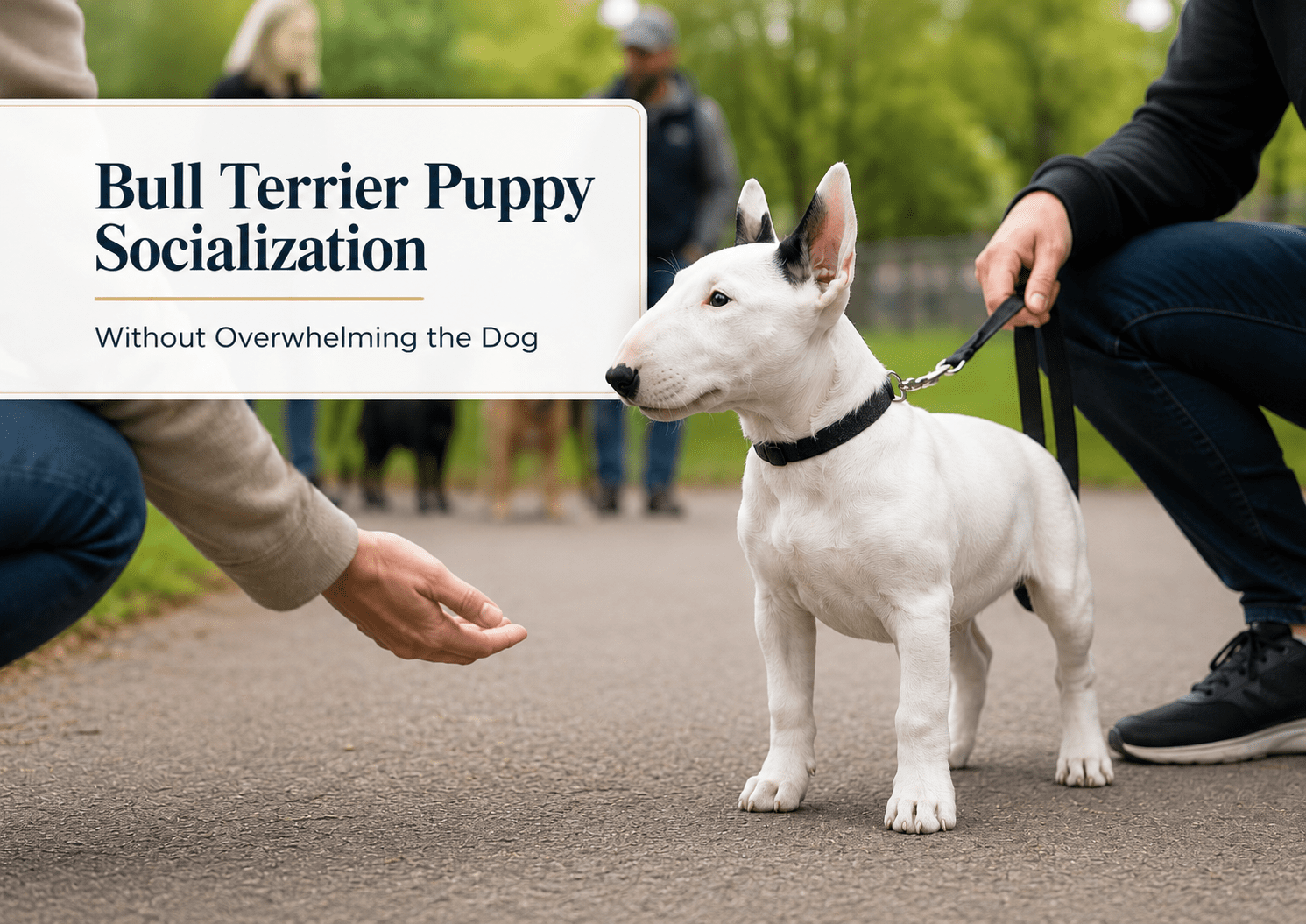
Socialization does not mean throwing your Bull Terrier puppy into everything.
It does not mean meeting every dog.
It does not mean letting every stranger touch them.
It does not mean busy parks, loud streets, crowded cafés, uncontrolled puppy play, children running toward them, or forcing the puppy to “get used to it” when they are clearly overwhelmed.
Good socialization is not flooding.
Good socialization is education.
A Bull Terrier puppy needs to learn about the world, but they need to learn in a way that builds confidence, neutrality, trust, and emotional control. The goal is not to create a puppy who runs toward everything. The goal is to create a puppy who can experience the world without losing their mind.
This distinction matters.
Many owners think they are socializing their puppy well because the puppy meets many people, many dogs, and many environments. But if every experience is too intense, too long, too uncontrolled, or too exciting, the puppy may not become confident. They may become overstimulated, reactive, frustrated, pushy, fearful, or unable to relax around normal life.
This is especially important with Bull Terriers.
Bull Terrier puppies are often bold, physical, curious, emotional, intense, and easily pulled into excitement. Some are confident and want to investigate everything. Some are sensitive and need more time. Some look brave but become overwhelmed underneath. Some love people so much they become wild around them. Some want to play with every dog until they learn bad habits. Some become frustrated when they cannot reach what they want.
So the question is not only, “How do I socialize my Bull Terrier puppy?”
The better question is:
“How do I help my Bull Terrier puppy experience the world without becoming overwhelmed?”
That is where real socialization begins.
Bull Terrier Puppy Socialization: What It Really Means
Quick Answer
Bull Terrier puppy socialization should be calm, short, controlled, and focused on confidence, neutrality, and recovery. A puppy does not need to meet every person or dog. They need to learn that people, dogs, sounds, surfaces, and new environments are safe and manageable without becoming overwhelmed, frustrated, fearful, or overexcited.
Bull Terrier puppy socialization should teach the puppy how to feel safe, think clearly, and stay connected around the world.
It is not only about exposure.
Exposure means the puppy sees something.
Socialization means the puppy learns something useful from that experience.
Those are not the same thing.
A puppy can see ten dogs and learn to pull, bark, lunge, or become frustrated. A puppy can meet twenty people and learn that every human means jumping and excitement. A puppy can visit a busy place and learn that the world is too much. A puppy can be passed from person to person and learn that they have no choice.
That is exposure, but it is not necessarily good socialization.
Good socialization teaches the puppy that different people exist, different sounds happen, different surfaces feel normal, different places are safe, other dogs can be seen without chaos, movement can happen without chasing, and the owner remains important even when the environment is interesting.
The puppy should come away from socialization more stable, not more frantic.
That is the standard.
Confidence Is Built Through Good Experiences, Not Just Many Experiences
More is not always better.
A puppy does not need to experience everything in one week. They need the right experiences at the right intensity.
One calm experience with a person can be more valuable than ten wild greetings.
One quiet observation of another dog at a distance can be more useful than a chaotic dog park.
One short visit to a new place where the puppy feels safe can be better than a long outing where the puppy is overwhelmed.
Confidence grows when the puppy can process what is happening.
If the puppy is too scared, too excited, too tired, or too stimulated, they may not learn the lesson the owner wants them to learn.
This is why the owner must observe the puppy carefully.
Does the puppy recover quickly?
Can they take food?
Can they look back at the owner?
Can they sniff calmly?
Can they watch without exploding?
Can they move away if needed?
Can they settle afterward?
These details matter.
A puppy who is learning well usually remains capable of thinking. A puppy who is overwhelmed often cannot process calmly anymore.
Socialization Should Include Neutrality
Many owners believe a social puppy must greet everyone.
That is a mistake.
A well-socialized Bull Terrier should not think every person, dog, animal, child, bicycle, or moving object is an invitation.
They should learn neutrality.
Neutrality means the puppy can notice something without needing to rush toward it. They can see another dog without pulling. They can hear children without chasing. They can pass people without jumping. They can watch movement without exploding into excitement.
This is extremely important for Bull Terriers.
A young Bull Terrier who learns that every dog means play may become frustrated later when they cannot reach dogs on lead. A puppy who learns that every person means intense greeting may become difficult around visitors. A puppy who learns that every moving child means excitement may become too physical in family homes.
Good socialization includes calm observation.
Not only interaction.
Sometimes the best socialization session is sitting at a distance and letting the puppy watch the world while staying connected to the owner.
That may look simple.
But it is powerful.
Do Not Use Dog Parks as Puppy Socialization
Dog parks are often a bad idea for Bull Terrier puppy socialization.
They are usually too uncontrolled. Too many dogs. Too much running. Too much pressure. Too many unknown temperaments. Too much risk of bad experiences. Too much rehearsal of wild play, chasing, bullying, fear, or frustration.
A Bull Terrier puppy does not need random dog park chaos to become social.
They need controlled, appropriate, carefully chosen experiences.
A calm adult dog with good manners can teach more than a pack of uncontrolled dogs. A quiet walk near another stable dog can teach more than rough group play. Watching dogs from a distance and staying calm can teach more than being thrown into the middle of excitement.
The goal is not to make the puppy obsessed with dogs.
The goal is to help the puppy behave sensibly around dogs.
That is very different.
Bull Terriers can become dog-selective as they mature. Early uncontrolled experiences can make that more complicated. Socialization should build calmness, respect, confidence, and neutrality, not uncontrolled expectation.
People Socialization Should Be Controlled
Many people love Bull Terrier puppies.
They are unusual, funny, striking, and full of personality. Strangers may want to touch them, talk to them, excite them, bend over them, pick them up, or encourage jumping.
But the owner must protect the puppy’s learning.
Not every person needs to greet the puppy.
Not every greeting should be high-energy.
Not every stranger should be allowed to touch the puppy.
A good people-socialization experience should teach the puppy that people are safe and normal, not that people are automatic excitement machines.
Short, calm greetings are better than wild greetings. The puppy should not be overwhelmed, grabbed, crowded, or forced. If the puppy is excited, the owner should help them stay connected. If the puppy is nervous, the owner should give space and not push interaction.
The puppy should learn:
People exist.
People can be calm.
I do not need to jump.
I do not need to rush.
I can stay connected to my owner.
That lesson becomes extremely useful later with visitors, public walks, family gatherings, and children.
Socialization With Children Needs Extra Care
Children can be very exciting for Bull Terrier puppies.
They run, shout, wave hands, drop food, move unpredictably, and often react loudly when a puppy jumps or bites. For a puppy, this can become a powerful game.
This does not mean Bull Terrier puppies cannot learn to be good around children.
It means child socialization must be structured.
The puppy should not be allowed to chase children, bite clothing, jump at faces, or practise rough behaviour just because they are young. Children should not be allowed to tease, grab, scream at, climb on, or overstimulate the puppy.
Both sides need guidance.
The puppy learns calm observation, controlled interaction, and appropriate behaviour.
The child learns how to move, touch, and respect the puppy.
A controlled five-minute experience is better than an uncontrolled hour of chaos.
With Bull Terriers, this matters because puppy behaviours become stronger as the dog grows. What is funny at ten weeks may become unsafe at ten months.
Build the rules early.
Socialization Is Not Only About People and Dogs
Many owners think socialization means only meeting people and dogs.
But a puppy also needs to learn about the environment.
Different surfaces. Grass. Gravel. Wood. Tile. Stairs when appropriate. Car sounds. Household appliances. Grooming tools. Vet handling. Collars. Harnesses. Leads. Doorways. Cars. Wind. Rain. Umbrellas. Bicycles at a distance. Different rooms. Different objects. Gentle noises. Quiet public places.
These experiences should be introduced calmly.
The puppy does not need to be forced through everything. They need time to investigate, choose, recover, and feel safe.
A Bull Terrier puppy who is confident with surfaces, sounds, handling, movement, and normal life will be easier to train later.
But again, the goal is balance.
Do not create a checklist and rush through it. Watch the puppy. Adjust the intensity. Keep sessions short. Make success more important than quantity.
Socialization is not about collecting experiences.
It is about building the puppy’s ability to handle life.
Watch for Signs of Overwhelm
Owners must learn the difference between curiosity, excitement, stress, and overwhelm.
A puppy who is learning well may sniff, look around, take food, check in, explore, recover, and remain relatively flexible.
A puppy who is overwhelmed may freeze, hide, pull away, refuse food, bark, lunge, shake, become frantic, bite more, jump excessively, pant, shut down, or become unable to respond.
Some puppies show overwhelm by becoming wild instead of fearful.
This is important with Bull Terriers.
Not every overwhelmed puppy looks scared. Some look silly, intense, or uncontrollable. The owner may think the puppy is “just excited,” when actually the puppy cannot process the situation calmly anymore.
If the puppy is overwhelmed, reduce the difficulty.
Increase distance. Shorten the session. Move somewhere quieter. Let the puppy sniff. Give them a break. End on something easy. Do not keep pushing because you want them to “get used to it.”
Flooding can create the opposite of confidence.
Good socialization respects the puppy’s state.
Keep Sessions Short
Puppy socialization should not become an expedition.
Short and successful is better than long and messy.
A few minutes in a new place can be enough. A short calm greeting can be enough. Watching dogs from a distance for a few minutes can be enough. A brief car ride, a short visit to a quiet area, or a small exposure to a new sound can all be useful.
The puppy’s brain is still developing.
Too much novelty stacked together can become exhausting. A puppy may handle the first experience well, then struggle with the third, fourth, or fifth new thing in the same outing.
This is why recovery matters.
After socialization, the puppy may need rest. Calm chewing. Crate time. A quiet nap. A predictable return to routine.
The experience is not finished when you leave the environment.
It is finished when the puppy has recovered from it.
Socialization Should Not Replace Focus Training
A Bull Terrier puppy should not only learn about the world.
They should learn about the owner in the world.
This is where focus training and socialization connect.
If the puppy sees people, dogs, noises, and movement but never learns to check in with the owner, the world may become more important than the handler. The puppy may start pulling, ignoring, lunging, greeting too intensely, or becoming frustrated when they cannot reach something.
During socialization, reward check-ins. Reward name response. Reward looking back. Reward calm observation. Reward staying connected near mild distractions.
Do not demand too much.
But keep the owner in the picture.
The puppy should learn:
The world is interesting.
But my owner still matters.
That one lesson can prevent many future problems.
Socialization Should Match the Puppy in Front of You
Not every Bull Terrier puppy needs the same socialization plan.
Some puppies are naturally bold and need more neutrality and impulse control.
Some are sensitive and need slower confidence-building.
Some are overly social and need to learn that not everyone is for greeting.
Some are easily overstimulated and need shorter sessions.
Some are environmentally curious but socially cautious.
Some become mouthy and intense when excited.
The owner must train the puppy they actually have.
Do not copy another owner’s routine blindly. Do not force your puppy into situations because another puppy handled them. Do not assume confidence means the puppy can handle unlimited exposure. Do not assume hesitation means weakness.
Good socialization is adjusted to the individual.
A Bull Terrier puppy should be guided, not compared.
Avoid Creating Frustration Around Other Dogs
One of the most common problems is lead frustration.
The puppy sees dogs. The puppy wants to reach them. The owner allows greetings sometimes but not others. The puppy pulls harder. The puppy becomes excited. The puppy learns that other dogs are highly valuable and that the lead is a barrier.
Later, this can look like reactivity.
Barking, lunging, pulling, whining, spinning, or frustration around dogs.
This is why socialization should not mean greeting every dog.
Instead, teach calm distance. Teach watching. Teach moving away. Teach checking in. Teach that seeing a dog does not always lead to interaction.
If greetings happen, choose calm, appropriate dogs and keep the interaction short. End before the puppy becomes too high. Do not let wild play become the normal expectation.
Bull Terrier puppies need to learn how to exist around dogs, not only how to explode toward them.
The Best Socialization Builds Recovery
A good socialization session should not leave the puppy wired for the rest of the day.
If every outing leads to hours of biting, zoomies, barking, and inability to settle, the puppy may be getting too much or the wrong kind of exposure.
A balanced session should be followed by recovery.
This is where crate training, place training, calm chewing, and routine become useful. The puppy experiences the world, then comes home and learns to settle. That rhythm teaches emotional control.
Activity, then recovery.
Exposure, then rest.
Curiosity, then calm.
This pattern is far better than letting the puppy stack excitement all day until they become impossible in the evening.
Socialization should support calmness.
Not destroy it.
Common Mistakes With Bull Terrier Puppy Socialization
One common mistake is forcing too much too soon.
Another is confusing excitement with confidence. Some owners allow wild greetings because the puppy seems happy, but the puppy is actually learning poor impulse control.
Some owners allow every dog greeting, which can create frustration later. Others avoid exposure completely and accidentally create uncertainty. Some take puppies to environments that are too busy. Some let strangers overwhelm the puppy. Some ignore signs of stress. Some forget to build focus during socialization.
Another mistake is thinking one bad experience is harmless.
A frightening dog interaction, a rough child greeting, or being overwhelmed in a loud place can affect how a puppy feels later. Puppies are impressionable. Their early experiences matter.
This does not mean the owner should be fearful.
It means the owner should be thoughtful.
Good socialization is not careless.
It is planned.
So, How Do You Socialize a Bull Terrier Puppy Without Overwhelming Them?
Start with calm, short, controlled exposure.
Let the puppy see the world from a distance they can handle. Reward check-ins. Keep the owner valuable. Choose safe people and appropriate dogs. Avoid dog park chaos. Build neutrality, not obsession. Watch for signs of overwhelm. Use routine and recovery after socialization. Keep sessions short and successful.
Do not rush.
Do not force.
Do not turn every new experience into a party.
Teach the puppy that the world is safe, interesting, and manageable.
That is the goal.
A Bull Terrier puppy who learns calm socialization becomes easier to guide later. They are less likely to become wild around every person, frustrated around every dog, or overwhelmed by every new environment.
They learn that life happens.
And they can handle it.
Final Thought
Socialization is not about creating a puppy who reacts to everything.
It is about creating a puppy who can live around everything.
That is a much higher goal.
A Bull Terrier puppy should learn confidence, but also neutrality. Curiosity, but also recovery. Engagement with the world, but also connection with the owner.
The world should not become more important than the human.
And the human should not use the world to overwhelm the puppy.
Good socialization builds trust.
It builds emotional strength.
It builds calm exposure.
It teaches the puppy that new things do not need to become chaos.
And when that foundation is built early, the future Bull Terrier becomes much easier to guide through adolescence and adult life.
Learn More From Working Bull Terriers Kennel
If your Bull Terrier puppy becomes overwhelmed, too excited, frustrated around other dogs, wild around people, or difficult to settle after outings, the answer is not always more exposure.
Often, the puppy needs better socialization structure, more recovery, stronger focus foundations, and calmer daily handling.
Our Bull Terrier Puppy Training Guide was created to help owners build routine, calmness, focus, bite control, controlled exposure, and early structure step by step. Our Quirks guide helps owners understand the breed-specific behaviours that often appear as the puppy grows.
For self-guided learning, start with the Puppy Training Guide and the Quirks guide.
If your puppy is already showing intense overexcitement, reactivity, fear, biting, inability to settle, or household chaos, personalized online training may be the better next step.
Socialize Your Bull Terrier Puppy Without Creating Chaos
Bull Terrier puppy socialization is not about meeting every person, every dog, or throwing the puppy into every busy environment. It is about building confidence, neutrality, focus, calm exposure, and recovery so your puppy can experience the world without becoming overwhelmed.
The Bull Terrier Puppy Training Guide helps you build that early foundation step by step, while the Quirks guide helps you understand the breed-specific behaviours that often appear as your puppy grows.

 Get the Puppy Training Guide
Explore the Quirks Guide
Get the Puppy Training Guide
Explore the Quirks Guide
Related Reading
If you are socializing a Bull Terrier puppy, these articles will help you build the foundation behind calm exposure: focus, crate and place work, settling, exercise balance, and recovery after stimulation.
A key companion article for teaching your puppy that checking in, name response, eye contact, and connection with the owner matter around distractions.
A practical guide for using crate training and place training to build rest, recovery, controlled freedom, and better household structure.
A helpful article for understanding why socialization must be followed by recovery, calmness, and the ability to switch off after excitement.
A strong companion article for understanding why more activity is not always better, and why balanced exercise, rest, and recovery support better socialization.
Leave a Reply