







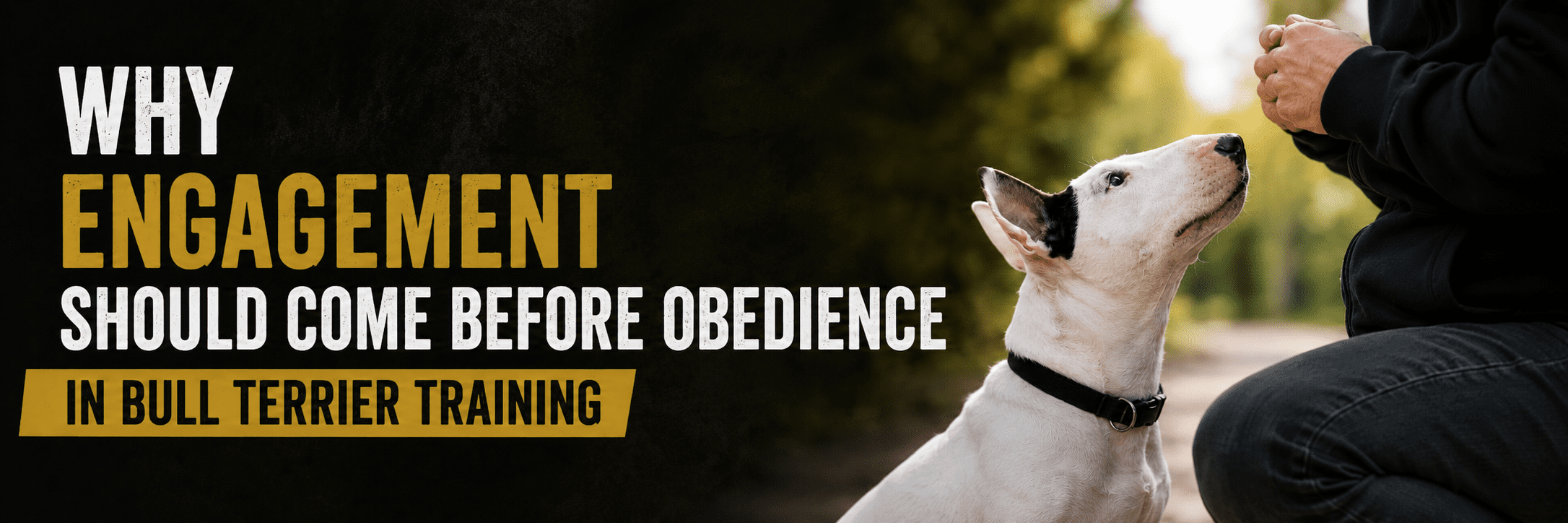
Most Bull Terrier owners start training from the wrong place.
They start with obedience.
Sit.
Down.
Stay.
Come.
Heel.
Leave it.
Stop.
No.
And of course, those commands matter. A Bull Terrier should learn obedience. They should learn rules, manners, recall, leash control, calmness, and boundaries. But obedience is not the first layer.
Engagement is.
Before a Bull Terrier can listen well, they must care that the owner exists in the moment. Before they can follow commands around distractions, they must learn that the owner has value. Before they can respond outside, they must understand that checking in, focusing, and participating with the human brings something worth choosing.
This is where many owners get frustrated.
Their Bull Terrier listens at home but ignores them outside. They sit perfectly in the kitchen but become deaf in the park. They take treats indoors but stare at dogs, smells, people, movement, and the world once they leave the house. The owner repeats commands, becomes louder, pulls the lead, gets annoyed, and eventually says the dog is stubborn.
But very often, the problem is not obedience.
The problem is engagement.
The dog has learned the command, but they have not learned to stay connected to the owner when the environment becomes more interesting.
That difference is huge.
A Bull Terrier can know what “sit” means and still ignore you if the world has more value than you in that moment. A Bull Terrier can understand “come” and still choose a smell, a dog, or a moving object if the relationship and reward history are weak outside. A Bull Terrier can behave beautifully in easy situations and fall apart when excitement rises.
This is not because the dog is broken.
It is because obedience was built on a weak foundation.
And with Bull Terriers, that foundation matters more than many people realize.
Bull Terrier Engagement Training: The Foundation Before Obedience
Quick Answer
Bull Terrier engagement training should come before obedience because a dog must first learn that the owner has value. Commands work better when the Bull Terrier is mentally connected, checking in, responding to their name, following guidance, and choosing the owner over distractions. Obedience tells the dog what to do, but engagement teaches the dog why paying attention matters.
Bull Terrier engagement training means teaching the dog that the owner is worth paying attention to.
It is not about begging for attention.
It is not about bribing the dog forever.
It is not about turning the owner into a circus performer.
It is about building a relationship where the dog learns that checking in, following guidance, responding to the owner, and staying mentally connected are valuable behaviours.
This comes before obedience because commands need a dog who is mentally available.
If the dog’s brain is already locked onto another dog, a smell, a person, a cat, a ball, a noise, or the general excitement of the environment, obedience becomes much harder. The owner may give a command, but the dog is not really with them.
They are physically attached to the lead.
Mentally, they are somewhere else.
Engagement brings the dog back into the conversation.
It teaches the Bull Terrier that the owner is not just the person holding the lead. The owner is part of the environment. The owner creates value. The owner gives direction. The owner opens access to good things. The owner is worth choosing.
When that foundation is missing, obedience becomes mechanical at best and unreliable under pressure.
When that foundation is strong, obedience becomes much easier to build.
Why Obedience Alone Often Fails With Bull Terriers
Many Bull Terriers are intelligent, but they are not usually automatic followers.
They are not empty waiting machines hoping for the next command. They are physical, curious, emotional, funny, intense, determined, and often very aware of what they want.
This is part of their charm.
It is also why generic obedience advice often fails.
If a training system only teaches commands without building engagement, the Bull Terrier may perform well in controlled situations but struggle when life becomes real. They may sit for a treat in the kitchen, but outside they are pulled toward smells, dogs, people, birds, grass, movement, and anything more interesting than the owner’s voice.
The owner thinks, “He knows this command.”
Yes, maybe he does.
But knowing a command is not the same as being ready to respond in a difficult environment.
A Bull Terrier may understand the word and still not feel enough reason to choose it over the distraction.
That is why engagement must come first.
Commands tell the dog what to do.
Engagement gives the dog a reason to stay with you long enough to hear and care about the command.
Engagement Is Not the Same as Excitement
This is an important distinction.
Some owners try to build engagement by becoming more and more exciting. They use a high voice, fast movement, constant food, toys, clapping, running, and dramatic energy. This may get the dog’s attention for a moment, but it can also create a dog who is aroused, not focused.
Engagement is not just excitement.
True engagement means the dog is connected, responsive, and able to think.
Sometimes engagement is active and playful. Sometimes it is calm and quiet. Sometimes it is eye contact before a release. Sometimes it is following the hand. Sometimes it is checking in on a walk. Sometimes it is choosing the owner instead of pulling toward a distraction.
For Bull Terriers, this balance matters.
Too much excitement can push the dog higher. A dog who is already intense may become more intense. A dog who is already overaroused may become less able to listen. A dog who is already frustrated may become more frantic.
Good engagement does not only switch the dog on.
It also teaches the dog how to stay connected without losing control.
The best training creates a Bull Terrier who can be enthusiastic and thoughtful.
Not just excited.
The Owner Must Become Valuable Before Commands Matter
A command is only as strong as the relationship, reward history, clarity, and context behind it.
If the owner has not become valuable to the dog, commands often become background noise.
This happens all the time.
The owner says the dog’s name twenty times a day without meaning anything clear. They say “come” when the dog is already distracted. They say “leave it” after the dog is fully committed to something. They say “heel” when the dog has never learned leash engagement. They say “no” repeatedly, but the dog has no better behaviour to choose.
Eventually, words lose power.
The dog hears the human, but the human is not important enough in that moment.
Engagement rebuilds that importance.
It teaches the dog that the owner’s voice matters. The owner’s movement matters. The owner’s hand matters. The owner’s reward timing matters. The owner’s direction creates access, play, food, movement, freedom, or relief.
This does not mean the owner must constantly feed the dog.
It means the owner must become relevant.
A Bull Terrier who sees the owner as relevant is much easier to train than a Bull Terrier who sees the owner as an interruption.
Engagement Starts With Small Daily Moments
Engagement training does not need to start with complicated exercises.
It starts with small moments.
The dog looks at you. Reward.
The dog checks in during a walk. Reward.
The dog responds to their name. Reward.
The dog follows your hand. Reward.
The dog turns with you. Reward.
The dog chooses you instead of rushing forward. Reward.
These moments may look simple, but they create the foundation for everything else.
A Bull Terrier who repeatedly learns that attention to the owner pays will begin offering more of it. They will start looking back more often. They will begin noticing the owner during movement. They will become easier to redirect. They will learn that the human is not just there to stop them from doing what they want.
The human becomes part of the reward system.
This is where many owners fail because they only reward formal obedience. They ask for a sit and reward that. They ask for a down and reward that. But they ignore spontaneous attention.
That is a missed opportunity.
Natural check-ins are gold.
When your Bull Terrier chooses to look at you without being forced, that is the beginning of real connection.
Do not waste it.
Why Engagement Helps With “Stubborn” Behaviour
Many behaviours that owners call stubborn are actually engagement problems.
The dog does not come when called outside.
The dog pulls toward a smell.
The dog stares at another dog.
The dog ignores commands in public.
The dog listens indoors but not outdoors.
The dog refuses to move away from something interesting.
The dog appears to “know better” but still does what they want.
Sometimes, yes, the dog is testing boundaries. Bull Terriers can test. They can push. They can negotiate with life. But very often, the owner has not built enough engagement under that level of distraction.
The dog is not choosing disobedience in a moral sense.
They are choosing the thing with the most value.
If the smell, dog, person, or environment has more value than the owner, the dog will naturally move toward that value.
Engagement changes the value picture.
It does not remove the dog’s personality. It does not make the Bull Terrier robotic. It simply teaches the dog that the owner is worth considering even when the world is tempting.
That is why engagement should come before obedience.
Without engagement, obedience is always competing from a weak position.
Focus Is Built Before It Is Needed
Many owners only ask for focus when they desperately need it.
The dog is already pulling.
Already staring.
Already lunging.
Already overexcited.
Already ignoring.
Already too high.
Then the owner says the dog’s name or gives a command and expects focus to appear.
But focus does not magically appear during difficulty if it has not been built during easier moments.
Engagement must be trained before the hard situation.
Start in the house. Then the garden. Then quiet outdoor areas. Then mild distractions. Then stronger distractions. The dog must learn in layers.
If a Bull Terrier cannot check in with you in the kitchen, do not expect reliable check-ins near another dog. If they cannot follow your hand in the garden, do not expect leash focus on a busy street. If they do not respond to their name in a quiet place, do not expect them to respond when a cat runs past.
This is not a dog problem.
This is a training progression problem.
Build the behaviour where the dog can succeed.
Then make the world gradually harder.
Engagement Makes Leash Training Easier
Many leash problems are not only leash problems.
They are engagement problems.
The dog pulls because the environment is more important than the owner. They drag forward because forward movement has value. They ignore the handler because they have not learned to move with the human. They reach the end of the lead because there is no reason to stay connected.
Of course, leash mechanics matter. Equipment matters. Timing matters. Reinforcement matters. But if there is no engagement, leash training becomes a physical battle.
The owner pulls back.
The dog pulls forward.
The owner says “heel.”
The dog wants the world.
The lead becomes a conflict line.
Engagement changes the walk from a fight into a shared activity.
The dog learns to check in. To turn with the owner. To follow movement. To respond to name. To earn access through connection. To notice the handler before hitting the end of the lead.
This is why leash focus should not begin with trying to force perfect heel position.
It should begin with making the owner valuable during movement.
When the dog learns to move with you, leash obedience becomes easier.
Engagement Helps With Recall
Recall is not only a command.
Recall is a value decision.
When you call your Bull Terrier, you are asking them to leave something and come to you. That something may be a smell, freedom, another dog, a person, a toy, movement, or the joy of running.
If coming back to you has not been built as valuable, the word alone may not be enough.
Many owners damage recall by calling the dog only when the fun is over. They call to end freedom. They call to put the lead on. They call when angry. They call when the dog is already too distracted. They repeat the word without reward.
Then they wonder why recall fails.
Engagement builds recall before recall is tested.
The dog learns that coming toward the owner is rewarding. Checking in is rewarding. Turning back is rewarding. Following is rewarding. Being near the owner creates good things.
A recall built on engagement has a much better chance than a recall built only on repetition.
Engagement Before Correction
Some owners try to correct before they have built engagement.
The dog ignores, so they correct.
The dog pulls, so they correct.
The dog does not come, so they correct.
The dog focuses on another dog, so they correct.
But if the dog has never learned what the owner wants instead, correction may only suppress, frustrate, or create conflict. It may stop a behaviour in that moment, but it does not necessarily create a dog who wants to work with the owner.
Before correction becomes part of any serious conversation, the dog needs understanding.
They need to know how to check in. How to follow. How to return. How to move with the owner. How to choose the owner. How to regulate after excitement.
This does not mean there are no rules.
Bull Terriers need rules.
But rules work better when the dog has a strong foundation of engagement.
Correction without engagement can create resistance.
Structure with engagement creates clarity.
Engagement Should Be Built Into Everyday Life
Engagement is not something you only practise during formal training sessions.
It should appear throughout daily life.
Before food, a moment of focus.
Before the door opens, a check-in.
During walks, reward looking back.
Before play starts, connection.
Before release, calm attention.
During distractions, small moments of choosing the owner.
After excitement, recovery with the owner’s guidance.
This teaches the dog that engagement is not a trick.
It is part of how life works.
The owner becomes the gateway to good things.
Not by constantly controlling the dog, but by teaching the dog that cooperation makes life better.
This is especially useful with Bull Terriers because they often enjoy access, movement, play, food, social contact, and exploration. All of those can become rewards when the dog learns that engagement opens the door.
Engagement Does Not Mean the Dog Never Gets Freedom
Some owners worry that engagement training means the dog must stare at them all day and never enjoy life.
That is not the goal.
A Bull Terrier should sniff. Explore. Play. Move. Enjoy walks. Experience the world. Use their body. Be a dog.
Engagement does not remove freedom.
It creates safer freedom.
A dog who checks in can be given more freedom than a dog who disconnects completely. A dog who responds to the owner can explore more safely. A dog who understands engagement can enjoy the world without becoming unreachable.
The goal is not constant control.
The goal is connection that remains available when needed.
That is a much healthier way to train.
How to Begin Engagement Training With a Bull Terrier
Start in an easy environment.
Use food, praise, play, movement, or anything your dog finds valuable. Reward eye contact. Reward name response. Reward check-ins. Reward following your hand. Reward turning with you. Reward walking near you. Reward choosing you instead of immediately rushing toward something else.
Keep sessions short.
Make success easy.
Do not wait for the dog to fail. Create situations where the dog can win.
Then gradually increase difficulty.
Different rooms. Garden. Quiet street. Mild distractions. More movement. Outdoor smells. People at a distance. Dogs at a distance.
Do not rush to the hardest place.
If engagement disappears, the environment is probably too difficult or the reward value is too low.
Make it easier, rebuild, and progress again.
This is how strong foundations are built.
Signs Your Bull Terrier Is Becoming More Engaged
You will know engagement is improving when your dog begins checking in without being asked.
They look back on walks. They respond to their name faster. They turn with you more easily. They follow your movement. They recover from distractions quicker. They seem more interested in training. They offer attention before you ask for a command. They become easier to redirect before excitement becomes too high.
These changes may be small at first.
But they matter.
They show that the dog is beginning to include you in their decisions.
That is the beginning of better obedience.
Common Mistakes Owners Make With Engagement
One mistake is asking for too much too soon.
Another is starting in environments that are too difficult. Some owners reward only commands and ignore natural attention. Others repeat the dog’s name until it means nothing. Some use food without timing, so the dog eats but does not understand what behaviour earned the reward.
Another mistake is becoming too exciting and creating arousal instead of focus.
The dog may look engaged, but they are actually becoming wild.
Good engagement should create connection and clarity, not just higher energy.
The owner must learn the difference.
So, Why Should Engagement Come Before Obedience?
Engagement should come before obedience because a dog must be mentally connected before commands can work reliably.
Obedience tells the dog what behaviour to perform.
Engagement teaches the dog why paying attention to the owner is worth it.
With Bull Terriers, this order is especially important. This breed can be powerful, curious, funny, intense, and very interested in the environment. If the owner only teaches commands but does not build value, the dog may understand the words but still choose the world.
Engagement changes that.
It gives obedience a foundation.
It makes focus easier. Leash work easier. Recall easier. Redirection easier. Outdoor training easier. Calmness easier. Communication easier.
It does not replace obedience.
It makes obedience possible in real life.
Final Thought
A Bull Terrier does not become reliable because the owner repeats commands louder.
Reliability starts when the dog learns that the owner matters.
That is engagement.
Before you demand more obedience, build more connection. Before you blame stubbornness, check whether the dog has enough reason to choose you. Before you expect focus outside, build focus in easier places. Before you fight distractions, make yourself more valuable.
This is not soft training.
It is smart training.
A Bull Terrier with engagement is easier to guide, easier to teach, and easier to live with.
And once that foundation is strong, obedience stops feeling like a battle and starts becoming a conversation.
Learn More From Working Bull Terriers Kennel
If your Bull Terrier ignores you outside, pulls toward distractions, listens at home but not in public, or seems to know commands but fails when excited, the problem may not be obedience alone.
The foundation may be engagement.
Our Bull Terrier training guides were created to help owners understand this breed more deeply and build training from the right order: bond, engagement, drive, focus, structure, and clear communication.
For self-guided learning, start with our Bull Terrier training books and guides.
If your Bull Terrier is already showing serious overexcitement, reactivity, pulling, poor recall, or lack of focus outside, personalized online training may be the better next step.
Build Engagement Before You Demand Obedience
Bull Terrier engagement training is the foundation behind better obedience, leash focus, recall, redirection, and outdoor control. Before a Bull Terrier can listen reliably, they must first learn that the owner has value and that checking in is worth choosing.
Our Bull Terrier training books help owners build the right foundation first: understanding, engagement, focus, structure, and clear communication. The Quirks guide then helps explain many of the breed-specific behaviours that make Bull Terriers feel so different from generic dogs.

 Explore the Bull Terrier Training Books
Explore the Quirks Guide
Explore the Bull Terrier Training Books
Explore the Quirks Guide
Related Reading
If you want to understand why engagement comes before obedience, these articles will help you build the foundation behind focus, calmness, recovery, and better control before commands become difficult.
A strong companion article for understanding how name response, eye contact, checking in, and owner value begin before obedience becomes reliable.
A useful guide for building rest, recovery, structure, and controlled freedom so the dog is more able to think and engage.
A helpful article for understanding why calmness and recovery make engagement easier, especially when excitement would normally take over.
A strong companion article for understanding why exercise must be balanced with routine, recovery, and mental connection instead of only tiring the dog out.
Leave a Reply