





Bull Terrier Behaviour & Owner Guidance
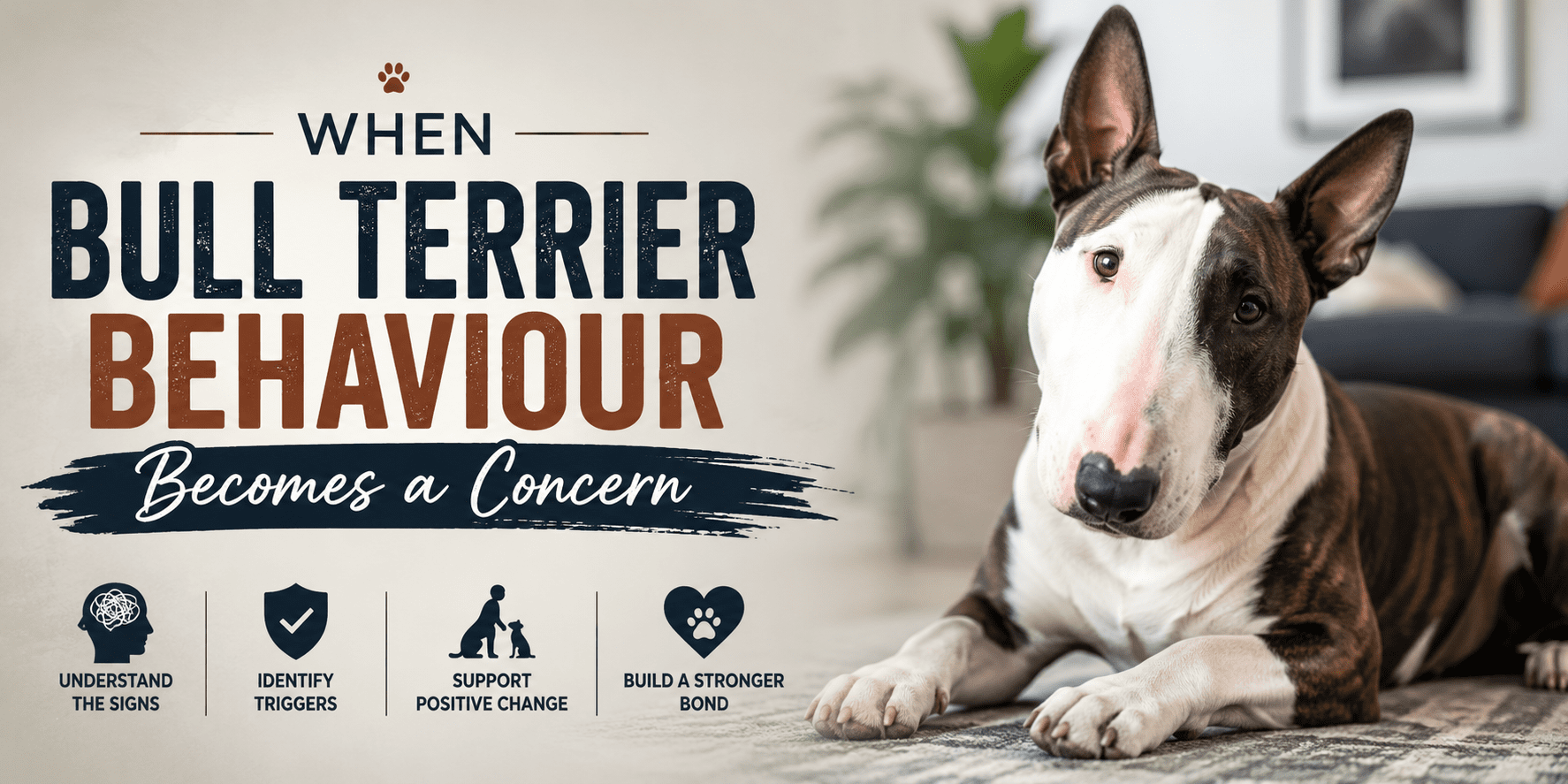
When Bull Terrier Behaviour Becomes a Concern
Bull Terriers are naturally funny, intense, physical, expressive, stubborn-looking, affectionate, and sometimes completely unreasonable in the most charming way possible. That is part of the breed. But there is an important line every owner must learn to recognize: the line between normal Bull Terrier personality and behaviour that is becoming a concern.
This line is not always obvious. A Bull Terrier that jumps, grabs, barks, pulls, refuses to settle, guards objects, reacts to dogs, or becomes too intense at home may still look playful to one person and dangerous to another. Some owners laugh too long. Others panic too early. The real skill is learning how to read the pattern behind the behaviour.
A single strange moment does not always mean there is a serious problem. But repeated patterns, increasing intensity, poor recovery, lack of control, and unsafe behaviour should not be ignored. With Bull Terriers, small patterns can become big patterns if the dog learns that intensity works.
Bull Terrier behaviour becomes a concern when it is repeated, escalating, difficult to interrupt, unsafe, connected to guarding or aggression, or when the dog cannot recover after excitement or stress. The issue is not whether the behaviour looks strange. The issue is whether the Bull Terrier can still settle, respond, respect boundaries, and live safely inside the owner’s structure.
Normal Bull Terrier Personality or a Real Concern?
Bull Terriers are not quiet background dogs. They are expressive dogs with strong opinions, powerful bodies, and a very specific way of interacting with the world. They may stare dramatically, lean heavily, race around the house, grumble, carry objects, invent routines, and test whether a rule still exists today.
Many of these behaviours are normal breed expression. The problem begins when the behaviour stops being harmless expression and starts becoming pressure, conflict, risk, or loss of control.
For example, a Bull Terrier who runs around the house after a bath may simply be releasing energy. But a Bull Terrier who cannot stop, crashes into people, grabs clothing, bites during excitement, and takes twenty minutes to calm down is showing a different pattern.
A Bull Terrier who leans against your legs may be affectionate. A Bull Terrier who uses his body to block people, push through doorways, or control movement is showing something that needs structure. The behaviour may look similar from the outside, but the meaning is different.
The question is not only “Is this normal for a Bull Terrier?” The better question is: “Is this behaviour safe, manageable, interruptible, and improving with structure — or is it becoming stronger over time?”
Early Warning Signs Owners Should Not Ignore
Most serious behaviour problems do not appear overnight. They usually begin as smaller signs that were missed, laughed off, excused, or managed without being properly understood.
This does not mean owners should become paranoid. It means they should become observant. Good Bull Terrier ownership requires the ability to enjoy the breed’s personality while still noticing when the dog is starting to move in the wrong direction.
A behaviour becomes more concerning when it increases in intensity, frequency, or duration. If your Bull Terrier used to bark once and now explodes every time someone passes the house, the pattern is growing.
Escalation matters. It means the dog is rehearsing the behaviour and becoming better at it.
Excitement is normal. Stress is normal. Reacting to something surprising can happen. But if the Bull Terrier cannot come back down after the event, that is important information.
Poor recovery often means the nervous system is staying too high for too long. This can affect walks, visitors, other dogs, training, and home life.
A Bull Terrier who can be guided back is different from a Bull Terrier who fully locks onto a behaviour and cannot hear, think, move away, or reconnect with the owner.
When the dog becomes unreachable, the owner is no longer training inside a calm learning state. They are trying to manage an emotional explosion.
Bull Terriers are physical dogs. But physical behaviour becomes a concern when the dog uses his body to push, block, jump, grab, shoulder into people, control space, or ignore human movement.
This is especially important with children, elderly people, visitors, smaller pets, or owners who cannot physically manage the dog.
Any behaviour that puts people, dogs, cats, livestock, children, visitors, or the Bull Terrier himself at risk needs to be taken seriously.
It does not matter whether the dog “means it” or not. Safety is not judged only by intention. Safety is judged by outcome and risk.
Common Bull Terrier Behaviours That Can Become Concerns
Many concerning behaviours begin as something that seemed manageable at first. The dog was “just excited,” “just playing,” “just being a Bull Terrier,” or “just testing.” Then the behaviour became stronger, more frequent, or more difficult to control.
These are some of the patterns owners should watch carefully.
- Jumping that becomes body-slamming, grabbing, or knocking people over.
- Mouthing that becomes hard biting, clothing grabbing, or arousal biting.
- Pulling that becomes lunging, fixation, or loss of control outside.
- Barking that becomes obsessive, defensive, or impossible to interrupt.
- Guarding toys, food, resting places, people, furniture, or stolen objects.
- Rough play that becomes too intense for people, dogs, or children.
- Following that becomes separation distress or constant pressure on the owner.
- Excitement around visitors that becomes chaos, jumping, nipping, or guarding.
- Reactivity toward dogs, people, vehicles, sounds, or movement.
- Refusal to settle that affects the household every day.
One of the biggest mistakes is waiting until the behaviour is extreme. The earlier the pattern is understood, the easier it is to change direction.
If your Bull Terrier is becoming reactive, intense, unsafe, difficult to interrupt, or hard to control in daily life, the responsible next step is not random advice. It is a proper evaluation of the pattern.
Working Bull Terriers Kennel offers customized online training for serious owners who want breed-specific structure, clear guidance, and a realistic plan.
The Difference Between a Quirk and a Problem
A Bull Terrier quirk is usually harmless, manageable, and part of the dog’s personality. It may be funny, strange, dramatic, or breed-specific, but it does not create serious pressure or risk. The dog can still respond, settle, and live safely with the owner’s guidance.
A behaviour problem is different. It begins to control the environment. The dog’s reaction affects walks, visitors, family life, other pets, or the owner’s confidence. The behaviour is no longer just something the dog does. It becomes something the household must constantly work around.
This distinction is very important because many Bull Terrier owners either underestimate or overreact. Some excuse everything as “just the breed.” Others panic over every unusual behaviour. Neither extreme helps the dog.
The best owner learns to say: “This is normal personality,” “This needs structure,” “This needs management,” or “This needs proper help.”
Why Structure Matters So Much With Bull Terriers
Bull Terriers are not dogs that do well with unclear daily rules. They may look funny and clownish, but they are also strong, determined, and very good at noticing patterns. If a behaviour works once, many Bull Terriers will try it again.
Structure does not mean harshness. It means the dog understands what is allowed, what is not allowed, when excitement is appropriate, when calmness is expected, and how to access things without pushing, demanding, grabbing, or exploding.
A Bull Terrier with no structure often becomes a dog who lives by impulse. He wants something, so he pushes. He sees something, so he lunges. He becomes excited, so he grabs. He feels frustrated, so he barks. He dislikes a boundary, so he tests harder.
The owner’s job is not to crush that personality. The owner’s job is to give it a safe frame.
Structure is not the opposite of love. For Bull Terriers, structure is often what allows love, freedom, humour, and affection to exist without chaos.
When Owners Should Take Action
Owners should take action when the behaviour is no longer isolated, harmless, or easy to guide. Waiting too long often allows the dog to rehearse the same pattern until it becomes part of daily life.
You do not need to panic. But you should pay attention when:
- The behaviour is happening more often.
- The dog is becoming harder to interrupt.
- The dog is slower to calm down after excitement or stress.
- The behaviour affects walks, visitors, children, other dogs, or household peace.
- The owner starts avoiding normal life because of the dog’s behaviour.
- The behaviour involves guarding, snapping, lunging, biting, or redirecting.
- The dog’s size, strength, or intensity makes the behaviour unsafe.
- The owner feels embarrassed, nervous, overwhelmed, or physically unable to manage the dog.
These signs do not mean the dog is hopeless. They mean the pattern deserves attention before it becomes more serious.

Many Bull Terrier behaviour concerns become easier to understand when the owner has a stronger foundation in breed-specific training, structure, engagement, focus, puppy development, and daily rules.
The Ultimate Bull Terrier Library Bundle brings together the core Working Bull Terriers Kennel guides for owners who want to understand, train, and live better with the breed.
What Not to Do When Behaviour Becomes a Concern
When owners become worried, they often start reacting emotionally. They shout more, repeat commands, tighten the lead, avoid everything, overexpose the dog, or try random tips from different sources. This usually creates confusion.
With a Bull Terrier, inconsistency can make the situation worse because the dog begins to test which version of the rule is real today.
- Do not wait for the behaviour to become extreme before taking it seriously.
- Do not excuse unsafe behaviour as “just Bull Terrier personality.”
- Do not rely only on punishment after the dog has already exploded.
- Do not force the dog into situations he cannot handle.
- Do not allow random greetings if the dog is reactive or socially unsafe.
- Do not turn stolen objects, jumping, mouthing, or grabbing into games.
- Do not ignore recovery, rest, arousal, and daily structure.
- Do not take advice from people who do not understand the breed’s intensity.
When Behaviour Needs Professional Guidance
Some behaviour concerns should not be handled through trial and error. If there is risk, escalation, aggression, guarding, reactivity, biting, redirecting, or the owner feels unsafe, the case needs a more serious approach.
Professional guidance becomes especially important when the behaviour involves:
- Snapping, biting, or attempts to bite.
- Guarding food, toys, stolen objects, furniture, people, or spaces.
- Reactivity toward dogs, people, visitors, vehicles, or movement.
- Redirecting onto the lead, clothing, or owner.
- Conflict with other dogs or pets in the home.
- Behaviour that affects children, elderly people, or vulnerable family members.
- Owner fear, loss of control, or physical inability to manage the dog.
- Patterns that are getting worse despite the owner trying to improve them.
Important: If your Bull Terrier has bitten, injured another animal, redirected onto a person, or made someone feel unsafe, do not rely on quick comment advice. Serious behaviour cases need proper evaluation and a safety-first plan.
Final Thought
Bull Terrier behaviour becomes a concern when the dog’s personality turns into pressure, risk, escalation, or loss of control. The goal is not to remove the breed’s character. A Bull Terrier should still be funny, expressive, affectionate, confident, and full of life.
But the dog also needs structure. He needs recovery. He needs engagement. He needs clear rules. He needs an owner who can read the difference between harmless weirdness and a pattern that is becoming serious.
The earlier you understand the pattern, the more options you have. Waiting until the behaviour controls the household is not fair to the dog or the owner.
A well-guided Bull Terrier does not lose his personality. He learns how to live with it safely.
If your Bull Terrier’s behaviour is becoming difficult, unsafe, reactive, or overwhelming, the next step should be clear and responsible. We start with a short evaluation form so we can understand the case properly before recommending the right direction.
Frequently Asked Questions About Bull Terrier Behaviour Concerns
You should pay attention when the behaviour is repeated, escalating, difficult to interrupt, unsafe, or affecting walks, visitors, children, other pets, or daily life. A single strange moment may not be serious, but a growing pattern should not be ignored.
Bull Terriers can be physical and intense, but rough behaviour should still have limits. If the dog is hurting people, grabbing clothing, knocking people over, ignoring boundaries, or becoming harder to calm down, the behaviour needs structure.
No. Many Bull Terrier quirks are harmless personality traits. They become behaviour problems when they create risk, pressure, conflict, guarding, reactivity, loss of control, or daily stress for the household.
Yes, many behaviour problems can improve with clearer structure, better engagement, improved recovery, safer management, and consistent owner guidance. Serious cases need a proper plan rather than random tips.
Professional guidance is recommended if the dog is biting, snapping, guarding, reacting strongly, redirecting, becoming unsafe, or if the owner feels overwhelmed or unable to control the dog. Safety and proper evaluation should come first.
Leave a Reply