





Bull Terrier Training & Behaviour Problems
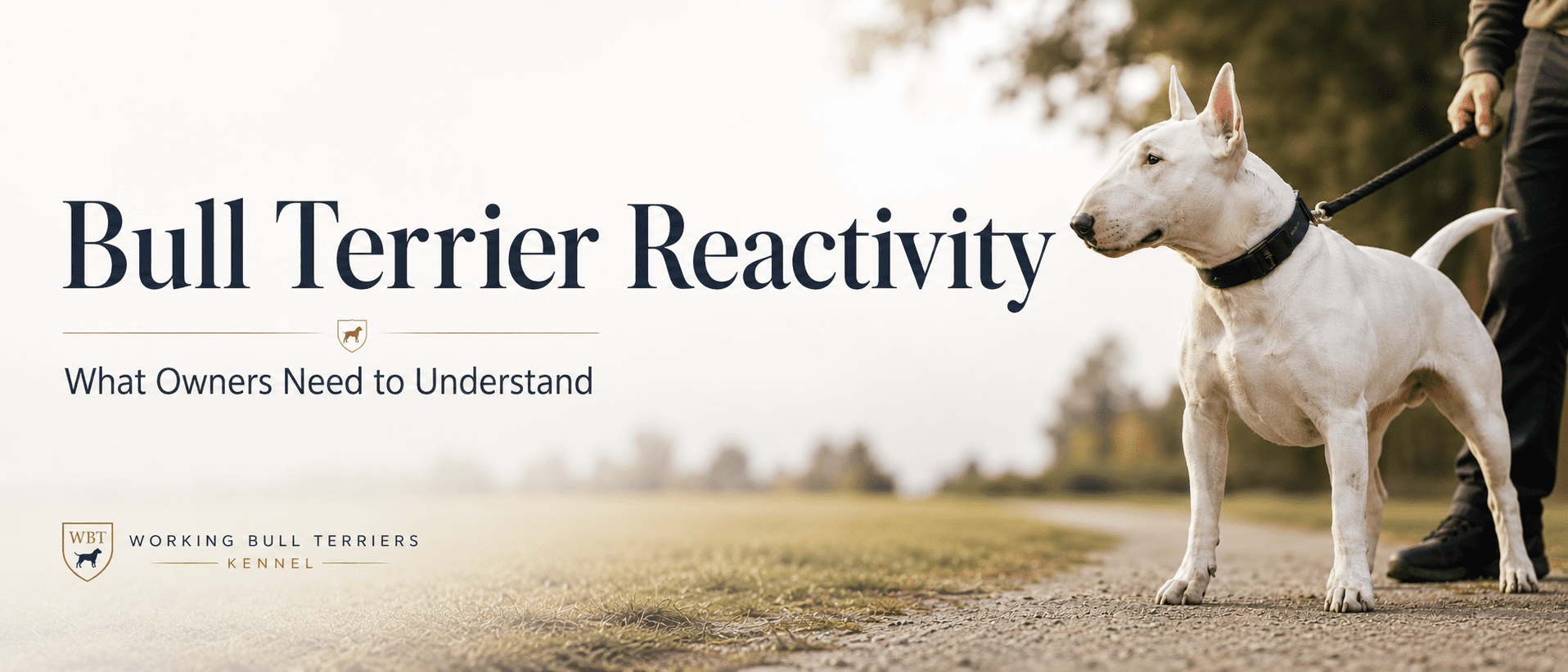
Bull Terrier Reactivity: What Owners Need to Understand
Bull Terrier reactivity is one of the most misunderstood behaviour problems in the breed. Many owners describe it as aggression, stubbornness, dominance, bad manners, or “he just goes crazy when he sees another dog.” But in many cases, reactivity is not the dog trying to be evil. It is a dog losing emotional control around a trigger.
That trigger might be another dog. A person. A bicycle. A loud vehicle. A visitor at the door. A child running past. A strange sound. A cat. A dog behind a fence. A person reaching toward the dog too quickly. Or even a situation where the Bull Terrier feels trapped, frustrated, excited, or unsure.
The visible behaviour can look dramatic: barking, lunging, screaming, pulling, spinning, stiffening, freezing, growling, jumping, grabbing the lead, redirecting onto the owner, or refusing to listen. But the behaviour you see on the outside is only the surface. The real work begins when you understand what is happening underneath.
With Bull Terriers, this matters even more because the breed is intense. They are physical, determined, emotionally expressive, and often very strong once aroused. A reactive Bull Terrier is not just “a little excited.” When this breed crosses threshold, the owner can feel like the dog’s whole brain has left the conversation.
Bull Terrier reactivity usually means the dog is overreacting to a trigger because of frustration, fear, excitement, poor regulation, lack of engagement, previous bad experiences, or unclear structure. It is not solved by shouting, forcing greetings, flooding the dog, or simply correcting the visible reaction. The owner must learn to read the dog earlier, control distance, rebuild focus, improve emotional regulation, and create safer, clearer training situations.
Bull Terrier Reactivity Is Not Always Aggression
One of the biggest mistakes owners make is assuming every reactive display is aggression. A Bull Terrier barking and lunging at another dog may look aggressive, but the emotional reason behind the reaction can vary.
Some dogs are fearful. Some are frustrated because they want to reach the other dog. Some are overstimulated by movement. Some have poor leash skills and no way to process pressure. Some have been allowed to rehearse chaotic greetings for too long. Some have learned that exploding makes the trigger move away. Some are not confident. Some are not socially safe. Some are simply over threshold and no longer thinking clearly.
The same outward behaviour can come from different internal states. That is why copying random advice from the internet can make things worse. If you treat fear like dominance, you may increase insecurity. If you treat frustration like harmless excitement, you may allow the behaviour to grow. If you treat every reaction the same way, you miss the dog in front of you.
The first rule: do not label the Bull Terrier too quickly. “Reactive” describes the behaviour pattern. It does not automatically explain the cause. Good training starts by understanding why the dog is reacting, not just trying to silence the reaction.
Why Bull Terriers Can Become Reactive
Bull Terriers are not fragile dogs, but they are not simple dogs either. They are intense, emotional, physical, and very pattern-aware. When the wrong pattern is repeated often enough, it can become very strong.
Reactivity often develops from a combination of factors, not one single cause. The owner may only notice the barking and lunging, but the foundation may have been building quietly for weeks, months, or even years.
Many Bull Terriers are powerful, enthusiastic dogs. Excitement is not automatically bad, but excitement without regulation becomes a problem. If the dog learns to explode every time something interesting appears, the nervous system begins to treat stimulation as a green light for chaos.
This is why some reactive Bull Terriers do not look afraid. They look excited, frustrated, and unable to contain themselves. The dog may want access, but the expression becomes too intense to be safe or manageable.
A Bull Terrier who has not learned to check in with the owner around distractions will often make his own decisions outside. The dog sees the trigger, locks on, builds pressure, and reacts before the owner has any real influence.
Many owners try to fix the explosion, but the real problem started earlier. The dog never learned that the owner matters when the environment becomes interesting.
A Bull Terrier who has been attacked, rushed, bullied, overwhelmed, or repeatedly placed in chaotic social situations may begin reacting before the other dog gets close. The reaction becomes a defensive strategy: “I will make space before something happens.”
This does not mean the dog is broken. It means the dog has learned to anticipate pressure and respond early.
Some Bull Terriers are not reacting because they want to fight. They are reacting because they cannot reach what they want. The lead creates restraint, the dog builds frustration, and the frustration turns into barking, lunging, spinning, or grabbing.
This is why allowing wild greetings when young can later create leash problems. The dog learns that seeing another dog means access, and when access is blocked, the emotional pressure rises.
Bull Terriers need freedom, but freedom without foundation can create problems. If the dog has been allowed to pull, scan, rush forward, stare, ignore, fixate, and make choices outside, reactivity can grow because the dog has never learned how to stay connected under stimulation.
Structure does not remove the dog’s personality. It gives the dog a framework where he can succeed.
The Most Important Word in Reactivity: Threshold
Threshold is the point where your Bull Terrier can no longer think clearly. Before threshold, the dog may notice the trigger but still be able to eat, respond, look back, move away, and process information. After threshold, the dog is no longer learning in a useful way. He is reacting.
Many owners begin training too late. They wait until the Bull Terrier is already barking, lunging, pulling, or screaming, then they try to give commands. But at that moment, the dog is usually too far gone. The owner is trying to train inside the explosion instead of working before the explosion.
This is one of the most important changes an owner can make. Stop waiting for the full reaction. Start reading the early signs.
- The ears lock forward.
- The body becomes stiff.
- The mouth closes.
- The dog stops sniffing.
- The eyes fix on the trigger.
- The breathing changes.
- The dog stops responding to normal cues.
- The lead pressure increases.
- The dog begins to rise emotionally before the visible explosion.
If you only react after the barking starts, you are late. With reactivity, the owner’s skill is not only stopping the behaviour. The skill is seeing the emotional build-up before the behaviour becomes big.
Reactivity cases need careful guidance. If your Bull Terrier is lunging, barking, redirecting, freezing, guarding space, reacting to dogs, or becoming difficult to control, the safest next step is not random advice. It is a proper evaluation.
Working Bull Terriers Kennel offers customized online training for serious owners who want breed-specific structure and a clear plan.
Common Mistakes Owners Make With Reactive Bull Terriers
Most owners are not lazy and they are not trying to make the problem worse. They are usually overwhelmed, embarrassed, worried, and desperate for the dog to stop. But when the owner is reacting emotionally too, the situation often becomes harder.
These are some of the most common mistakes we see with reactive Bull Terriers.
Some owners believe the dog must “get used to it” by staying close to the trigger. But if the dog is already over threshold, staying there often creates more stress, more rehearsal, and more emotional pressure.
Exposure is not automatically training. Bad exposure can make the reaction stronger.
Socialization does not mean allowing every dog to approach your Bull Terrier. Many reactive dogs became worse because the owner allowed too many random greetings, too much face-to-face pressure, or too many uncontrolled interactions.
A Bull Terrier does not need access to every dog. He needs neutrality, safety, and guidance.
Correcting the dog only when the reaction is already huge may suppress the visible behaviour temporarily, but it does not always change the emotional pattern underneath. In some dogs, it can add more pressure to an already overloaded situation.
Structure matters, but timing and understanding matter too.
Food can be useful, but many owners present food when the dog is already locked, stiff, barking, or lunging. At that point, the food may be ignored, snatched without thought, or accidentally become part of the chaos.
Rewards work best when the dog is still capable of thinking.
If the only time the owner works on focus is when another dog is already close, the dog is being asked to perform the hardest version of the skill with the weakest foundation.
Reactivity work begins away from the trigger. Attention, engagement, movement, calmness, leash skills, and owner value must be built before they are tested.
What Owners Need to Understand Before They Try to Fix It
A reactive Bull Terrier does not need the owner to panic, shout, plead, apologize to the whole street, or become embarrassed every time the dog reacts. The dog needs the owner to become clearer, calmer, earlier, and more strategic.
That does not mean passive. It does not mean soft. It does not mean allowing the behaviour. It means the owner stops chasing the reaction and starts building the system that prevents the dog from living in that reactive state.
Real improvement usually comes from several layers working together.
- Better management so the dog stops rehearsing the same explosion every day.
- Better distance control so the dog can observe without tipping over threshold.
- Better engagement so the dog learns the owner matters around distractions.
- Better leash handling so the lead does not become a source of constant pressure.
- Better daily structure so the dog is not living in unmanaged excitement.
- Better reading of body language so the owner acts before the full reaction.
- Better recovery after exposure so the dog learns to come back down.
Reactivity is not only a walking problem. It is often a regulation problem, an engagement problem, a clarity problem, and a pattern problem. That is why a serious case needs more than one trick.
Distance Is Not Avoidance. Distance Is Training Space.
Many owners feel guilty when they create distance from the trigger. They think they are avoiding the problem. But in reactivity work, distance is not weakness. Distance is where the dog becomes capable of learning again.
If your Bull Terrier cannot think at three meters, then three meters is too close. If he can notice the dog at twenty meters and still breathe, eat, look back, and move with you, then twenty meters may be the training space for now.
The goal is not to live forever far away from everything. The goal is to work at a distance where the dog can succeed, then gradually build capacity. Pushing too close too soon often creates more failure. Working at the correct distance creates better repetitions.
The Goal Is Neutrality, Not Forced Friendship
Many owners think their Bull Terrier must become friendly with every dog. That is not the goal. The goal is neutrality. A reactive Bull Terrier does not need to love every dog, greet every person, or investigate every trigger. He needs to learn that triggers can exist without creating chaos.
Neutrality means the dog can see the trigger and still remain connected enough to move, think, and recover. For many Bull Terriers, this is a much healthier goal than forced social interaction.
Not every Bull Terrier is meant to be a dog-park dog. Not every Bull Terrier should be pushed into close greetings. Some dogs need carefully controlled exposure, clear rules, and a life built around safety and stability rather than random social pressure.

If your Bull Terrier struggles with focus, overexcitement, pulling, ignoring, or emotional control, reactivity work becomes much harder without the right foundation.
The Ultimate Bull Terrier Library Bundle brings together the core Working Bull Terriers Kennel guides for owners who want to understand the breed and build clearer daily structure.
When a Reactive Bull Terrier Needs Professional Help
Some cases should not be handled through trial and error. If the dog is strong, the reactions are escalating, people or dogs are at risk, the owner is struggling physically, or the dog has redirected onto the handler, professional guidance becomes much more important.
Owners should take reactivity seriously when they see patterns like:
- Hard lunging toward dogs, people, cars, bikes, or visitors.
- Growling, snapping, or biting attempts.
- Redirecting onto the lead, clothing, or owner.
- Reactions that are becoming more intense or more frequent.
- Inability to recover after seeing a trigger.
- Reactivity inside the home toward visitors, family members, or other pets.
- Guarding behaviour combined with reactivity.
- An owner who feels unsafe or unable to physically control the dog.
In these cases, the goal is not to shame the owner. The goal is to protect the dog, the owner, and the environment while creating a serious plan.
Important: If your Bull Terrier has bitten, redirected, injured another animal, or made you feel unsafe, do not rely on comments, quick tips, or random online advice. Serious behaviour cases need proper evaluation and a safety-first plan.
Final Thought
Bull Terrier reactivity can feel embarrassing, frustrating, and even frightening for owners. But the dog is not helped by panic, labels, or emotional reactions from the human side. The dog is helped by clarity.
Reactivity is not only about stopping barking. It is about understanding the emotional build-up before the barking. It is about knowing when the dog is still capable of learning and when he has already crossed threshold. It is about building the owner’s timing, structure, engagement, and decision-making.
With Bull Terriers, the personality is strong. The reactions can be strong too. But strong does not mean hopeless. It means the training must be intelligent, breed-specific, consistent, and built around the real dog in front of you.
The goal is not to create a robot. The goal is to create a Bull Terrier who can see the world without feeling the need to explode at it.
If your Bull Terrier is reactive toward dogs, people, visitors, movement, or the outside world, the next step should be clear and responsible. We start with a short evaluation form so we can understand the case properly before recommending the right direction.
Frequently Asked Questions About Bull Terrier Reactivity
Not always. Reactivity describes an overreaction to a trigger. The cause may be fear, frustration, excitement, insecurity, poor regulation, previous bad experiences, or social conflict. Some reactive dogs can be aggressive, but not every reactive display has the same meaning.
Lunging can happen because the dog is fearful, frustrated, overexcited, socially unsafe, or unable to stay regulated around other dogs. The reason matters because the training plan should match the cause, not just the visible behaviour.
Not automatically. Many reactive Bull Terriers need neutrality before social contact. Random greetings, dog parks, and forced interactions can make the problem worse if the dog is not ready or the situation is not controlled.
Yes, many reactive Bull Terriers can improve with the right structure, distance control, engagement work, safer exposure, better owner timing, and a clear training plan. The goal is better regulation and safer behaviour, not forcing the dog into situations he cannot handle.
You should seek help if your Bull Terrier is lunging hard, redirecting, snapping, biting, reacting more frequently, becoming difficult to control, or making you feel unsafe. Serious reactivity cases need proper evaluation and a safety-first plan.
Leave a Reply