

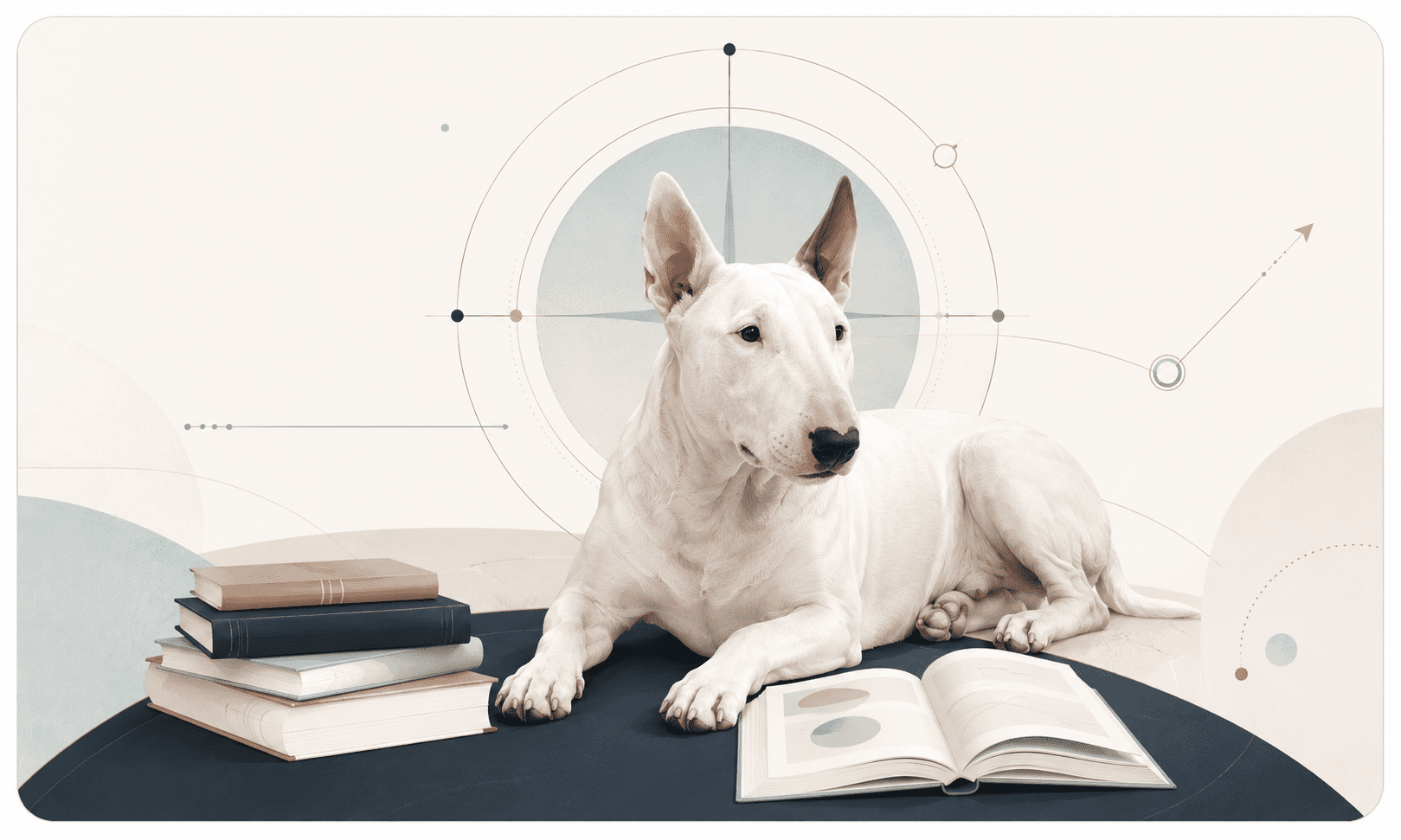






The Bull Terrier Mindset: Why This Breed Feels So Different
There is a moment almost every Bull Terrier owner experiences sooner or later.
At first, you think you brought home a dog. A strong dog, a funny dog, a stubborn dog maybe, but still a dog. Then, slowly, you begin to realize that living with a Bull Terrier is not quite the same as living with most other breeds.
They do not simply enter a room. They make an entrance. They do not casually investigate something. They turn it into a full project. They do not become mildly excited. They explode with enthusiasm. They do not always respond automatically, even when they clearly understand what you asked.
And then there is that look.
The pause. The stare. The moment where your Bull Terrier seems to be thinking, calculating, considering their options before deciding whether your idea is worth agreeing with.
This is where many owners begin to struggle. They describe the dog as stubborn, difficult, dramatic, crazy, too much, or impossible. And from the outside, it can look that way. But once you understand the Bull Terrier mindset, those labels start to feel too simple.
Because Bull Terriers are not random.
They are not difficult for the sake of being difficult.
They are a breed with a very specific way of thinking, feeling, reacting, and interacting with the world. The problem is that many owners try to train the behavior without first understanding the mind behind it. And with this breed, that almost always leads to frustration.
To handle a Bull Terrier well, you need to understand how they process life.
Bull Terriers Are Not Built for Ordinary Expectations
Many people approach Bull Terriers with expectations borrowed from other breeds. They expect quick obedience, easy repetition, soft responses, and a dog that naturally waits for instructions before making decisions.
But Bull Terriers are not built that way.
They are intelligent, intense, physical, emotionally expressive, and highly independent in how they process situations. They don’t blindly follow just because a command was given. They want clarity. They want consistency. They want engagement. And in many cases, they want the situation to make sense to them.
This does not mean they cannot be trained. Quite the opposite. A well-guided Bull Terrier can become focused, cooperative, reliable, and deeply connected to their human. But the path to that result is different.
You cannot treat them like a machine that simply repeats commands. You have to treat them like a thinking dog with drive, personality, and strong opinions about the world.
That is where the work begins.

The First Force: Enthusiasm
The first thing most people notice about Bull Terriers is their enthusiasm.
They do nothing halfway. When they greet, they greet with their whole body. When they play, they commit fully. When they get excited, the excitement can fill the entire room. Even ordinary moments can become big moments in the Bull Terrier mind.
This enthusiasm is part of what makes the breed unforgettable. It is why they make people laugh, why they create such strong emotional bonds, and why life with them rarely feels boring.
But enthusiasm without structure can quickly become chaos.
A Bull Terrier who has never learned how to regulate excitement may jump on people, bark, mouth, spin, pull, rush doors, or lose focus the moment something interesting happens. The owner may look at this and think, “He is just being naughty,” or “She is too hyper.”
But the deeper truth is usually this: the dog has energy, emotion, and drive, but no clear way to organize it.
Enthusiasm is not the enemy. Unstructured enthusiasm is the problem.
The goal is not to remove the Bull Terrier’s spark. That would be a mistake. The goal is to teach the dog how to carry that enthusiasm with control. A balanced Bull Terrier is not a dull dog. A balanced Bull Terrier is a powerful dog who has learned when to switch on, when to pause, and how to remain connected even when excitement rises.
That is not created by accident. It is taught through daily structure, calm leadership, and consistent guidance.
The Second Force: Curiosity
If enthusiasm is the engine, curiosity is the steering wheel that often sends the Bull Terrier straight into trouble.
A Bull Terrier does not simply notice an object. They investigate it. They test it. They interact with it. A shoe is not just a shoe. It is a texture, a smell, a chew project, and possibly a stolen treasure. A cardboard box is not rubbish. It is an activity. A new sound is not background noise. It is something that must be studied immediately.
This curiosity is not a flaw. It is part of the breed’s intelligence and confidence. Bull Terriers want to understand the world physically. They use their nose, mouth, body, paws, and full attention to explore what interests them.
The problem appears when curiosity has no boundaries.
Without guidance, curiosity becomes stealing, chewing, digging, door rushing, fixation, or constant involvement in everything the human is doing. The dog is not necessarily trying to be bad. They are exploring without a system.
This is why management and structure matter so much with Bull Terriers. If you leave them to create their own entertainment, they usually will. And their version of entertainment may not match yours.
A curious Bull Terrier needs appropriate outlets. They need mental work, structured play, clear rules, and enough interaction to satisfy the mind without allowing the dog to turn the house into a personal research laboratory.
Curiosity becomes a strength when it is directed. It becomes a problem when it is left to run the show.
The Third Force: Independent Thinking
This is the part of the Bull Terrier mindset that frustrates many owners the most.
Bull Terriers think.
They pause. They evaluate. They sometimes appear to question the instruction before responding. They may know exactly what you asked and still take a moment to decide whether they are going to do it.
This is where the word “stubborn” gets used far too often.
But stubbornness is usually not the full story. In many cases, what owners call stubbornness is independent thinking combined with unclear communication, low engagement, weak motivation, or inconsistent structure.
A Bull Terrier may pause because the cue was unclear. They may ignore because the environment is more valuable than the owner in that moment. They may delay because past repetition has taught them that the first command does not really matter. They may resist because pressure has replaced communication.
From the human side, it looks like defiance.
From the dog’s side, it is a decision.
This distinction matters because if you label the dog as stubborn, you tend to react emotionally. You repeat yourself. You get frustrated. You raise your voice. You try to force the outcome.
But if you understand that the dog is processing, you approach the situation differently. You become clearer. You build engagement before asking. You reward decisiveness. You reduce unnecessary words. You make the correct choice easier for the dog to make.
That is how independent thinking becomes cooperation.
You do not break the Bull Terrier mind. You guide it.

Why Generic Training Advice Often Fails
A lot of dog training advice sounds good in theory, but fails when applied to Bull Terriers because it only looks at the visible behavior.
The dog pulls, so the advice focuses on the leash. The dog jumps, so the advice focuses on stopping the jump. The dog ignores commands, so the advice focuses on obedience. The dog becomes overexcited, so the advice focuses on draining energy.
But with Bull Terriers, the visible behavior is often only the surface.
Pulling is not only a leash problem. It may be an engagement problem. Jumping is not only a greeting problem. It may be excitement without impulse control. Selective hearing is not only an obedience problem. It may be a decision-making problem. Overexcitement is not only an energy problem. It may be a lack of regulation and structure.
This is why many owners feel stuck. They keep trying to fix one behavior at a time, but the same patterns return in different forms. They stop the jumping, but the dog starts barking. They reduce the pulling, but the dog still fixates. They correct the reaction, but the overexcitement remains.
The reason is simple: the mindset behind the behavior has not changed.
When you understand the Bull Terrier mind, you stop chasing symptoms. You begin looking at the system that is producing them.
That is where real progress starts.
What the Bull Terrier Actually Needs
A Bull Terrier does not need a weak owner, and they do not need a harsh one either. They need a clear one.
This breed responds best to people who provide calm, consistent leadership without turning every moment into a battle. They need a human who understands that affection is important, but affection alone is not enough. They need connection, but they also need boundaries. They need freedom, but only after structure has been built. They need outlets for drive, but those outlets must have rules.
A Bull Terrier needs several things working together:
- A strong bond with the human
- Engagement that makes the dog want to participate
- Clear structure in daily life
- Consistent rules that do not change depending on mood
- Proper outlets for energy, curiosity, and drive
- Calm guidance instead of emotional reactions
- Short, meaningful training that fits the breed’s mind
This is why our approach always comes back to the same foundation: Bond, Engagement, Drive, Focus.
Bond comes first because the dog must trust and value the relationship. Engagement follows because the dog must choose to connect with the human. Drive must then be directed, not suppressed. And focus becomes possible when the first three pieces are in place.
Without that foundation, commands often feel like pressure. With that foundation, training becomes communication.
The Bull Terrier Is Not Trying to Fight You
One of the biggest shifts an owner can make is to stop taking the dog’s behavior personally.
Your Bull Terrier is not chewing something to insult you. They are not jumping to embarrass you. They are not ignoring you because they are plotting against you. They are not being dramatic because they woke up with a plan to ruin your day.
They are responding through the mindset they have, the habits they have practiced, and the structure they have been given.
That does not excuse the behavior. It explains it.
And explanation is not weakness. Explanation is where good training begins.
When you understand the reason behind a behavior, you can guide it properly. When you only react to the behavior, you often make the pattern stronger without realizing it.
This is especially true with Bull Terriers because they learn from patterns very quickly. They notice what works. They notice what gets attention. They notice when the rules change. They notice when the human becomes emotional. They notice when pressure replaces clarity.
They are not random.
They are reading the system.
From Fighting the Dog to Understanding the Dog
The real turning point with a Bull Terrier is not when the dog suddenly becomes easy. It is when the owner starts seeing the dog clearly.
You stop saying, “Why is he doing this to me?” and start asking, “What is this behavior showing me?”
That question changes everything.
If the dog is overexcited, you ask where regulation is missing. If the dog is ignoring, you ask where engagement is weak. If the dog is destructive, you ask where curiosity and drive need better outlets. If the dog is constantly testing limits, you ask whether the rules have been consistent enough to make sense.
This does not mean blaming yourself for everything. It means becoming aware of the system your dog is living inside.
And once you see the system, you can improve it.
That is when the relationship begins to change. The dog becomes easier to understand. The owner becomes calmer and more precise. Training stops feeling like a fight and starts becoming a conversation.
Not always an easy conversation, of course. It is still a Bull Terrier.
But now it makes sense.

The Beauty of the Bull Terrier Mind
The same mindset that creates challenges is also what makes this breed extraordinary.
Their enthusiasm becomes joy when guided. Their curiosity becomes intelligence when directed. Their independent thinking becomes cooperation when the relationship is strong. Their physical intensity becomes confidence when structure is present.
This is why Bull Terriers are not for everyone.
They require patience, humor, consistency, and a willingness to understand the dog behind the behavior. But for the right owner, that is exactly what makes the breed so rewarding.
You are not living with a simple dog. You are living with a personality, a thinker, a clown, an athlete, a shadow, and sometimes a little chaos machine with a heart full of loyalty.
The goal is not to remove that. The goal is to shape it.
Want to Understand Your Bull Terrier on a Deeper Level?
This is exactly what we break down in detail in How to Handle Bull Terrier Quirks Like a Pro.
The guide is built around the Bull Terrier mindset, the patterns behind common quirks, and the practical structure owners need to guide the breed properly. It is not about generic tips or quick fixes. It is about understanding why the behavior happens, what the dog is showing you, and how to handle it with more clarity and confidence.
If you want to stop reacting to the symptoms and start understanding your Bull Terrier properly, you can find the guide here:
https://workingbullterrierskennel.shop/products/how-to-handle-bull-terrier-quirks-like-a-pro
Once you understand the mind, the behavior starts to make sense. And once it makes sense, you can finally guide it properly.


Leave a Reply