





The Moment You Realize Your Bull Terrier Is Thinking… Not Disobeying
There is a moment every Bull Terrier owner experiences, even if they don’t realize it at first.
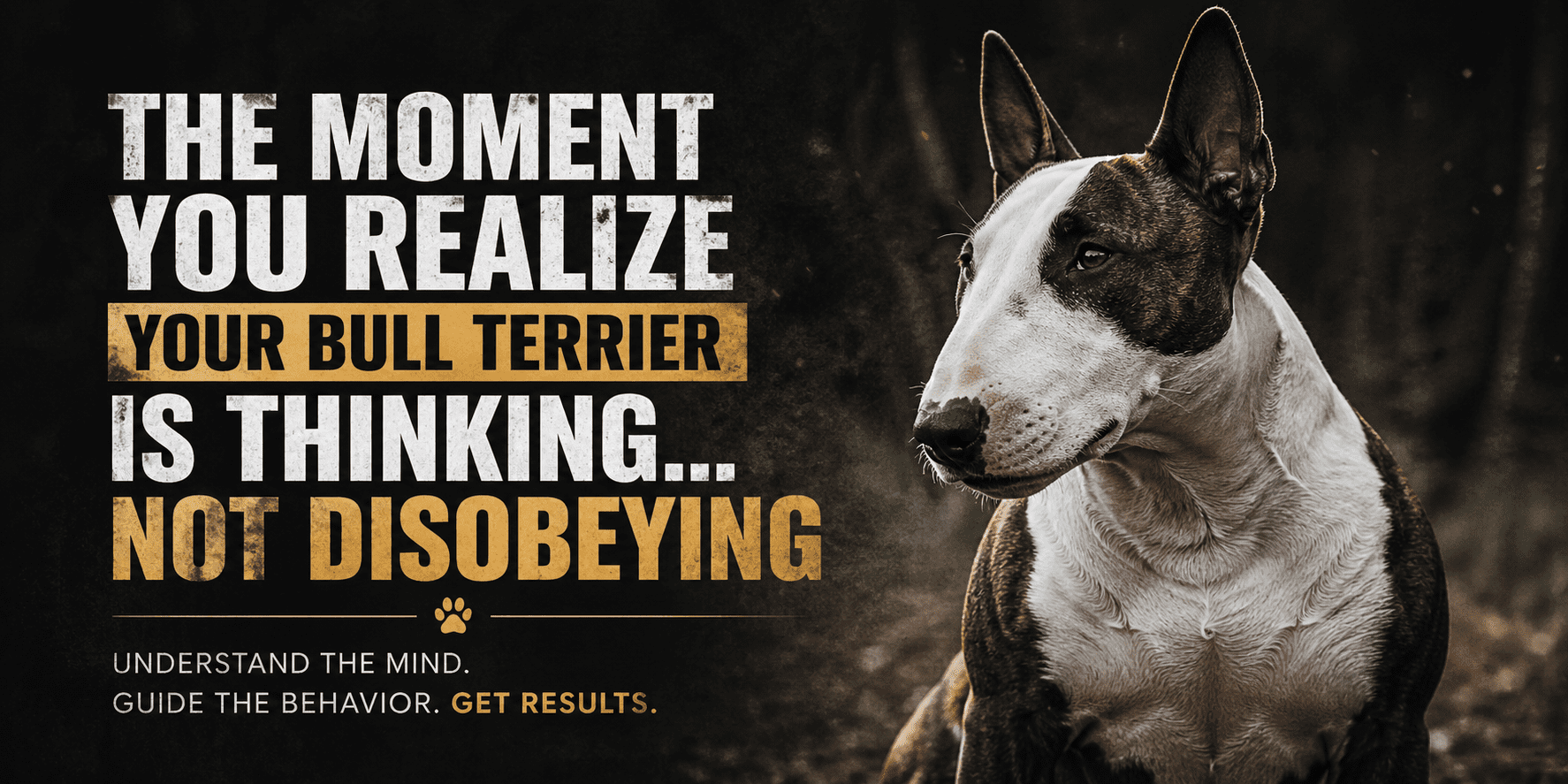
It doesn’t happen during a perfect training session or when everything is going smoothly. It usually happens in the middle of a small, everyday situation. Your dog is about to do something they shouldn’t. You give a command. They stop… just for a second. They look at you.
And in that brief moment, something becomes very clear.
They understood you.
They just haven’t decided yet.
That realization is subtle, but once you notice it, it changes the way you see everything that follows. Because up until that point, most owners believe they are dealing with a simple training issue. The common thoughts are familiar: “My dog is stubborn,” “My dog ignores me,” or “My dog only listens when it feels like it.”
From the outside, that interpretation makes sense. But once you’ve seen that pause—that look, that moment of evaluation—you begin to understand that something deeper is happening. You are not dealing with a dog that doesn’t understand. You are dealing with a dog that is thinking.
This Isn’t Disobedience — It’s How Bull Terriers Work
Bull Terriers do not operate like most breeds, and this is where many owners get stuck. They are not designed for automatic responses or mechanical repetition. They don’t simply follow commands because they have heard them enough times.
Instead, they process.
They observe what is happening around them, they evaluate the situation, and then they make a choice. Sometimes that choice aligns with what you asked. Other times, it doesn’t.
This is why traditional approaches often fall apart. The more you repeat commands without addressing the underlying decision-making, the more the dog disconnects. What starts as a simple delay becomes hesitation, then resistance, and eventually frustration on both sides.
You are no longer guiding your dog. You are negotiating with them.
The Real Issue: Decisions Without Structure
That small pause before your dog acts is not random. It is a decision point.
In that moment, your dog is effectively asking:
- Does this matter?
- Do I need to listen right now?
- What happens if I don’t?
If your dog repeatedly decides against you, the problem is not a lack of understanding. The problem is that nothing in their experience has clearly shown them that choosing you is the better option.
This is where most training approaches miss the mark. People focus on the visible behavior:
- the jumping
- the pulling
- the barking
- the ignoring
But behavior is only the surface. It is the result of a pattern that has been repeated over time. If the pattern doesn’t change, the behavior won’t either.
Why Fixing the Behavior Rarely Works
It is natural to try to correct things as they happen. The dog ignores a command, so you correct it. The dog reacts, so you try to stop it. The dog repeats the behavior, so you increase the intensity.
For a moment, it may seem like progress is being made. But then the same issue appears again, often in the same situations, with the same intensity.
The reason is simple: the decision behind the behavior has not changed.
By the time you react, your dog has already chosen what to do. You are trying to control the outcome without influencing the process that created it. That is why the same patterns keep coming back.
What Actually Changes Everything
The real shift happens when you stop focusing only on behavior and start influencing the decisions that come before it.
This doesn’t require complicated techniques. It requires clarity and consistency in a few key areas:
- Engagement
Your dog needs to see value in staying connected to you, especially when something more interesting is happening around them. - Structure
Clear rules and predictable patterns remove uncertainty. When your dog understands what works and what doesn’t, decisions become easier. - Consistency
Repetition of the right patterns builds stability. Inconsistent guidance creates confusion, and confused dogs make inconsistent choices. - Calm Guidance
Reacting emotionally often adds more energy to the situation. Calm, clear responses help your dog understand rather than react.
Over time, something important happens. The hesitation begins to disappear—not because your dog has stopped thinking, but because they already know the outcome. The decision becomes automatic.
Why Bull Terriers Feel So Different
Many breeds respond well to repetition and routine training methods. Bull Terriers require something more precise. They need clarity, purpose, and a system that makes sense to them.
Without that, owners often experience the same patterns:
- selective listening that seems unpredictable
- bursts of uncontrolled energy
- behaviors that repeat no matter how many times they are corrected
With the right approach, the picture changes completely:
- the dog becomes more focused
- responses become more reliable
- calmness replaces constant intensity
- communication becomes clearer on both sides
It is not a different dog. It is a different level of understanding.
From Frustration to Clarity
At some point, almost every Bull Terrier owner thinks the same thing: “He knows what I’m asking… he just doesn’t do it.”
And in a way, that’s true.
The understanding is there. What’s missing is guidance that shapes how decisions are made. Once that piece falls into place, the relationship changes. The constant back-and-forth disappears, and training becomes something much more natural.
Instead of trying to control every moment, you begin to guide the patterns behind them.
If This Feels Familiar
If you recognize your own dog in these situations, you are not alone. More importantly, you are not stuck.
This way of thinking—understanding the decisions behind behavior—is exactly what we break down in detail in our guide:
How to Handle Bull Terrier Quirks Like a Pro
Inside, we go deeper into:
- why these patterns form in the first place
- what most owners unintentionally reinforce
- how to guide behavior without constant correction
- how to build structure, calmness, and real engagement step by step
It’s not a collection of tips. It’s a system built from real experience with Bull Terriers and the patterns we see every day.
If you want to explore it further, you can find it here:

https://workingbullterrierskennel.shop/products/how-to-handle-bull-terrier-quirks-like-a-pro
Take your time with it.
And if you start noticing that pause… that look… and understanding it differently, you’re already moving in the right direction.


Leave a Reply