





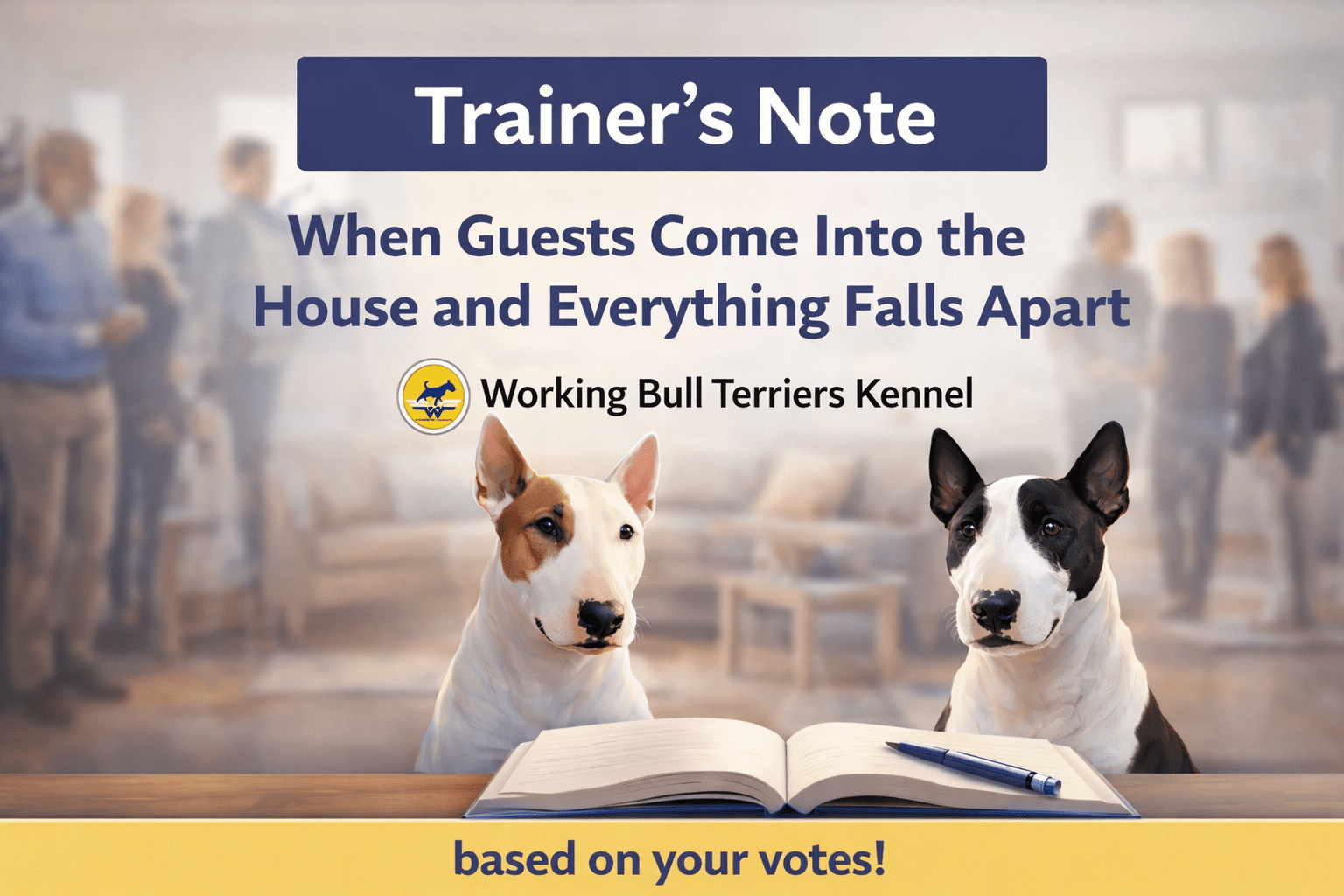
Trainer’s Note
When Guests Come Into the House and Everything Falls Apart
Before we begin, one important thing:
This article exists because you voted.
When we asked Bull Terrier owners which behaviour affects their daily life the most, “guests in the house = chaos” stood out clearly. That told us something important — this isn’t a rare issue, and it isn’t about bad dogs or careless owners. It’s a shared experience.
So this Trainer’s Note is written directly in response to that vote.
The moment everything changes
Many Bull Terrier owners describe the same situation.
The dog is fine:
* with family
* during training
* on calm days at home
Then a guest arrives.
Suddenly the behaviour shifts:
* barking
* jumping
* blocking people’s movement
* over-excitement
* inability to settle
* intensity that feels out of proportion
Often, the end result is the same:
“We just crate him when people come over.”
This article is not here to judge that decision. It’s here to explain why this pattern happens so often — and why it’s so misunderstood.
Let’s clear up a few myths first.
This behaviour is not:
* dominance
* stubbornness
* lack of respect
* a failure of early socialisation
* a simple obedience problem
And it is rarely resolved by:
* neutering
* firmer corrections
* more exercise
* repeating commands louder
If those things worked consistently, this wouldn’t have won the vote . But it did.
Why guests are such a powerful trigger for Bull Terriers
Bull Terriers are not neutral house dogs.
They are:
* extremely people-oriented
* sensitive to movement and energy
* physically confident
* emotionally expressive
* fast to escalate internally
When a guest enters the home, the dog is suddenly dealing with:
* unfamiliar scent
* unfamiliar body language
* unpredictable movement
* change in routine
* social pressure inside their own space
This is very different from seeing people at a distance or passing strangers on a walk. It’s direct social pressure in a familiar environment — and for many Bull Terriers, that overwhelms their ability to self-regulate.
“But he’s fine in public… even in crowds” This confuses many owners.
How can a dog behave better:
* in busy places
* around many people
* in noisy environments
…but struggle badly at home?
Because crowds are impersonal.
Guests are personal.
In public:
* people don’t focus on the dog
* movement is predictable
* space is open
At home:
* attention is directed at the dog
* movement happens close
* expectations rise
* pressure increases
Different environment. Different internal state. Same dog.
Why crating becomes the default solution
Most owners don’t crate because they want to.
They crate because:
* guests are uncomfortable
* the dog won’t settle
* safety feels uncertain
* nothing else has worked
Crating becomes management, not training. And management is not failure.
But management alone doesn’t teach the dog:
* how to exist calmly around people
* what behaviour is expected
* how to regulate themselves under pressure
So when the crate opens, the pattern returns.
Why neutering often changes nothing
This is one of the most discouraging moments for owners.
They’re told:
“Castration should help.”
They do it.
They wait.
Nothing changes. That’s because guest-related reactivity is rarely hormone-driven.
It’s:
* emotional
* state-based
* reinforced through repetition
* linked to arousal, not testosterone
Neutering may be the right choice for other reasons — but it doesn’t teach regulation.
And regulation is the missing piece here. “He knows better… he just won’t do it” This sentence comes up again and again. But dogs don’t choose behaviour the way humans do. They access behaviour based on state.
A Bull Terrier in a calm state can:
* sit
* down
* stay
* settle
The same dog in a high-arousal state:
* loses access to those behaviours
* reacts faster than they can think
* feels compelled to act
Nothing was forgotten. Nothing was ignored out of spite. Access was lost. The real pattern behind “guests = chaos” When you step back, the pattern becomes clear.
This issue is about:
* lack of trained default behaviour under social pressure
* lack of emotional regulation in familiar spaces
* no clear role for the dog when stimulation increases
It’s not about control. It’s not about dominance. And it’s not about tiring the dog out. It’s about structure before stimulation.
Why this affects people so deeply
This isn’t just a training frustration.
It affects:
* social life
* confidence
* relationships
* stress levels
* quality of life
Owners stop inviting people over. They feel embarrassed. They feel judged. They feel stuck.
And many quietly accept:
“This is just how my dog is.”
It doesn’t have to be. But understanding must come before intervention.
A final Trainer’s Note
If your Bull Terrier struggles when guests come into the house, it does not mean:
* you failed
* your dog is broken
* the situation is hopeless
It means your dog is responding honestly to a situation they were never taught how to handle. That’s not a character flaw. It’s a training gap. And it’s exactly why this topic won the vote.
Want to go deeper?
This article focuses on understanding first — because without understanding, no method works.

For owners who want structured guidance beyond articles, our Triple Pack goes deeper into:
* understanding your Bull Terrier’s internal state
* why behaviour changes under pressure
* and how structure influences behaviour before any correction or technique
It’s not a quick fix, and it’s not for everyone. But for owners who want a deeper framework, it’s there.
https://workingbullterrierskennel.shop


Leave a Reply