





The Hidden Reason Calmness Often Turns Into More Chaos
There is a moment almost every Bull Terrier owner knows very well. The dog is already excited. Maybe visitors have just arrived. Maybe another dog has appeared outside. Maybe the lead came out. Maybe food is being prepared. Or maybe, for reasons known only to the Bull Terrier mind, 8:13 PM suddenly became the perfect time to sprint through the house like a tiny rhinoceros who has discovered caffeine.
The owner naturally tries to calm the situation. They say, “Relax,” “Calm down,” “Stop,” “No,” or “It’s okay.” Their voice becomes more active. Their hands become more active. Their body language changes. Their emotional energy enters the room more strongly.
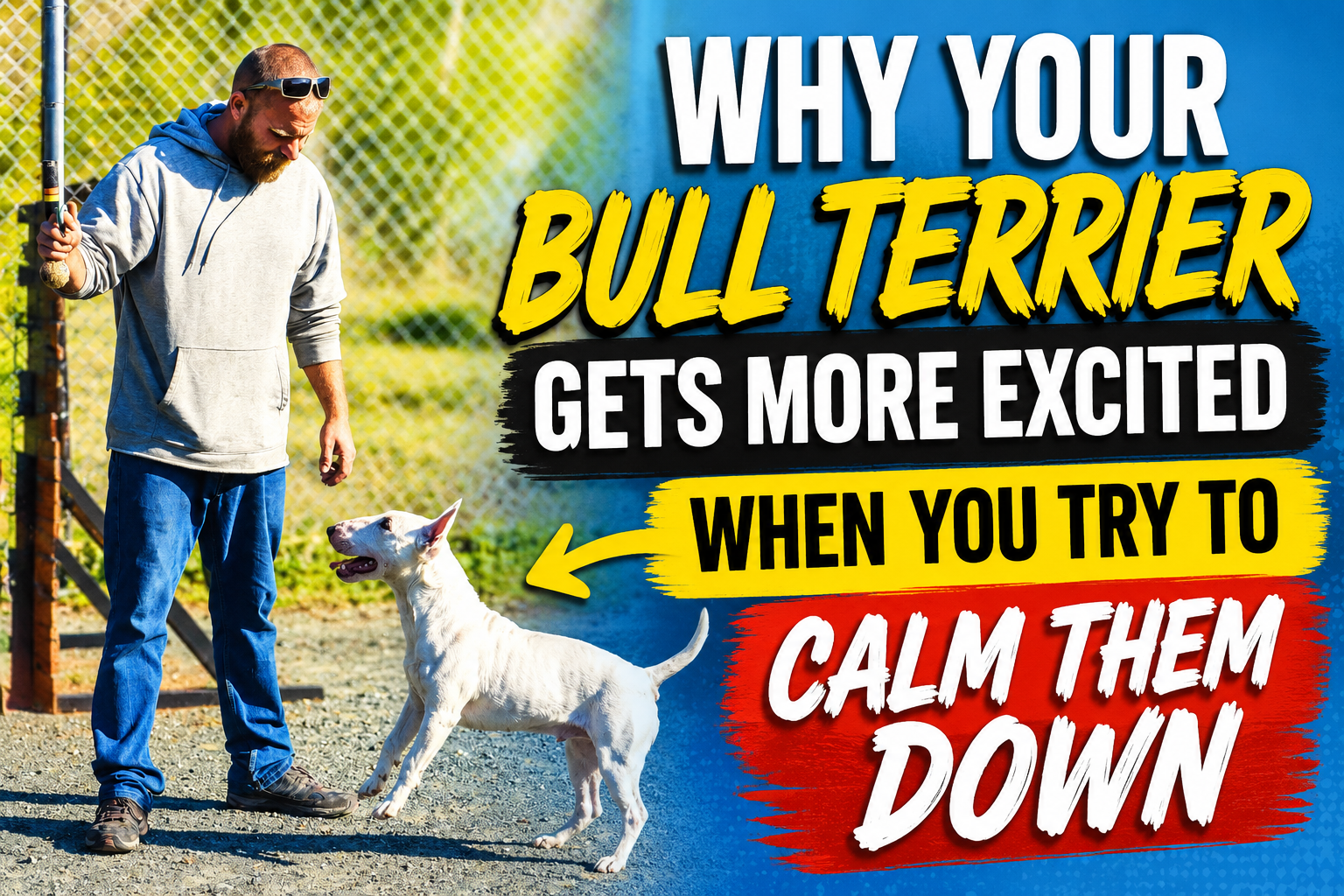
And somehow, instead of settling, the Bull Terrier becomes even more excited. There is more jumping, more barking, more spinning, more intensity, and more emotional chaos.
At first, this feels completely irrational. The owner is trying to reduce the excitement, not increase it. But from the dog’s perspective, something very different may be happening. In many cases, the owner is not actually calming the nervous system. They are adding stimulation to it.
When a Bull Terrier gets more excited instead of calming down, it usually means the owner’s timing, energy, or response is accidentally adding more fuel to the behavior.
Excitement and Attention Are Deeply Connected
Bull Terriers are highly social, emotionally expressive dogs. They pay close attention to movement, tone of voice, facial expression, posture, and changes in human energy. This is one of the reasons they can feel so connected to their people. It is also one of the reasons they can become emotionally amplified so quickly.
When owners attempt to calm an already excited Bull Terrier, they often unknowingly become more animated themselves. The voice changes, the body posture changes, the pace changes, and the emotional intensity in the room changes. From a human perspective, this feels like intervention. From the dog’s perspective, it may feel like participation.
This distinction is extremely important. A Bull Terrier does not always separate “calming attention” from “engaging attention.” In fact, many dogs experience both as stimulation. The owner is now speaking more, moving more, reacting more, and investing more emotional energy into the moment. For a dog who is already aroused, that additional energy can act like fuel.
This is one reason some Bull Terriers appear to become more excited when the owner starts talking rapidly, repeating commands, waving hands around, or emotionally pleading for calmness. The dog is not necessarily refusing to settle. Very often, the dog’s nervous system is becoming even more activated.
Calmness Is Not Created Through More Noise
One of the biggest misunderstandings in dog training is the belief that calmness can be verbally pushed into existence. Owners often assume that if they keep repeating calming words, the dog will eventually absorb the emotional message behind them.
But dogs do not process emotional language the way humans do. A Bull Terrier does not hear, “Please regulate your emotional state because guests have arrived and social harmony is important.” What the dog often experiences is much simpler: the human is suddenly very engaged.
This is why repeating commands during high arousal often becomes counterproductive. The owner keeps talking because the dog is not calming down, and the dog keeps escalating because the owner’s growing involvement is increasing the intensity of the moment. Without realizing it, the owner and the dog begin feeding each other’s energy.
The more excited the dog becomes, the more emotional the owner becomes. The more emotional the owner becomes, the more stimulated the dog becomes. Suddenly, everyone in the room is participating in the same nervous system spiral.
Bull Terriers Are Particularly Sensitive to Emotional Momentum
Every breed has its own emotional rhythm. Bull Terriers are often intense, expressive, persistent, physical, and highly responsive to interaction. Many of them do not experience excitement in small, moderate waves. They experience it like a chain reaction.
Once momentum begins building, the whole body joins the event. The bouncing, the vocalizing, the spinning, the inability to disengage, and the inability to settle even after the original trigger disappears can all become part of the same emotional wave.
This is why many Bull Terrier owners feel as though their dog struggles to “switch off.” The problem is not always a lack of obedience. Very often, it is a nervous system that has not yet learned how to transition smoothly from high arousal back into regulation.
That distinction matters because obedience and regulation are not the same thing. A dog may know commands perfectly and still struggle emotionally. A dog may understand “sit,” “down,” or “leave it,” but still be internally overloaded. The command may exist in the dog’s learning history, but the emotional state may be too high for the dog to access that learning clearly.
Why Repeating Commands Often Makes Things Worse
One of the most common patterns owners develop is repeated verbal correction during excitement. They say “Stop,” “No,” “Down,” “Leave it,” “Relax,” and “Calm down” again and again. At first, this feels productive because the owner feels involved. Silence can feel passive, and humans naturally want to intervene when chaos appears.
But dogs learn through patterns. If commands are repeated over and over during moments of emotional overload, two things often happen.
First, the commands begin losing meaning. The dog hears the words repeatedly without truly processing them or successfully responding to them. Over time, the words become background noise rather than clear information.
Second, the owner’s constant verbal engagement becomes part of the stimulation itself. The dog is no longer simply excited about the original trigger. Now the owner’s energy has entered the loop too.
This is why experienced trainers often appear calmer during chaotic moments. They are not being passive. They are avoiding adding unnecessary stimulation to an already overloaded nervous system. Calm leadership is often quiet, not because words are useless, but because timing matters.

The Difference Between Suppression and Regulation
Many owners accidentally aim for suppression instead of regulation. They want the outward behaviour to stop immediately, so they attempt to interrupt every expression of excitement the moment it appears. This is understandable, especially when the dog is jumping, barking, pulling, spinning, or becoming difficult to manage.
But emotional regulation is not built through panic. If the dog never learns how to settle internally, the excitement simply goes underground or explodes somewhere else later. This is why some dogs appear calm for a moment and then suddenly erupt again seconds later. The nervous system never truly recovered. The behaviour was briefly interrupted, but the emotional state remained unchanged.
True calmness is not just the absence of movement. True calmness is the ability to recover. A regulated dog can transition from excitement back into stability without needing emotional conflict, constant commands, or physical exhaustion.
That recovery process is a skill. Like every skill, it has to be developed gradually.
Why Physical Exhaustion Alone Does Not Solve This
Many owners respond to overexcitement by increasing physical exercise. Sometimes this helps temporarily, but sometimes it creates a more conditioned athlete instead of a calmer dog. This is especially true with Bull Terriers.
A dog who only learns intensity often becomes extremely good at intensity. The nervous system adapts, the body adapts, and the excitement threshold shifts higher. Soon the owner feels trapped in an exhausting cycle: more stimulation, more exercise, more excitement, and more difficulty settling.
Physical outlets are important. Bull Terriers need movement, engagement, and opportunities to use their energy properly. But if the dog never practices calm transitions, recovery, frustration tolerance, and emotional disengagement, exercise alone cannot create balance.
A dog can be physically tired and still emotionally dysregulated. Many owners discover this the hard way after watching an exhausted Bull Terrier continue zooming around the house with the emotional control of a drunken Olympic gymnast.
Calmness Must Be Practiced, Not Demanded
One of the biggest mindset shifts for owners is understanding that calmness is not simply a personality trait. Calmness is a skill, and skills require repetition.
Many dogs spend large portions of their lives practicing excitement. They practice excitement before walks, before food, during play, when visitors arrive, when the owner returns home, during training, during frustration, and during everyday household activity. Very few dogs spend equal time practicing calm transitions.
This is one reason structured routines matter so much. Predictable transitions help the nervous system understand when energy rises and when energy comes back down.
A Bull Terrier who learns, “Now we engage,” “Now we settle,” “Now we play,” and “Now we recover,” usually becomes far easier to live with than a dog who experiences endless emotional acceleration without clear endings.
The goal is not to remove the Bull Terrier’s personality. That would be impossible, and honestly, it would also remove much of what makes the breed so entertaining and lovable. The goal is to teach the dog how to move between emotional states without getting trapped in the highest gear.
Why Owners Often Accidentally Reward Excitement
Excited behaviour frequently earns enormous amounts of attention. Owners speak more, touch more, react more, negotiate more, chase more, and sometimes even laugh more. From the dog’s perspective, excitement can become socially powerful.
This does not mean owners should become cold, robotic, or emotionally distant. Relationship matters deeply, especially with Bull Terriers. But it does mean that timing matters.
If calm behaviour receives very little engagement while chaotic behaviour receives constant interaction, the nervous system naturally begins valuing excitement more heavily. Dogs repeat behaviours that work, and Bull Terriers are especially good at repeating behaviours that successfully pull the human into the game.
This is why owners need to become more aware of what their attention is actually reinforcing. Sometimes the dog is not being difficult on purpose. Sometimes the dog has simply learned that intensity creates interaction.
The Power of Calm Presence
One of the most effective things an owner can develop is calm presence. Not fake calmness. Not suppression. Not robotic behaviour. Real emotional steadiness.
A calm owner creates a different emotional environment. The dog begins learning that excitement does not automatically produce emotional explosions from the human side. The owner does not need to compete with the dog’s intensity. The owner needs to become the point of stability inside the moment.
This is why experienced handlers often seem almost boring during moments that overwhelm less experienced owners. They are not ignoring the dog. They are reducing unnecessary emotional fuel.
The calmer the human nervous system becomes, the easier it often becomes for the dog’s nervous system to recover too. This is not magic. It is emotional influence.

Teaching the Nervous System to Recover
The goal is not to eliminate excitement completely. Bull Terriers are joyful, expressive dogs. Their enthusiasm is part of what makes the breed special. A Bull Terrier without personality would not be a Bull Terrier.
The real goal is recovery. Can the dog return to calmness after excitement? Can the dog disengage? Can the dog settle without emotional conflict? Can the dog transition smoothly between states? Can the dog remain connected to the owner without needing constant chaos to feel engaged?
These questions matter far more than whether the dog can perform commands in isolation. A dog who can emotionally recover is often far more stable than a dog who simply obeys while remaining internally overwhelmed.
This is where true training becomes deeper than obedience. It becomes emotional education. It becomes nervous system education. It becomes teaching the dog not only what to do, but how to come back down after life becomes exciting.
Final Thoughts
Many Bull Terrier owners are not accidentally rewarding overexcitement because they are careless. They are doing it because they care. They want to calm the dog, help the dog, regain control of the situation, and bring peace back into the room.
But sometimes, the very energy used to calm the dog becomes part of the stimulation keeping the dog excited.
This is why emotional regulation matters so much in training. Calmness is not created through louder voices, faster reactions, emotional pleading, or endless correction. Very often, calmness is created through clarity, predictable structure, calm presence, thoughtful timing, and teaching the nervous system how to recover instead of endlessly accelerating.
Once a Bull Terrier learns that skill, life with the breed becomes dramatically different. The dog is still expressive. The dog is still funny. The dog is still full of personality. But there is now a path back down.
And with Bull Terriers, that path back down is often the difference between living with chaos and living with a dog who can finally understand how to settle.

In How To Train Your Bull Terrier — Step by Step, we go deeper into arousal, emotional regulation, engagement, calmness, timing, and how to build a dog who can not only perform behaviours, but emotionally recover and function clearly in real life.
The guide is available on its own, and it is also part of our Triple Pack, which combines training, behaviour understanding, everyday Bull Terrier life, and bonus material designed to help owners apply these concepts beyond simple obedience.
Because with Bull Terriers, understanding the nervous system often changes more than another command ever will.
Related reading: If your Bull Terrier also pushes limits, read Why Your Bull Terrier Pushes Boundaries.


Leave a Reply