






Why Does My Bull Terrier Ignore Me Outside?
It usually starts the same way.
At home, things feel easy. Your Bull Terrier responds, follows you around, and often checks in with you without being asked. There’s a sense of connection that makes everything feel under control.
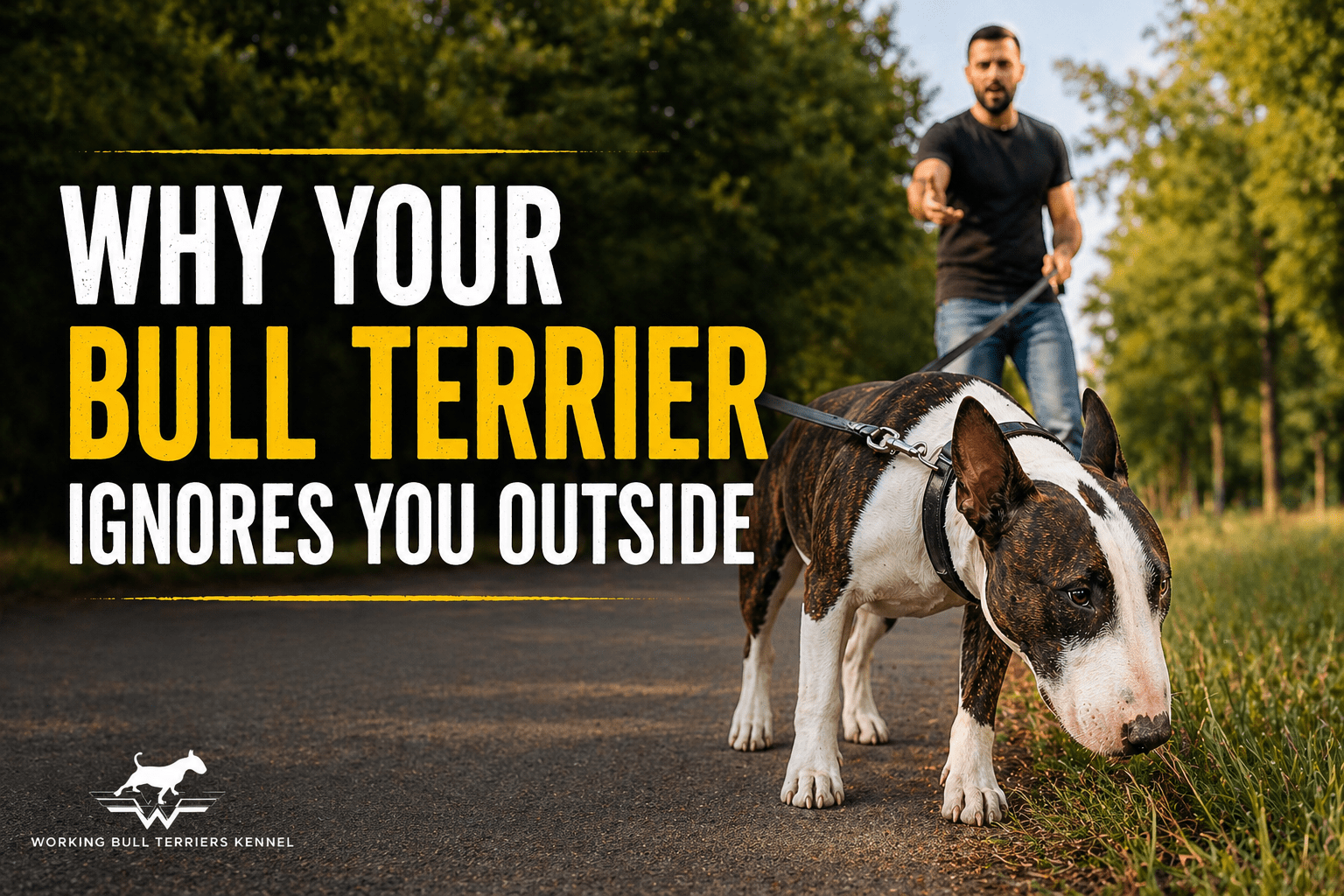
Then you step outside. And almost instantly, that connection fades. You call your dog’s name once… nothing. You call again… still nothing. Now you’re louder, more insistent, maybe even a little frustrated. And somewhere in that moment, the thought forms:
“My Bull Terrier is ignoring me outside.”
What’s really happening when your Bull Terrier ignores you outside
Your Bull Terrier isn’t ignoring you. In most cases, your dog is choosing the environment over you because it has more value in that moment.
Outside, everything changes:
- The ground is full of scent information
- Sounds are unpredictable
- Movement is constant
- New opportunities appear every second
To your dog, this isn’t background noise it’s highly engaging. So when your Bull Terrier doesn’t listen outside or seems to lose focus on walks, it’s not a lack of intelligence or respect. It’s a decision.
Why your dog listens at home but not outside
At home, the environment is familiar and low in distraction. There are fewer competing stimuli, which makes it easier for your dog to focus on you. You naturally become the most relevant point of interest. Outside, that balance shifts.
Now your dog is processing:
- Smells from other dogs
- Distant sounds
- Visual movement
- Environmental changes
If you haven’t built enough engagement in that setting, your dog will default to what feels most rewarding. That’s why many owners say their dog is “perfect at home but ignores commands outside.”

Why trying to fix it during the walk doesn’t work
This is where most people get stuck. When their dog ignores them outside, they try to fix it in the moment:
- Repeating commands
- Raising their voice
- Tightening the leash
- Trying to interrupt the behavior
Sometimes it works briefly. But it doesn’t hold. Because by that point, your dog is already fully engaged with the environment. You’re not building focus you’re trying to take it back. And that’s much harder.
The part most owners never build
The real change doesn’t happen during the distraction. It happens before it. What needs to be developed is not control in the moment, but connection that carries into that moment.
That includes:
- Engagement — your dog choosing to pay attention to you
- Focus — the ability to stay connected for short periods, even with mild distractions
- Value — you becoming relevant in environments where distractions exist
When those are missing, the outside world will almost always win.
Why your Bull Terrier loses focus on walks
If your dog ignores you on walks, it’s usually not random. It’s predictable.
Your dog is responding to:
- What has been reinforced
- What feels rewarding
- What has meaning in that environment
If the environment consistently offers more stimulation than you do, your dog will keep choosing it. This is especially true for Bull Terriers, who are naturally curious, driven, and highly engaged with their surroundings.
Quick breakdown: why your Bull Terrier ignores you outside
- The environment has higher value
- Engagement hasn’t been built outside
- Focus hasn’t been trained under distraction
- You’re trying to fix it after it starts
A different way to look at it
Instead of asking:
“How do I make my dog listen outside?”
It’s more useful to ask:
“Why would my dog choose me in that situation?”
Not emotionally — practically.
What do you represent in that moment?
Are you clear, consistent, and engaging? Or do you only become relevant when you’re asking for something?
Dogs respond to patterns and outcomes. Once that becomes clear, their behavior becomes easier to understand — and easier to change.
Bull Terriers, in particular, don’t respond well to mechanical repetition. They think, they assess, and they engage when something makes sense to them.
That’s what makes them challenging for some owners — and incredibly rewarding for those who understand how to work with them.
If this feels familiar, you’re not alone. Many owners experience the same thing when their dog moves from a controlled environment into a more stimulating one.
And it’s also one of the areas where a small shift in approach can make a noticeable difference over time.
If you want to go deeper into how to build real engagement, focus, and control step by step, it’s something we’ve structured clearly inside our training guide designed specifically for Bull Terriers, not generic dog training.


Leave a Reply