
Bull Terrier Health, Skin Comfort & Seasonal Management
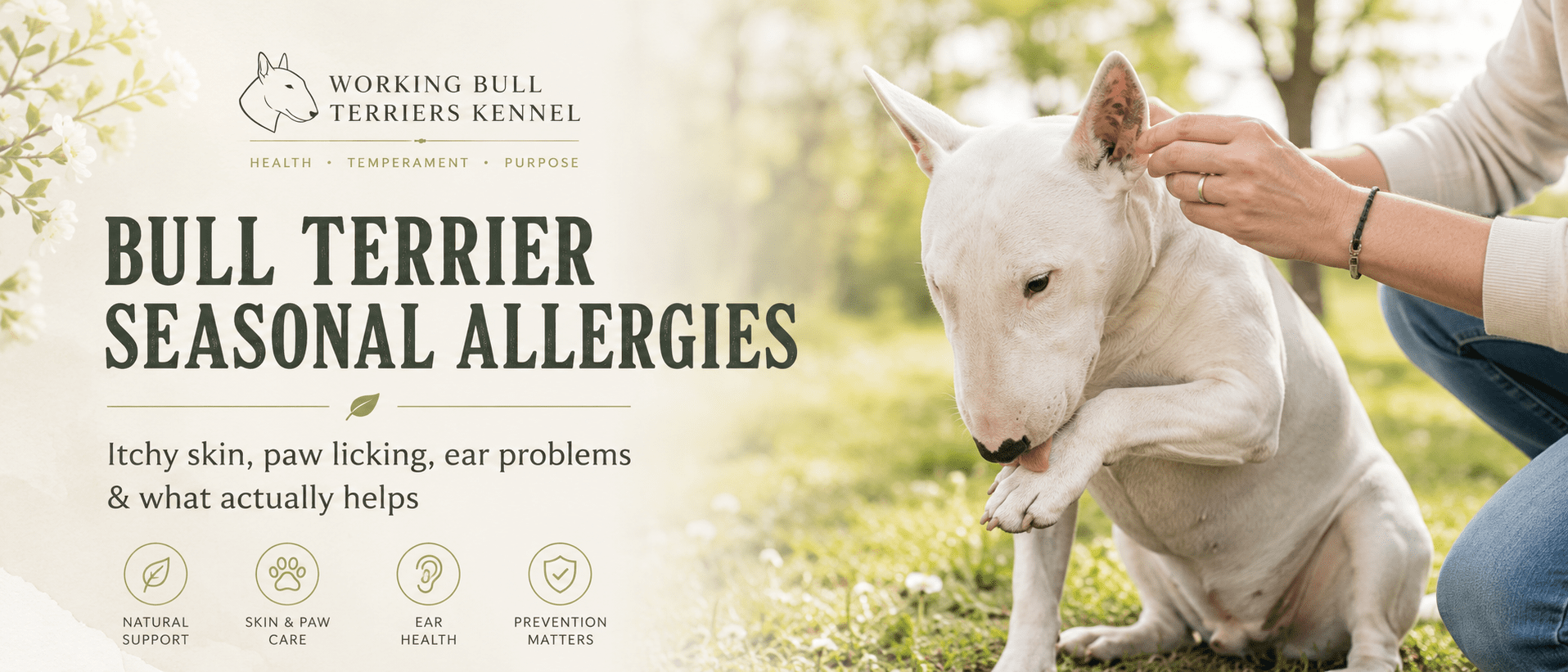
Bull Terrier Seasonal Allergies: Itchy Skin, Paw Licking, Ear Problems and What Actually Helps
Bull Terrier seasonal allergies can turn a comfortable dog into an itchy, restless, frustrated dog very quickly. Paw licking, red feet, face rubbing, ear scratching, head shaking, irritated bellies, hot spots, chewing, yeast smell, and poor sleep are all signs owners may begin to notice more often in spring and summer.
Over the last few weeks, several of our online students have mentioned the same pattern again: dogs becoming itchy, uncomfortable, and harder to settle as the season changes. At the same time, more Bull Terrier owners in online groups are asking about red paws, licking, ears, rubbing, and dogs suddenly looking uncomfortable after grass, heat, pollen, or outdoor exposure.
We understand it because this is not only something you read about. When you live with the breed for years, and when you live with several dogs, you see the seasonal pattern. You notice how quickly skin discomfort can affect sleep, mood, tolerance, focus, and behaviour. You also learn very quickly that allergies are not solved by one spoon of honey, one supplement, one shampoo, or one trick from a comment section.
But there are things that genuinely help when they are used intelligently.
Bull Terrier seasonal allergies often show through the skin rather than only through sneezing. Common signs include paw licking, red feet, face rubbing, ear scratching, head shaking, itchy belly, chewing, hot spots, yeast smell, restless sleep, and sudden irritability. The best approach is to reduce the total allergy load: control fleas, rinse paws and belly after exposure, keep bedding clean, support the skin barrier, use appropriate bathing, consider omega-3 and probiotic support when suitable, and involve your veterinarian early when there are infections, painful ears, wounds, severe itching, or recurring flares.
Responsible health note: This article is educational and based on breed experience and general allergy-management principles. It does not replace veterinary diagnosis or treatment. If your Bull Terrier has open wounds, painful ears, strong smell, swelling, bleeding, severe itching, hair loss, hot spots, discharge, or repeated infections, speak with your vet.
Bull Terrier Seasonal Allergies Are Not Always Obvious
When people think about allergies, they often think of sneezing, watery eyes, blocked nose, and hay fever. Dogs can show respiratory signs too, but very often allergic disease in dogs shows up through the skin.
That is why many owners miss the early stage. They may think the dog is being annoying, obsessive, dirty, bored, stubborn, or “just licking again.” Underneath the behaviour, the dog may be itchy, irritated, inflamed, or already developing a secondary skin or ear problem.
In Bull Terriers, this can be especially frustrating because the breed can be intense, physical, persistent, and dramatic in how it responds to discomfort. A Bull Terrier with itchy paws may not lick once and move on. He may chew, obsess, rub, roll, scratch, pace, become frustrated, and struggle to settle.
Then the owner asks, “Why is my dog suddenly behaving badly?”
Sometimes the answer is not obedience. Sometimes the dog is uncomfortable.
Common Signs of Seasonal Allergies in Bull Terriers
Seasonal allergies can show differently from dog to dog, but many owners notice the same areas again and again: paws, ears, belly, groin, armpits, face, and skin folds.
- Licking, chewing, or biting the paws.
- Red, inflamed, swollen, or stained feet.
- Rubbing the face on carpets, furniture, grass, bedding, or people.
- Scratching the ears or shaking the head.
- Recurring ear smell, redness, wax, discharge, or sensitivity.
- Red belly, groin, armpits, inner thighs, or skin folds.
- Chewing the legs, sides, tail base, or belly.
- Brown staining on the paws from saliva.
- Hot spots, scabs, hair thinning, or irritated patches.
- Yeasty smell, greasy skin, thickened skin, or recurring skin infections.
- Restless sleep, pacing, irritability, lower tolerance, or poor focus.
Breed reality: Bull Terriers often make discomfort very visible. What looks like stubbornness, obsession, or “bad behaviour” may sometimes be the dog trying to cope with itching, ear pain, skin irritation, or poor sleep.
Why Spring and Summer Can Be Difficult
Seasonal flare-ups often become more obvious in spring and summer because the dog is exposed to more environmental triggers and the skin is dealing with more pressure.
Possible seasonal triggers and flare factors include:
- Grass pollen, tree pollen, weed pollen, dust, and mould spores.
- More rolling, lying, training, walking, and playing on grass or soil.
- Heat, humidity, sweating through the paws, and moisture trapped on the skin.
- Insects and flea exposure, even when fleas are not obvious.
- More bathing mistakes, harsh shampoos, or over-cleaning that strips the skin.
- More outdoor particles being carried into beds, sofas, crates, and sleeping areas.
The important point is that allergy problems often stack. Many owners look for one cause. They ask, “Is it food?” “Is it grass?” “Is it pollen?” “Is it fleas?” Sometimes there is one main trigger. But often several things are pushing the dog at the same time.
Your dog may tolerate a little pollen. He may tolerate some grass exposure. He may tolerate mild yeast on the skin. He may tolerate heat. He may tolerate one flea bite better in winter. But when pollen, grass, heat, fleas, weak skin barrier, yeast, and stress all stack together, the bucket overflows.
That is when the dog suddenly licks paws all night, rubs the face, scratches ears, chews the belly, and becomes restless.
The goal is not to find one magic cure. The goal is to reduce the total allergy load on the dog.
The Big Mistake: Waiting Until the Dog Is Already in a Flare
One of the biggest mistakes owners make is waiting until the Bull Terrier is already red, raw, itchy, infected, and unable to sleep before they start doing anything.
By that point, the problem is harder. The skin is inflamed. The dog has been licking. The paws may be irritated. The ears may already be infected. Yeast or bacteria may be involved. The dog may be sleeping badly. Behaviour may already be affected.
This is why preparation matters. If your dog has a known pattern of spring or summer allergies, do not wait until he is suffering. Start reducing the load before the season becomes difficult.
Support does not mean you can stop every flare. It means you give the dog a better chance of staying comfortable and you catch problems earlier.
If your Bull Terrier suddenly becomes restless, irritable, reactive, less tolerant, harder to handle, or unable to settle during allergy season, do not only ask how to correct the behaviour. Ask whether the dog is itchy, inflamed, sore, or sleeping badly.
What Actually Helps Bull Terrier Seasonal Allergies?
Seasonal allergy management is not one trick. It is a layered plan. The best results usually come from combining several sensible steps rather than hoping one supplement or one wash will fix everything.
A Bull Terrier walks through grass, soil, pollen, dust, weeds, and outdoor particles, then comes inside and brings those irritants onto the bed, sofa, crate, and skin.
During allergy season, many dogs benefit from paw wiping, paw rinsing, belly rinsing, face wiping after heavy grass exposure, and more frequent bedding hygiene. This is simple, but it can make a real difference because it reduces what sits on the skin for hours.
Bathing can help remove allergens from the coat and support comfort, but the product matters. Human shampoos, harsh products, heavy perfumes, or random strong washes can make irritated skin worse.
For many allergy-prone dogs, a gentle dog-appropriate shampoo used consistently during the season can help. If there is yeast, bacteria, greasy skin, strong smell, or repeated infection, your vet may recommend a medicated shampoo or specific topical treatment.
Many owners say, “My dog does not have fleas.” But allergy-prone dogs cannot afford even small flea exposure. You may not see fleas, and fleas may still be part of the flare pressure.
Flea control does not mean every itchy Bull Terrier has fleas. It means fleas are a major extra trigger that should not be ignored in an allergy-prone dog. Removing extra triggers is part of reducing the total load.
Allergic skin is often not only reactive. It may also be easier to irritate. Once the dog starts licking and scratching, the skin becomes more damaged, and damaged skin becomes easier for yeast and bacteria to colonise.
Skin barrier support can include omega-3 support where appropriate, gentle bathing, avoiding harsh products, bedding hygiene, flea control, early infection treatment, and reducing allergen load after outdoor exposure.
Omega-3 support is one of the more sensible supplement layers for seasonal skin support, especially when started early and used consistently. The important omega-3 fatty acids are EPA and DHA.
This is not an instant itch-stopper. It is background support for skin and inflammatory balance. If your dog usually flares in spring or summer, starting before the flare period often makes more sense than starting only when the paws are already raw.
Probiotics are not magic, but they may be a useful support layer for some dogs, especially those with gut sensitivity, soft stool, antibiotic history, food sensitivity signs, or recurring inflammatory skin issues.
If you use a probiotic, think in terms of a proper trial, not five random days. Use a dog-specific probiotic with named strains where possible. Yogurt is food. A good probiotic supplement is more controlled.
Local Honey for Dog Allergies: Mostly Myth, Not a Real Plan
Many owners have heard that local honey can help seasonal allergies because it may contain tiny amounts of local pollen. The idea sounds logical, but it is not something we would rely on for a Bull Terrier allergy plan.
The pollen in honey is not controlled. You do not know what pollen is present, how much is present, or whether it matches your dog’s real allergy triggers. Many seasonal reactions involve windborne pollens from grasses, weeds, and trees, while bees often collect from flowering plants. That means honey may not match the problem.
Veterinary allergy immunotherapy is different. It is controlled, targeted, and guided by testing and veterinary decision-making. Honey is not immunotherapy.
A tiny amount of honey may be safe for some healthy adult dogs as an occasional treat, but it is still sugar. It should not be treated as allergy treatment, and it is not suitable for every dog, especially puppies, diabetic dogs, overweight dogs, or dogs with compromised immune systems.
Our honest view: honey is not the solution. If you want to give a healthy adult dog a tiny amount occasionally as a treat, that is one thing. Do not build your allergy plan around it.
Food: Be Careful With Random Changes
When a dog gets itchy, many owners immediately change food. Sometimes food is involved. Food allergies and food sensitivities are real. But random food changes every few weeks can create confusion.
If you keep changing protein, brand, treats, chews, toppers, supplements, and snacks, you may never know what helped or what made things worse.
A proper food trial is different from guessing. A real elimination diet needs structure, consistency, and time. It usually means one carefully selected diet, no random treats, no flavoured chews, no table scraps, and enough weeks to judge properly with your vet.
If the dog has year-round itching, recurring ear infections, digestive signs, or symptoms that do not match only spring and summer exposure, food may need to be investigated. But do not turn the dog’s diet into chaos because of one seasonal flare.
Read the pattern first.
- Does it happen every spring or summer?
- Does it get worse after grass, fields, parks, or warm humid days?
- Does it improve in winter?
- Are the ears affected all year?
- Are there digestive signs too?
- Did it start after a food, treat, chew, or supplement change?
- Is the dog worse after certain proteins or treats?
Behaviour Changes During Allergy Season
This is something many owners miss: discomfort changes behaviour.
A dog that is itchy, inflamed, sleeping badly, or dealing with ear pain may become more restless, more reactive, more irritable, more sensitive to handling, less focused, less tolerant, or more obsessive.
With Bull Terriers, this can be very obvious. A dog that cannot settle because his paws itch may start pacing. A dog with sore ears may avoid touch. A dog with skin irritation may become frustrated. A dog that is sleeping badly may become more reactive. A dog that feels constant discomfort may struggle with training.
This does not mean every behaviour problem is medical. But it does mean the body must be considered.
At Working Bull Terriers Kennel, we always look at the full dog. Training matters, but the dog is not a machine performing commands. Health, discomfort, environment, sleep, arousal, genetics, routine, and handling all affect behaviour.
If your Bull Terrier becomes harder to handle during allergy season, the next step is not always more correction. Sometimes the dog needs relief, better management, veterinary treatment, and a calmer daily structure.
Before Allergy Season: A Practical Support Plan
If your Bull Terrier has a known seasonal allergy pattern, preparation is your friend. The aim is to reduce pressure before the dog becomes red, raw, infected, and miserable.
Discuss the right product and dose with your vet, especially if your dog has pancreatitis history, sensitive digestion, weight issues, or medication concerns.
Use a proper dog probiotic for a real trial period, especially if your dog has gut sensitivity, soft stool, or antibiotic history.
Do not wait until you see fleas. Allergy-prone dogs need prevention before the season becomes difficult.
Have the right shampoo ready before the dog flares. Ask your vet what is appropriate if your dog has yeast, bacteria, or recurring infections.
Pollen, dust, skin debris, and outdoor particles build up where the dog sleeps. Bedding hygiene is simple but important.
Write down when itching starts, where it appears, what makes it worse, and what helps. This information is very useful.
During Allergy Season: What Helps Day to Day
Once the season starts, the goal is to reduce the daily load. You are not trying to live in fear of pollen or grass. You are trying to stop unnecessary irritation from building up on the skin.
- Wipe or rinse paws after walks, especially after grass, fields, parks, or dusty areas.
- Rinse the belly and groin if your dog flares after grass exposure.
- Keep baths consistent with a suitable dog shampoo.
- Check ears early before smell, pain, or discharge become severe.
- Watch for yeast signs such as strong smell, greasy coat, red paws, brown staining, or recurring ear issues.
- Keep omega-3 and probiotic support consistent if they are suitable for your dog.
- Reduce repeated high-trigger exposure when possible.
- Keep sleeping areas, blankets, crates, and sofas clean.
Management is not weakness. It is intelligent ownership. If your dog always flares badly after lying in high grass, do not keep repeating that exposure and then wonder why the dog is worse.
Further veterinary reading: For a veterinary overview of dog allergies and atopic dermatitis, see the Merck Veterinary Manual guide to allergies in dogs and Cornell’s Riney Canine Health Center article on atopic dermatitis in dogs.
When Supplements Are Not Enough
Supportive care can help many dogs, but there are times when the dog needs veterinary treatment. Once yeast, bacteria, ear infection, open wounds, or severe inflammation are involved, supplements alone are not enough.
Speak to your vet if you see:
- Open wounds, bleeding, scabs, hot spots, swelling, or severe redness.
- Painful ears, strong ear smell, ear discharge, or constant head shaking.
- Hair loss, thickened skin, greasy skin, or strong yeasty smell.
- Intense paw chewing or licking that interrupts sleep.
- Repeated seasonal infections or flares that return every year and get worse.
- Sudden behaviour changes connected to discomfort, touch sensitivity, or poor sleep.
- Symptoms that continue despite good hygiene and sensible management.
If the dog is in a serious flare, the priority is to stop suffering, control infection if present, reduce inflammation, and then build a better long-term support plan.
There is no honour in letting a dog suffer because we want everything to be “natural.” Natural support has its place. Veterinary treatment has its place too. A good owner uses both intelligently.
The Realistic WBT View
Here is the honest summary.
- Honey is mostly myth for allergy control and should not be treated as a real plan.
- Probiotics may be useful support for some dogs, especially through the gut–skin–immune connection, but they are not a cure.
- Omega-3 is one of the more sensible supplement supports, especially when started early and used consistently.
- Bathing, paw rinsing, coat hygiene, and bedding hygiene are underrated and practical.
- Flea control is non-negotiable for allergy-prone dogs.
- Skin barrier support matters.
- Food may be involved in some dogs, but random food changes create confusion.
- If the dog has infection, pain, wounds, ear problems, or severe itching, veterinary help is needed.
The real goal is not to find one magic answer. The real goal is to reduce the total load on the dog.
Less pollen sitting on the skin. Less flea pressure. Less yeast and bacteria. Better skin barrier. Better gut support. Cleaner bedding. Earlier intervention. Better pattern reading.
That is how you help an allergy-prone Bull Terrier through the season.
Final Thoughts
Bull Terrier seasonal allergies can be frustrating, especially in a breed where discomfort can quickly turn into licking, chewing, rubbing, restlessness, frustration, and behaviour changes.
But once you understand the pattern, you can help your dog much more effectively.
Do not fall for miracle claims. Do not wait until the dog is raw and infected. Do not ignore paws, ears, belly, skin, sleep, and behaviour. Do not forget that discomfort affects training and tolerance. And do not be afraid to involve your vet when your dog needs more support.
Prepare before the season. Manage the daily exposure. Support the skin, gut, and immune system. Treat infections early. Watch the whole dog.
That is the difference between reacting in panic and managing the season intelligently.
At Working Bull Terriers Kennel, this is how we see it: the better you understand the dog in front of you, the better you can help him. And with Bull Terriers, understanding always comes before intervention.
Frequently Asked Questions About Bull Terrier Seasonal Allergies
Common signs include paw licking, red feet, face rubbing, ear scratching, head shaking, itchy belly, chewing, hot spots, yeast smell, greasy skin, hair thinning, restless sleep, and sudden irritability.
Paw licking in spring or summer may be connected to environmental allergies, grass exposure, pollen, fleas, yeast, bacteria, moisture, irritation, or skin barrier problems. If the licking is intense, repeated, red, smelly, or painful, speak with your vet.
Yes. Allergic inflammation can contribute to itchy, irritated ears, and secondary yeast or bacterial infections may develop. Head shaking, ear smell, redness, discharge, or pain should be checked by a vet.
Local honey should not be treated as a reliable allergy treatment. The pollen content is not controlled and may not match your dog’s triggers. It is better to focus on reducing allergen load, skin support, flea control, appropriate bathing, and veterinary guidance when needed.
Omega-3 fatty acids may support the skin barrier and help reduce inflammatory pressure in some dogs, especially when used consistently and started before flare season. Ask your vet about the right product and dose for your dog.
Speak to your vet if your dog has open wounds, severe redness, swelling, painful ears, strong smell, discharge, constant head shaking, hair loss, hot spots, thickened skin, intense paw chewing, no sleep because of itching, or repeated seasonal infections.