





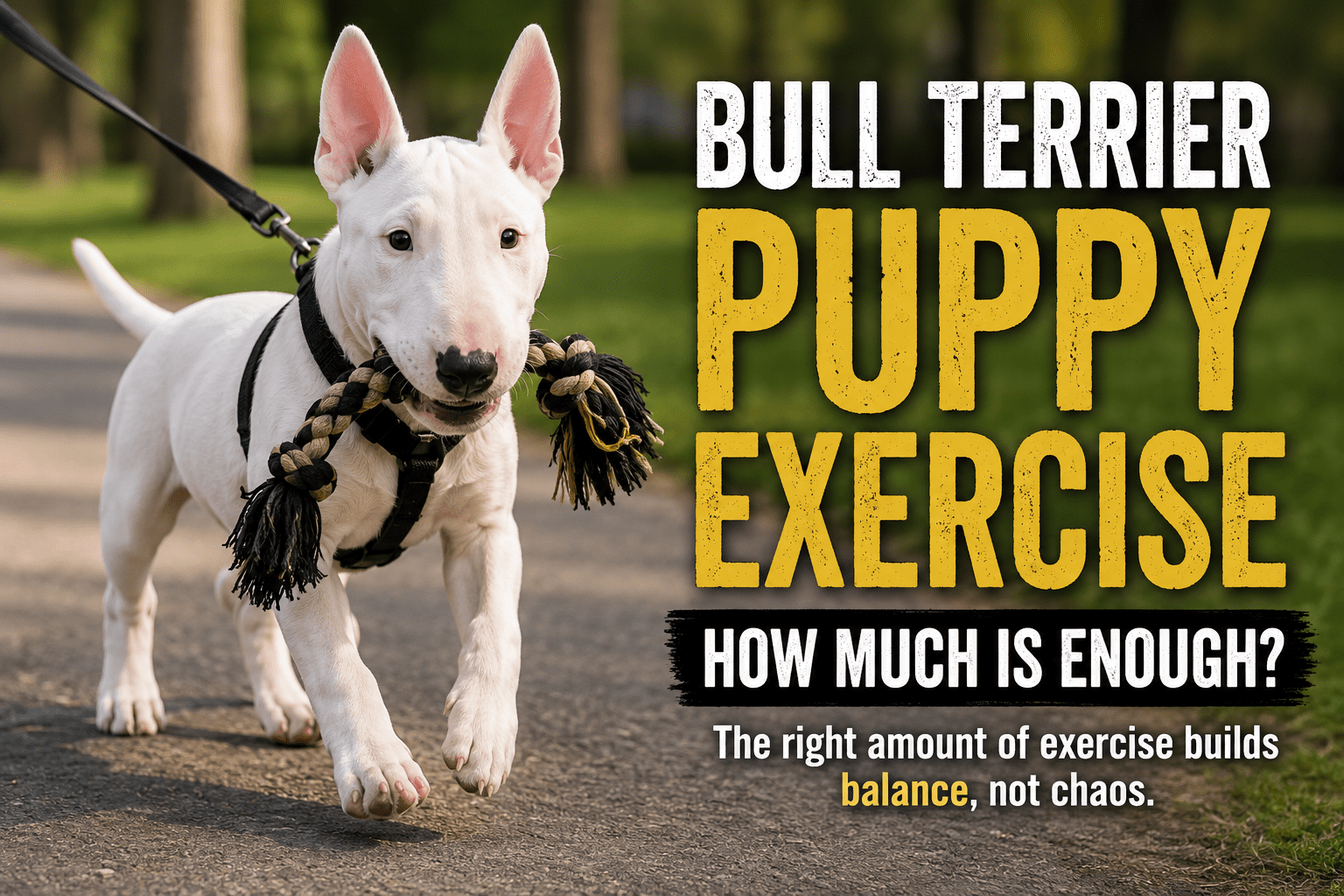
Bull Terrier puppy exercise is important, but more activity is not always the answer. A young Bull Terrier needs movement, play, chewing, training, exploration, rest, and recovery in the right balance, because too much stimulation can create more biting, overexcitement, and chaos instead of calmness.
A Bull Terrier puppy needs exercise.
But not endless exercise.
This is where many owners get confused.
They see a puppy biting, jumping, running through the house, stealing socks, grabbing trousers, barking for attention, refusing to settle, and turning the evening into a small domestic disaster. So they think the answer is obvious.
The puppy must need more exercise.
More walking. More running. More play. More stimulation. More time outside. More tiring out.
And sometimes, yes, a Bull Terrier puppy does need a better outlet. A young dog with no movement, no play, no chewing, no training, and no chance to explore the world will naturally become frustrated.
But very often, the problem is not that the puppy needs more and more exercise.
The problem is that the puppy has no rhythm.
No structure.
No recovery.
No clear end to excitement.
No ability to come down after activity.
That is why some owners exercise their Bull Terrier puppy more, only to find the puppy becomes worse. The biting becomes harder. The zoomies become crazier. The puppy refuses to settle. The home becomes louder. The owner becomes frustrated. The puppy becomes even more overstimulated.
This is an important lesson with Bull Terriers:
A tired puppy is not always a calm puppy.
Sometimes a tired puppy is just an overtired Bull Terrier with teeth.
Bull Terrier Puppy Exercise: Why More Is Not Always Better
Quick Answer
Bull Terrier puppy exercise should be short, age-appropriate, and balanced with rest. A puppy needs movement, play, chewing, gentle exploration, and training, but more exercise is not always better. Too much stimulation can create biting, overexcitement, poor settling, and evening chaos. The goal is not to exhaust the puppy, but to build a balanced routine with activity, recovery, and calmness.
Bull Terrier puppy exercise should support healthy development, confidence, calmness, and better behaviour. It should not turn the puppy into a constantly overstimulated athlete before they have learned how to rest, focus, and recover.
This breed often has a strong body, a big personality, and a natural desire to push into life. Even as puppies, Bull Terriers can seem physically powerful, dramatic, intense, and full of energy.
That does not mean they should be pushed like adult dogs.
A puppy is still developing. Their joints, muscles, coordination, confidence, nervous system, and emotional control are still immature. They need movement, but they also need protection from too much repetitive stress, too much pressure, and too much arousal.
The goal is not to exhaust the puppy into silence.
The goal is to create a balanced puppy who can move, play, explore, learn, chew, rest, and settle.
Those are not the same thing.
An exhausted puppy may collapse for a while, but if nothing is being taught, the same problems return again. A balanced puppy gradually learns how the day works, how to use energy properly, how to recover after excitement, and how to live calmly inside the home.
That is what we want.
Exercise Is Only One Part of the Puppy’s Needs
Many owners talk about exercise as if it is the whole answer.
But a Bull Terrier puppy has several needs at the same time.
They need physical movement.
They need sleep.
They need chewing.
They need gentle exposure to the world.
They need human connection.
They need simple training.
They need controlled freedom.
They need routine.
They need calmness.
They need to learn how to stop.
If the puppy only gets physical activity but no structure, the owner may simply build a fitter, stronger, more intense puppy.
That puppy may run more, pull more, bite harder, recover poorly, and demand higher levels of stimulation.
This is why “tiring them out” can become a trap.
If every problem is answered with more exercise, the puppy may learn that excitement is the normal state. They may expect constant entertainment. They may struggle to settle unless completely exhausted. They may become dependent on high stimulation instead of learning everyday calmness.
A Bull Terrier puppy should not need to be destroyed with activity before they can live in the house.
They should be taught how to live in the house.
Exercise helps.
But it does not replace training, routine, boundaries, and rest.
The Problem With Overexercising a Bull Terrier Puppy
Overexercise does not always look obvious.
Some puppies do not simply lie down and show they have had enough. Some keep going. Some become sillier. Some bite more. Some zoom around. Some become rougher. Some look like they still have energy, when actually they are losing control.
This is where Bull Terrier owners must learn to read the puppy carefully.
A puppy who becomes more frantic after activity may not need more.
They may need less intensity and better recovery.
A puppy who bites harder after play may be overtired.
A puppy who cannot settle after a walk may have become overstimulated.
A puppy who becomes wild every evening may not be under-exercised. They may have had too much stimulation and not enough sleep.
Too much exercise, especially too much intense, repetitive, uncontrolled exercise, can create both physical and behavioural problems. Long forced walks, endless chasing, too much jumping, rough uncontrolled play, slippery-floor madness, and repeated high-impact activity are not ideal for a developing puppy.
Bull Terriers can be tough, but puppies are still puppies.
We want to build the dog, not burn the puppy out.
What Kind of Exercise Is Best for a Bull Terrier Puppy?
The best exercise for a Bull Terrier puppy is controlled, age-appropriate, varied, and balanced with rest.
This means short walks or outdoor exploration depending on age, vaccination status, and environment. It means gentle play rather than endless roughness. It means using food, toys, movement, and the owner’s voice to build engagement. It means letting the puppy sniff, investigate, and experience the world without turning every outing into a physical challenge.
A puppy does not need every walk to be a mission.
Sometimes a short sniffing walk teaches more than a long march.
Sometimes five minutes of calm engagement teaches more than twenty minutes of pulling.
Sometimes a gentle garden session with recall, name response, play, and calm chewing is better than letting the puppy run wild until they lose their mind.
With Bull Terrier puppies, quality matters more than simply counting minutes.
The owner should ask:
Did this activity help the puppy become more balanced?
Did the puppy recover well afterward?
Did the puppy learn anything useful?
Did the puppy stay connected to me?
Did the puppy become calmer after, or more chaotic?
Those questions matter more than blindly adding more exercise.
Mental Stimulation Should Not Become Mental Chaos
Some owners understand that puppies need more than physical exercise, so they add puzzles, training, scent games, toys, enrichment, and food activities.
That can be excellent.
But even mental stimulation needs balance.
A Bull Terrier puppy can also become overstimulated mentally. Too many puzzles, too many exciting games, too much training, too much frustration, and too many new things in one day can create a puppy who is mentally tired but emotionally restless.
The goal of mental stimulation is not to constantly entertain the puppy.
The goal is to build the puppy’s ability to think, focus, problem-solve, engage, and settle.
Short sessions are enough.
A few minutes of name response. A few simple food games. A little follow-the-hand. A short recall game. Calm reward for eye contact. A small scent search. A chew after training. A place mat moment. A calm end.
This teaches the puppy to use their brain without living in constant excitement.
A good Bull Terrier puppy routine should include mental work, but it should not turn the whole day into a festival of stimulation.
Even learning needs recovery.
Play Is Important, But It Needs Rules
Bull Terrier puppies need play.
Play builds confidence, relationship, body awareness, joy, engagement, and trust. It is one of the best ways to become important to your puppy.
But play should not mean chaos without rules.
If every play session becomes biting hands, grabbing clothes, jumping at faces, chasing children, refusing to let go, or getting more intense until someone gets hurt, the puppy is learning the wrong lessons.
Good play has a beginning and an ending.
The owner starts the game. The owner guides the energy. The owner keeps the puppy successful. The owner ends before the puppy completely loses control.
This is especially important with Bull Terriers because many enjoy physical interaction and can become very intense when excited. They may not automatically know when to stop.
So we teach them.
Not by removing play.
By making play clearer.
Short tug games, controlled toy play, simple chase-the-food games, gentle recall games, and calm reward moments can all be useful. But rough human wrestling, hand-biting games, constant chasing, and wild uncontrolled play often create problems later.
Play should build connection.
Not create a tiny gladiator in the living room.
Exercise Must Be Followed by Recovery
This may be the most important part of the whole subject.
After exercise, the puppy must learn recovery.
Many owners take the puppy out, play hard, come home, and then allow the puppy to continue running around the house. The walk ends physically, but the arousal does not end emotionally.
The puppy is still high.
So they bite, jump, steal, bark, and demand more.
The owner thinks, “How can you still have energy?”
But the puppy may not need more energy release. They may need help coming down.
This is where calm chewing, crate time, pen time, place mat work, a quiet room, lower household activity, and predictable rest become valuable.
The pattern should be:
Activity happens.
Then recovery happens.
Play happens.
Then calm happens.
Exposure happens.
Then decompression happens.
This rhythm teaches the puppy how to regulate.
Without recovery, exercise can become gasoline on the fire.
Watch the Puppy After Exercise
The best way to judge whether exercise is helping is not only to watch the puppy during the activity.
Watch them after.
A good amount of exercise usually leaves the puppy satisfied, able to rest, easier to redirect, and more balanced.
Too much or the wrong kind of exercise may leave the puppy frantic, mouthy, restless, unable to settle, more demanding, or more reactive.
This is one reason generic advice can fail.
One puppy may handle a short walk easily. Another may become overwhelmed by the same walk because of traffic, dogs, noise, people, heat, or too much novelty.
One puppy may enjoy tug and settle afterward. Another may become too high and start biting clothing.
One puppy may benefit from more sniffing. Another may become frustrated if the environment is too busy.
The owner must learn the individual puppy.
Bull Terriers are not machines.
They are powerful personalities in developing bodies. The right amount of exercise is the amount that supports growth, confidence, health, and calm behaviour — not the amount that simply exhausts the owner less for an hour.
Signs Your Bull Terrier Puppy May Need More Appropriate Activity
Some Bull Terrier puppies genuinely do need more or better activity.
Signs may include constant restlessness when the puppy has had very little movement, frustration from being confined too long without appropriate outlets, destructive chewing from boredom, poor engagement because the puppy never gets meaningful interaction, and excessive energy that improves after short structured activity.
But even then, the answer is not usually wild exercise.
It is better activity.
Short training.
Structured play.
Sniffing.
Chewing.
Controlled exploration.
Food-based engagement.
Age-appropriate walks.
Small confidence-building experiences.
The puppy does not just need to be tired.
They need to be fulfilled.
That is a higher standard.
Signs Your Bull Terrier Puppy May Be Getting Too Much
A Bull Terrier puppy may be getting too much exercise or stimulation if they become more frantic after activity, bite harder when tired, struggle to settle, have repeated evening chaos, become rougher during play, ignore redirection completely, seem wired after walks, or need longer and longer activity to become manageable.
This does not always mean the owner should remove exercise.
It means the routine needs balancing.
Less intensity. More recovery. Shorter sessions. Better sleep. More calm chewing. More structure. Better transitions. Fewer wild games. More owner-guided activity. Less freedom immediately after excitement.
The question is not only, “How much exercise does my puppy need?”
The better question is:
“What kind of day helps my puppy become more balanced?”
That is where real progress begins.
The Role of Sleep in Puppy Behaviour
Sleep is one of the most underrated parts of Bull Terrier puppy behaviour.
A puppy who does not sleep enough may look energetic, but actually be overtired. They may bite more, listen less, become more impulsive, and struggle to control themselves.
Owners often miss this because the puppy does not politely say, “I need rest.”
Instead, the puppy becomes a menace.
They chew the wrong things. Attack trouser legs. Jump at people. Run around the house. Refuse to settle. Bark for attention. Grab everything they can find.
The owner sees energy.
The trainer sees a puppy who may need sleep.
A healthy puppy routine must protect rest. Especially after play, training, walks, visitors, children, or new experiences.
Exercise without sleep is not balance.
It is just stimulation stacked on stimulation.
So, How Much Exercise Does a Bull Terrier Puppy Really Need?
There is no single perfect number that fits every Bull Terrier puppy.
Age, health, vaccination status, confidence, environment, temperament, sleep, routine, and daily stimulation all matter.
A very young puppy needs short, gentle, safe activity and plenty of rest. As the puppy grows, activity can gradually increase, but it should still be balanced with recovery and guided by the puppy’s behaviour afterward.
The owner should not chase exhaustion.
They should build balance.
A good day for a Bull Terrier puppy usually includes several short opportunities for movement, toilet breaks, gentle exploration, calm training, chewing, rest, and controlled play. It does not require turning the puppy into an endurance athlete.
The real answer is this:
A Bull Terrier puppy needs enough exercise to support healthy development and fulfilment, but not so much stimulation that they lose the ability to settle.
That is the difference.
And it matters.
Final Thought
When a Bull Terrier puppy is wild, the answer is not always more exercise.
Sometimes the answer is better routine.
Better rest.
Better play.
Better structure.
Better recovery.
Better owner guidance.
Exercise is important, but it is only one piece of the foundation. A Bull Terrier puppy raised with movement but no calmness may become physically capable but emotionally chaotic. A puppy raised with balanced activity, rest, engagement, and routine has a much better chance of becoming confident, connected, and easier to live with.
Do not only ask how to tire your puppy out.
Ask how to raise a puppy who can live well.
That is the real goal.
Learn More From Working Bull Terriers Kennel
If you are raising a Bull Terrier puppy, the goal is not to create a tired puppy. The goal is to build a puppy who understands routine, rest, calmness, play, structure, and recovery.
Our Bull Terrier Puppy Training Guide was created to help owners build that foundation step by step. Our Quirks guide helps owners understand the breed-specific behaviours that often appear as the puppy grows, especially when excitement, personality, and lack of structure begin to mix.
For self-guided learning, start with the Puppy Training Guide and the Quirks guide.
If your puppy is already showing intense biting, overexcitement, inability to settle, fear, reactivity, or household chaos, personalized online training may be the better next step.
Build Balance, Not Just a Tired Puppy
Bull Terrier puppy exercise is not only about burning energy. The right foundation teaches your puppy how to move, play, recover, rest, focus, and settle without turning every day into more biting, overexcitement, and chaos.
The Bull Terrier Puppy Training Guide helps you build that early foundation step by step, while the Quirks guide helps you understand the breed-specific behaviours that often appear as your puppy grows.

 Get the Puppy Training Guide
Explore the Quirks Guide
Get the Puppy Training Guide
Explore the Quirks Guide
Related Reading
If you are raising a Bull Terrier puppy, these articles will help you understand why exercise must work together with routine, structure, rest, biting control, and the right early foundation.
A useful next step for understanding how daily rhythm, rest, calm chewing, short activity, and predictable structure help prevent puppy chaos.
The foundation article for understanding why controlled freedom, rest, calmness, rules, and clear daily patterns matter so much with Bull Terrier puppies.
A practical guide for understanding puppy biting, overexcitement, tiredness, mouthiness, and why biting often needs better structure instead of only correction.
A strong companion article for understanding how the first months shape routine, calmness, engagement, confidence, and future behaviour.
Leave a Reply