







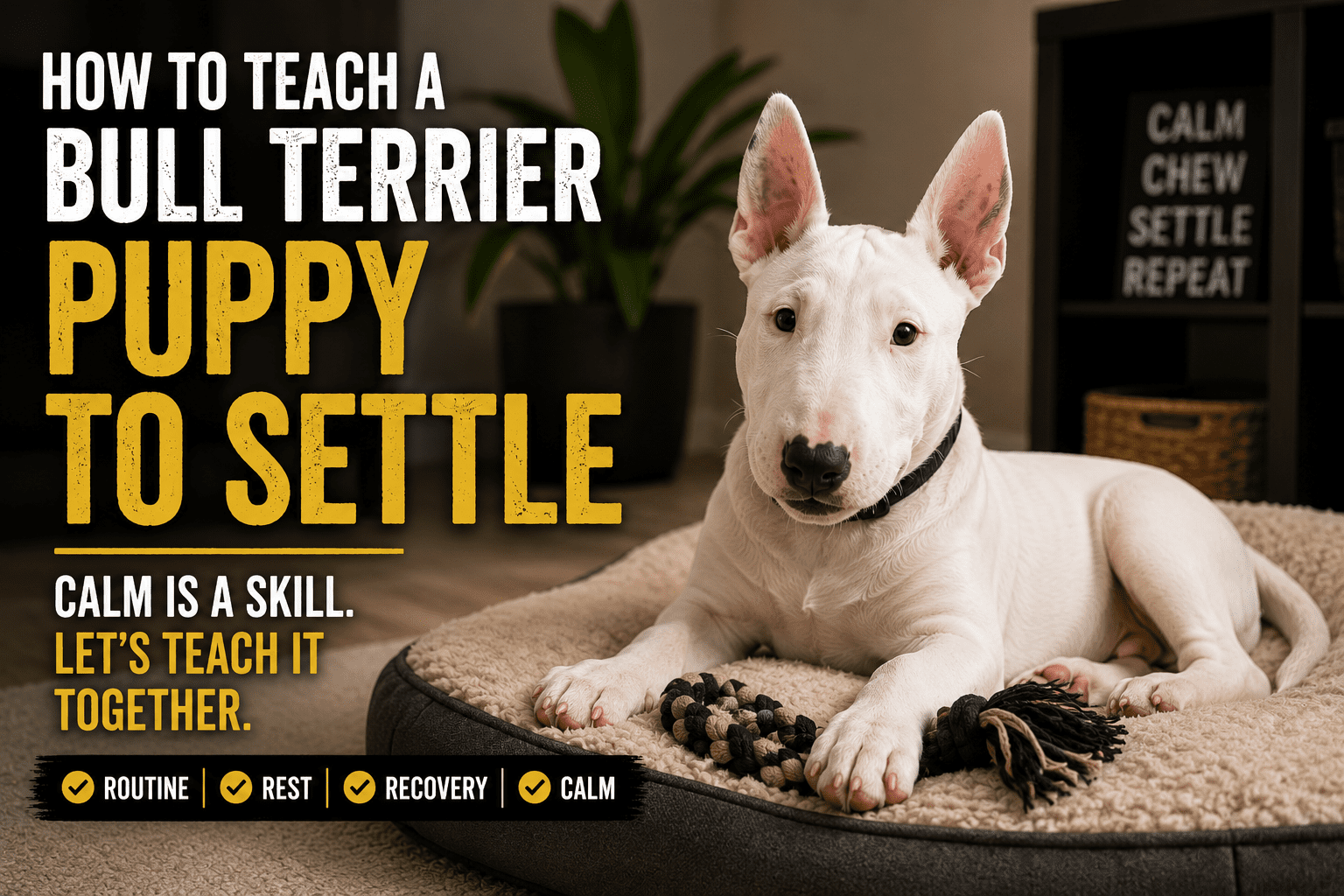
A Bull Terrier puppy does not automatically know how to settle.
Some puppies naturally relax more easily than others, but many Bull Terrier puppies need to be taught that calmness is part of life. They need help learning that not every moment is play, not every movement is an invitation, not every person is a toy, and not every burst of energy needs to become chaos.
This is one of the most important lessons a Bull Terrier puppy can learn.
Many owners focus only on exercise, biting, toilet training, socialization, or basic commands. Those things matter. But if the puppy never learns how to settle, the home can become exhausting very quickly.
The puppy plays, then bites.
Walks, then zooms.
Eats, then jumps.
Meets visitors, then becomes wild.
Gets tired, then becomes even worse.
The owner thinks, “He has so much energy.”
But sometimes the real problem is not energy.
Sometimes the real problem is that the puppy does not know how to come down.
A Bull Terrier puppy who cannot settle may look stubborn, naughty, dominant, hyperactive, or impossible. But very often, the puppy is simply overstimulated, overtired, under-structured, or never shown how calm behaviour works.
Settling is not the absence of training.
Settling is training.
And with Bull Terriers, it should start early.
Bull Terrier Puppy Settle Training: Why Calmness Must Be Taught
Quick Answer
Bull Terrier puppy settle training should start early because many puppies do not naturally know how to switch off. Teach settling with routine, short activity followed by recovery, a clear rest area, calm chewing, place or crate training, and quiet rewards for calm behaviour. The goal is not to remove the puppy’s personality, but to help them learn how to rest, recover, and live calmly inside the home.
Bull Terrier puppy settle training matters because calm behaviour does not always appear naturally in a busy home.
A puppy enters a world full of movement, sounds, smells, people, hands, clothes, toys, food, furniture, children, visitors, other animals, and constant opportunities for excitement. For a confident, physical, curious Bull Terrier puppy, the home can feel like a playground that never closes.
If every moment becomes stimulation, the puppy learns stimulation.
If every bite creates a reaction, the puppy learns biting has power.
If every jump brings attention, the puppy learns jumping works.
If every stolen object starts a chase, the puppy learns stealing is a game.
If every restless moment leads to entertainment, the puppy learns that calmness is unnecessary.
This is why settling must be taught deliberately.
A Bull Terrier puppy needs to learn that calm behaviour has value. Lying down matters. Chewing quietly matters. Watching without reacting matters. Staying on a bed matters. Being calm while people move around matters. Resting after play matters.
The puppy does not learn this because the owner wishes for it.
The puppy learns it because the daily routine teaches it.
Settling Is Not the Same as Exhaustion
One of the biggest mistakes owners make is confusing exhaustion with calmness.
A puppy who collapses after a long day is not necessarily trained to settle. They may simply be physically finished.
That is not the same thing.
Real settling means the puppy can lower their energy before they are completely exhausted. It means they can rest after activity. It means they can chew quietly. It means they can stay in a calm area while family life continues. It means they can begin learning that doing nothing is normal.
A puppy who only “settles” when destroyed by exercise has not really learned emotional control.
They have learned collapse.
This matters because as the puppy grows, the amount of activity needed to exhaust them may increase. The owner then ends up chasing tiredness every day, trying to create calm through fatigue.
That becomes a trap.
The better path is to teach the puppy how to settle as a skill.
Exercise helps. Routine helps. Chewing helps. Structure helps. But the puppy must also practise calmness itself.
Start Before the Puppy Is Already Wild
Settle training works best before the puppy reaches the point of madness.
Many owners wait until the puppy is biting, zooming, barking, grabbing trousers, jumping at people, and losing control before they try to calm the puppy down.
By then, the puppy may already be too high.
It is much easier to build settling before the puppy explodes.
If your Bull Terrier puppy has a predictable wild time in the evening, begin the calming routine earlier. If the puppy becomes mouthy after visitors, plan recovery before the behaviour escalates. If the puppy bites after play, end the game sooner and move into a calmer activity before the puppy tips over the edge.
This is a key part of raising Bull Terrier puppies.
Do not only react to chaos.
Prevent the rehearsal of chaos.
A puppy who practises settling every day will improve faster than a puppy who only hears “calm down” after they are already out of control.
Create a Clear Settle Area
A Bull Terrier puppy needs a place where calmness is expected.
This can be a crate, pen, dog bed, place mat, quiet corner, or a specific room setup. The exact tool depends on the puppy and the home, but the purpose is the same: the puppy needs a predictable area where activity lowers and rest becomes normal.
This area should not feel like punishment.
It should feel safe, familiar, and boring in a good way.
The puppy can have a chew there. They can rest there. They can watch the family from there. They can recover there after play, training, walks, visitors, or excitement.
At first, do not expect too much.
A young puppy may only settle for short periods. That is fine. We are building the behaviour gradually.
The owner should not throw the puppy into the area only when frustrated. The settle area should be part of normal daily life, not just a reaction to bad behaviour.
The puppy should learn:
This is where I relax.
This is where I chew.
This is where I sleep.
This is where the world slows down.
That association becomes extremely valuable as the puppy matures.
Reward Calm Behaviour When It Appears
Many owners accidentally ignore the puppy when they are calm and only interact when the puppy becomes difficult.
This teaches the wrong lesson.
If the puppy lies quietly, nobody notices.
If the puppy bites, everyone moves.
If the puppy jumps, everyone talks.
If the puppy steals, everyone chases.
If the puppy barks, everyone reacts.
From the puppy’s point of view, excitement creates attention.
So we must reverse the pattern.
When your Bull Terrier puppy is calm, quietly mark and reward it. When they lie down, notice it. When they chew the right object, support it. When they stay on their bed for a moment, make that moment valuable. When they watch movement without chasing, reward that choice. When they settle after play, do not ignore the success.
The reward should match the behaviour.
Do not explode with excitement and accidentally wake the puppy back up. Use calm praise, a small food reward, gentle presence, or simply quiet approval.
We want to show the puppy that calmness works.
Not by making calmness exciting.
By making calmness valuable.
Use Chewing to Help the Puppy Come Down
Chewing can be one of the best tools for settle training.
A suitable chew gives the puppy something appropriate to do with their mouth, helps reduce inappropriate biting, and can support a calmer emotional state after activity.
This is especially useful for Bull Terrier puppies because many are naturally mouthy, physical, and determined. They often need a legal job for their mouth.
But chewing should be used thoughtfully.
Do not only give a chew when the puppy is already impossible. Use chewing as part of the routine. After play. After training. After a short walk. During quiet time. In the crate or pen. On the place mat. Before the evening chaos begins.
This teaches the puppy that chewing belongs to calm periods, not just emergency management.
The owner should choose safe, age-appropriate options and supervise properly. Every puppy is different, and some chew more intensely than others.
The purpose is not to distract the puppy forever.
The purpose is to help them transition from activity into calmness.
Teach the Puppy That Play Has an Ending
Many Bull Terrier puppies struggle to settle because play never has a clear ending.
The game becomes faster. The puppy bites harder. The owner laughs, pushes, reacts, wrestles, chases, or keeps going because the puppy seems to enjoy it. Then suddenly the puppy is too high and the owner wants calm.
But the puppy has only learned escalation.
A better approach is to make play clearer.
Start the game.
Guide the game.
End the game before the puppy loses control.
Then help the puppy recover.
This might mean a short tug session followed by a calm chew. A few minutes of toy play followed by place time. A small training game followed by rest. A short garden session followed by crate time.
The puppy learns that excitement has a beginning and an ending.
That lesson is powerful.
A Bull Terrier puppy who learns how to come down after play will be much easier to live with than a puppy who believes every game should continue until the house surrenders.
Do Not Turn Settling Into a Battle
If the puppy is overtired and overstimulated, settling may be difficult at first.
They may complain. Move around. Bite the bed. Try to leave. Bark. Grab the blanket. Act like rest is a personal insult.
This is normal with many Bull Terrier puppies.
The owner must stay calm.
If settling becomes a fight, the puppy may become even more frustrated. If the owner becomes emotional, loud, or physically intense, the puppy may escalate.
The goal is not to overpower the puppy into calmness.
The goal is to create a setup where calmness becomes easier.
Use the environment. Use routine. Use timing. Use management. Use appropriate chewing. Use short expectations. Use repetition.
A puppy who cannot settle for thirty minutes may be able to settle for three minutes.
Start there.
Success builds.
Place Training Can Help, But It Must Be Built Properly
Place training can be extremely useful for Bull Terrier puppies.
A place mat or dog bed can teach the puppy where to go, where to relax, and how to stay connected to the owner without constantly being underfoot.
But place training should not begin as a long stay with too much pressure.
For a young puppy, it should start simply.
Step on the mat. Reward.
Sit or lie on the mat. Reward.
Stay for a short moment. Reward.
Chew calmly on the mat. Reward.
Watch the owner move slightly and remain there. Reward.
Over time, the puppy learns that the place has value.
The mistake is expecting adult-level place behaviour too early. A puppy may not be ready to stay on a mat while the house is full of visitors, children running, food on the table, and people moving everywhere.
Build the foundation first.
Then increase difficulty gradually.
Place training is not magic, but when taught patiently, it becomes one of the best tools for calm household behaviour.
Crate Time Is Not Failure
Some owners feel guilty using a crate or pen.
But a crate, when introduced properly and used responsibly, can be a very helpful part of teaching a Bull Terrier puppy to settle. It can protect sleep, reduce rehearsal of bad habits, support toilet training, prevent overtired chaos, and give the puppy a safe recovery space.
The problem is not the crate.
The problem is poor use of the crate.
A crate should not be used as a place of anger, isolation, or punishment. It should be introduced gradually, paired with calm experiences, and used as part of a healthy routine.
For some puppies, a pen or gated area may work better. For others, a crate becomes an important rest tool. The exact setup can vary.
The principle remains the same:
The puppy needs a safe place where the world slows down.
Without that, some Bull Terrier puppies stay involved in everything and never properly rest.
The Family Must Stop Creating Constant Excitement
Sometimes the puppy cannot settle because the family keeps preventing it.
Children run past the puppy.
Visitors excite the puppy.
Someone talks to the puppy every time they rest.
Someone wakes the puppy because they look cute.
Someone plays rough games late in the evening.
Someone laughs when the puppy bites trousers.
Someone lets the puppy out every time they complain.
Then the owner says the puppy will not settle.
But the puppy is living in an environment that keeps switching them back on.
The family must help protect calmness.
This does not mean the puppy is ignored or treated coldly. It means the home learns when to lower the energy. Children learn not to turn the puppy into a chase game. Visitors learn not to create madness. The owner learns not to reward every demand for attention.
A Bull Terrier puppy can be very social and affectionate, but that does not mean they should be stimulated all day.
Calmness needs space.
What Settling Should Look Like
Settling does not always mean the puppy falls asleep immediately.
At first, settling may look like chewing quietly for five minutes. Lying down for thirty seconds. Watching the room without jumping. Staying in the pen without constant barking. Resting on a mat after play. Taking a nap after a morning routine. Being able to relax while the owner works nearby.
These are small wins.
They matter.
Over time, those small wins become longer periods of calm behaviour.
Do not expect perfection too early. A puppy is still a puppy. They will still have silly moments, biting phases, bursts of energy, and days where the routine feels harder.
The goal is not to create a statue.
The goal is to teach recovery.
A Bull Terrier puppy who can recover is already ahead.
Common Mistakes When Teaching a Bull Terrier Puppy to Settle
The most common mistake is waiting until the puppy is already too wild.
Another mistake is giving too much freedom and then expecting calmness. A puppy cannot practise chaos all day and suddenly understand settling at night.
Some owners also use too much exercise and not enough recovery. Others use the crate only when angry. Some reward wild behaviour with attention and ignore calm behaviour completely. Some expect too much too soon. Some allow the family to create excitement and then blame the puppy for becoming excited.
These mistakes are common, but they can be fixed.
The owner must stop thinking of settling as something the puppy should magically do and start treating it as a behaviour to build.
That change alone makes everything clearer.
So, How Do You Teach a Bull Terrier Puppy to Settle?
You teach a Bull Terrier puppy to settle by building calmness into the daily routine.
Use short activity followed by recovery. Give the puppy a clear rest area. Reward calm behaviour when it appears. Use safe chewing to help the puppy come down. End play before it becomes chaos. Protect sleep. Reduce unnecessary stimulation. Teach place or crate gradually. Keep the family consistent.
Do not wait for the puppy to become impossible before trying to calm them.
Start earlier.
Build the pattern before the explosion.
A Bull Terrier puppy does not need to be forced into calmness. They need to be shown, repeatedly and fairly, that calmness is part of life and that settling has value.
That is how the puppy begins to learn.
Not through one perfect session.
Through daily rhythm.
Through calm repetition.
Through structure that makes sense.
And when that foundation is built early, the future dog becomes much easier to guide.
Final Thought
A Bull Terrier puppy who can settle is not less playful.
They are not less funny, less confident, or less full of character.
They are simply better equipped for life.
They can play and recover. Explore and rest. Get excited and come down. Be part of the family without controlling the whole room. That is the real goal.
We do not teach settling to remove the Bull Terrier personality.
We teach settling so that personality can live safely, clearly, and happily inside the home.
Because a Bull Terrier with no off-switch can become exhausting.
But a Bull Terrier who learns calmness early becomes much easier to enjoy.
Learn More From Working Bull Terriers Kennel
If your Bull Terrier puppy struggles to settle, becomes wild in the evening, bites when tired, or cannot switch off after play, the answer is not always more exercise.
Often, the puppy needs better structure, routine, rest, and calm guidance.
Our Bull Terrier Puppy Training Guide was created to help owners build that foundation step by step. Our Quirks guide helps owners understand the breed-specific behaviours that often appear as the puppy grows, especially when excitement, personality, and lack of structure begin to mix.
For self-guided learning, start with the Puppy Training Guide and the Quirks guide.
If your puppy is already showing intense biting, overexcitement, inability to settle, fear, reactivity, or household chaos, personalized online training may be the better next step.
Teach Calm Before Chaos Becomes a Habit
Bull Terrier puppy settle training is not about removing personality. It is about teaching your puppy how to rest, recover, switch off after excitement, and live calmly inside the home before biting, overexcitement, and wild evening behaviour become daily patterns.
The Bull Terrier Puppy Training Guide helps you build that early foundation step by step, while the Quirks guide helps you understand the breed-specific behaviours that often appear as your puppy grows.

 Get the Puppy Training Guide
Explore the Quirks Guide
Get the Puppy Training Guide
Explore the Quirks Guide
Related Reading
If your Bull Terrier puppy struggles to settle, these articles will help you understand the bigger foundation behind calm behaviour: routine, structure, biting control, rest, and the first months of puppy development.
A strong companion article for understanding how daily rhythm, rest, calm chewing, and predictable structure help a puppy learn how to switch off.
The foundation article for understanding why controlled freedom, rest, calmness, rules, and clear daily patterns matter so much with Bull Terrier puppies.
A practical guide for understanding puppy biting, overexcitement, tiredness, mouthiness, and why biting often becomes worse when the puppy cannot settle.
A strong companion article for understanding how the first months shape routine, calmness, engagement, confidence, and future behaviour.
Leave a Reply