






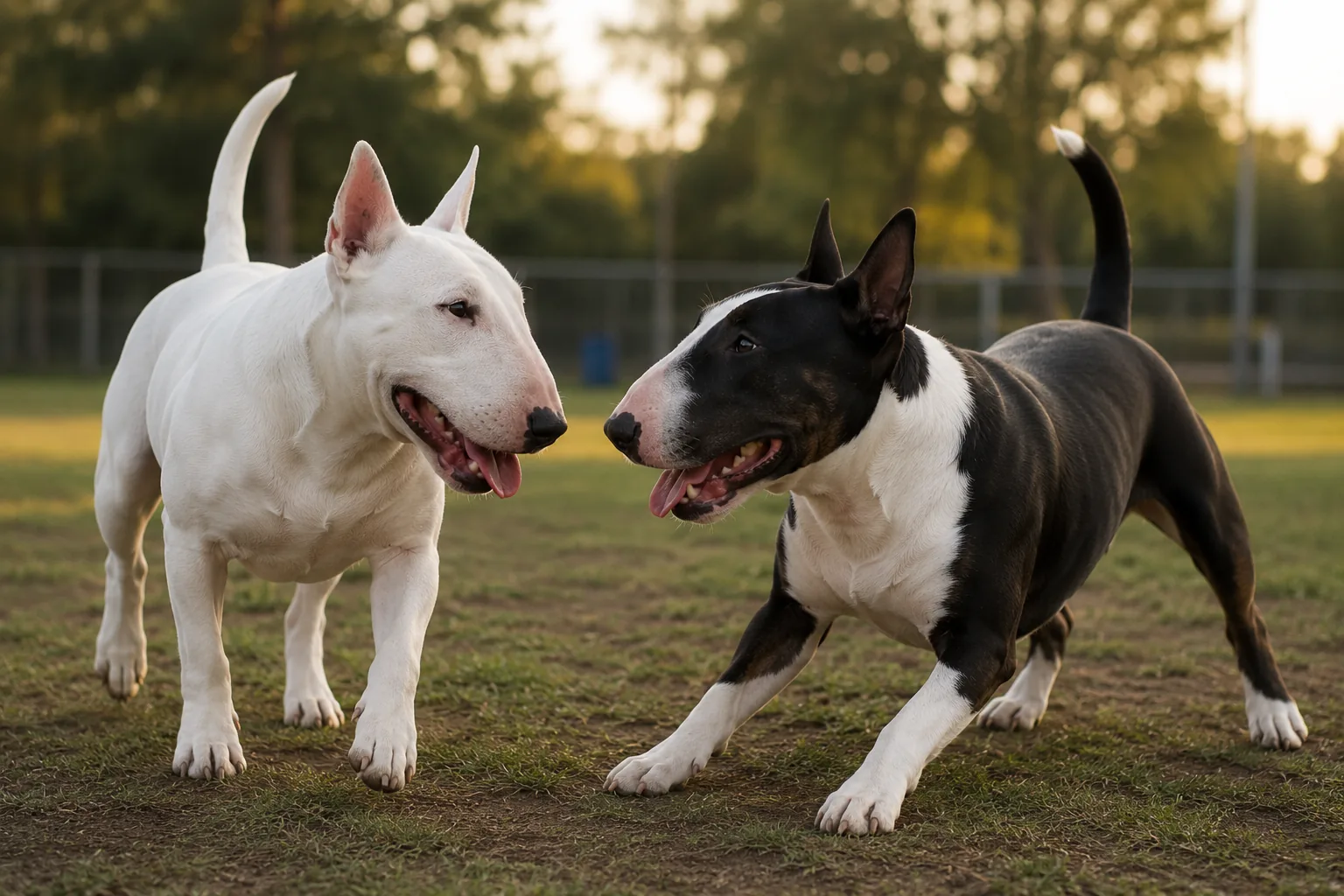
Bull Terriers can be good with other dogs, but this is not a breed where owners should rely on luck, hope, or the idea that “all dogs should get along.”
That is the honest truth.
Some Bull Terriers live peacefully with other dogs. Some enjoy selected dog friends. Some are social when young and become more selective as they mature. Some do well with dogs inside their own household but react differently toward strange dogs outside. Some can coexist calmly with the right structure, while others need careful management and should not be forced into unnecessary dog interactions.
This does not make the breed bad.
It makes the breed serious.
Bull Terriers are powerful, physical, confident, determined dogs. They often have strong personalities, strong bodies, and very clear opinions. When they are well bred, well raised, properly socialized, and guided by a responsible owner, they can learn to behave calmly around other dogs. But when they are overexcited, poorly socialized, under-structured, pushed into bad interactions, or allowed to practise reactive behaviour, problems can develop quickly.
So, are Bull Terriers good with other dogs?
The best answer is this: some Bull Terriers can be very good with other dogs, but owners must understand dog selectivity, maturity, arousal, structure, supervision, and the difference between healthy socialization and uncontrolled exposure.
A Bull Terrier does not need to love every dog.
A Bull Terrier does need to learn how to behave responsibly around other dogs.
Those are not the same thing.
The Short Answer: It Depends on the Dog, the Owner, and the Situation
Quick Answer
Are Bull Terriers good with other dogs? Some Bull Terriers can live peacefully with other dogs, enjoy selected dog friends, and learn calm behaviour around dogs with the right structure. But owners should not assume every Bull Terrier will be naturally dog-social. This breed needs careful socialization, calm exposure, supervision, maturity awareness, leash control, and responsible management around other dogs.
There is no honest one-word answer to this question.
Some Bull Terriers are naturally more social. Others are more selective. Some are playful with familiar dogs but uncomfortable with pushy strangers. Some are calm around calm dogs but react badly to dogs that rush, bark, stare, challenge, or invade their space. Some are fine as puppies and become less tolerant during adolescence or adulthood.
This is normal in many breeds, and especially important to understand in strong, confident terrier-type dogs.
The mistake many owners make is believing that a “good dog” must enjoy every other dog. That belief creates pressure. It pushes dogs into greetings they do not need, playgroups they cannot handle, dog parks that are too chaotic, and face-to-face interactions that create tension instead of confidence.
A Bull Terrier does not need to be a social butterfly to be a well-trained dog.
A much better goal is neutrality.
A well-managed Bull Terrier should be able to see other dogs without exploding, walk past dogs without losing their mind, ignore dogs when asked, disengage from tension, and listen to the owner even when another dog is present.
That is more valuable than random play.
Dog-Friendly and Dog-Social Are Not the Same Thing
Many owners confuse several different things.
A dog can be dog-tolerant without being dog-social. A dog can live with one familiar dog but dislike strange dogs. A dog can enjoy play with selected dogs but become reactive on leash. A dog can be friendly in one context and tense in another.
This is why simple labels are often misleading.
When someone says, “My Bull Terrier is good with dogs,” we need to ask: which dogs, where, under what conditions, and with what level of owner control?
A Bull Terrier that lives peacefully with another dog in the home may not enjoy unknown dogs running into its face. A dog that played well as a puppy may become more selective as it matures. A dog that seems excited to see other dogs may not actually be relaxed; it may be overstimulated, frustrated, or rehearsing a pattern that could become reactive later.
Excitement is not always friendliness.
This matters.
Many owners see pulling, whining, barking, bouncing, and frantic movement toward another dog and say, “He just wants to play.” Sometimes that is true. But sometimes the dog is already over threshold. Sometimes the excitement is too high. Sometimes the dog does not know how to approach calmly. Sometimes the behaviour is one step away from frustration.
A strong Bull Terrier with poor emotional control can turn a “friendly greeting” into chaos very quickly.
Socialization Does Not Mean Meeting Every Dog
One of the biggest misunderstandings in dog ownership is the word socialization.
Many people think socialization means allowing the puppy or young dog to meet as many dogs as possible. They let the dog greet every dog on walks, play with every dog at the park, and interact with unknown dogs without much structure. They believe this will create a social adult dog.
Sometimes it does the opposite.
Good socialization is not uncontrolled exposure. It is not letting the dog rehearse wild greetings, bad play, frustration, or overexcitement. It is not forcing the dog into interactions where the owner has no control.
Good socialization teaches the dog how to stay calm in the world.
A Bull Terrier should learn that other dogs can exist nearby without becoming the main event. They should learn to observe, disengage, move away, walk calmly, and stay connected to the owner. They should learn that not every dog means play, pressure, conflict, or frustration.
This is especially important for Bull Terriers because they can be physically intense in play. Even when they are friendly, their style may be too much for some dogs. They may body-slam, push, chase, grab, or escalate quickly if not guided. Some dogs will not enjoy that. Some dogs will react badly to it. Then the Bull Terrier may respond, and the owner suddenly has a problem.
The goal is not to remove the Bull Terrier’s personality.
The goal is to teach social control.
Dog Parks Are Usually a Bad Idea for Bull Terriers
Many Bull Terriers do not need dog parks.
In fact, dog parks often create more problems than they solve.
A dog park is full of unknown dogs, unknown owners, mixed temperaments, different play styles, poor supervision, uncontrolled greetings, toys, tension, running, barking, chasing, and social pressure. For a powerful dog with high arousal or strong personality, that environment can be risky.
Even if your Bull Terrier is friendly, the other dogs may not be. Even if your dog is stable, another dog may be rude, fearful, defensive, possessive, or pushy. Even if your dog has never started a problem, they may still respond if another dog challenges them.
And when a Bull Terrier responds, people often blame the Bull Terrier.
This is part of the responsibility of owning the breed.
Owners must protect their dog from situations where failure is likely, unnecessary, or unfair. A dog does not need to be placed in chaotic environments to prove it is social. A responsible owner chooses situations that build confidence, neutrality, and control.
For many Bull Terriers, structured walks, calm exposure, controlled training around dogs, and selected dog relationships are much better than random dog park play.
Living With Another Dog
Bull Terriers can live with other dogs, but introductions and household structure matter.
The easiest situation is usually when a Bull Terrier is raised properly with another stable dog, with clear rules, supervision, and enough space. Even then, owners should not assume everything will always be simple. Maturity, hormones, resources, excitement, jealousy, space, food, toys, resting areas, and owner attention can all affect the relationship.
A household with multiple dogs needs management.
Feeding should be controlled. High-value items should be handled carefully. Doorways, narrow spaces, sofas, beds, visitors, and excitement points should be supervised if there is tension. Owners should watch for subtle changes: stiffness, blocking, staring, hovering, guarding, pushing, mounting, interrupting, or one dog constantly controlling access to people or places.
Problems often start quietly before they become obvious.
The owner must not wait for a serious fight before creating rules.
If the Bull Terrier is living with another dog, the goal is not simply that they “get along.” The goal is a stable household where both dogs can rest, move, receive attention, eat, train, and live without constant pressure.
This requires leadership from the humans.
Not shouting. Not panic. Not favouritism.
Structure.
Maturity Can Change Things
A common mistake is assuming that because a Bull Terrier puppy was social with dogs, the adult dog will remain the same forever.
Some do. Some do not.
As dogs mature, their tolerance can change. Confidence can increase. Hormones can influence behaviour. Play style can become more serious. Social preferences can narrow. A dog that once accepted everything may begin to dislike rude dogs, pushy dogs, same-sex tension, or chaotic interactions.
This does not mean the dog has “turned bad.”
It may simply mean the dog is maturing.
Owners should respect that. They should not force the adult Bull Terrier to live like the puppy version of itself. If the dog becomes more selective, the owner should adjust expectations and focus on neutrality, obedience, structure, and controlled exposure rather than endless free interaction.
A mature Bull Terrier does not need to be everyone’s friend.
A mature Bull Terrier does need to be manageable.
That is the difference.
Leash Reactivity and Frustration
Many Bull Terriers that appear aggressive toward other dogs on leash are not necessarily trying to attack. Some are frustrated. Some are overexcited. Some are fearful. Some are defensive. Some have learned that barking and lunging create distance. Some have been allowed to rehearse the same pattern for months until it becomes automatic.
Leash behaviour can be complicated.
A tight leash, face-to-face approach, owner tension, narrow paths, repeated greetings, and lack of engagement can all make things worse. If the dog has no focus on the owner outside, no ability to disengage, and no habit of calm movement around dogs, reactivity becomes more likely.
This is why leash training is not only about stopping pulling.
It is about building communication.
A Bull Terrier should learn that the owner matters outside. The dog should learn how to check in, follow guidance, change direction, pass calmly, and stay under control even when another dog appears. Without that foundation, the owner is often just holding the end of a leash and hoping the dog makes good decisions.
Hope is not a training system.
The Owner’s Behaviour Matters
The owner plays a huge role in how a Bull Terrier behaves around other dogs.
Some owners create tension by tightening the leash, panicking, shouting, correcting too late, or forcing interactions. Others create problems by allowing too much freedom, letting the dog drag them toward other dogs, or laughing at rough behaviour until it becomes dangerous.
Both extremes are harmful.
A Bull Terrier needs an owner who is calm, clear, and proactive. The owner should not wait until the dog is already exploding before trying to control the situation. They should read the dog early, manage distance, reward engagement, prevent rehearsals, and choose appropriate social situations.
Good dog-to-dog behaviour is not created in the middle of chaos.
It is built through many small, controlled repetitions where the dog learns what to do instead of reacting.
The owner must also be honest about the dog in front of them. If the Bull Terrier is not comfortable with random dogs, do not pretend they are. If the dog is selective, manage that. If the dog is reactive, train it properly. If the dog is dangerous with other dogs, protect everyone involved and get serious help.
Responsible ownership begins with honesty.
What Should the Goal Be?
The goal should not be to make every Bull Terrier love every dog.
That is unrealistic and unnecessary.
The goal should be to create a Bull Terrier that can function calmly in a world where other dogs exist. A dog that can walk past another dog without losing control. A dog that can disengage. A dog that can respond to the owner. A dog that can live safely under the right structure. A dog that does not need to greet every dog to feel fulfilled.
For some Bull Terriers, selected dog friendships are possible and enjoyable. For others, neutrality is the safest and most realistic goal. Both can be perfectly acceptable depending on the dog.
A dog does not have to be dog-park friendly to be a good dog.
A Bull Terrier does not need a large group of dog friends to live a happy life.
What they need is clarity, structure, appropriate exercise, mental stimulation, owner engagement, and a lifestyle that respects who they are.

So, Are Bull Terriers Good With Other Dogs?
Some Bull Terriers are good with other dogs.
Some are selective.
Some need careful management.
Some should not be placed in uncontrolled dog situations.
The honest truth is that this breed should not be judged by fantasy or fear. Bull Terriers are not automatically aggressive toward other dogs, but they are powerful, intense, confident dogs that need thoughtful handling. Owners must understand socialization, arousal, maturity, dog selectivity, and the difference between controlled exposure and random chaos.
A well-managed Bull Terrier can learn to behave calmly around other dogs. Many can live with other dogs successfully. Many can have selected dog friends. But the owner must be realistic, consistent, and responsible.
The best goal is not forced friendliness.
The best goal is calm control, neutrality, and safe choices.
That is what protects the dog, the owner, other dogs, and the reputation of the breed.
Learn More From Working Bull Terriers Kennel
If you are raising a Bull Terrier or dealing with dog-to-dog issues, our Bull Terrier books and guides were created to help owners understand the breed before problems become habits.
For self-guided learning, start with our Bull Terrier training guides and owner education books. If your Bull Terrier is already showing reactivity, dog-selective behaviour, leash explosions, guarding, household tension with another dog, or repeated conflict, personalized online training may be the better next step.
Build Calm Control Around Other Dogs
A Bull Terrier does not need to love every dog to be a good dog. What matters more is calm control, neutrality, engagement, structure, and safe choices when other dogs are nearby.
Our Bull Terrier books and training guides were created to help owners understand the breed beyond generic advice, build better foundations, and prevent dog-to-dog problems from becoming repeated habits.

 Explore the Bull Terrier Guides
Related Reading
If you are trying to understand Bull Terriers around other dogs, these articles continue the same theme: responsible ownership, breed-specific structure, social behaviour, and realistic expectations.
A useful companion article for understanding prey drive, supervision, introductions, small animals, and safe management.
A deeper explanation of why Bull Terriers need breed-specific structure, engagement, consistency, and understanding.
A helpful guide for understanding the calm, consistent, structured ownership this breed needs around people, dogs, and other animals.
A practical article for owners dealing with reactivity, leash explosions, overexcitement, pulling, or repeated behaviour problems.
Leave a Reply