

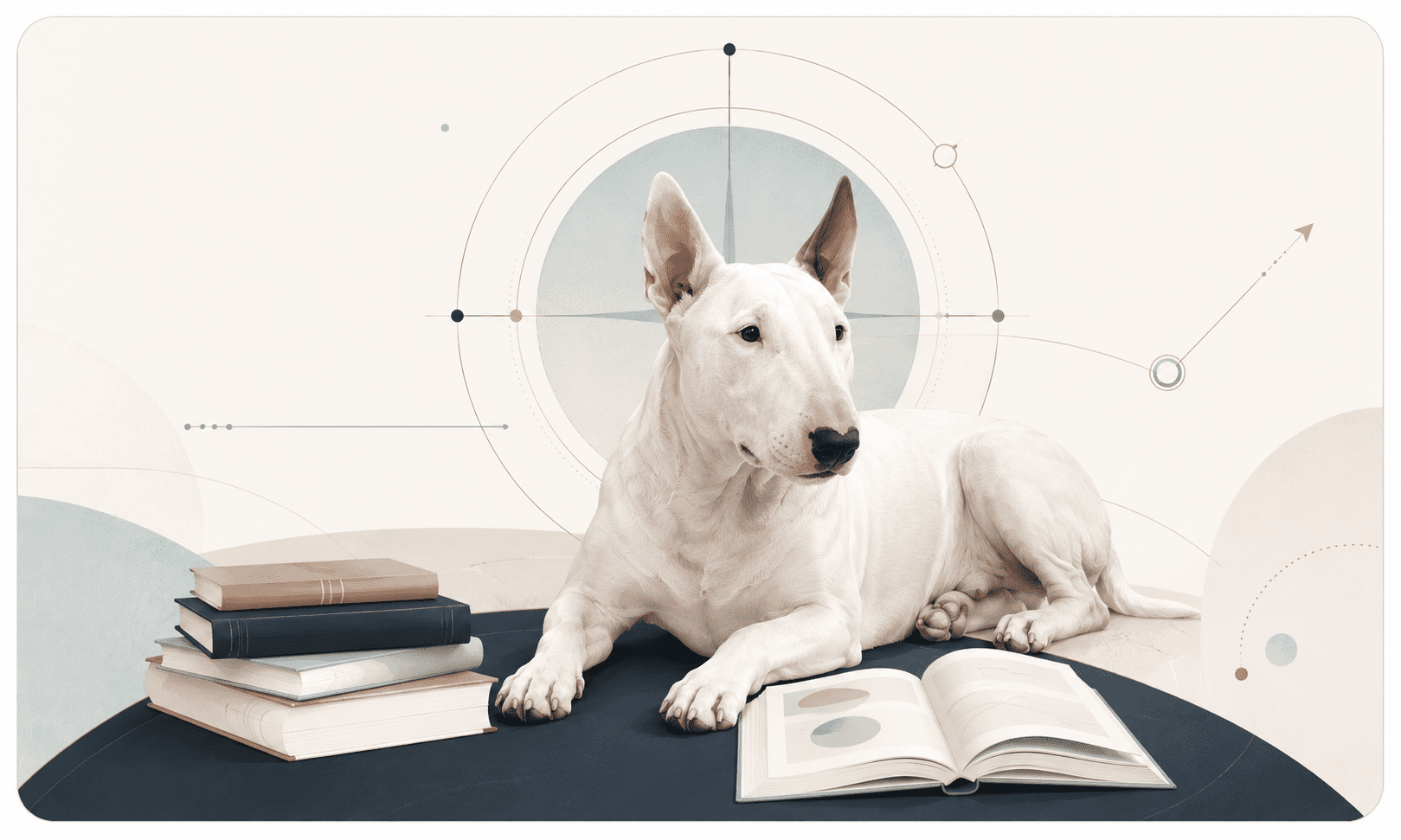


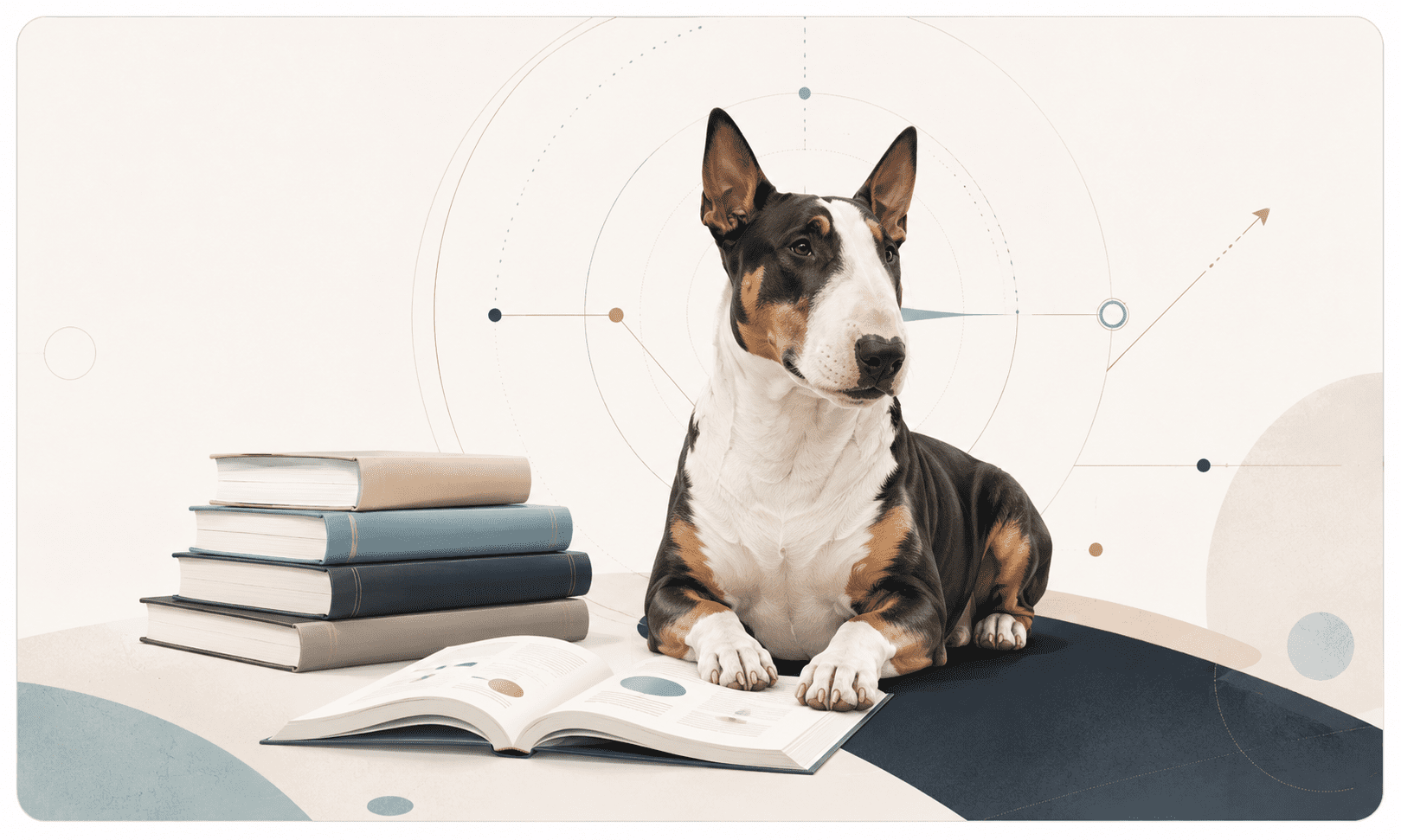



Why are Bull Terriers so misunderstood? Because many people judge the breed by its appearance, strength, humour, stubborn-looking behaviour, and intensity before they understand the dog underneath.
Bull Terriers are one of the most misunderstood dog breeds in the world.
Some people see them and immediately think they are dangerous. Others live with them and describe them as clowns, shadows, philosophers, athletes, comedians, emotional wrecking balls, and deeply loyal companions. Some owners call them stubborn. Some trainers call them difficult. Some people judge them by their appearance before they have ever understood the dog underneath.
The truth is more interesting than the reputation.
Bull Terriers are misunderstood because they do not fit easily into simple dog categories. They are strong, but often sensitive. Funny, but intense. Affectionate, but independent-minded. Playful, but physically powerful. Loyal, but not always obedient in the easy, automatic way people expect from some breeds.
They are not usually dogs that quietly disappear into the background of family life.
They have presence.
They have opinions.
They test unclear rules.
They notice weakness in structure.
They can be both ridiculous and serious in the same five minutes.
This is why so many people misread them. They judge the visible behaviour without understanding the state behind it. They see stubbornness where there is confusion. They see aggression where there is over-arousal. They see defiance where there is lack of engagement. They see comedy and forget that the behaviour is being reinforced. They see affection and assume training will happen automatically.
But Bull Terriers are not impossible dogs.
They are dogs that demand better understanding.
The Outside Reputation and the Inside Reality
Quick Answer
Why are Bull Terriers misunderstood? Bull Terriers are misunderstood because people often judge their appearance, strength, humour, stubborn-looking behaviour, and intensity without understanding the dog underneath. Many behaviours that look like aggression, defiance, or stubbornness are actually signs of overexcitement, confusion, weak engagement, missing structure, or poor communication. Bull Terriers are not impossible dogs, but they need breed-specific understanding, calm guidance, fair rules, and responsible ownership.
From the outside, the Bull Terrier can look like a hard dog.
The head shape, the muscular body, the confidence, the strong movement, and the history of the breed all influence how people see them. Many people who do not know Bull Terriers judge them before they understand them. They see the physical package and create a story around it.
But the inside reality of a well-raised Bull Terrier is often very different.
People who truly live with the breed know the comedy. They know the strange sleeping positions, the intense staring, the dramatic sighs, the clownish timing, the sudden zoomies, the stubborn-looking pauses, the ridiculous routines, and the deep emotional attachment many Bull Terriers form with their owners.
This is part of what makes the breed so special.
The Bull Terrier can look powerful and serious to outsiders, then go home and act like a strange little house hippo who wants the sofa, the blanket, the snack, and the owner’s full attention.
This contrast creates misunderstanding.
Outsiders often see only the reputation.
Owners often see only the love.
The truth sits between the two.
A Bull Terrier is not a monster, and it is not a cartoon toy. It is a powerful, intelligent, emotional, physical breed that needs structure, clarity, and respect.
Their Behaviour Often Looks Like Stubbornness
One of the biggest misunderstandings about Bull Terriers is the idea that they are simply stubborn.
Many owners say, “He knows what I want, but he refuses.”
Sometimes that may be partly true. Bull Terriers can be persistent. They can test rules. They can choose what benefits them if the owner is unclear or inconsistent. But many behaviours labelled as stubbornness are not really stubbornness at all.
Sometimes the dog is confused.
Sometimes the dog is overexcited.
Sometimes the dog has not generalized the behaviour to that environment.
Sometimes the reward is not valuable enough.
Sometimes the owner has not built engagement.
Sometimes the dog understands the command in the living room but not outside with dogs, smells, movement, and pressure around them.
This is where many owners get frustrated. They think the dog is deliberately disrespecting them. But in reality, the dog may not have the emotional control, clarity, or connection needed to respond in that moment.
A Bull Terrier that ignores you outside may not be trying to insult you.
The dog may simply be more connected to the environment than to you.
That is not a character flaw.
That is a training foundation problem.
They Are Strong Dogs With Big Feelings
Bull Terriers are physically powerful, but many are also emotionally sensitive.
This combination can confuse people.
A dog can look strong and still be affected by pressure, tone, environment, stress, frustration, or inconsistency. Some Bull Terriers are very sensitive to their owner’s mood. Some become more intense when the human becomes emotional. Some shut down under unfair pressure. Others push harder when the rules are unclear.
Because they are physically strong, people often assume they need rough handling.
That is a mistake.
A Bull Terrier does not need to be bullied into obedience. But they also should not be raised with no boundaries. The breed needs a balanced approach: clear, firm, fair, consistent, and emotionally controlled.
Too soft, and the dog may create its own rules.
Too harsh, and the dog may become resistant, defensive, confused, or less connected.
This is where many people fail the breed. They go to extremes. They either allow everything because the dog is funny and affectionate, or they become heavy-handed because the dog is strong and intense.
Neither approach truly understands the Bull Terrier.
Their Humour Can Create Problems
Bull Terriers are funny dogs.
This is one of the reasons people love them so much. They do strange things. They create chaos in creative ways. They have dramatic expressions. They repeat odd habits. They can turn a normal room into a theatre. They often make their owners laugh even when they are being completely unreasonable.
But humour can become a trap.
Many unwanted behaviours begin as funny behaviours.
A puppy biting clothes is funny until the dog is older. Jumping is funny until the dog is too strong. Stealing things is funny until the dog starts guarding them. Ignoring the owner is funny until the dog does it outside. Crashing into people is funny until children or visitors are involved. Barking for attention is funny until it becomes a daily demand.
The Bull Terrier does something dramatic.
The family laughs.
The dog learns.
This is one of the most overlooked parts of the breed. Bull Terriers are very good at discovering what gets a reaction. If chaos gets attention, chaos may become part of the dog’s communication system.
This does not mean owners should remove the dog’s personality.
It means owners should be careful what they reward.
A Bull Terrier can be funny without being allowed to become uncontrolled.
Generic Dog Advice Often Fails Them
Bull Terriers are often misunderstood because many people try to handle them with generic dog advice.
More exercise. More corrections. More socialization. More commands. More freedom. More treats. More punishment. More affection.
But more is not always the answer.
A Bull Terrier that is overexcited may not need more stimulation. They may need better regulation. A dog that ignores commands may not need louder commands. They may need stronger engagement. A dog that repeats behaviour may not need constant correction. They may need the pattern interrupted and the environment changed. A dog that becomes reactive may not need to be forced closer to the trigger. They may need distance, clarity, and controlled exposure.
Generic advice often looks only at the behaviour.
Bull Terriers require owners to look deeper.
What is the dog’s state? What is being reinforced? What has the dog practised? What does the owner do before and after the behaviour? Is the dog tired, overstimulated, frustrated, confused, under-structured, or medically uncomfortable? Is the owner consistent? Does the dog know how to disengage? Has calmness actually been taught?
When you ask better questions, the dog begins to make more sense.
They Need Structure, Not Constant Control
Another misunderstanding is that Bull Terriers need to be controlled every second.
They do not.
They need structure.
There is a difference.
Constant control means the owner is always reacting, correcting, blocking, shouting, chasing, pulling, and managing chaos after it starts. Structure means the home and routine are built in a way that teaches the dog what to do before chaos becomes the normal pattern.
A structured Bull Terrier knows when to rest, where to go, how to settle, how to wait, what behaviour gets access, how to play, how to stop, and how to respond to the owner.
This is not about crushing the dog’s personality. It is about giving that personality a safe framework.
Without structure, Bull Terriers can become too much. They may become pushy, demanding, mouthy, destructive, reactive, or impossible to switch off. With structure, the same dog often becomes easier to enjoy because the owner is no longer fighting the dog all day.
The Bull Terrier does not need a home with no fun.
The Bull Terrier needs a home where fun has rules.

They Are Often Judged by the Wrong Moments
Many Bull Terriers are judged by their worst moments.
The moment they pull toward another dog. The moment they jump on a visitor. The moment they bark at the window. The moment they steal something. The moment they ignore a command. The moment they become too intense.
But a moment is not the whole dog.
A behaviour is information. It tells us something about the dog’s state, training, environment, reinforcement history, or management. If we only judge the dog, we miss the lesson.
This is why some people become unfair to the breed. They see intensity and call it bad temperament. They see rough play and call it aggression. They see testing and call it dominance. They see excitement and call it madness.
Of course, serious behaviour should not be excused. If a Bull Terrier is unsafe, reactive, guarding, nipping, fighting, or causing household problems, the owner must take it seriously.
But taking behaviour seriously is not the same as judging blindly.
The goal is to understand what is happening so the right solution can be built.
The Breed Requires an Owner Who Thinks
Bull Terriers reward thoughtful owners.
They do not always reward lazy ownership.
This is a breed that often exposes unclear communication. If the owner is inconsistent, the dog will usually notice. If the rules change every day, the dog may test them. If the owner relies only on physical exercise, the dog may become fitter but not calmer. If the owner uses only affection, the dog may love them but not listen. If the owner uses only force, the dog may resist or lose trust.
A good Bull Terrier owner learns to think.
Why did that happen? What came before it? What did the dog get from it? What state was the dog in? What did I reinforce? What rule was unclear? What skill is missing? What can I change tomorrow?
This is not complicated in theory, but it requires honesty.
Many people want the dog to change without changing the system around the dog. Bull Terriers often do not make that easy. They show you where the system is weak.
That is one of the reasons the breed can be challenging.
It is also one of the reasons the breed can make you a much better owner.
Misunderstood Does Not Mean Easy
It is important to say this clearly: misunderstood does not mean harmless, easy, or suitable for everyone.
A Bull Terrier can be misunderstood and still need serious training. A Bull Terrier can be loving and still be too intense for a certain home. A Bull Terrier can be funny and still require boundaries. A Bull Terrier can be loyal and still become difficult if badly raised.
Understanding the breed is not an excuse for poor behaviour.
It is the starting point for fixing it.
When we say Bull Terriers are misunderstood, we are not saying every behaviour should be tolerated. We are saying the behaviour should be read correctly. If the dog is overexcited, treat the overexcitement. If the dog is confused, create clarity. If the dog lacks engagement, build engagement. If the dog has too much freedom, reduce freedom and add structure. If the dog is showing serious behaviour problems, get proper help.
Understanding does not replace responsibility.
It creates better responsibility.
So, Why Are Bull Terriers So Misunderstood?
Bull Terriers are misunderstood because they are a breed of contrasts.
They look tough but can be sensitive. They are funny but intense. They are affectionate but not automatically obedient. They are powerful but often emotionally connected. They can be playful and serious, stubborn-looking and confused, confident and easily overstimulated, ridiculous and deeply loyal.
People misunderstand them when they judge only the surface.
They misunderstand them when they see the head and body but not the mind. They misunderstand them when they mistake excitement for aggression, confusion for stubbornness, affection for obedience, humour for harmlessness, and freedom for love.
The Bull Terrier does not need more myths.
The breed needs better understanding.
With the right owner, structure, training, routine, and respect, the Bull Terrier can become one of the most rewarding dogs in the world. But with the wrong expectations, the same breed can quickly become overwhelming.
The truth is simple.
Bull Terriers are not ordinary dogs.
And they should not be owned, trained, or judged in an ordinary way.
Learn More From Working Bull Terriers Kennel
If you want to understand your Bull Terrier more deeply, our Bull Terrier books and guides were created to help owners move beyond generic advice and learn how this breed really thinks, feels, and behaves.
For self-guided learning, start with our Bull Terrier training guides and owner education books. If your Bull Terrier is already showing overexcitement, reactivity, nipping, household chaos, guarding, or repeated behaviour problems, personalized online training may be the better next step.
Understand the Bull Terrier Beneath the Reputation
Bull Terriers are often misunderstood because people judge the surface: the strength, the head, the stubborn-looking moments, the intensity, and the chaos. But this breed makes much more sense when you understand the mind, the emotions, the structure needs, and the training foundation behind the behaviour.
Our Bull Terrier books and training guides were created to help owners move beyond generic advice and understand how this breed really thinks, learns, reacts, tests boundaries, and builds trust.

 Explore the Bull Terrier Guides
Related Reading
If you want to understand why Bull Terriers are so often misread, these articles continue the same theme: breed-specific behaviour, owner expectations, structure, and real understanding.
A deeper explanation of the breed’s unusual combination of power, humour, sensitivity, emotional intensity, and independent thinking.
A perfect next read for owners who want to understand the difference between real testing, confusion, overexcitement, and weak engagement.
A useful guide for understanding the calm, consistent, structured ownership this breed needs to thrive.
A practical next step if misunderstood behaviour has become pulling, nipping, overexcitement, reactivity, or household chaos.
Leave a Reply