





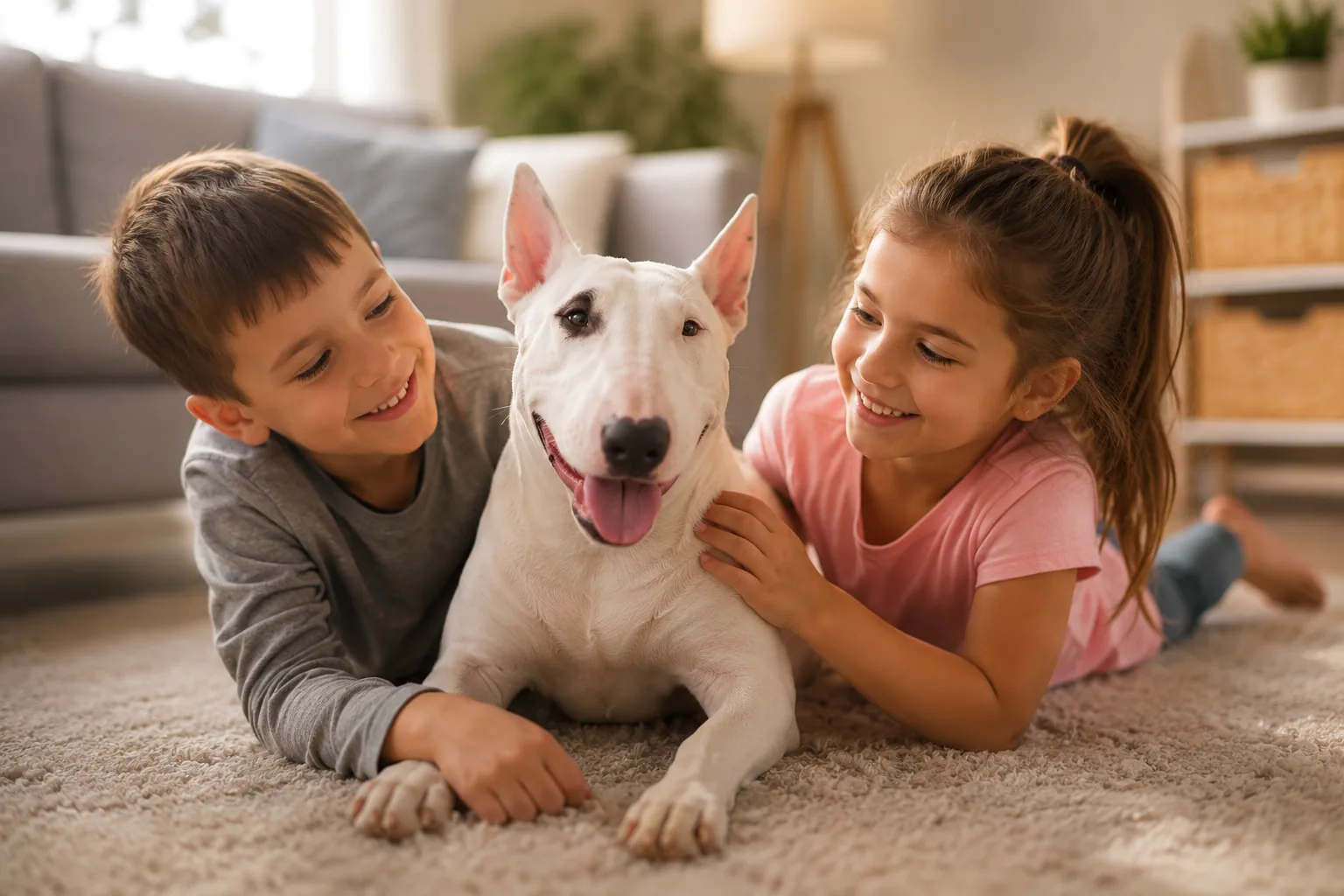
Bull Terriers can be excellent with children, but only when the adults in the home understand their responsibility.
That is the honest answer.
A well-raised Bull Terrier can be affectionate, playful, funny, gentle, loyal, and deeply connected to the children in the family. Many Bull Terriers enjoy being part of family life. They often love attention, routine, games, affection, and the emotional energy of the people around them.
But this does not mean every Bull Terrier is automatically suitable for every child, every home, or every family situation.
Bull Terriers are strong dogs. They are physical dogs. They are enthusiastic dogs. They can be intense, excitable, stubborn-looking, impulsive, and full of character. Even when their intentions are friendly, their body can be too much for a young child if the dog has not been taught calmness, impulse control, and boundaries.
So the question is not simply:
Are Bull Terriers good with children?
The better question is:
Are the adults prepared to manage the relationship properly?
Because children and dogs should never be left to “figure it out” by themselves. A safe, healthy relationship between a Bull Terrier and children is created by adult guidance, supervision, structure, and education on both sides.
The Short Answer: Yes, With the Right Supervision and Structure
Quick Answer
Are Bull Terriers good with children? Yes, Bull Terriers can be excellent family dogs with children when adults provide supervision, structure, calm guidance, and clear rules. But they are strong, physical, enthusiastic dogs, so children must also be taught how to respect the dog. A safe relationship is created through adult responsibility, not luck.
Bull Terriers can be very good with children when they are raised, trained, and managed correctly.
They are often affectionate with their family, and many are naturally drawn to human interaction. They can be playful and emotionally close, and some Bull Terriers become deeply attached to the children they grow up with.
But affection is not the same as reliability.
A dog can love children and still knock them over. A dog can enjoy being near children and still become overexcited when they run. A dog can be gentle most of the time and still react badly if a child climbs on them, grabs them, disturbs them while resting, or takes something from them.
This is why responsible supervision matters.
A good family Bull Terrier is not created by luck. It is created by daily habits. The dog learns how to behave around children. The children learn how to behave around the dog. The adults control the environment so neither side is pushed into situations they cannot handle.
That is the real foundation.
Why Bull Terriers Often Love Family Life
Many Bull Terriers are very people-oriented dogs. They usually do not want to be ignored in a corner of the house. They want to be involved. They notice what the family is doing. They often follow their people around, watch routines, join activities, and seek physical closeness.
For children, this can be wonderful.
A Bull Terrier can be a funny, affectionate companion. They can bring laughter into the home. Their expressions, habits, and strange little behaviours often become part of the family’s daily life. They are not boring dogs. They have presence. They have personality. They often make children laugh simply by being themselves.
This is one of the reasons families fall in love with the breed.
But personality must be guided.
A Bull Terrier that is allowed to express every feeling with full physical force can quickly become too much. Excitement around children can turn into jumping, mouthing, grabbing sleeves, chasing, barking, spinning, or crashing into people. This is especially common when children run, scream, play roughly, wave toys, or turn every interaction into high energy.
The dog may not be trying to hurt anyone.
But intention does not erase impact.
A friendly Bull Terrier can still be powerful enough to scare or injure a child accidentally. This is why the family must teach calm behaviour early and not wait until the dog is older, stronger, and harder to manage.
The Biggest Risk Is Usually Overexcitement, Not “Bad Temperament”
When people ask if Bull Terriers are good with children, they often worry about aggression.
That is understandable, but in many family homes the more common problem is not true aggression. It is overexcitement, lack of structure, poor impulse control, and unmanaged physical play.
A Bull Terrier puppy jumping at a child may not be aggressive. A young dog grabbing clothing may not be trying to harm anyone. A dog chasing children through the house may simply be stimulated by movement, noise, and excitement.
But these behaviours still matter.
If the family laughs at them, encourages them, or only reacts when they become extreme, the dog learns that this is part of family life. What starts as funny puppy behaviour can become dangerous or exhausting when the dog becomes stronger.
This is where many families make the mistake of waiting too long.
They say, “He is just playing.”
Sometimes that is true.
But play still needs rules.
A Bull Terrier should not learn that children are moving toys. The dog should not learn that excitement means using teeth, body pressure, or uncontrolled movement. Children should not become the dog’s main source of chaos and stimulation.
Instead, the dog should learn how to be calm around children, how to disengage, how to settle, and how to respond to the adults even when the environment is exciting.
That is training.
Not punishment. Not harshness. Training.
Children Must Be Taught Too
A lot of responsibility is placed on the dog, but children also need guidance.
This is one of the most important parts of safe dog ownership.
Children should be taught not to climb on the dog, pull ears or tail, grab the dog’s face, disturb the dog while sleeping, take food or toys, corner the dog, scream into the dog’s face, or treat the dog like a toy. They should also learn that a dog resting on a bed, in a crate, or on a place mat should be left alone.
Respect is not optional.
Even a good dog has limits. A family dog should not be expected to tolerate endless pressure just because the child is young. The goal is not to test how much the dog can take. The goal is to build a relationship where the dog feels safe and the child learns responsibility.
This is especially important with very young children.
Toddlers move strangely, fall suddenly, make loud noises, grab without warning, and do not understand canine body language. They can accidentally create pressure that makes a dog uncomfortable. In these situations, supervision must be active, not passive.
Active supervision means the adult is paying attention and ready to guide the interaction.
It does not mean sitting across the room scrolling on a phone while the child and dog manage each other.
The adult must control the situation before it becomes a problem.
The Bull Terrier Needs a Safe Place Away From Children
Every family Bull Terrier should have a safe place where the dog can rest without being disturbed.
This can be a crate, a dog bed, a place mat, a room, or another clearly defined resting area. The exact setup depends on the home, but the principle is the same: the dog must have somewhere to switch off.
This is not only for the dog’s comfort. It is also for safety.
Children create movement and noise. Family homes can be busy. Visitors, toys, meals, school routines, playtime, and excitement can all raise a dog’s arousal. A Bull Terrier that never gets calm separation from that environment may become more reactive, more demanding, more mouthy, or more easily overstimulated.
Rest is not a luxury.
It is part of training.
A dog that can go to place, settle, and relax while family life continues around them is much easier to live with. This is one of the most useful skills a Bull Terrier can learn in a home with children.
It teaches the dog that not every moment requires participation. Not every movement needs a reaction. Not every child running through the house is an invitation to chase. Not every visitor or noise requires full involvement.
Calmness must be practised.
The Adults Must Control Rough Play
Rough play is one of the fastest ways to create problems between Bull Terriers and children.
This does not mean the dog can never play. Play is important. Bull Terriers often enjoy play, and structured play can be a beautiful way to build relationship, confidence, and communication.
But wild, uncontrolled play with children is different.
If a child wrestles with the dog, runs away screaming, waves sleeves, encourages biting games, or pushes the dog into constant excitement, the Bull Terrier may learn to interact with children using too much intensity. The dog may start to think that children mean chaos.
That is not fair to the dog or the child.
Adults should decide what kind of play is allowed. Tug games, fetch, food games, training games, and structured interaction can all be useful when done properly. But the dog should learn rules around starting, stopping, releasing, and settling after play.
The end of play is as important as the start.
A Bull Terrier that can play and then calm down is far safer and easier to live with than a dog that becomes more and more excited until the family loses control.
Warning Signs Should Not Be Ignored
Families should learn to notice when a dog is uncomfortable, overstimulated, tired, or stressed.
Not every warning sign looks dramatic. Sometimes the dog turns away. Sometimes the dog becomes stiff. Sometimes they avoid contact. Sometimes they lick lips, yawn, freeze, move away, or become suddenly more intense. Sometimes the dog does not look scared, but becomes too excited and physical.
Both discomfort and overexcitement matter.
A Bull Terrier that is overwhelmed may not always leave the situation on their own, especially if the environment is busy or the dog has not been taught how to disengage. This is why adults must step in early.
Do not wait for growling, snapping, or a serious incident before creating rules.
Responsible ownership means preventing pressure from building.
If a Bull Terrier begins to show repeated discomfort, guarding, intense reactions, nipping, chasing, or fixation around children, the family should take it seriously. This does not mean the dog is bad. It means the situation needs better management, better structure, and possibly professional guidance.
The earlier a family responds, the easier the problem usually is to improve.
What Makes a Bull Terrier Good With Children?
A Bull Terrier is more likely to do well with children when several things are in place.
The dog has been given structure from the beginning. The children have been taught respectful behaviour. The adults supervise properly. Excitement is managed. Rough play is controlled. The dog has a safe place to rest. Training is consistent. The family does not rely on hope.
The best Bull Terrier family homes are not necessarily the quietest homes or the most experienced homes. They are the homes where adults take responsibility.
They do not say, “The dog should just know better.”
They teach.
They do not say, “The children are just playing.”
They guide.
They do not wait for chaos and then blame the dog.
They prevent chaos from becoming the normal pattern.
This is how trust is built.
When children learn to respect the dog and the Bull Terrier learns how to behave calmly around children, the relationship can be beautiful. But it must be built properly.
Are Bull Terriers Good With Children?
Yes, Bull Terriers can be very good with children in the right home.
But they are not a breed that should be left unmanaged around children just because they are loving or funny. They need structure, supervision, calm handling, and clear rules. Children also need guidance, respect, and boundaries.
A Bull Terrier can become a wonderful family companion, but adults must lead the relationship.
The dog should not be expected to tolerate everything. The child should not be allowed to do anything. The family should not rely on affection alone. A safe relationship is created through understanding, prevention, and consistent daily habits.
When raised and managed properly, a Bull Terrier can bring enormous joy to a family with children.
But the breed deserves owners who take that responsibility seriously.
Learn More From Working Bull Terriers Kennel
If you are raising a Bull Terrier or preparing to bring one into your family, our Bull Terrier books and guides were created to help owners understand the breed before problems become habits.
For self-guided learning, start with our Bull Terrier training guides and owner education books. If your Bull Terrier is already showing serious behaviour problems, overexcitement, reactivity, nipping, or household chaos, personalized online training may be the better next step.
Build a Safe Family Foundation
A Bull Terrier can become a wonderful family companion, but the relationship between the dog and children must be guided by the adults. Calmness, boundaries, safe rest areas, controlled play, supervision, and structure matter more than hope.
Our Bull Terrier books and training guides were created to help owners understand the breed beyond generic advice and build safer, calmer, more structured foundations at home.

 Explore the Bull Terrier Guides
Related Reading
If you are raising a Bull Terrier in a family home, these articles continue the same theme: responsible ownership, structure, calmness, behaviour, and safe expectations.
A helpful guide for understanding the calm, consistent, structured ownership this breed needs inside a family home.
A useful next read for families who want to build routine, bite control, calmness, and good habits from the beginning.
A deeper explanation of why Bull Terriers need breed-specific understanding, structure, engagement, and fair rules.
A practical article for owners dealing with overexcitement, nipping, chaos at home, reactivity, or repeated behaviour problems.
Leave a Reply