





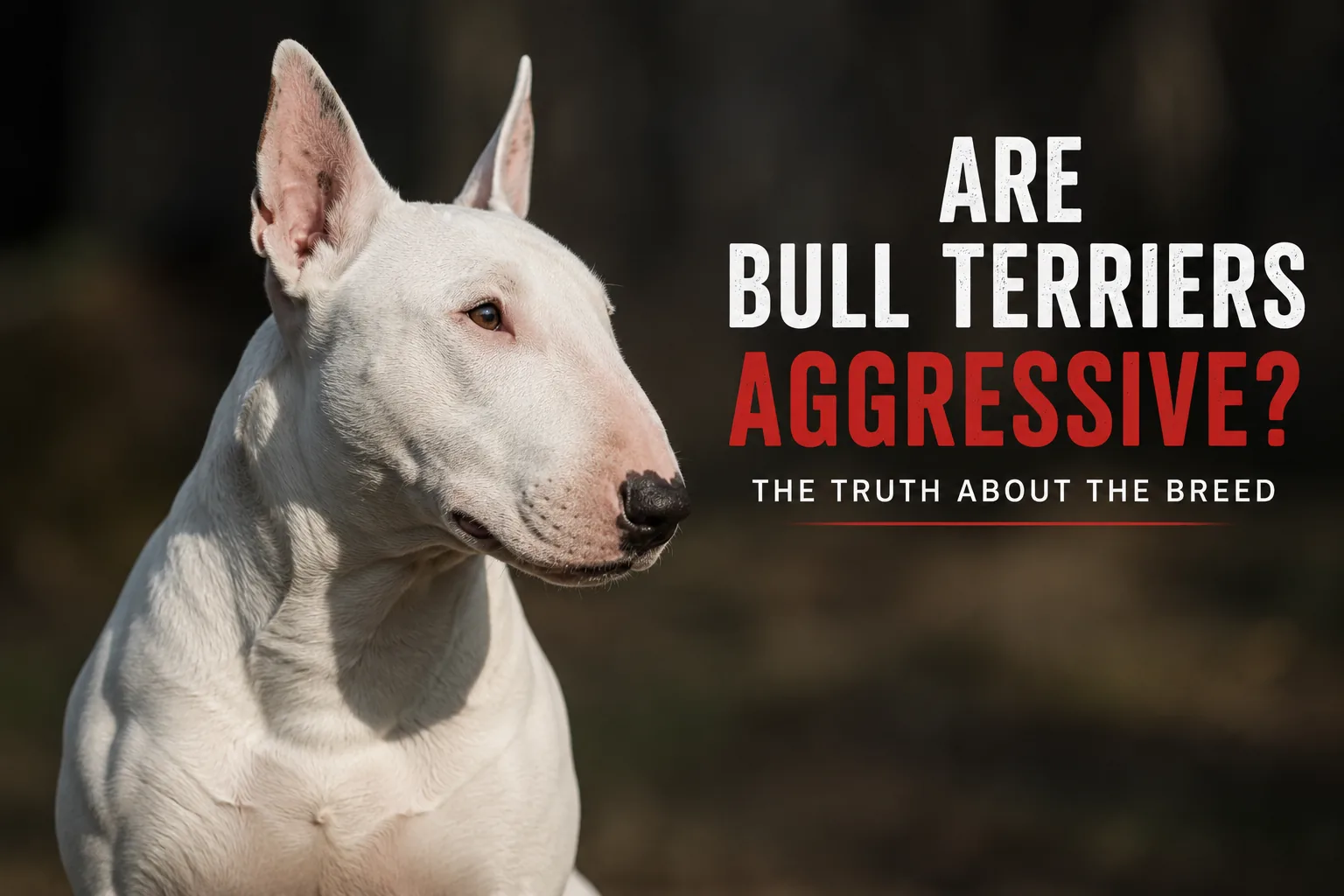
Bull Terriers are not automatically aggressive dogs.
But they are powerful dogs, intense dogs, physically confident dogs, and often misunderstood dogs. That difference matters.
The Bull Terrier has a reputation that is often shaped by appearance, history, exaggeration, poor ownership, and people who do not understand the breed deeply enough. Some people look at the head, the body, the strength, and the confidence, and they immediately make assumptions. Others hear the word “terrier” or know something about the breed’s past and decide the dog must be dangerous by nature.
That is too simple.
It is also unfair.
A well-bred, well-raised, properly managed Bull Terrier can be affectionate, funny, stable, loyal, playful, and deeply connected to their family. Many Bull Terriers live peacefully as family companions and show no desire to harm people. They can be loving, clownish, sensitive, and surprisingly gentle with the humans they trust.
But that does not mean the breed should be treated casually.
A Bull Terrier is not a soft, low-drive, low-impact breed that can be raised without structure. This is a strong dog with determination, confidence, physical power, and a big personality. If the wrong dog is bred poorly, raised badly, under-socialized, overexcited, unmanaged, punished unfairly, medically uncomfortable, or allowed to rehearse bad behaviour for months, serious problems can develop.
So, are Bull Terriers aggressive?
The honest answer is this: Bull Terriers are not naturally aggressive toward people as a breed, but they require responsible breeding, proper training, clear structure, socialization, supervision, and owners who understand their intensity.
The breed is not the problem by itself.
Poor understanding is often the problem.
The Short Answer: No, But They Must Be Taken Seriously
Calling Bull Terriers “aggressive” as a general rule is wrong.
But pretending they are easy dogs that anyone can own without guidance is also wrong.
Both extremes create problems.
Bull Terriers are often affectionate and people-oriented. Many are extremely attached to their owners and enjoy human contact, routine, play, and attention. They are usually not emotionless, cold, or distant dogs. They can be deeply loving and very expressive.
At the same time, they are physically strong and mentally persistent. When a Bull Terrier becomes overexcited, frustrated, reactive, possessive, overstimulated, or poorly managed, the result can look more serious than it would in a smaller or softer dog. Their body is powerful. Their play can be rough. Their reactions can be intense. Their determination can make them difficult to interrupt if the owner has no control or relationship with the dog.
This is why the breed needs respect.
Not fear.
Respect.
A Bull Terrier should be raised with clarity from the beginning. The dog should understand boundaries, calmness, engagement, controlled play, social rules, and how to respond to the owner in real life. If the owner waits until the dog is already strong, pushy, reactive, or out of control, training becomes much harder.
Aggression is not something we should ignore, excuse, or romanticize. But we also should not use the word carelessly every time a Bull Terrier is intense, excited, frustrated, or badly handled.
Understanding the difference is important.
Aggression Is Not One Simple Thing
One of the biggest mistakes people make is treating all aggressive-looking behaviour as the same thing.
A dog that growls over a bone is not the same as a dog that lunges at another dog on a walk. A dog that snaps because a child falls on them is not the same as a dog that has learned to control the whole household with threats. A dog that barks at the window is not the same as a dog that truly wants to attack. A dog that becomes rough when overexcited is not the same as a dog with serious intent to harm.
The visible behaviour may look similar to an inexperienced owner, but the cause can be very different.
Bull Terriers can show problematic behaviour for many reasons: fear, frustration, over-arousal, lack of socialization, resource guarding, pain, hormonal changes, poor handling, unclear rules, bad breeding, repeated rehearsal, or simply because the owner has allowed the dog to practise the wrong pattern for too long.
This is why labels are not enough.
Saying “my Bull Terrier is aggressive” does not tell us the whole story. We need to know what the dog does, when it happens, what happens before it, what happens after it, who is involved, what the dog’s body language looks like, what the owner does, how the dog lives, what the routine is, what the dog has rehearsed, and whether there may be health factors involved.
Good training starts with understanding.
Not panic.
Not excuses.
Understanding.
The Bull Terrier Reputation
The Bull Terrier’s reputation is complicated.
The breed has history. It has strength. It has a distinctive appearance. It has been used and portrayed in ways that make people react emotionally. Some people see a Bull Terrier and immediately think of toughness, fighting, danger, or stubbornness. Others know the breed personally and see comedy, sensitivity, affection, and loyalty.
Both the outside image and the inside reality can be very different.
People who live with good Bull Terriers often know how loving and ridiculous the breed can be. They know the “house clown” side. They know the dog that wants the sofa, the blanket, the attention, the routine, and the emotional connection. They know the dog that can look powerful and serious one moment, then act like a strange little comedian the next.
But public reputation does not come only from good examples.
Poor breeding, irresponsible owners, lack of training, uncontrolled dogs, and dramatic stories all affect how people see the breed. One bad incident can shape more public opinion than hundreds of stable dogs living normal lives.
This is why responsible Bull Terrier ownership matters so much.
Every owner represents the breed.
A well-managed Bull Terrier helps protect the truth of the breed. An uncontrolled Bull Terrier reinforces the myths.
Bull Terriers and People
A stable Bull Terrier should not be randomly aggressive toward people.
Many Bull Terriers are naturally affectionate with humans and enjoy attention. They may be friendly, social, playful, or very bonded to their immediate family. Some are confident with strangers; others are more reserved. As with any breed, temperament varies from dog to dog.
But human-directed aggression should always be taken seriously.
If a Bull Terrier is repeatedly growling, snapping, biting, threatening, guarding people or spaces, reacting badly to handling, or showing unpredictable behaviour toward humans, the owner should not ignore it. They should not excuse it as “just the breed.” They should not wait until the behaviour becomes dangerous.
At the same time, the owner should not immediately panic and assume the dog is hopeless.
There is always a reason behind behaviour.
The reason may be training-related. It may be environmental. It may be connected to pain, stress, hormones, fear, confusion, or repeated bad experiences. It may be connected to the way the family handles the dog. It may be connected to poor genetics. It may be a combination of several things.
This is why serious cases need careful assessment.
A Bull Terrier showing concerning behaviour around people is not a situation for random internet tips. It needs responsible management, safety, and professional guidance from someone who understands behaviour and the breed.
Bull Terriers and Other Dogs
When people talk about Bull Terrier aggression, they often mean behaviour toward other dogs.
This is a separate subject from aggression toward people.
Some Bull Terriers are social with other dogs. Some are selective. Some are tolerant when young and less tolerant as they mature. Some can live with other dogs under the right structure, while others need careful management. This should not surprise anyone who understands terrier temperament, maturity, sex, arousal, and individual personality.
Dog-selective behaviour does not automatically mean a dog is “bad.” But it does mean the owner must be realistic.
A Bull Terrier should not be forced into chaotic dog parks, uncontrolled greetings, random face-to-face meetings, or situations where the owner has no influence. Many owners create problems by believing that every dog must love every other dog. That idea is not realistic, especially with strong, confident breeds.
Socialization does not mean throwing the dog into every interaction.
Good socialization means teaching neutrality, confidence, calm exposure, recovery, and handler engagement. A Bull Terrier does not need to play with every dog it sees. In many cases, the better goal is a dog that can ignore other dogs, walk calmly, respond to the owner, and avoid unnecessary conflict.
That is responsible ownership.
Not fear.
Responsibility.
Why Poor Ownership Can Create Problems
Bull Terriers often suffer because people underestimate them.
They allow too much freedom too early. They laugh at pushy behaviour. They allow rough play to become normal. They let the puppy rehearse jumping, grabbing, chasing, guarding, and ignoring the owner. They avoid structure because they do not want to be “strict.” Then, when the dog becomes older and stronger, the same behaviours are no longer funny.
The dog did not suddenly change into a different animal.
The dog practised.
Bull Terriers are very good at learning what works. If barking works, they may bark. If pushing works, they may push. If guarding works, they may guard. If ignoring the owner works, they may ignore. If explosive reactions make the world move away, those reactions may become stronger.
This is not unique to Bull Terriers, but the breed’s strength and determination make the consequences more serious.
The solution is not to dominate the dog with harshness. It is also not to give the dog unlimited freedom and hope love will solve everything.
The solution is structure, clarity, engagement, calmness, fair boundaries, and consistent daily habits.
A Bull Terrier needs to know what behaviour works in the home and outside the home. The owner must teach that before the dog creates their own rules.
The Role of Breeding and Early Development
Good breeding matters.
A stable Bull Terrier does not begin with training alone. It begins with genetics, temperament, early development, the mother, the environment, and the decisions made before the puppy ever reaches the new owner.
Breeders have responsibility. They should not breed only for appearance. Temperament matters. Health matters. nerve matters. Confidence matters. Recovery matters. Social stability matters. A beautiful dog with unstable temperament is not a success.
The early weeks of a puppy’s life also matter. Puppies need appropriate exposure, handling, development, and a stable environment. Then the new owner must continue that work with structure, socialization, routine, and training.
When breeding is poor and ownership is poor, problems become more likely.
When breeding is responsible and ownership is serious, the breed has a much better chance to show its true qualities.
This is one reason Working Bull Terriers Kennel always emphasizes understanding the breed, not just owning the breed.
A Bull Terrier is not a casual purchase.
It is a commitment.
Health Can Affect Behaviour
Not every behaviour problem is only a training problem.
Pain, illness, hormonal changes, thyroid problems, neurological issues, poor sleep, chronic discomfort, and other health factors can affect how a dog behaves. A dog that suddenly becomes irritable, reactive, defensive, unusually tired, sensitive to touch, or unpredictable should not simply be labelled aggressive without considering health.
Bull Terriers, like all breeds, deserve responsible health awareness.
This does not mean every difficult behaviour is caused by a medical issue. It means owners should be intelligent enough to keep health in the picture, especially when behaviour changes suddenly or does not match the dog’s normal pattern.
Training and veterinary care are not enemies.
They support each other.
A responsible owner looks at the whole dog: behaviour, environment, routine, training, health, genetics, and daily life.

What Responsible Bull Terrier Ownership Looks Like
Responsible Bull Terrier ownership means taking the breed seriously before problems develop.
It means teaching calmness, not only excitement. It means building engagement, not only giving commands. It means using structure, not constant reaction. It means supervising interactions, managing freedom, and understanding that this breed can become too much if left to make all its own decisions.
It also means being honest.
If your Bull Terrier is showing concerning behaviour, do not pretend it is fine. Do not wait until it becomes dangerous. Do not blame the breed and do nothing. Do not ask strangers online for one magical tip and expect a serious issue to disappear.
Look at the situation properly.
What is the dog rehearsing? What triggers the behaviour? What does the owner do before and after? Is the dog overexcited, fearful, frustrated, guarding, in pain, confused, or under-structured? What is missing in the dog’s daily life? What rules are unclear? What patterns have become normal?
The earlier you answer these questions, the easier it is to help the dog.
So, Are Bull Terriers Aggressive?
No, Bull Terriers are not automatically aggressive dogs.
But they are strong, intense, determined dogs that need responsible people.
A stable Bull Terrier in the right home can be affectionate, funny, loyal, and deeply bonded to their family. The breed can be a wonderful companion when bred well, raised properly, trained clearly, and managed with respect.
But Bull Terriers should never be treated like low-effort dogs.
Their strength, confidence, and personality require structure. Their humour requires boundaries. Their affection requires guidance. Their intensity requires understanding.
The truth is not that Bull Terriers are aggressive.
The truth is that Bull Terriers are often misunderstood.
And when a powerful breed is misunderstood, the result can become a problem.
When the breed is understood, respected, trained, and managed properly, the Bull Terrier can show what so many dedicated owners already know: behind the reputation is one of the most unique, loyal, entertaining, and emotionally rich dogs in the world.
Learn More From Working Bull Terriers Kennel
If you are raising a Bull Terrier or thinking about bringing one into your home, our Bull Terrier books and guides were created to help owners understand the breed before problems become habits.
For self-guided learning, start with our Bull Terrier training guides and owner education books. If your Bull Terrier is already showing serious behaviour problems, reactivity, guarding, nipping, household conflict, or unpredictable reactions, personalized online training may be the better next step.


Leave a Reply